
Translated material
In 2022, the Russians received a record number of new passports because of the “sex change”. This is said by the data of the Ministry of Internal Affairs
Against the background of the invasion of Ukraine, “partial” mobilization and new repressive laws against LGBTK+ in Russia, the number of new passports issued due to changes in the gender marker has increased significantly. This is evidenced by the statistics of the Ministry of Internal Affairs, which was studied by the Mediazona. The human rights activists and the transpersons themselves explain the growth by the fact that even those who put off this procedure for later hastened to issue new documents. Someone spurred the risk of getting into the army, someone is the need to settle all issues with documents before emigration, and someone is afraid that the transgender transition in Russia will be completely banned.
“I specially dressed as feminine as possible so that it doesn’t occur to the cops to stop me,” says Anita Muscovite. “But still very lively imagined how I came to the MFC, I say that I am changing my passport due to floor change, and they immediately call me the cops to mobilize until I have time to change anything.”
Anita says that she did not plan to change the passport in 2022, but Russia's invasion of Ukraine forced her to hurry: “I even had a list of cases related to the transition, and I thought that at first I would start hormone therapy, I would wait for changes in appearance and only then proudly receive a female passport.”
The girl says that this summer she graduated from the university and went through a medical commission to change documents and go to study abroad with a new passport. Anita has already entered a foreign university, but could not emigrate due to lack of money and so far remains in Russia.
At first, Anita was in no hurry with the change of documents, but on September 21 they announced mobilization. “Now I needed to change my passport not just to be in my gender, but in order to survive: I saw what is happening in Ukraine, and I do not want to die or kill others,” she emphasizes.
So Anita became one of those who, against the backdrop of the war, decided to quickly draw up new documents. Having studied the statistics of the Ministry of Internal Affairs, the Mediazona found that in 2022 the department issued almost twice as many new passports issued in connection with a change in the gender marker.
How a transgender transition and a change of documents occurs in Russia
The transgender transition may include different elements: hormonal therapy, surgical operations, and changes in documents. There is no mandatory set of actions for all, for example, a person can take hormonal drugs, but not change documents. Or get a new passport with the desired gender marker, but not to do any operations.
In different countries, legislative norms on transgender transitions and the change of documents are very different . In Russia, for this, you need to go through a medical commission from a sexologist, medical psychologist and psychiatrist. The psychiatrist is diagnosed with transsexuality.
Based on this diagnosis, a person receives a “sex change certificate” in form No. 087/y. This certificate is valid for a year and gives the right to officially change the documents (first a birth certificate, then a passport and everything else), indicating a new gender marker.
Data of the Ministry of Internal Affairs: In 2022, Russians almost twice as often received new passports due
In 2022, the number of Russians who received a new passport in connection with the “change in sex” increased sharply, this follows from the data of the Ministry of Internal Affairs of Russia, which monthly publishes the statistics of passports. It separately takes into account each of the possible reasons for the execution of the document, including “Changing the floor” (trans-organization recommends that this legal procedure “change the gender marker”).
"Mediazona" studied statistics over the past four years (the earlier data of the Ministry of Internal Affairs are published only fragmentedly).
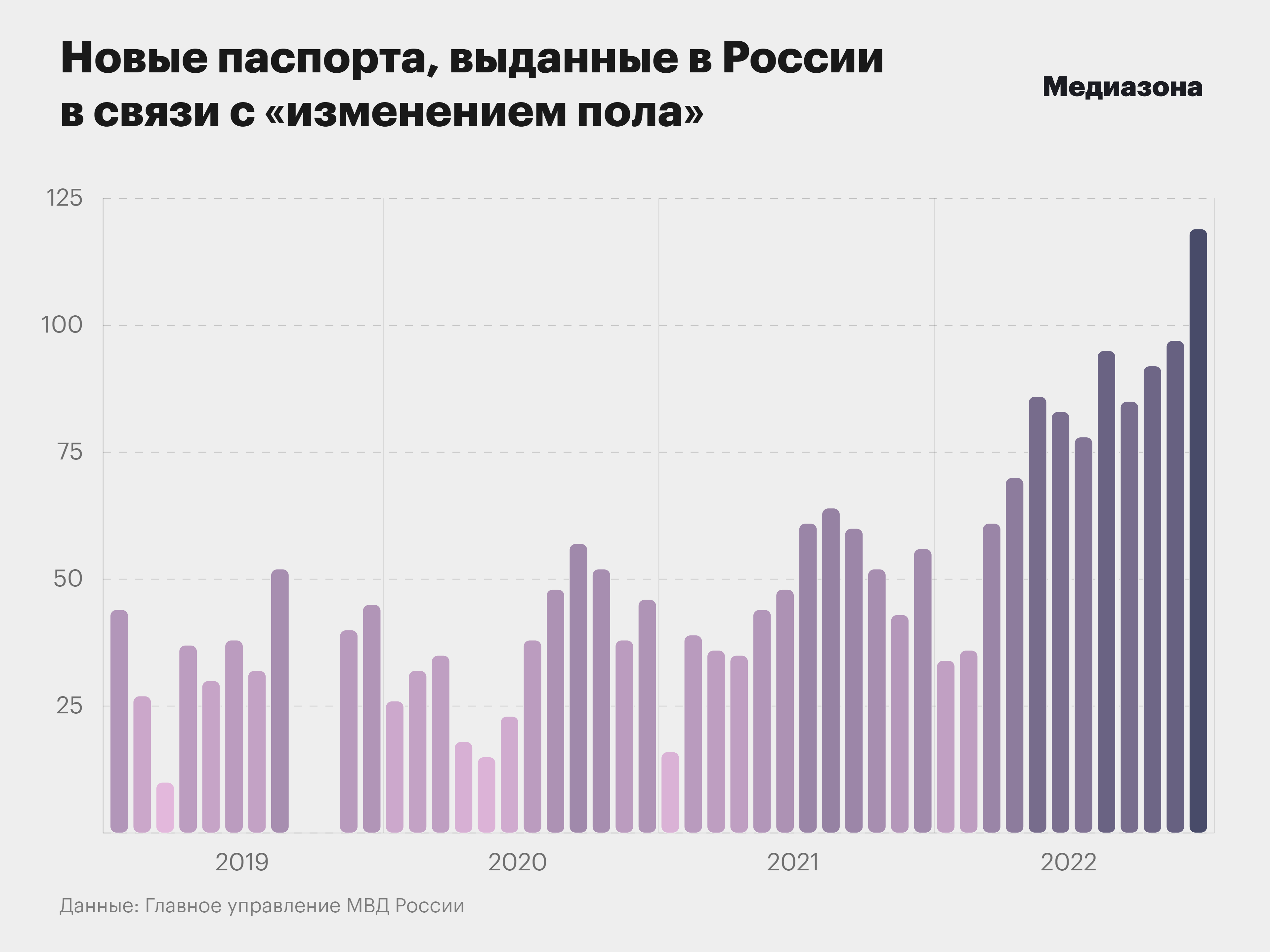
In 2020, 428 passports were issued in connection with the “change in sex”, in 2021-554 passports, and 936 documents were already issued for 2022 g.
A noticeable growth began already in March, that is, immediately after the Russian attack on Ukraine, and lasted all year. If in February the Russians received only 36 passports in connection with a change in the gender marker, then in March there were already 61, and by December about one hundred new documents were issued monthly. December has become a record yet: 119 new passports were issued in a month.
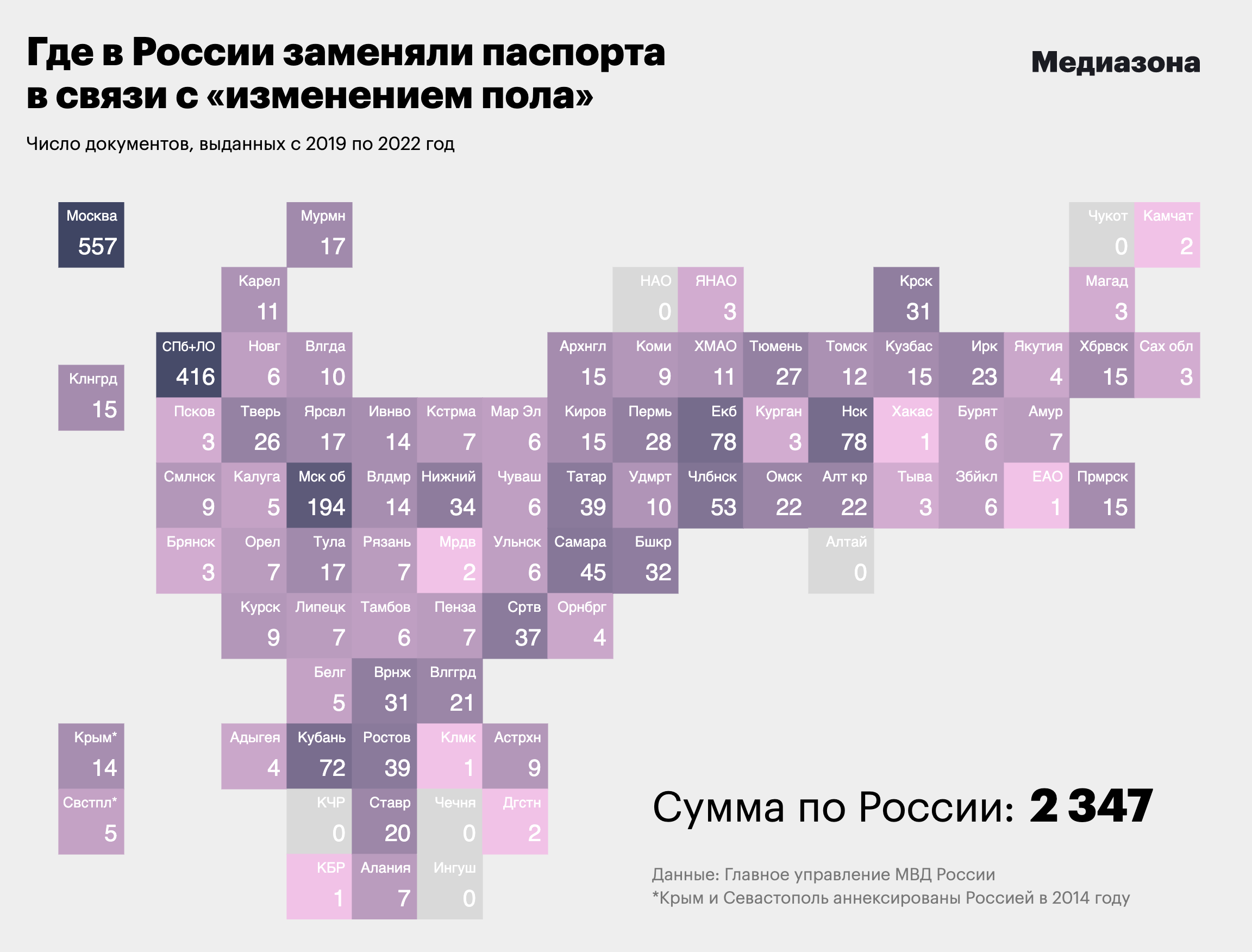
The leaders in the change of gender marker were expected to have metropolitan agglomerations - Moscow with the suburbs and St. Petersburg with the Leningrad region. Next are regions with million-plus centers: Novosibirsk and Sverdlovsk regions, Krasnodar Territory. In Russia, only six regions, where over the past four years, have not been issued a single passport in connection with the “change in sex”: the Nenets Autonomous Okrug, Chukotka, the Altai Republic, as well as the three Caucasian republics-Ingushetia, Karachay-Cherkessia and Chechnya.
Mobilization and war pushed transfeminic people to change documents
Human rights activists, with whom the Mediazona spoke, explain this growth by several basic factors: war and mobilization, the desire to emigrate, strengthen repression.
“Of course, all transfer people (with a male gender marker attributed to the male gender) who planned to make a legal transition, tried to change the documents faster with the beginning of mobilization,” says the head of the center T, Aan Dvorkin.
So it was in the case of Anita. She began the process of changing documents at the end of September and received a new passport in early December. The girl notes that she was forced to change the passport before the start of hormonal therapy and because of this she is not very comfortable. “They tell me that I have a good pass, but so far I have to try very hard to look more feminine, there would be no such problem on hormones,” she says. “I am afraid that someday I relax and some cop on the street considers me as a guy, he will ask a passport, and I don’t know if I can explain that this is my passport, and not the twin sisters.”
Lesya did not go so smoothly. She wanted to change her passport after graduation, so that there were no problems with study, but mobilization confused all plans. “The fear of problems with study was less of fear of dying or being in prison. Why so? Because I certainly would not follow criminal orders, ”the girl emphasizes.
She passed the medical commission back in July and applied for documents in September. Then, even before the start of mobilization, she was received by a summons from the military registration and enlistment office, she was invited to the medical board before the call. The girl came to the department and said that while she was waiting for new documents in connection with a change in the gender marker. Then she was discharged the agenda at the end of November, so that she came with ready -made documents and withdrew from military registration.
“However, when I came, I was suddenly dumped that there is no reason to take me from the register,” recalls Lesya. - I went to talk with all the leaders up to the military commissar, but he told me that I should prove that I was a transgender woman, providing documents on hormonal therapy and surgical operations and underwent a medical examination. He explained this by the fact that “we won’t believe you with a word”, although the documents, including a passport, are not like a word. I should not provide any such documents and even more so to go through the commission with men. When I tried to prove something, they only raised my voice and repeated the mantra: "We won’t take a word for a word."
Lesya consulted with lawyers, they offered to sue the military registration and enlistment office or leave everything as it is and not to derive from the register - all the more so since it is impossible to call a person with a female gender marker. “It’s difficult to sue and for a long time, and in such circumstances I do not want to attract a lot of attention, so they decided to leave it as it is,” she says. The military did not bother her anymore.
Transmasculine people, on the contrary, decided to postpone the change of gender marker
After the declaration of mobilization, many transmuins try to stay away from the official organs. “Fearing to be called up by mobilization, transmascular people (persons with a female gender marker attributed to birth) often decided to wait with the change of documents until the end of mobilization, so as not to go to the military registration and enlistment office for a military ticket,” said Jan Dvorkin.
The LGBT group “Exit” recorded at least two cases when transmascular people decided to postpone the change of documents so as not to fall under mobilization, the coordinator of the Trans*Mission project, who wished to maintain anonymity, told Mediazone.
Ekaterina Dikovskaya, the head of the legal assistance program “Sphere”, adds that the project helped several transmasculine people to challenge the category of suitability D, assigned to them in the military registration and enlistment office due to transgenderness (they disputed this decision as discriminatory).
“But as soon as these military operations began in February, and especially after mobilization began in September, they all abruptly abandoned the claims, because with the category of fitness D they may be sure that they will not be called, and with the category of fitness in steel,” she notes.
Many are afraid of a prohibition on a transgender transition in Russia
After the start of the war, the Russian authorities strengthened the pursuit of LGBTK+ people. On November 24, the State Dumaadopted a bill on the prohibition of “propaganda of non -traditional sexual relations and sex change” among Russians of all ages (earlier the lawmakers sought to protect only children from “propaganda”).
“Because of the war and mobilization, time to change documents for male is definitely not the best. That's why I was in no hurry and thought to do it after the war ended. But time passed, the war did not end, and the state began to talk more and more about different laws prohibiting, ”says Victor from one of the Siberian regions.
Moskvich Mariana had similar motives: “In July-August, new anti-LGBT bills began to be discussed, and how detailed they were, a little strained and caused anxiety how long the commission would exist. In addition, many of my acquaintances from psychological and psychiatric circles were finished with preparation for emigration just in July, because of which there were thoughts that specialists who are part of the commission can emigrate soon. ”
Margarita from St. Petersburg, who replaced documents in the fall, is sure that soon transgender transitions will really be completely banned. “I was not ready for the“ transition ”: no passage, no financial pillow, no voice, nothing. I understood that hell was waiting for me, ”she says. “But I still replaced documents.” Because it was no longer possible to be over my strength. ”
It is better to change documents before emigration
The interlocutors of the Mediazones noted that they were prompted by possible emigration to the change of passports. For Mila, this was also an important factor: “Even before all the horror, I planned to change the documents in 2022–2023. But the fear that in the future this process can be complicated or become completely inveterate, pushed me to the active actions of the previously planned. And, of course, the prospect of emigration also played a role - I thought it was better to leave with current documents. ”
“People tried to complete the transition faster, including changing documents in order to emigrate already with the preferred gender marker, since the possibilities of changing the Russian passport from abroad may not be, in principle,” confirms Aang Dvorkin.
The head of the “Resource Center for LGBT” Arseniy Pastukhov adds that “the procedure for changing documents in Russia is one of the best”, so it is easier to issue a change of gender marker before leaving the country.
People are disturbed by the unknown, war and repression
As a result, in 2022, many events occurred at once that could push transgender people to change documents. “It is difficult to divide clearly which factors influenced more. Rather, in general, every next blow is the beginning of the war, the intensifying transphobic agenda of the state, mobilization, the release of the Law "On the prohibition of LGBT Propaganda" among adults-all these are factors that enhance the alarm, confirm that it is unsafe to live in Russia, ”Svyvykin summarizes.
In 2022, Center T received significantly more appeals for information consultations, says Dvorkin: “Since the beginning of the war, the number of appeals for a month has doubled - from 130 requests per month to 245, and with the start of mobilization, we began to conduct 400 consultations a month.”
People are worried about the strengthening of repressions and the unknown, he says: “For the most part, people asked what would happen after the adoption of the law, whether the medical and legal transition would be possible in the future, whether the state would force the documents back in the case when the change of gender marker has already been made, whether they would pursue them at work after a camming-out. There were also many questions about emigration and how a transgender transition in other countries takes place. ”
Editor: Yegor Skovoroda