
Translated material
"This is not difficult to circumvent sanctions"
This Story is Also Available in EnglishGeere
With the introduction of sanctions, export of Western technologies to Russia is virtually prohibited. So, in the United States, personal sanctions ( SDN list ) are prohibited by American citizens and companies to conduct business with specific Russian people and companies. Sectoric sanctions ( SSI ) forbid them to conduct business with entire industries. Secondary sanctions can be imposed on non -American companies that are caught in violation of American prohibitions. For any export of high -tech products to Russia, it is necessary to receive special permission, and it is stipulated that such a permit can be issued only in an exceptional case (that is, it cannot be issued). The largest manufacturers of microelectronics - ANALOG Devices, Texas Instruments and others - stopped commercial activities in Russia.
Nevertheless, in Ukraine, the products of these companies are discovered everywhere - in the remnants of Russian drones and missiles. Components fall into Russia through a chain of intermediary firms in different countries. For example, an American company can buy them from the manufacturer, sell them to the Chinese, the Russian intermediary, who is not formally connected with the defense complex, and the intermediary will transfer the goods to the manufacturer. “Important stories” told how these schemes work, for example, here and here .
Is it possible to completely deprive the Russian defense complex of Western components? Most likely, no, the exporting specialist Eric Woods from the American Center for Research in the field of non -proliferation of the name James Martin believes.
"The rules are written so that it is difficult to understand even the Americans themselves"
- Russian intermediaries who help the defense complex buy microelectronics bypassing sanctions, after the start of the war they only increased imports. How is it possible?
- Your research has perfectly shown how primitive schemes they use - it's just funny. Their usual tactics is to issue one product after another, to use transit through third countries and fake companies as intermediaries.
Previously, Russia bought components directly in Europe. A good example - recently, German special services discovered a company that the Ephesians used to purchase dual -purpose components for the "beginner". Now dummy companies are in China, but tactics are the same. And often this is legally, because not all components are under export control. And these dummies are not under sanctions.
- The sanctions relate only to military and dual -purpose chips, right? Can civil electronics quite legally get to Russia?
- It is important to distinguish between sanctions and export control. People often think this is one and the same. According to their functions, yes, but sanctions and export control use different mechanisms. There are many rules duplicate, and these rules are written in such a way that it is difficult to understand even the Americans themselves.
If I am a US citizen who wants to export something to Russia, I need to check if the goods are under export control. All goods subject to export control are double goods, but not all dual -use goods are under export control - after the collapse of the USSR, the United States simplified the rules and export such things became easier. This confuses the business.
We have many sanctions, but there is no understanding of how they work. Laws are so complex that it is difficult for customs officers to figure it out
Household electronics are not under export control. But here it all depends on the context, on the final consumer. If my grandmother orders electronics, this will be legally if the Russian military enterprise-de jure must receive an export permit, although it will not be received de facto.
We have many sanctions, but there is no sufficient understanding of how they work. The laws are so complicated that it is difficult for customs officers at the airport or in the port to figure it out. This is used by smugglers. It is not difficult to circumvent sanctions.
- Is it possible to, in principle, control the exports of civil microelectronics, preventing her from getting into the hands of the military?
- If the military or special services want to receive components who are under export control, then they usually receive them - through intermediaries. Yes, it is difficult and appropriate for the goods, but if customers have time, energy and resources, there are no problems.
- Manufacturers of components assure that they do not supply anything to Russia and carefully fight illegal imports. How true is it?
- These companies say: "We do not send to Russia, we do not send to Iran, we do not send to North Korea." And this is true, they don’t send. But their clients can do this. And some companies have thousands of customers. The interest of manufacturers is to make money, and not spend millions of dollars, checking each client. When the client comes and says: “Here is a million dollars, I need a product” - you do not ask questions.
There is such a case, for example. One American company directly sold computer equipment to a Russian enterprise, which makes launchers for the S-400 anti-aircraft missile system. Just sold them. The compliance department said to his bosses: "We cannot do this, this is a rocket factory in Moscow." But this warning was ignored.
Another example was in Washpost -the American company makes "miracle-armed", hypersonic rockets for the Pentagon. And they sold the technology of one company in the United States, the other, and now these technologies in Chinese weapons. Washpost interviewed a Chinese scientist, and he said: yes, these American technologies are simply amazing, we could not work without them.
It is difficult to check everything when many intermediaries are involved. But companies should ask questions.
"The scheme has been working since Soviet times"
- How long has the Russian defense complex uses these schemes with intermediaries, with transit countries?
- The scheme for using third countries to access goods under export control has been working since Soviet times. There are documents and studies of the 1970-1980s that a lot of computer equipment and electronics from the USA had received a lot of computer equipment and electronics. Even in the time of Stalin, the International Coordinating Committee on Export Control (COM) was created, which was supposed to make sure that dual -use technologies did not fall into the USSR. However, third countries, such as Finland, were traded with both sides.
Until February 24, there were many cases when prohibited goods were imported, for example, through Finland or Estonia. Today, of course, they just won’t cross the border. Estonia and Finland are trying to make their boundaries with Russia safer. In addition, there is almost no trade with Russia - so it’s more difficult to hide. Now we see more successful attempts in Taiwan and Hong Kong, and not in Europe.
Such schemes are used for imports from the USA. For example, Alexander Fishchenko illegally exported the microelectronics - including those brands whose products were found in Russian weapons in Ukraine - under the nose of the FBI for years. In December last year, another group of people was detained in New York-they did the same.
In general, there is so much corruption and mismanagement in the Russian military -industrial complex that I would say, it all depends on the management level of each particular design bureau or plant.
- The West began to impose sanctions back in 2014, but it seems that this did not bother Russian weapons manufacturers - they did not replace foreign components in their weapons.
- They were going. A huge amount of money was allocated to the defense system to solve this problem. But I don’t know where this money went, Putin does not know where this money went. False corrupt management is possible. Although in this sense I am very happy for Ukrainians.
-As a result, there is any effect of sanctions? Or do they not work at all?
- I do not agree. There are many studies that show that the Russian defense complex is really Fucked UP since 2014. They work. Those cases of bypassing the sanctions that we become aware of, these are the stories of the success of smugglers.
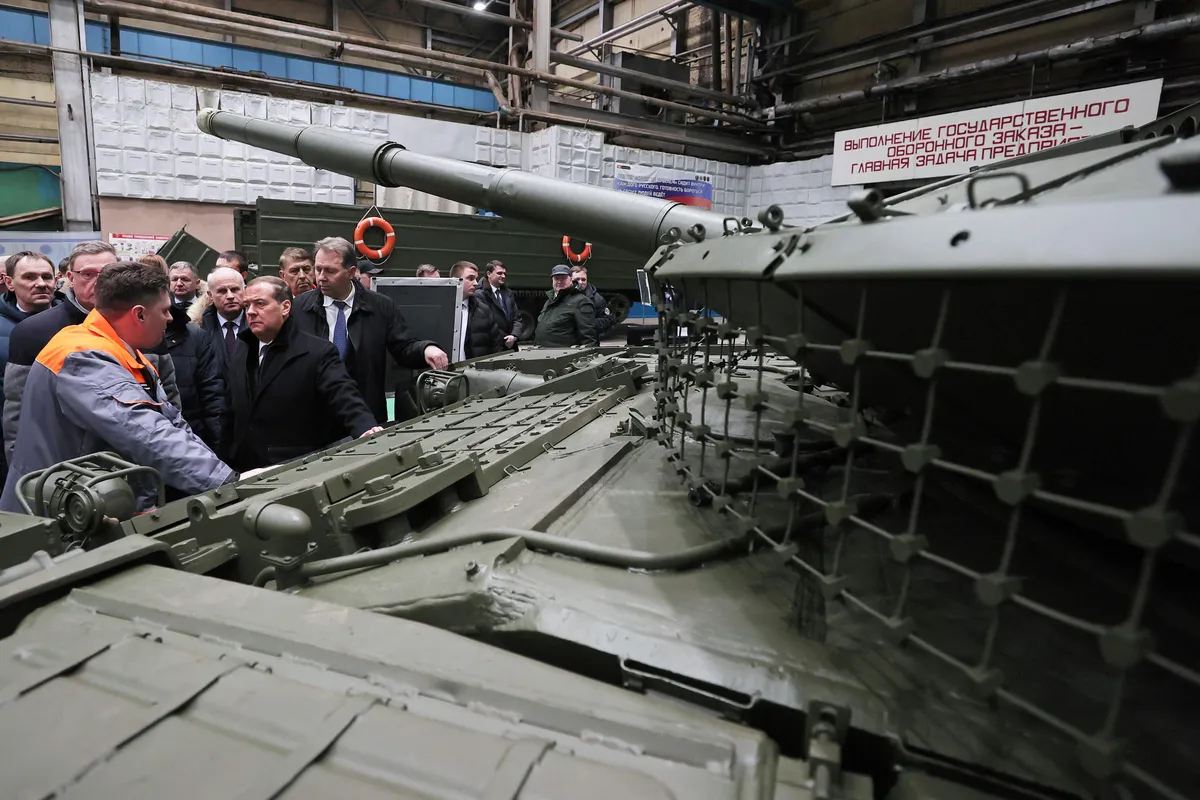
Yes, there are businessmen who use sanctions as an opportunity and supply military components to Russia for millions of dollars. But are these supplies enough? We do not know for sure. We only know that Medvedev was furious from the fact that tanks could not be done quickly enough.
- It seems that the fact that these components are produced in China are playing a large role in the supply of Russian defense -in -law with Western components ...
- ... in Malaysia, in Indonesia and so on. Therefore, the United States to combat sanctions require the help of Malaysia, Indonesia and all countries that these components produce. But this is almost impossible.
If China wants to stop such flows, he can. The question is whether Beijing knows about this. I am not a specialist in China, but maybe the authorities there in the same information bubble as Putin. Well, the main question: will they want? It is difficult to cooperate with the country that all the time speaks of the war with China. Why should China help America to fight Russia?
- Why not transfer the production of microcircuits to more loyal countries?
- It will cost a lot of money. It is economically more profitable to produce components in Malaysia, Indonesia, in other countries. Only the most modern components do in the USA. Outdated-in Southeast Asia.
- And how does Russia get access to modern components?
- I did not see the advanced chips to get to the Russian military -industrial complex. Manufacturers of radiation resistant chips or, for example, advanced gyroscopes, check with whom the business is being conducted. These goods are not sold through distributors.
But the old chips work perfectly. Electronics is important, but a winged rocket is just a plane that does not land.
- There are secondary sanctions that the United States can impose on companies from other countries for cooperation with sanctions Russian persons. How effective are they?
- If I were a Taiwanese company, I would be worried about secondary sanctions. The Americans have a lot of money, and they are ready to spend it in Taiwan, and it would be bad to lose the American market. Latering China companies can also worry, but it depends on who they consider their main client.
-I remember once you said that Russian weapons manufacturers specifically use outdated components in their products so that you do not have to go through export control. What other tricks do they use to gain access to Western components?
- Many criminal cases initiated in the United States are due to the fact that the company simply does not apply for a license at the industry and safety bureau. It is like a smuggling of weapons - you are taking one product under the guise of another. International trade has such a scale that you can hide for some time in sight. And in some countries, the law simply does not cover all the nuances of exports of different microchips.
"Russia is behind for decades even from Malaysia"
- Can the Russian defense sector quickly establish import substitution now? Or at least replace American components with Chinese?
- Even in the USSR, microelectronics was very behind the American one and often copied the development of the United States instead of creating its chips. I don’t know if Putin can translate the military -industrial complex from American components.
As for the replacement of Western components with Chinese. Many American chips are included in complex supply chains involving companies that have offices in China. They are already Chinese to some extent. Whether the Russian defense system will be able to switch to Chinese development electronics is not yet clear.
- The use of less high -quality components can lead to the fact that Russian missiles will get into civilian objects more often?
- Rockets amaze civilians when you use inaccurate weapons in settlements. Rockets, especially those that were developed and built during the Cold War, are not as accurate as the military strive to represent, although they were modernized under Putin. Or when you do not know what you are shooting at. This can be due to inattention, lack of information about the goal, for example, when using old, Soviet maps, or because of political pressure for the purpose of launch. We have already seen all this during the war.
Subscribe to our ravykums we will send you only important storiesThe Americans have the so -called assessment of combat injuries - when the military check whether they got where they wanted. I have no idea how this is done in Russia, but if these reports are falsify, like others, to report to the authorities what it wants to hear is very bad. In this sense, the human factor plays a big role than electronics.
- What would happen to Russian weapons if the military completely lost access to components from the West?
- I spoke with several Russian specialists. In their opinion, without Western technologies, it will be just a weapon of the 1970s level.
- If Russia decides to organize its own production of microelectronics, can it do it without Western equipment?
- The capabilities of Russia for the production of microelectronics are behind decades even from a country such as Malaysia. The equipment that is necessary to create your own production is large, heavy, it is difficult to hide it, it will be difficult to import it with smuggling. Maybe Russia will be able to buy used equipment. Or maybe the Chinese market of semiconductors will advance. Be that as it may, Putin had two decades to build a semiconductor industry. And his attempt was as successful as this war.