
Translated material
"Manipulation of spirituality" and "romanticization of alcohol." What does Roskomnadzor see when the clips of Koka Koki and Kis -Chis are watching

Roskomnadzor announced that he launched the Okulus system, which would look for “forbidden information” in videos and pictures. Mediazona has already told how the department was developing this system - it is mentioned in the correspondence of employees, access to which the Belarusian "cyber -partisans" was transferred to reporters. But in the end, Roskomnadzor still appeals to living people-in the letters of its employees there are regularly “express research” of Russian television channels for propaganda (or descriptions) of suicide, “non-traditional sexual relations”, pornography or simply obscene vocabulary and violation of the rules of age-related marking. To give an idea of the quality and content of these examinations, Mediazona publishes two documents, they present the results of Roskomnadzor studying two clips: for the song Koki Koki “Drunk Home” and the song “Friend” of the Kis-Kis group.
Employees of Roskomnadzor sometimes even have to explain in detail to each other in detail what information should be considered “forbidden” (this is how monstrous lists like a vocabulary of curses that cannot be called Vladimir Putin). In the “cyber -partisans”, for example, there is, for example, a letter of the head of the examination group in relation to the media and the QMS of Anna Rotovskaya with examples of “content containing signs of LGBT propaganda”.
In the investments-the express study of the clip of the KIS-CIS group for the song “Girlfriend” and the articles of Evgenia Albats “Country of Minorities” , a certificate of the “MUZ-TV” award and a description of the clip of the American rapper Lil Nas X for the song Thats What I Want . Studying the latest video, the expert of Roskomnadzor, in detail, the scenes “affecting the topic of non-traditional sexual relations between the men-male characters” in detail.
Despite the attention of Roskomnadzor, neither the clips of LIL NAS X and “KIS-CIS”, nor the article by Evgenia Albats in the register of prohibited information. But in November 2021, for one million rubles under the article on gay propaganda, Muz-TV was fined among minors. The basis of Roskomnadzor was based on, in which experts came to the conclusion that the images of the guests of the program “culturally did not correspond to the image of a man of traditional sexual orientation” in Russia and had “traditional female characteristics”, for example, long hair, makeup and jewelry.
It seems that the work of experts, who, from the end of December 2021 to mid-January 2022, at least five expressions of the clip of Koka Koki “Drunk home” conducted at least five-information about whether after this conclusion, at least one of the television channels showed, “Mediazone” was not found. In one case, the clip was marked with the “18+” sign, but the expert’s conclusion did not change from this: the video was broadcast at seven in the morning, which means that the children could see it. So, the clip could cause these children "the desire to drink alcohol products."
Such express research is made according to one template and are not very different from each other. "Mediazona" publishes two examples that present the results of the study of the clips of the performers popular in Russia: Koka Koki and the Kis-Kis group.
"If she smokes Bong, then I'm flowing." RKN and "demonstration of scenes romanticizing same -sex relationships"
Express composure based on the results of the study (express research) video material “Musical clip of Kis-kis-girlfriend”
In accordance with the order of Roskomnadzor, an express study of the video “ Musical clip of Kis-kis-girlfriend ” was conducted on the air of the Radio-Television Company Omiks (Certificate of registration of EL No. 42-00749 dated 10/27/2014) 03/17/2022 at 05:51.
The video material received for the study, lasting 04 min. 00 sec., It is a record of a fragment of the broadcast of the television channel "Radio -Television Company" Omix ". The distribution of the material was carried out through television broadcasting from 05 hours 51 minutes. 43 sec. at 05 hours 54 min. 24 sec. with a sign of information products "16+".
This material contains scenes affecting the theme of same -sex relationships, while the visual component (hugs, kisses, interested delicate views, poses, touch) duplicates the verbal: “... I fell in love stupidly to my girlfriend”; “With every minute, it seems to be even stronger”; “Kisses as long as the lips”; "I fell in love."
This material was analyzed for the availability of information specified in part 2. Art. 5 of the Federal Law of December 29, 2010 No. 436-ФЗ “On the Protection of Children from Information causing harm to their health and development” (hereinafter referred to as Federal Law No. 436-FZ) prohibited for distribution among children, which, in addition to other ones, include information that promotes non-traditional sexual relations (in accordance with clause 4 of paragraph 2 of Article 5 of the specified federal law).
Note that, according to Art. 6.21 of the Code of Administrative Offenses, the propaganda of non -traditional sexual relations among minors is understood as the activity expressed in the dissemination of information aimed at the formation of minors of non -traditional sexual attitudes, the attractiveness of non -traditional sexual relations, a distorted idea of the social equivalent of traditional and non -traditional sexual relations, or the introduction of information about information about information about information about Non -traditional sexual relations that cause interest in such a relationship.
Only public actions that acquire an aggressive, obsessive nature, which are offensive in form and are able to harm harmful to the rights and legitimate interests of others (primarily minors) can be recognized as unlawful. The purpose of these public actions is to disseminate information that popularizes among minors or imposing them, including on the basis of the circumstances of this act, non -traditional sexual relations.
Initially, we note that the storyline of the above music clip is the story of the relationship of two girls who, according to the text of the song, begin to feel a feeling of love to each other: “There is one problem, / How to tell her? / Что я влюбилась / тупо в свою подругу / Боже, как это глупо / Что же мне делать с ней? / So difficult / every minute, like / feelings even stronger ”; “A suspicious look and jokes of friends / over me / How unbearably difficult for me / I could not resist, the word fell / could not work / and incredibly keep silent, / told everything to her”; "I fell in love / What should I do with her?"
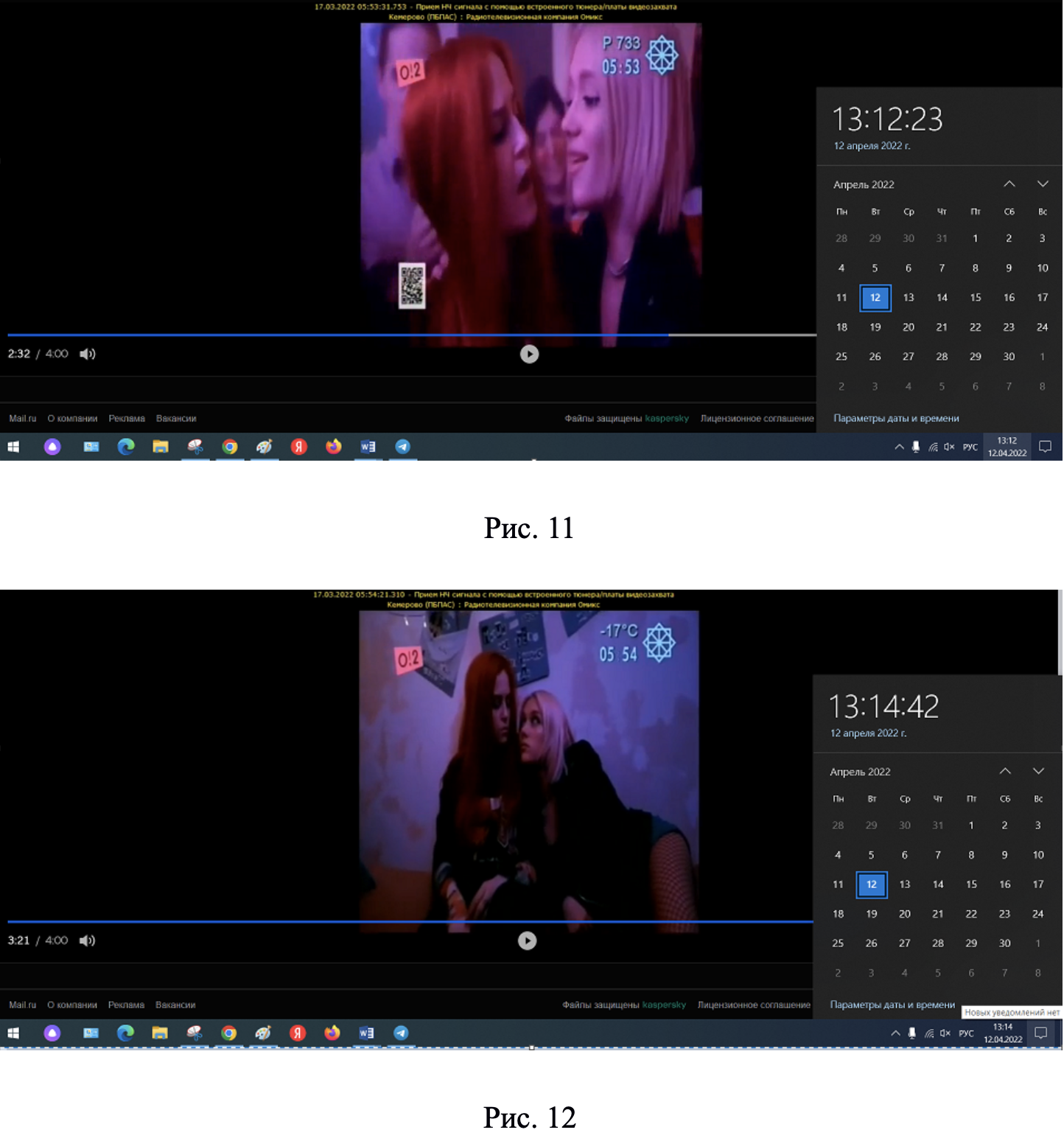
Screenshots from the express study of the clip of the Kis-Kis group
In the material, the focus of attention is aimed at demonstrating a bright, emotional, saturated, positive lifestyle that friends lead, while the girls experienced by girls increase the intensity of emotions and feelings with a joint time: “We can burn together for several days”; “With every minute, as if the feelings are even stronger”; “If she smokes a bong, then I am on the maximum of lips.”
Analyzing a video of the material presented, we note a demonstration throughout the clip of scenes, romanticizing the same -sex relationships and creating a positive image: interested delicate views on each other, a kiss of two girls, touching the face, hair, hugs.
We also note that in this material the installation of representatives of the category of persons who prefer same -sex relations to the traditional one is created on the “normality”, while such relationships act as an attribute of the usual normal life of youth, which is confirmed by the visual component (the ease of integration of the same -sex pair into the youth environment, demonstration of acceptance and positive attitude to girls at the party), as well as the words of the song: “suspicious view and Prikolya and Prioli. friends / over me with her. "
It is important to note that today the impact on the audience, manipulation of the consciousness of the masses, the crowds are characteristic features of mass communication (and the video clip is a means of communication between the artist and the viewer). Through the images in the video clip, its creators report information to the recipient. It should be emphasized that one of the tasks of any communication is not only the report of certain information, but also the approval and change in value attitudes and motivation of behavior. The influence on the audience can be both verbal (through the lyrics) or non -verbal (dance, images, movements, symbols, markers, allusias). So, E.L. Dotsenko emphasizes: “Manipulation is a type of psychological impact, the skillful execution of which leads to the hidden excitement of another person in the other person, which does not coincide with his relevant desires.” The author considers manipulation from the point of view of the means of psychological impact and the nature of intrapersonal processes. He distinguishes: with images , operational-subject manipulation, conventional manipulation, manipulation of spirituality and personality exploitation . The combination of types of manipulation in one art work enhances the effect of exposure to the audience.
In addition, we note that in adolescence there is a formation of systemic thinking. Children at 12-17 years old do not always separate the personality of the performer from his artistic reincarnation. This is how the technique of demonstration of oneself is triggered, in which the confidence in the famous personality is equal to the degree of its popularity: he is a well -known, popular, which means he can be trusted and, therefore, a model of his behavior (behavior of his hero) is advantageous. In this regard, it is worth emphasizing that a characteristic feature of the adolescence is as follows: what is prohibited is attractive. And if an adult can say “impossible” to himself, “stop”, then an anarchist waking up in a teenager requires a violation of generally accepted rules of behavior, overthrowing power in the face of parents and diversity in behavior. But adolescents are still children and often cannot believe that such behavior of performers is a stage mask that they shoot after shooting a video, and can easily begin to follow the manners of idols from videos in real life. So, A. Garnitskaya, a psychiatrist, a candidate of medical sciences, a psychologist of a psychoanalytic direction, a specialist in the European Confederation of Psychoanalytic Psychotherapy (ECPP), remarks: “Many parents think that adolescents begin to watch such a video due to the fact that at some point they lost control over their children. But often it happens the other way around: adolescents, trying to escape from hyper -beams and total parents' control, “freeze” on rollers, where they receive virtual, but freedom, “high” and envious of bloggers, artists who are free to live as they want. ”
It is also worth noting that art plays an extremely important role in the formation of the personality of a high school student. Youth age is especially sensitive to the perception of works of art. The development of self -awareness and enrichment of the emotional world causes young men and girls many new aesthetic experiences that cannot be expressed or comprehended without the help of art. The quantitative and qualitative shifts in the content of aesthetic interests and needs, as well as the artistic consumption of high school students are associated with this.
In addition, it should be emphasized that the neoplasm of the critical phase of the beginning of adolescence, a sense of adulthood, is a special form of teenage self -awareness, a subjective idea of himself as a person who belongs to the adult world. The types of adulthood, in addition to others, include imitation of the external signs of adulthood : smoking, the use of cosmetics, the use of alcohol, copying the ways of entertainment, imitating adults in clothing and hairstyle, etc.
In this regard, it is important to note the presence in the material of the psychological technique of obsessive repetition ( speech perseverance ), which forms at the first stage the desire to repeat the audible words in the beat of music. Next, the verbal component with internal filling takes place. That is, the speech perseverance is the result of associative activity, part of consciousness and does not occur by accident. The essence of the impact is a constant, devoid of diversity, the repetition of the same thesis that reduces the consciousness of the recipient and allows you to integrate the corresponding theses into its psyche. It is the multiple repetition of the chorus that allows you to remember the song well, synchronize the sound of singing, configure them to a single wave. In a brief psychological and philological dictionary T.V. Poyagovova is understood to mean a tendency to follow a certain behavior model, as long as it becomes inadequate. We emphasize that the syntactic structure “I fell in love” against the backdrop of a demonstration of same -sex relationships is repeated in a video clip 7 times.
Thus, the analysis of the material made it possible to establish the following: a video sequence, as well as the lyrics presented in the material, are aimed at the formation of a positive image of non -traditional sexual relations. In addition, the identified techniques of non -verbal impact on the psyche of the child adversely affect the moral consciousness of the child and lay the concept of non -traditional sexual relations as norms. The desire to imitate your idol can contribute to the drawing of false analogies, false behavioral stereotypes and, as a result, a false perception of oneself as a person, including in a sexual aspect. In addition, repeated viewing (as well as an intrusive broadcast) of this clip can cause interest in non -traditional sexual relations. Indeed, it is teenage (also early youth) age - the period of self -determination, self -knowledge and reassessment of values - is a sensitive to the formation of a hedonistic orientation. It is at this age that the main elections are carried out in such spheres such as the social role and self -determination of the teenager.
On the basis of the foregoing, the expert commission came to the conclusion that there is an information in the analyzed material that promotes non -traditional sexual relations prohibited for the distribution among children and requiring marking the sign of information products “18+”.
Conclusion : The results of the study of the video material “Musical clip Kis-kis-girlfriend” showed:
- the inconsistency of the material to the sign of information products "16+";
- the availability of information prohibited for the distribution among children and the corresponding sign of the 18+ information products, namely, information that promotes non -traditional sexual relations
"My password is Aperol." RKN and "romanticization of relations, an integral part of which is the use of alcohol"
Express compare based on the results of the study (express study) of the Playerist material
In accordance with the instructions of Roskomnadzor, an express study of the video material “Playlist” was conducted on the air of the TV channel “TNT Music” (certificate of registration of EL No. FS 77-65664 dated 05/13/2016) 01/26/2016 at 22:45.
The studied video material is 03 min. 03 sec. It is a record of a fragment of the broadcast of the TV channel "TNT Music". The video clip of the performer under the pseudonym Klava Kok for a song called “Drunk home” is broadcast on the airtime from 22 hours 46 minutes. 15 sec. 22 hours 49 min. 00 sec. with a sign of information products "16+".
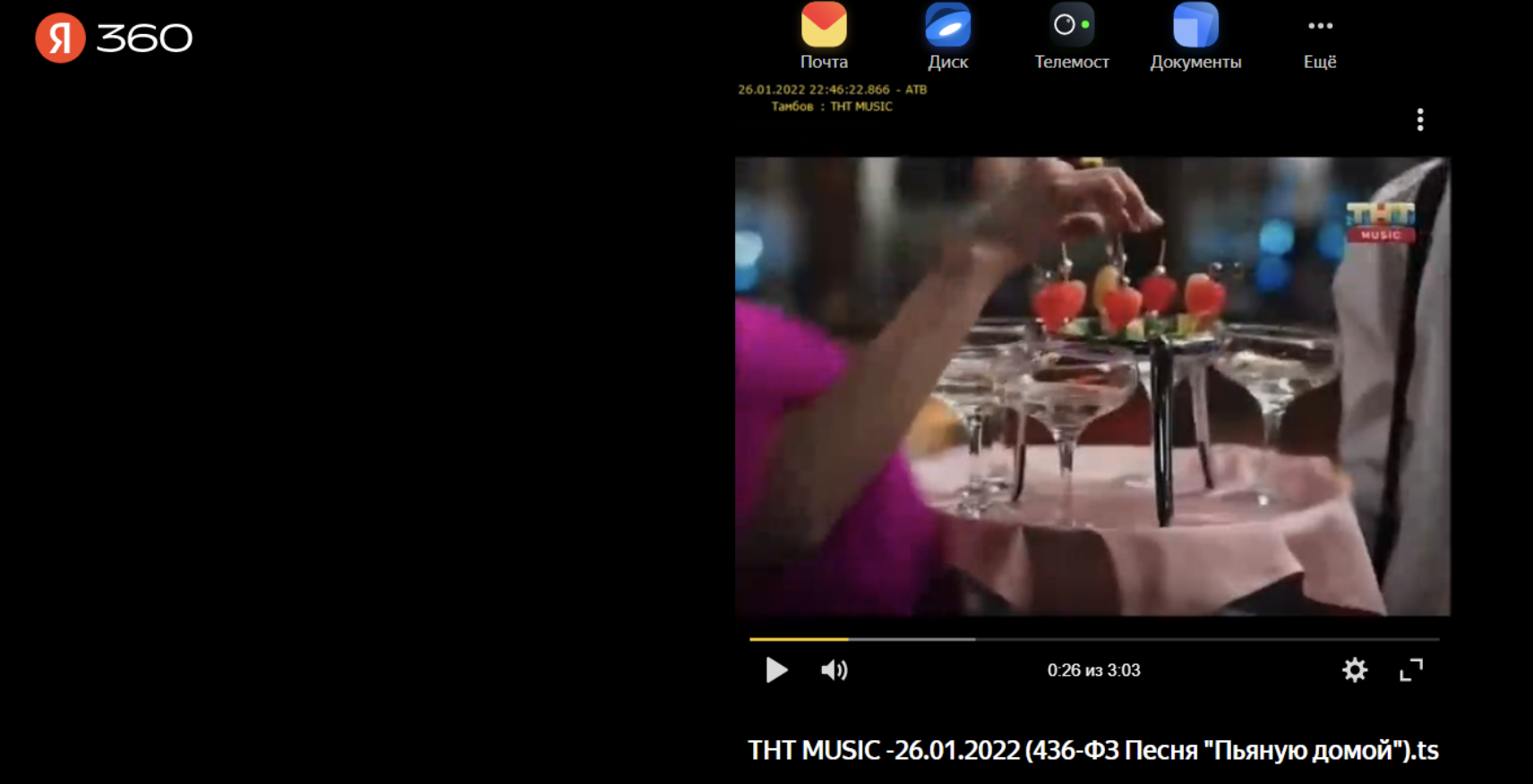
Screenshot from the express study of the clip Klava Koki
This material contains scenes of drinking alcoholic beverages, as well as syntactic constructions with semantic filling “Alcohol consumption”, in connection with which it was decided to analyze the presented video clip for the detection of information prohibited for distribution among children, to the number of which, in accordance with paragraph 2 of Part 2 of Art. 5 of the Federal Law of December 29, 2010 No. 436-ФЗ “On the Protection of Children from Information Causing their Health and Development” (hereinafter referred to as Federal Law No. 436-FZ), in addition to other ones, it includes information that can cause children to use alcohol and alcohol-containing products.
Turning to the analysis of the material, it should be said that the storyline of the video clip is built around the active use of alcohol products by the main character. We also emphasize that in the material the focus of attention is aimed at demonstrating its uncontrolled dissolved behavior (in a state of intoxication) and accessibility, which is confirmed by scenes of drinking alcoholic beverages, an episode with a dance on the table and falling on the hands of the tables surrounding the table, as well as the words of the song “Take a drunk home, do everything you want with me” ; “I will dance for a long, long time, / at least I stand on my feet. / And there are so many, many in me ... " .
In this video clip, there is a romanticization of relations between a man and a woman, an integral part of which is the use of alcohol. Данную информацию следует рассматривать в качестве положительного аспекта употребления вышеназванной продукции, поскольку игнорируются негативные последствия, а также нивелируется отрицательная сторона происходящего: «Ты не жди меня, я буду поздно / Пьяные SMS, мой сигнал — SOS /И у тебя ко мне потерян доступ»; «Забери пьяную домой, / Завтра мне будет стыдно. / Забери пьяную домой, / Тока не ругайся сильно / Забери пьяную домой / Делай со мной все, что хочешь, / Забери пьяную домой, / Да, этой ночью»; «И во мне всего так много-много, / Но я к тебе хочу на самом деле» ; «Посмотри и заблудись, / Мои stories — лабиринт / Удалить и забыть, / Удалить и забить. / Дай себя я накручу, / Позвоню, но промолчу, / Мой косяк, sorry, зай, / Приезжай, забирай ». Напротив, алкоголь в данном случае придает отношениям некую романтичную легкость, оставляя их на ступени флирта.
Анализируя видеоряд представленного материала, отметим демонстрацию символического расположения и выражения любви окружающих мужчин по отношению к женщине, находящейся в состоянии алкогольного опьянения (посредством демонстрации макетов сердца, а также заинтересованных взглядов мужчин на героиню).
Отметим также, что в данном видеоклипе алкоголь выступает в качестве неотъемлемого атрибута «красивой» жизни, что подтверждается изобразительной составляющей (боа из денежных купюр, соответствующие интерьеры), а также словами песни: «Мой пароль — Апероль, / Smokey eyes, face-контроль, / Ты не жди меня, я буду поздно».
Немаловажно отметить, что в наши дни воздействие на аудиторию, манипуляции сознанием масс, толпы являются характерными чертами массовой коммуникации (а видеоклип является средством общения артиста и зрителя). Через образы в видеоклипе его создатели доносят информацию реципиенту. Следует подчеркнуть, что одной из задач любой коммуникации является не только донесение определенной информации, но также одобрение и изменение ценностных установок и мотивации поведения. Влияние на аудиторию может быть как вербальным (через текст песни), так и невербальным (танец, образы, движения, символы, маркеры, аллюзии). Так, Е.Л. Доценко подчеркивает: «Манипуляция — это вид психологического воздействия, искусное исполнение которого ведет к скрытому возбуждению у другого человека намерений, не совпадающих с его актуально существующими желаниями» . Автор рассматривает манипуляцию с точки зрения средств психологического воздействия и характера внутриличностных процессов. Он выделяет: манипуляцию образами , операционально-предметную манипуляцию, конвенциональную манипуляцию, манипуляцию духовностью и эксплуатацию личности . Сочетание видов манипуляции в одном художественном произведении усиливает эффект воздействия на аудиторию.
Кроме того, отметим, что в подростковом возрасте происходит формирование системного мышления. Дети в 12-17 лет не всегда отделяют личность исполнителя от его художественного перевоплощения. Так срабатывает прием демонстрации себя, при которомстепень доверия к известной личности равна степени ее популярности: он известный, популярный, значит ему можно доверять и, значит, модель его поведения (поведения его героя) выигрышная. В этой связи стоит подчеркнуть, что характерной чертой подросткового периода является следующая: что запрещается — притягательно. И если взрослый может сказать себе «нельзя», «стоп», то просыпающийся в подростке «анархист» требует нарушения общепринятых правил поведения, свержения власти в лице родителей и разнообразия в поведении. Но подростки — еще дети и зачастую не могут поверить, что такое поведение исполнителей — сценическая маска, которую они снимают после съемки видео, и запросто могут начать следовать манерам кумиров из видеороликов в реальной жизни. Так А. Гарницкая, врач психиатр, кандидат медицинских наук, психолог психоаналитического направления, специалист Европейской Конфедерации Психоаналитической Психотерапии (ЕКПП), замечает: «Многие родители думают, что подростки начинают смотреть такое видео из-за того, что они в какой-то момент потеряли над своими детьми контроль. Но часто бывает наоборот: подростки, пытаясь сбежать от гиперопеки и тотального контроля родителей, "зависают" на роликах, где получают пусть и виртуальную, но свободу, "кайфуя" и завидуя блогерам, исполнителям, артистам, которые вольны жить, как им захочется».
Стоит также отметить, что исключительно важную роль в формировании личности старшеклассника играет искусство. Юношеский возраст особенно сензитивен к восприятию произведений искусства. Развитие самосознания и обогащение эмоционального мира вызывает у юношей и девушек множество новых эстетических переживаний, которые невозможно ни выразить, ни осмыслить без помощи искусства. С этим связаны количественные и качественные сдвиги в содержании эстетических интересов и потребностей, а также художественного потребления старшеклассников.
Кроме того, следует подчеркнуть, что новообразование критической фазы начала подросткового возраста, чувство взрослости, — это особая форма подросткового самосознания, субъективное представление о себе как о человеке, скорее принадлежащем к миру взрослых. К видам взрослости, кроме прочих, в психологии относят подражание внешним признакам взрослости : курение, использование косметики, употребление алкоголя, копирование способов развлечения, подражание взрослым в одежде и прическе и др.
В этой связи немаловажно отметить наличие в материале психологического приема навязчивого повторения ( речевой персеверации ), который формирует у реципиента на первом этапе желание повторить слышимые слова в такт музыки. Далее происходит связь вербального компонента с внутренним наполнением. То есть речевая персеверация является результатом ассоциативной деятельности, частью сознания и не происходит случайно. Суть воздействия — постоянное, лишенное разнообразия повторение одного и того же тезиса, что снижает сознательность реципиента и позволяет интегрировать соответствующие тезисы в его психику. Именно многократное повторение припева позволяет хорошо запомнить песню, синхронизировать звучание поющих, настроить их на единую волну. В кратком психолого-филологическом словаре Т.В. Летяговой под персеверацией понимается тенденция следования определенной модели поведения, до тех пор, пока она становится неадекватной. Подчеркнем, что синтаксическая конструкция «Забери пьяную домой» повторяется в видеоклипе более 12 раз.
Дополнительно стоит отметить отсутствие в видеоклипе каких-либо указаний на опасность употребления названной продукции.
Принимая во внимание все вышеупомянутое, а также содержание изобразительного и аудиального компонентов видеоматериала, подчеркнем, что процесс употребления алкоголя в данном клипе подан в положительном ключе, выступающим неотъемлемым атрибутом «красивой» жизни и романтических отношений между мужчиной и женщиной. Отсюда следует, что такое представление информации способно сформировать позитивный образ алкогольной продукции и мотивацию ребенка к ее употреблению.
На основании вышеизложенного комиссия экспертов пришла к выводу о наличии в проанализированном материале информации, способной вызвать у детей желание употребить алкогольную продукцию, запрещенной для распространения среди детей и требующей маркировки знаком информационной продукции «18+».
В заключение стоит сказать, что, согласно ч. 1 ст. 13 Федерального закона № 436-ФЗ, информационная продукция, содержащая информацию, предусмотренную пунктами 1-5 части 2 статьи 5 данного Федерального закона (в том числе информацию, способную вызвать у детей желание употребить алкогольную продукцию), не подлежит распространению посредством теле- и радиовещания с 4 часов до 23 часов по местному времени, за исключением теле- и радиопрограмм, теле- и радиопередач, доступ к просмотру или прослушиванию которых осуществляется исключительно на платной основе с применением декодирующих технических устройств и с соблюдением требований частей 3 и 4 названной выше статьи.
Из сказанного следует, что трансляция данного видеоклипа, осуществленная 26.01.2022 в 22:46, противоречит требованиям ч. 1 ст. 13 Федерального закона № 436-ФЗ.
Вывод : Результаты проведенного исследования видеоматериала «Плейлист»показали:
- несоответствие заявленному знаку информационной продукции «16+»;
- наличие информации, способной вызвать у детей желание употребить алкогольную продукцию, запрещенной для распространения среди детей и требующей маркировки знаком информационной продукции «18+»;
- наличие информации, подлежащей ограничениям по времени трансляции и противоречащей требованиям ч. 1 ст. 13 Федерального закона от 29.12.2010 № 436-ФЗ «О защите детей от информации, причиняющей вред их здоровью и развитию».