
Translated material
Small ring
Astronomers found a ring in a kvavar - a small planet of the solar system. But, according to theoretical ideas, it should not be! We understand the scientific sensation
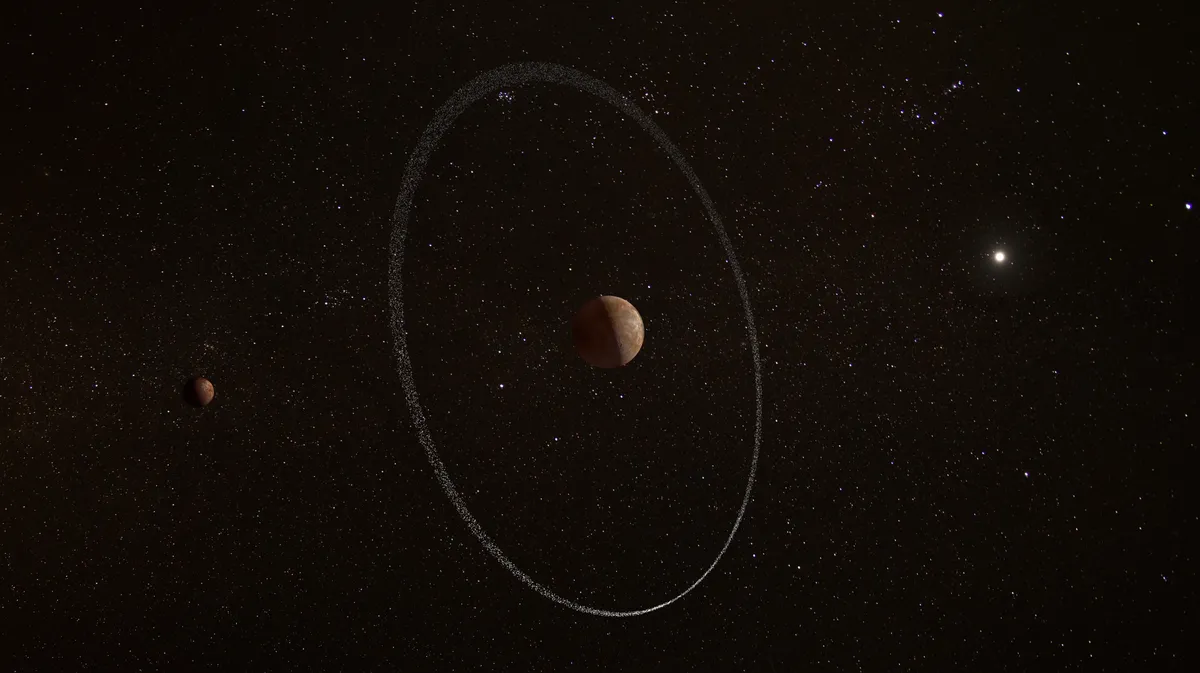
The headlines of world news agencies were the news, which seemed to be narrowly professional interest: the dwarf planet KvAOAR (QUAOAR) of the Cloner system found a ring - like Saturn. Why did this be so excited?
Dwarf planets - a class of objects of the solar system that did not "reach" to ordinary planets according to the criterion of the orbit cleaning. This planet, by definition, cleanses its orbit of any “garbage” - for example, from asteroids flying at close distances to its orbit. That is why, for example, Pluto stopped considered a full -fledged planet and transferred to the category of dwarfs.
Kvarvar is one of the largest such bodies, only twice smaller than Pluto in size. He turns in orbit located, roughly speaking, between the orbits of Neptune and Pluto, and makes one revolution in about 300 years.
Watching the stars next to the kvavar, the astronomers noticed that the light of these stars sometimes weakens, since it is overlapped by a dense ring of small particles. By the position of shaded stars, it was possible to determine the position of this ring.
What is unusual in this? The rings around large and small planets can form due to the destruction of their satellites with tidal forces (tidal forces arise due to the difference in attraction forces acting on different parts of the object). Such destruction can occur only if the satellite flies too close to the surface of the planet - closer to the distance called the "limit of Roche." Below the limit of Rosha (that is, close to the planet), tidal forces are more powerful than the forces of mutual attraction of the debris, and do not allow the satellite to arise from the debris. Above the limit of Rosha, on the contrary, the fragments of the substance will strive to "stick" into the satellites.
All well -known planets of the solar system that have rings have this rule.
However, Kvarova surprised everyone. His ring turned out to be 2.4 times larger than the limit of Roche.
Theoretically, in a short time, the wreckage, of which the ring consists, would have to “stick” into a normal satellite under the influence of mutual attraction.
This significantly puzzled scientists. One of the explanations that astronomers propose is orbital resonance: a situation in which the periods of circulation of celestial bodies correlate as integers. So, the Kvavar ring rotates exactly six times faster than its only satellite. Another explanation is that at such low temperatures (approximately minus 220 degrees Celsius), pieces of ice, of which the rings are mainly consisted, are poorly connected, so the “snowball” cannot be blinded from them.