
Translated material
The ends are in the ode
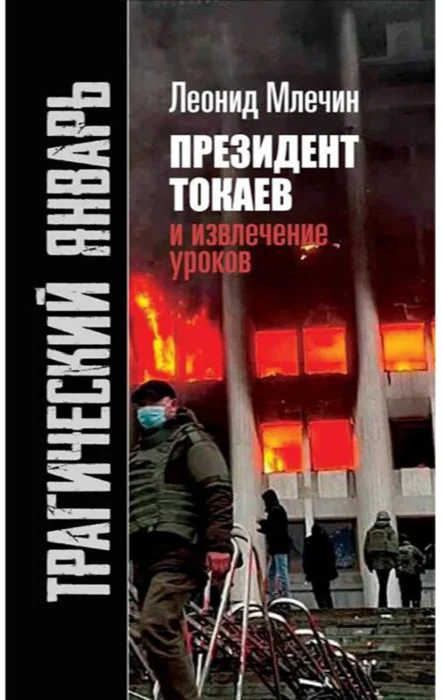
Historian Leonid Mlechin wrote a panegir book to the President of Kazakhstan, who deal with the “bandits” during the January events. We read it - and we do not advise you
Rumors about the new book of Russian journalist Leonid Mlechin about the tragic events of January 2022, when, after protests across the country, mass riots began, which led to the deaths of 230 people, appeared in Kazakhstan in December - immediately after its Moscow presentation and long before going on sale. We were waiting for such an interest. Mlechin's work was submitted as a documentary study and the “first deep analysis of the January crisis”. However, almost immediately the version arose that it was written by order of Kazakhstani authorities and shows the reader a picture of events that they benefit. However, if so, this is not a reason to immediately refuse to read. Rather, one more opportunity to understand what view of the bloody January (in Kazakhstan it is called Kantar: this is the literal name of the month in the Kazakh language, and the play of words, since the “kan” is blood) the team of President Tokayev offers society.
The long name easily beats in two - “Tragic January”, “President Tokaev and the extraction of lessons”. In the media field, Mlechin appeared as the author of the study precisely about Kantar, but in the book itself only the first and fourth chapter is devoted to him - the beginning and the end. It turns out a kind of frame for the portrait. In the middle, the new biography of Kasym-Zhomart Tokayev is from childhood to date. Thus, the journalist also gives his vision of the President’s image - I must say, in the details of the non -eating. Actually, the book is dedicated to these two subjects. According to the author, the “tragic January ...” is written for the Russian reader and should contribute to mutual understanding and friendship between countries. The latter does not cause doubts. But the addressees are still Kazakhstanis. It can be assumed that the work of Mlechin was originally conceived as such a “historical document”, which journalists, bloggers, filmmakers and researchers will later be eager to refer to.
The author is not involved in local political intrigues, but at the same time a person is not a stranger. And from Tokayev he took an interview, and wrote about his predecessor of the book.
A completely suitable figure in order to play the role of an independent researcher. But the “draw”, unfortunately or fortunately, came out completely not convincing.
The fault of this is the text issuing in Leonid Mlechin, at least a very hot supporter of the president. One who, even for disguise, is not ready to say something not enthusiastic about Kasim-Zhomart Tokaev. This is actually strange taking into account the bright international career of the president-if you prick somewhere, then it would be possible to crush your own injection with quite real achievements from his biography. It would look much more convincing - it would be less like the "felitsa" of Derzhavin. It is also significant that the “independent researcher” of Mlechin does not at all voiced the opinion of the relatives of the victims on the January days. But it gives the floor to several security forces at once, fighting with the riots. In “Tragic January ...”, the names of journalists and human rights activists, who made up the victims of the bloody January, are never mentioned. And most importantly, Mlechin did not necessarily agree with their interpretations. He could argue, bring his arguments, but instead simply did not notice their activity very noticeable in Kazakhstan.
Game for defeat
“Classical diplomacy implies impressiveness,” the journalist reports casually, thinking about Tokayev’s colleagues according to the Ministry of Foreign Affairs. And it seems that this is related to classical diplomacy with the book itself. It is “lack of fire”, “silence” - the main weapon and, at the same time, the trouble of “tragic January ...”. The beginning of the story, contrary to all rumors, inspires hope: "The difficulty of January events is that everything mixed up there." Yes, this is almost “not everything is so unambiguous” - the notorious, but in this context, looking much more appropriate than in the usual one. It may even seem that the output will turn out a balanced picture of January events.
Mlechin distinguishes three constituent elements of Cantar. It all started with a peaceful protest against sharply soared prices for liquefied gas. It flared up in Janaozen, but quickly enough the geography of performances expanded to the Mangistau region, and then to the country. Economic requirement "GAZ ELEU!" (“Gas according to 50”) soon replaced the famous political slogan “Schal Ket!” (“Old man, go away!”), Aligned not to the end of the ex-president Nazarbayev and his “family”, and in essence-simply an authoritarian and unfair system. Mlechin evaluates the actions of the authorities in this situation as operational and almost impeccable, which, of course, is an exaggeration. By the evening of January 4, the government agreed to return the prices for the previous level for the Mangistau region, but this temporary concession could no longer stop protests. However, the first stage is much less interested in the author than the following. Further, bandits and looters appeared on the streets, who caused especially severe damage to Almaty. The third element is “well -trained militants” who attacked a coup d'etat.
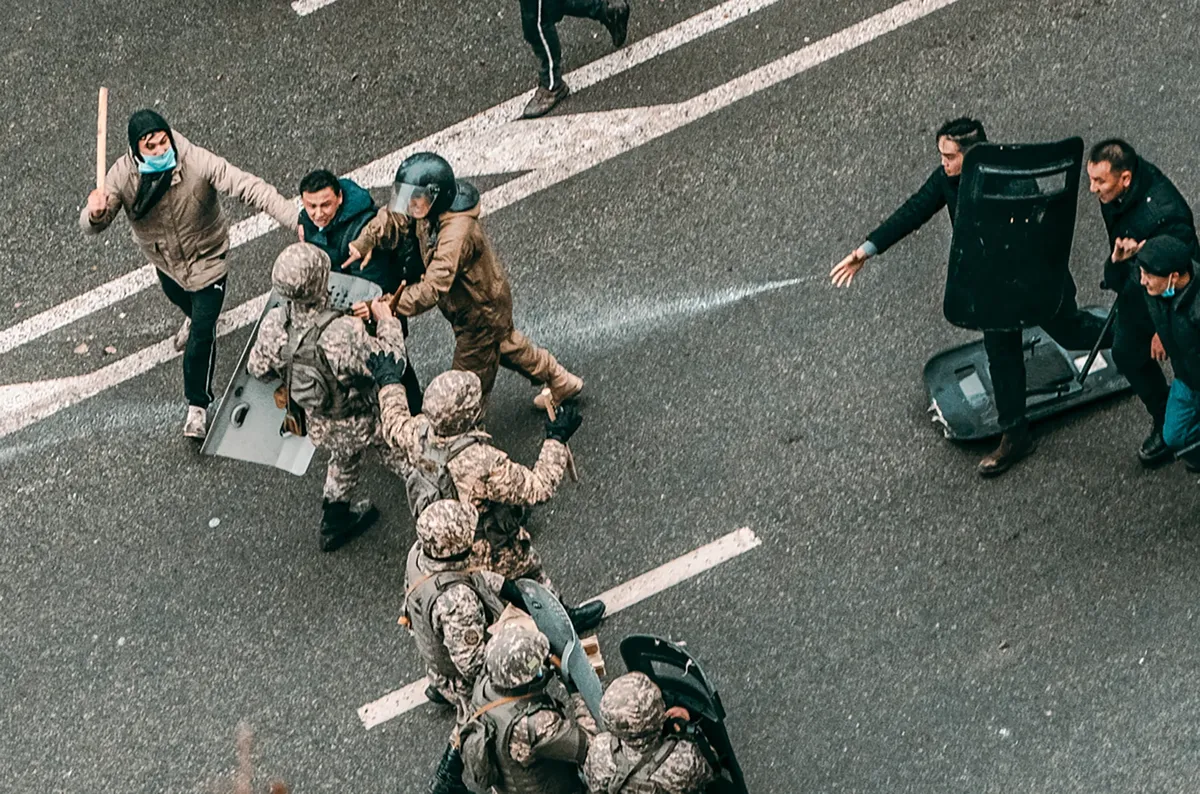
To describe peaceful protests, the journalist did not need either interlocutors or paint. Everything is clear there - they came out of the dissatisfied, inimed, the authorities heard them, but they are not very good. Details begin simultaneously with the violent phase. The interlocutors (mainly from the police) talk about cruel clashes, and “protesters” and “militants” in their confused speech are mixed to indistinguishability. Burning cars, flying stones, beaten by a ruthless crowd of law enforcement officers. Then suddenly broken windows and looted shops, whose employees complement the picture with their losses. Primitive chaos, which really took place in Almaty in those days, was fully transferred on the pages of the book. But this, at first glance, of the chaotic part has its own hidden structure.
Mlechin writes: “A real war? And the police are still without weapons. The entire arsenal of law enforcement officers is a special means of non -lethal action. ” A little later: “But the police were still most afraid to shoot in the crowd and kill the innocent. The police did not shoot, and this was perceived as weakness. " After a few more pages, a new replica is defenseless, because the “unarmed” police. Finally, a quote that was not called by the author of an eyewitness, who wrote to him in the evening of January 5, a very strangely formulated letter: “The building of the city administration was captured. City in the power of looters. Protesters learned that Tokaev gave the order not to shoot the combat. Tokaev is an intellectual and will not sign a decree on the use of military weapons. And this is bad. " How this line will end is known. On January 7, the president will voice a completely different order from the television screen: "Open fire to defeat without warning." Mlechin “legitimizes” him with this wording: “Someone was indignant: President Tokaev ordered to shoot, but this is cruel! And many Almaty people then said something else: it is a pity that they did not immediately use force, so ultimately so many people died. ”
There were no doubts that “many Almaty people” thought in a similar way, in her frankly,. To do this, it is enough to scroll through some Facebooks. But, of course, not all. However,
Marauders, bandits and provocateurs are not accepted. Therefore, the author of the “tragic January ...” must solve another problem: to show that those who deserved this were killed:
“The demonstrators who, the day before, went out into the streets with various requirements, were scared and stayed at home. The other in the city is now in the city. ” Mlechin voices what the authorities said the whole last year. Under “everything mixed up” at the beginning, obviously, “religious radicals, political extremists, notorious bandits, loafers and small hooligans” were obviously meant. But the peaceful demonstrators were just “not mixed” - the first phase of Mlechin hardly delimits in time and does this, of course, not by chance. There were enough witnesses to the fact that in the evening of January 6, fire was opened on the Republic Square precisely according to the peaceful protesters who stretched the banner with an appeal to the president: “We are not terrorists! We are a simple people. " And many of the dead in the days of stripping would be absurd to suspect in an attempt by the coup - these are children, pensioners, passengers of cars who accidentally found themselves next to the square.
Around the notorious order of Tokayev, a lot of unsplained remains. Could the president really believe that only “armed bandits” remained on the streets, that they would only shoot at them and in the conditions of chaos of peaceful victims?
Or did he still treat the latter as little blood? One way or another, from the possible options for suppressing the riots, Tokaev chose almost the hardest. Human Rights Watch interpreted it as the use of “excessive power”. Among the inhabitants of Almaty (and, in many ways, probably the whole country) there was a split, primarily related to personal experience. Some, who saw the looters and the “revolutions”, supported the president. Others, who knew about the cases of shooting at peaceful demonstrators and random passers -by, considered his decision criminal. At the same time, the former often cannot separate protesters from pogromers. And the latter, it seems, sometimes underestimate the danger of coming to power of forces, who allegedly tried to take advantage of their interests. Radicalism from any of the parties, regardless of its justification, does not contribute to rally. Having shown a really difficult picture of events, Mlechin could invest in the desired consolidation of society. But his electoral view, on the contrary, helps to strengthen the split.
A curious detail. At the end of the “tragic January ...”, the journalist again returns to the order “open fire to defeat” (“without warning” in the text, he, softening, tries to lower). And here he writes: “... from January 4 to 6, 2022 - Tokaev was in the information isolation organized by security forces. The president was intimidated by the scale of the riots that attacked the main regional centers of bandits, their plans to attack Akorda ... ”This replica is quite strange to combine with the first chapter, in which Tokayev’s decision was submitted as a strong and only true. Now Mlechin justifies the order by the fact that the president was deliberately misled. Then, the arrested ex-minister of defense Murat Bektanov, who "clearly exceeded his powers and applied force, was completely mentioned when this was not necessary." If you believe in the custom nature of the book, an interesting picture is obtained. Order and “stripping” for the authorities, as well as for a noticeable part of society, is the most sore spot of the January tragedy. It is much more painful than entering the CSTO troops into the country, and, I must say, is notibriently. At the same time, on the one hand, the authorities try to shut up some of the most acute episodes, on the other hand, prove the loyalty of the decision, from the third, they want to justify themselves for a mistake, without calling it a mistake. Clearly admit your share of guilt in Kantar’s victims and are also clearly apologized by an apology (and will they be?). Perhaps that is why they are so persistently trying to convince society in their picture of what happened and are silent about alternative, usually “uncomfortable” interpretations. And this, of course, is an extremely dangerous path that greatly annoys the active part of society.
Sorry Elbasy, he won't be like that anymore
Mlechin's book is rich in possible “spoilers” of the results of an official investigation. The fact that one of the guilty in an attempt by the coup, the journalist will call the former chairman of the national security committee Karim Masimov was expected. He and several of his deputies have long been under investigation. The main intrigue was whether Mlechin would tell about the alleged involvement in the coup Nursultan Nazarbayev and the family. After all, Masimov is known precisely as the person of the first president and, in general opinion, is unlikely to be suitable for the role of an independent player. On the first pages, Nazarbayev receives a very flattering characteristic-such that it is not even clear how society could get tired of it in some 30 years. But the conclusion is unexpectedly tough. Mlechin gives the opinion of certain “knowledgeable people” who “very confidently” voiced a plan of the coup from the words of the defendant Masimov. Nazarbayev planned to return for another 3 years, and then choose a more suitable successor. Masimov himself acted at his direction and was supposed to receive a post of prime minister with unlimited powers. At the same time, the psychological contrast is important-the ex-head of the KNB appears as a person personally devoted to Nazarbayev, although not without selfish interest. Whereas the former “leader of the nation” in the book cynically rejects from the association with his ally: “Masimov worked with me for many years, but how do you know, did Jesus Christ know next to Judas?”
However, the final of the Anti-Nazarbayevsky bloc scattered to various chapters is preparing a new surprise to the reader. Mlechin explains that it is accusing the "founder of the modern Kazakhstani state" - "it means to discredit the idea of state independence itself." And then recalls the formula of Dan Xiaopin, in which Mao was 30% wrong, but the rest of 70% very much even. Tokayev’s sympathy for the policy of the Chinese reformer is known, and, frankly, the revival of this formula is unlikely to be a surprise. However, so far it seemed to be no longer.
In “Tragic January ...” there is a line addressed to the Russian reader purely. At the book, attacks on nationalist ideas are scattered.
This criticism is primarily associated with the threats of individual Russian officials and propagandists about the annexation of Northern Kazakhstan. Mlechin explains to readers excited by imperial idea that there is no problem of nationalism in Kazakhstan, and ethnically, Russian Kazakhstanis are full -fledged representatives of the civil nation, and not a “minority”. The journalist warns the Russians about the "Chinese threat." At one time, Mao Zedun had territorial claims to the USSR, and each call to “return home” some tidbit of someone else's land reminds China that they, in principle, can bite something away from Russia.
A short but also notable plot is associated with “latent Stalinism”, which is often suspected by the President of Kazakhstan. This is due to the ambiguous characteristics of the leader and several Stalinist phrases, which Tokaev unsuccessfully quoted last year. Very alarming, especially after Kantar. But apparently, the president heeded this criticism. His “updated” assessment of Stalinism still puts repressions and Asharshlyk, monstrous hunger, which claimed more than a million Kazakhs in the early 1930s.
Beneration of the president
The second and third chapters are entirely devoted to Tokaev’s biography. And his image is given a lot of space in the rest of the book. The biographical narrative frees the reader from the sugary taste of propaganda. The plot is drowning in countless and very detailed lyrical digressions. Nevertheless, reading this part of the book is quite exciting. Unless the secondaryness is disappointed. If you have an idea of the life of Tokayev from newspaper publications, memoirs of colleagues or his own books, then the story of Mlechin is unlikely to seriously complement it. “The tragic January ...” is replete with quotes (especially from numerous presidential publications), and sometimes it seems that they inform the reader much more than the author’s comments.
The image of Kasim-Zhomart Tokayev is dual, and this largely explains such a different attitude to his figure in his homeland and abroad.
Foreigners, as a rule, see in Tokaev an experienced and successful international official-was a Soviet diplomat in Singapore and China, in both countries he ended up during periods of bright reforms, then became one of the authors and engines of the foreign policy of young Kazakhstan, for a long time headed the Ministry of Foreign Affairs, and ultimately grown to the post of Deputy Secretary General of the UN (2011-2013) and the head of its Geneva branch. This picture fits well and not the most banal image of the president-intellectual. Kazakhstanis often see a fad, until recently, an absolutely loyal official from the Nazarbayev system. Both the portraits are justified. In a sense, the prospects of the country depend on which of them will win in the president itself. In Mlechin’s book, the first, of course, dominates the second, absent. But much more interesting are the new images prepared for him to replace.
First of all, it is a “strong leader” - decisive, cold -blooded, with an iron will. Especially often, Mlechin rests on the fact that during the January tragedy, the conspirators from the KNB persuaded Tokayev to throw the country, saving their lives, and even offered him a large sum “for the first time”. But the president, as you know, did not leave Kazakhstan. Другой излюбленный контраст: заговорщики, граждане, иностранцы — все они считали Токаева слабым интеллигентом, а он ошарашил их мужеством и жесткостью, с которым «боролся за страну против бандитов и предателей из силового блока». Тех, кто надеялся увидеть в Токаеве реформатора-демократа, этот образ, думается, разочарует. Костюм, конечно, пошит на авторитарного лидера — и не факт, что «просвещенного автократа», вроде Дэн Сяопина.
Самый впечатляющий и актуальный ход Млечина — образ «президента сопереживающего». Растет он очевидно из концепции «Слышащего государства», предложенной Токаевым еще в 2019-м. А она, в свою очередь, была реакцией на растущий разрыв между властью и обществом. Официальную Астану даже называют «Матрицей», отгороженной от народа и глухой к его запросам. «Меня поражает, что вы не утратили человеческого восприятия страдания людей» — говорит Млечин президенту как бы вскользь. Но потом еще несколько раз возвращается к этой идее, показывая ее на контрасте с «типичным равнодушным чиновником»: «Поразительным образом после стольких лет во власти Токаев сохранил умение сочувствовать и сопереживать. Всегда готов помочь тем, кто попал в беду… Симпатизирует несчастным и одиноким». Основные идеи «Слышащего государства» в книге тоже описаны. На уровне концепции они действительно выглядят обаятельно и адекватно запросу общества. Другой вопрос, что изменения, реально воплощенные в жизнь, оказались косметическими и мало кем были замечены. Раньше это оправдывалось влиянием Назарбаева на политику, но Млечин всю вину сваливает на пандемию.
«Сопереживающий президент», конечно, ценен сам по себе. Но в «Трагическом январе…» у него есть и другая миссия. Образ должен противопоставить Токаева назарбаевским элитам и незаметно вытеснить из сознания читателя память о нем как лояльном чиновнике и преемнике. В некоторых местах президент выглядит едва ли не Робином Гудом, пришедшим во власть, чтобы одолеть клептократов и коррупционеров, всех тех, кто «привыкли жить не по закону» и кому «не понравилась его идея «Слышащего государства», потому что президент требовал от чиновников заниматься нуждами народа». Еще один дополнительный штрих к мифу о Кантаре: «Почему заговорщики проиграли? Во-первых, люди выступили против истеблишмента, против тех, у кого на руках все богатства, а вовсе не против Токаева…» Эта трактовка, конечно, большое лукавство. Да, протестовали против Назарбаева, но в то время очень немногие воспринимали второго президента как самостоятельную фигуру и, конечно, считали его частью несправедливой системы. Теперь, очевидно, эта память нуждается в корректировке. В каком-то смысле тоже часть «деназарбаевизации».
В марте 2022-го президент говорил о нехватке социальной справедливости и связанном с ней устойчивом недоверии к институтам власти. Вообще тема доверия/недоверия часто звучит в книге. Например, в разговоре о дипломатии: «Надо говорить прямо, как есть, иначе будет потеряно дорогое время и доверие. Исчезновение доверия в дипломатии страшно опасно. Возникает подозрительность… Все убеждены, что другая сторона сознательно делает выбор в пользу конфронтации и вынашивает коварные замыслы…». Кажется, эти слова очень точно подходят к ситуации в сегодняшнем Казахстане. Токаеву приходится работать в условиях дефицита доверия. Но многие действия властей — прежде всего, связанные с официальным расследованием январских событий, — только усугубляют ситуацию. Тенденциозная книга Леонида Млечина, как и всякая лобовая пропаганда на тему Кантара — тоже шажок к окончательному разрыву «дипломатических отношений» между властью и обществом. Если ушагать слишком далеко, возможно, уже никакая правда команды Токаева не будет услышана и поддержана. Ведь «…Эскалация — от потери доверия до уверенности во враждебности замыслов соперника — происходит мгновенно».