
Translated material
Year of war: Biden in Kyiv
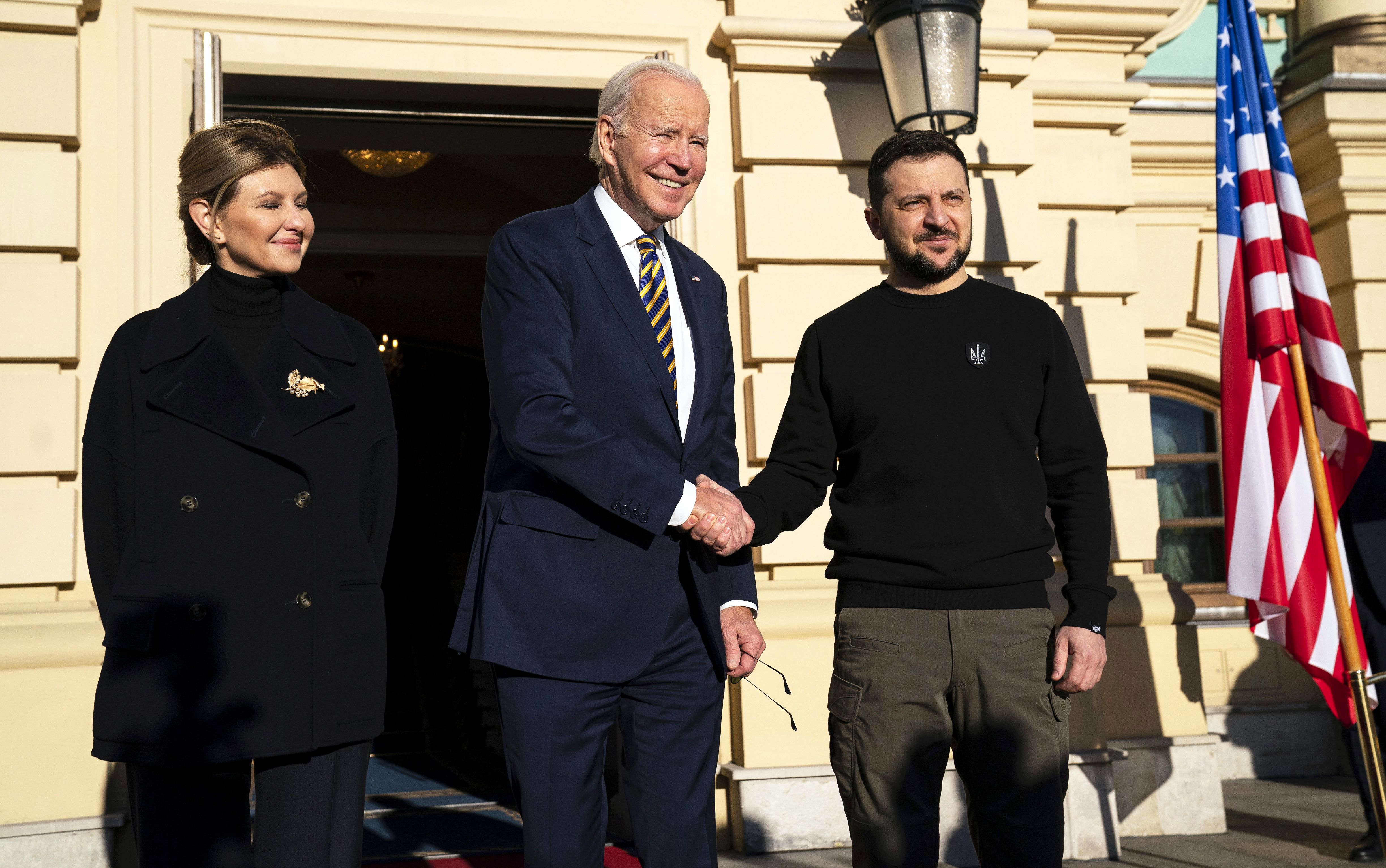
Olga Len and Mikhail Samus - about the symbolism of the visit of the US President

Olga Len and Mikhail Samus - about the symbolism of the visit of the US President
Vitaly Portnikov: On February 24, 2022, Russia launched a large-scale invasion of Ukrainian territory. A year after this event, US President Joseph Biden visited the Ukrainian capital. This visit became a symbol. It would seem that for a whole year Ukraine should not have existed as a sovereign state, or a puppet government should have been operating in its capital, which would have been supported by the bayonets of Russian troops. It would seem that most of the territory of Ukraine should have been occupied by Russian troops, and Ukraine would have become part of some new integration construct with the participation of Russia and Belarus. It would seem that the civilized world should have come to terms with this triumphant victory of Vladimir Putin and seek mutual understanding with the Russian president. But something completely different happened: the Russian blitzkrieg failed, the US President was in Kyiv, and earlier the Ukrainian capital was visited by the leaders of many other countries in the civilized world. Ukraine continues to fight Russian aggression and liberate its territories.
Of course, this is some simplification of the situation. Now they are talking about a possible new Russian offensive on Ukrainian positions, and they are expecting help from Western countries to Ukraine. The United States indicates that China can help Russia, even with lethal weapons. To what extent does Joseph Biden's visit demonstrate the collapse of Russian political plans? Let's talk about this with Ukrainian journalist and TV presenter Olga Len and military expert, Deputy Director for International Affairs of the Center for Army, Conversion and Disarmament Research Mikhail Samus .
Ukraine continues to fight Russian aggression and liberate its territories
Correspondent: On February 20, the US President made an unexpected visit to Kiev. To the sound of an air raid, Joe Biden and Ukrainian President Vladimir Zelensky honored the memory of the fallen defenders of Ukraine on St. Michael's Square.
Receiving the American leader at the Mariinsky Palace, Zelensky thanked him for his visit to the capital of the warring state, noting that all of Ukraine is proud of this event. According to Biden, “Putin’s war of conquest is heading towards defeat,” and the West will support the Ukrainians as long as necessary. The United States is providing Ukraine with a new package of military aid worth almost half a billion dollars. It will include , in particular, ammunition for HIMARS missile systems, anti-tank systems and air surveillance radars.
The Ukrainian authorities are counting on Western countries to supply not only modern tanks, infantry fighting vehicles and air and missile defense systems, but also military aircraft. F-16 fighters could be crucial for airspace control in the new expected large-scale Russian offensive and counter-offensive of the Ukrainian army. While Western countries are in no hurry to transfer fighters or other military aircraft to Ukraine, it is possible that Kyiv will be able to receive combat aircraft and helicopters from its allies after training Ukrainian pilots. Despite the obvious successes of the Ukrainian army over the past year - the liberation of previously Russian-occupied areas of the Kharkov region and part of the Kherson region, along with the largest city in this region - Russia still controls almost 20% of the territory of Ukraine and is now, as noted by NATO Secretary General Jens Stoltenberg, preparing to continue the war.
Vitaly Portnikov: This is the first time the US President is visiting a warring country whose airspace is not controlled by American aircraft. Protocol ceremonies to the sound of air raid sirens! These images will be shown for decades to come and mentioned in history books. Is this really a symbol?
Olga Len: Yes, it’s such a long way from the moment when the American embassy took down the flag a few days before the invasion and quickly evacuated from the territory of Ukraine, to the moment when, during an air raid, Joe Biden was in Ukraine after a 15-year break with the visit of the US President. Russian propaganda constantly says: Ukraine does not exist as a country. How can it not exist if the US President calmly comes to this country?
Vitaly Portnikov: For you, was this visit proof that Western military assistance will increase?
This is the first time a US president has visited a country at war whose airspace is not controlled by American aircraft.
Mikhail Samus: Of course, this is a powerful signal, which means that, despite any attempts by Russia and allies that it may still have... In particular, China is now going to play a hybrid operation, I feel that it will manifest itself more and more, China will demonstrate its readiness for peace, its readiness to represent the interests of Russia, and try to seem like a friend of Ukraine. In fact, what happened is a point in the conversation about whether the United States, NATO, and the European Union will support us until victory. From now on, Ukraine will definitely have this. The West says: we will support Ukraine until victory – not a diplomatic one, not just any victory, but a military victory.
Vitaly Portnikov: President Biden said in Kiev that Vladimir Putin miscalculated, made an obvious mistake when he launched this invasion. Biden talked to him several times before this war, tried to explain that this should not be done, but no one listened.
Olga Len: There are two points here that are now obvious, in my opinion, not only to us, but also to the Russian propagandists themselves. First of all, they were absolutely sure that everyone here was just waiting for the Russians to come: “there are no reliable state institutions, there are no internal connections, this country will fall apart as soon as Russian troops enter.” They expected that there would be some kind of mass flight of some, mass collaboration of others, no one would defend themselves. This is Russia’s confidence, formed over decades, that Ukraine exists simply because Russia allowed it to exist. And then it turns out that no, it’s just an absolutely self-sufficient country with a different people, with a different self-sufficient population.
The second point: none of them, even in a nightmare, could have thought that this time there would be no long attempt to understand what was happening - “not everything is so simple, let’s figure out who attacked whom.” In fact, all Russian propaganda on the eve of a large-scale invasion was based on creating a smoke screen. In our minds, the war began on February 24, and if you watched Russian TV, you would be surprised to learn that it all started, it turns out, on February 17 with some strange shelling (which did not happen), with the evacuation of Donetsk children and women, who for some reason were brought back to Donetsk a month later, as if it had become calmer there. And most importantly, mobilization was announced in Donetsk and Lugansk on February 19. So a lot was hinted at, and very strongly. They just had their own concept that it would take about two months for everyone to figure out what was happening, and during that time they would seize Ukraine. But what happened was completely different.
Vitaly Portnikov: Probably there was also a miscalculation related to the assessment of the level of the Ukrainian armed forces, or perhaps the expectation that the Ukrainian armed forces would simply join the Russian army? After all, Vladimir Putin openly proposed this to the Ukrainian military command in the first days of the war.
The West says: we will support Ukraine until victory – not diplomatic, but military
Mikhail Samus: It would be interesting to see the intelligence reports that were brought to Putin these days. This is a normal thing when in dictatorial regimes the dictator is told what he would like to hear, and not what is happening in reality. In my opinion, General Ivashov said about a week or two before February 24 that it would be a disaster. There was some kind of leak, in any case, Ivashov did not have anything for it, and this is very interesting, in Russian reality this means that some forces tried to convey this to the Kremlin. The FSB and the GRU told Putin that everything would be fine, that there were a lot of agents, a lot of money had been invested, Putin’s godfather reported: everything was fine, everyone was at the starting position, ready to take power into their hands. Or Putin didn’t want to know the real picture, he created his own reality in his imagination, and they played along with him.
And in your program literally a week, two before February 24, they said that yes, from a military point of view, Russia is ready to carry out this operation, but it will be a disaster. You cannot prepare 150 thousand people, abandon them and occupy such a huge country. Moreover, the Ukrainian army was already ready for this; in any case, they had been preparing for eight years; everyone understood that sooner or later this would happen.
Vitaly Portnikov: Why were these 150 thousand people perceived in the Kremlin as a force capable of occupying such a huge state?
Mikhail Samus: I think they were not preparing to fight. The very wording “special military operation” answered what Putin was actually planning. They thought that there would be a quick capture of Kyiv, landing operations were carried out, paratroopers were landing on airfields around Kyiv, key roads were captured, Yanukovych and puppets were brought in (I don’t know whether this is true or not), all this happened very quickly. And those troops that entered through the Chernigov, Sumy, and Kharkov regions were simply supposed to ensure order. There were a lot of Russian Guards there, and they were carrying shields, batons and everything else, that is, perhaps they were preparing to disperse some protests. Literally on the evening of February 24, Russian propaganda already declared: there is no Ukrainian army, some scattered pockets of resistance remain, there will be a parade on March 8, everything is ready.
And when the Ukrainian army began to fight really hard, the Russian troops were not ready for this, and it was a complete failure. The first week was critical. The fifth day was the most critical; near Moshchun there was a really large concentration of Russian and Ukrainian forces. It was practically a decisive battle, but then no one knew that such battles would even take place. They landed to the music of a waltz, filmed beautiful videos, until all this turned out to be a tragedy for them.
When the Ukrainian army began to fight really hard, the Russian troops were not ready for this, and it was a complete failure
Vitaly Portnikov: Did they draw conclusions in Russia? Do they understand that they have miscalculated, or do they not want to tell themselves that?
Olga Len: It seems to me that they don’t want to. The failure of the operation to seize Ukraine was the result of the self-deception that they actively developed in themselves over the previous eight years. That is, I would say, to a certain extent, this is a victory for Ukrainian propaganda. Russia has a concept that there are some kind of gangs of nationalists, there is an army - these are two different things. I think they came up with this concept in connection with how they captured Crimea. You will remember that, in principle, they did not fight there with the regular army, they withdrew it from there. In addition, they apparently expected the success of their agents inside the army, the National Guard, border troops, the SBU and so on, which is why Putin’s appeal and everything else was there.
Apparently, everything happened as always, that is, they wrote off money for a hundred thousand agents, but it turned out that there were only one thousand of them, and as a result, these people were unable to do anything to really change the situation. I think we will find out about this, just as we are learning now in certain regions where there was an element of obvious betrayal. There were such elements, but there was no general betrayal. Moreover, there was no general unwillingness to defend oneself. Look at the path Russian propaganda has taken during this time: it’s a very funny path from the phrases “Kyiv in three days” and “we are not at war with the Ukrainian people, we are at war with nationalists” to the fact that now they say that “all Ukrainians are bad, they are Russophobes, and we always knew about it.”
Vitaly Portnikov: Mikhail, I think after the war you will need to write a history of the Ukrainian army. After all, for many this army was just a job; people, in principle, did not imagine that they would fight, much less with Russia. Who should Ukraine fight with? Here is an eternally friendly Russia, here is a civilized world that is definitely not encroaching on Ukraine. But now it has become an army that has turned out to be a role model for many military men in many countries of the world; they learn from it and admire it. How could this happen? We remember: before 2014 it was a completely different army.

Mikhail Samus: The “Revolution of Dignity” played a very important role; it laid the foundation for this ideology of the new army. Volunteer battalions, and in general the concept of a volunteer attitude towards the army, is something completely different from what existed before 2014. And what we see now is, of course, the result of eight years of work at the front, at headquarters, and in ideology. And our partners helped us, including the Baltic countries, told us how to properly build volunteer territorial defense, and the Americans taught us what network-centric warfare is. When all this came together (thank God, we just managed to do it all!), it turned out that we could asymmetrically fight a huge army, the mere mention of which still makes some in Europe and the world shake in the stomach. How can you imagine fighting this army for a year? The Ukrainian army succeeded, of course, with the help of our allies and partners; resource-wise, of course, we would not have been able to withstand it, but ideologically and psychologically we survived, that’s true.
The “Revolution of Dignity” played a very important role and laid the foundation for the ideology of the new army
Vitaly Portnikov: However, President Biden and President Zelensky come out to a press conference, and Biden says that there are difficult days, months, years ahead, and Zelensky says that we really want to end the war in 2023 and win. These are two different attitudes: Biden sees some kind of long distance ahead of him, and Zelensky hopes that he will be able to solve all this in a shorter time. Of course, Ukrainian citizens would not want to fight for years. But how to get out of this situation, from these two different views on the future?
Olga Len: I think that somewhere these positions will converge. We want it faster, but the world doesn’t quite understand how it can coexist with Russia after it loses. At some point it will come together: our understanding of how dynamic it should be, and our understanding of the world. It’s just that we apparently need to talk more about what Russia should be like after the war. In the end, this is not the first time we have been developing Russia; apparently, this time we will have to show some kind of initiative in this regard. After all, it is clear that Russia cannot come out of the war in the form it is; it must come out in some other form.
Vitaly Portnikov: Is the Ukrainian army capable of quickly liberating those territories that are internationally recognized as Ukrainian, or is this still the long process that is being talked about in the West?
Mikhail Samus: It depends on the help that we constantly talk about. Now, for example, long-range missiles, which would allow the enemy’s logistics to be thrown back 150 kilometers, and not 100-70, as now, would change the configuration of the front. If we talk about the de-occupation of Crimea, then, of course, aviation would play a very important role in gaining air supremacy; without this, the process would be longer.