
Translated material
Help of a friend
The American president made a speech to the anniversary of the war in Ukraine in Poland - the old US ally in Europe. We explain whether this will reduce the EU pressure on Warsaw
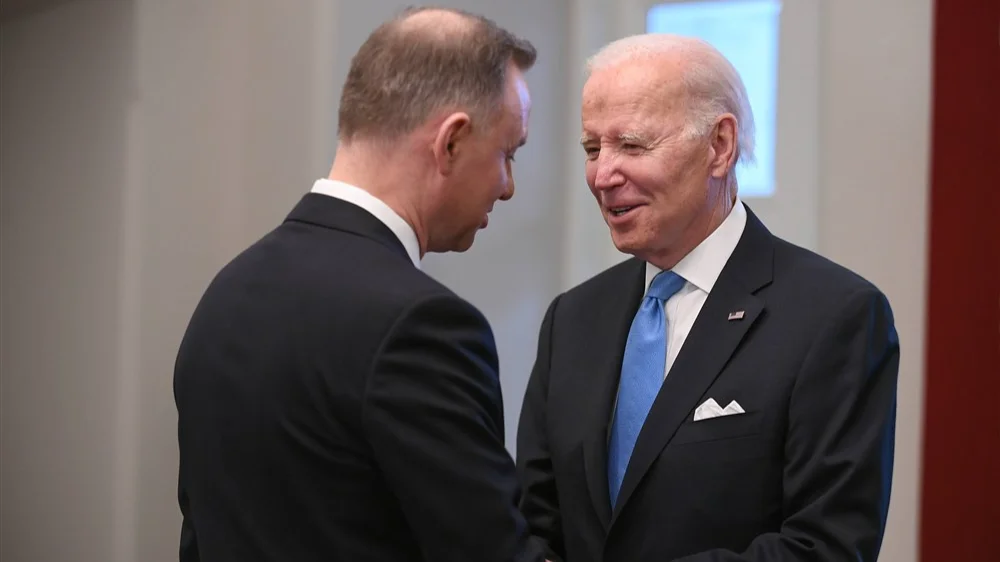
The world - immediately after Vladimir Putin’s appeal to the two chambers of the Russian parliament on the anniversary of a full -scale invasion - was waiting for the “response” speech of US President Joe Biden, in which his appeal to the Russians was announced. The appeal sounded, but Biden devoted much more words to Poland and its role in the confrontation of the Kremlin and the support of Ukraine.
Having made this historical speech for the year of the war in Europe from Warsaw, the American president recalled the special allied relations of the United States and Poland. The efforts of the Polish lobby in the States, American politicians such as Zbignev Brzezinsky and the constant aspirations of Warsaw itself to build Fort Trump, then the first country in the EU start the purchases of American liquefied gas - they really make Poland the EU country with “special” relations with Washington. How these relations help Warsaw in its confrontation with the European Commission, and why Poland seeks to become a new center of European military force within the framework of NATO-political scientist Denis Leven was specifically sorted out for New Evrop.
"God bless you"
On February 21, US President Joseph Biden made a 20-minute speech during his visit to Poland. This is Biden's second trip to Poland after the start of the invasion of Ukraine - the previous one took place in March 2022. It was announced that the speech of the American president will be devoted to how “the US has raped the whole world to support Ukraine,” and the representative of the US National Security Council John Kirby said that the president would turn to “Vladimir Putin and the Russian people”. However, in reality, a much more noticeable part of the speech was devoted to the gratitude of the Polish side and the Polish people.
“Poland accepts more than 1.5 million refugees from this war. God bless you. The generosity of Poland, your willingness to discover your hearts and your homes are unusual, ”and this is only one of the laudatory statements of the US president that sounded in Warsaw. In addition, Poland was chosen by Biden’s meeting place with the heads of Bucharest nine - an informal organization of the Eastern European countries, which includes Poland, Bulgaria, Czech Republic, Estonia, Hungary, Latvia, Lithuania, Romania and Slovakia.
Such a demonstration of allied relations of the United States and Poland looks unexpected, given the position of the Polish Republic in the European Union.
In recent years, especially before Russia's invasion of Ukraine, Poland has become for the EU if not a “sick person”, then certainly a problematic relative.
The right -conserving party “Law and Justice” located in power in the Republic adopted several resonant laws that contradict democratic and European values. First, a judicial reform was carried out, as a result of which the Polish courts actually lost independence. In response, the European Union blocked 35.4 billion euros, laid down for the republic in pan -European funds for restoring economies after a pandemic. Another conservative step of the Polish authorities was an almost complete ban on abortion in Poland in 2020. There was no response in the form of real measures to this from the EU, but the decision was convicted by the European Parliament.
All this, however, did not completely damage the relations of the United States and Poland, which develop regardless of the pan -European context. Based on the results of Biden, it became clear that Washington still distinguishes Poland as an extremely important US ally in the region.
Polish lobby
Despite the fact that modern Poland has existed a little over thirty years, the Polish lobby in American politics has been present for a long time. Back in 1944, an organization called the Polish American Congress was founded, which by 2023 has branches in 19 states. According to the organization’s website, it represents the interests of more than 10 million Americans of Polish origin. Although you need to understand that the Polish lobby is far from the only and not the most influential ethnic group in the United States. Among the much more influential lobby, Jewish, Cuban, Greek, Turkish and Armenian are distinguished . Nevertheless, the Polish lobby, along with the Mexican and Indian, is considered a “developing” lobbying group.
The Congress calls Poland’s entry into NATO in 1998. The organization began to apply efforts to this in the Union with the post-communist Polish government since the beginning of the 1990s-then the idea of expanding NATO was not yet popular, especially in the context of the need to maintain complacency with Russia. Nevertheless, with the help of regional branches, Congress was able to enlist the support of many senators and congressmen, and also deployed a public campaign. Then more than hundreds of thousands of calls, hundreds of thousands of paper and several thousand emails were received in the White House, calling for the adoption of Poland and other Eastern European countries to NATO.
The work of the Congress was also conducted during the Cold War, during which he gained influence and expanded the presence in the United States. The most noticeable actions of the organization include assistance in the post-war restoration of Poland, cooperation with the opposition anti-communist movement “Solidarity” in the 1980s and the supply of humanitarian aid to Poland during the crisis in the countries of the socialist camp.
In addition to lobbying organizations, politicians of Polish descent also acted in the United States, who tried to influence the construction of bilateral relations.
The most famous of them is Zbignnev Brzezinsky, an adviser to national security in the administration of President Carter and a popular internationalist. Some believe that it was he who achieved the support of "solidarity" by the American administration.
Against the background of such close ties with the states, which were largely established due to the large diaspora and lobbying groups, a very benevolent attitude towards the United States and their politics was established in Poland. So, in 2022, the vast majority of Polish citizens (91%) belonged to the States positively. For comparison, in the early 2020s, the corresponding indicator for the UK was only 51%, for France-50%, and for Germany-even 40%.
The faithful ally
The United States and Poland have strategic foreign policy reasons to maintain good relations, the main of which is the restraint of Russia. From the moment of joining NATO, Poland has in every possible way demonstrated its desire to strengthen a close alliance with the United States. The most noticeable episode was support from Poland by the American military campaign in Iraq in 2003. Risking their relations with Germany and France, which did not approve of invasions, on the eve of the entry into the European Union scheduled for 2004, Poland openly announced its consent in this matter with the United States and sent a military contingent to Iraq.
In addition, Poland became one and few NATO countries that fulfilled the alliance of military spending in the amount of 2% of the country's GDP. Poland, as well as Lithuania, Latvia, Estonia, Croatia and Slovakia, reached the required level after the annexation of Crimea in 2014. Such an increase allowed some analysts to predict the transformation of Poland into a new European military superpower. So, by 2035, Poland plans to double the number of military personnel up to 300 thousand people, which, for example, is almost twice as much as the number of the army of Germany. The United States, interested in the deterrence of Russia, support the aspirations of its ally and emphasize the willingness to expand cooperation within the framework of the US Polish strategic dialogue .
Poland, fearing the increasing authoritarian Russia, regularly advocated the expansion of the military presence of the United States and NATO and on its territory, once even proposing to create Fort Trump. This is the initiative of the Donald Trump administration, which was not implemented, involved the creation of a US military base on the territory of Poland, which would be located an American tank division.
The name “Fort” - was designed to recall the times of the war for the independence of the United States, in which the wrestler for Polish independence of the 18th century Tadeusz Kostyushko took part. The United States and NATO at the same time treated such initiatives traditionally carefully, fearing to provoke Russia. Therefore, these efforts of Poland were not very successful-the number of US troops and NATO in the country, of course, grew for the last ten years, but by the beginning of the war it reached only 4,500 people, which does not compare, for example, with the 35,000th US military presence in Germany. However, after the start of the Russian invasion of Ukraine, the number of US and NATO soldiers in Poland increased to 11,600 people, amounting to almost 10% of the number of Armed Forces of Poland.
Finally, Poland in every possible way demonstrated the willingness to cooperate with the United States and in the economic sphere: in 2016, she opened her first regal terminal and began the purchase of liquefied natural gas in the United States. This decision was of important symbolic meaning. Firstly, Poland has begun diversification of electricity supplies in order to reduce dependence on Russia. Secondly, it was once again indicated to strategic partnership with the United States. And thirdly, this step was taken against the background of the construction of the Northern Stream-2, which was supported by Germany and other European countries.
New Center for Power
Since the beginning of the war, Poland has become one of the main suppliers of military and humanitarian assistance to Ukraine and a supporter of a more active expansion of weapons. The most stringent position on the issue of sanctions against Russia and almost the largest decisiveness among Europeans in the supply of military equipment pushed Brussels claim to Warsaw to the background. Attempts to return Poland to the vector of democracy and the supremacy of law continue , but sound much less loudly than before Russia's invasion of Ukraine.
By the outcome of the first year of the war, it was important for the Biden administration to support its main strategic ally in Eastern Europe - this explains such a wide symbolic gesture. At the same time, the February visit and speech of Biden were carried out by the presidential administration formed by the Democratic Party, although the Polish lobby in the United States mainly relies on the Republicans. An unprecedented party consensus by the standards of the States emphasizes the priority of the Union with Warsaw for Washington.
Such support of America adds points to Poland in the confrontation with the European Commission. The fact that Warsaw has close and special relations with the main ally of Europe significantly reduces the possibility of Brussels to put pressure on Poland in an effort to overtake authoritarian and conservative trends.
In addition to this, the army growing against other European countries and a strategic union with the United States can make Poland a new center of military force within the framework of NATO, which will strengthen the country's position in the EU. When implementing such a scenario, the European Commission attempt to put pressure on Poland with its new role as the driver of rearmament and strengthening of Europe in military terms will become completely ineffective.