
Translated material
Are there any changes at the front?
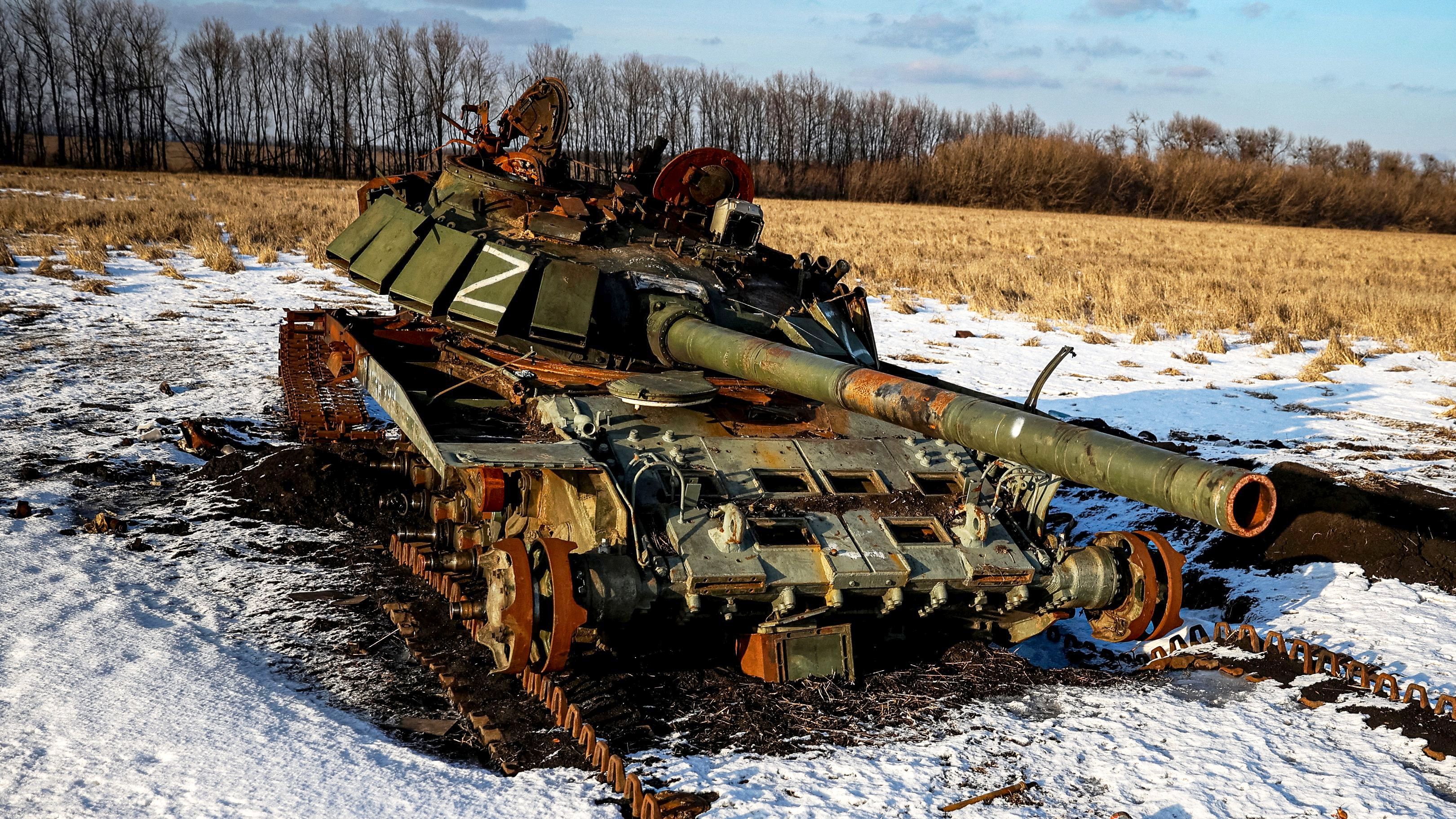
On the air - military experts Mikhail Samus, Sergey Grabsky and political analyst Nikolai Petrov. How is the situation at the front of the Russian-Ukrainian war by the beginning of the spring of 2023.
Video version of the program
Mikhail Sokolov: To begin with, we will begin to figure out how today the situation at the front of the Russian-Ukrainian war is taking shape. Let's look at her plots.

Width PX Height PX
The url has been copied to your clipboard
No Media Source Currently Available
0:00 0:04:42Mikhail Sokolov: Mikhail, what is your assessment of the current situation? I understand that Prigogine is busy with propaganda. Indeed, does this area continue to be under the threat of the environment, is it necessary to withdraw troops, as some are talking about now?
Mikhail Samus: Firstly, you need to decide on terminology. During your report, the word "strategic", the cutting of communications, logistics of Ukraine, was heard several times. Strategic is what affects the national level. When we talk about Bakhmut, this is a tactical level of the maximum. A month ago, we discussed a large -scale offensive of the Russian army, meaning a truly operational level and even strategic. At the moment, all these conversations have focused on one point on the map, from the entire front of about two thousand kilometers we are now talking about a point on the map, which has several tens of kilometers maximum. Indeed, it is important for Ukraine, like every city in Ukraine, a settlement, Ukrainians live there, of course, the Ukrainian army will do the maximum that is possible in this situation. On the other hand, from a military point of view, it is really a convenient defensive fortress, as we call it, where the conditions are created for the maximum disposal of manpower and armored vehicles of the enemy. How many Russian military and "Wagnerians" have already died there, it is difficult to calculate how many equipment was destroyed there, and all this is because of this point on the map. If the Russian army manages to take this city, nothing will change from the point of view of the tactical situation, the Ukrainian army will depart in pre -prepared borders and the same thing will begin in a couple of kilometers. There is another settlement for which the battle will last several weeks or months. If we say that the Russian army is only capable of this, then I think that Putin is time to stop the war. Because if you beat for several months for one settlement, with the efforts of the whole of Russia, the Wagnerians, Prigozhin shoots films - this is also worth the money, I think it is time to stop this war, withdraw troops and think about how to record losses. If he expects to somehow turn the course of this war-this is definitely not the same method.
In addition, let's not forget that in a few weeks the Ukrainian army will be ready to conduct its offensive operations, which will have a slightly different nature. In addition, I would like to pay attention to another feature, another trend. While the Russian army reduces its actions to a point on the map, the Ukrainian army expands its impact as much as possible. Indeed, the Ukrainian army now affects several thousand kilometers, if we take the Machuli, where drones and forces of special operations, military intelligence worked, there is work at various points in Russia, there is work on Crimea. If you look at which territory all this is formed - this is the operational level, that is, these are several operational areas, unlike the point on the Bakhmut map, which is actually formed mainly in the information field. That is, this is all information work, and not really a military situation.
Mikhail Sokolov: It is completely incomprehensible why concentration goes on one site. At the same time, Ukrainian intelligence officers noted that Bakhmut fulfilled his main mission - he tore off the winter offensive of the Russian troops. Is it really so?
Sergey Grabsky: Yes, absolutely. We can already boldly talk about this, because the level of losses that the Russian invaders suffered precisely that they, fulfilling the political order, were recalculated on one location, like a bulldog that clings to someone’s throat, even if there is no need for this. We can safely say that Bakhmut has fulfilled his task today, the enemy lost the pace that he would like to ensure for the offensive in other areas. In fact, we will now observe the continuation of the inertia of desperate battles in the Bakhmut direction, where the enemy presses very strongly, and a slight attenuation or inertiality in other directions. If we talk about Ugro, there is generally a complete defeat of the enemy.
Mikhail Sokolov: What happened there?
Sergei Grabsky: An absolutely obvious thing happened in the Ugledarian direction, that is, it once again proves our assumptions that the enemy is not learning, they threw fresh units into battle, which were not even informed about the nature of the fighting in this direction, that is, they acted exclusively according to the template. The formation of the column, the column is put forward to the sections that were actually mined, the first and last tank was destroyed, then the attempts were advancement, bypass, the demolition in minefields, the artillery was still destroyed from afar, the column was destroyed behind the column. Not even according to Ukrainian estimates, more than a hundred units of equipment in three weeks have been destroyed.
Mikhail Sokolov: There is also a Svatovo - Kremennaya area, write that the usual situation of a long winter confrontation with artillery duels in anticipation of the offensive.
Sergey Grabsky: Absolutely. There are now such combat operations in format who, oncoming battles, are moving around somewhere, somewhere Ukrainian troops are moving. It is mainly about battles in the so -called Kremensky forest, where the enemy is trying to advance, short skirmishes are in the rest of the areas. Attempts of movement there are still carried out. If you compare this with the Southern Front, then activity on the Eastern Front is an order of magnitude higher.
Mikhail Sokolov: A picture of such a protracted war is visible, standing in the middle of winter, several points where there is a heavy struggle. What is the British and European reaction to these events, what comments dominate that you are striking now?
Nikolai Petrov: First of all, I am not a military expert, so I have acted more from a political point of view. It seems to me that it would be too early and too optimistic to judge now that the Russian offensive has already choked, nothing will happen then. The fact that Bakhmut really grinds strength, probably forces on both directions, is a very important and significant thing, more significant, probably, than that position that Bakhmut occupies on the map. Here, really, one cannot but agree that no strategic significance, even if Ukrainian troops are forced to move away from there, does not have a common picture.
I would recall the only thing that it sounded from American experts that it was necessary to evaluate costs and results, it is quite possible that the Bakhmut will have to be left, because war is not only the struggle for the territory, but also the struggle for people. Ukrainians, military, not military, they are no less important than the territory that, now, say, Wagner will be able to take huge victims at the cost of tremendous efforts. What will happen next, let's see how the events will develop. So far, it seems to me that it is too early to draw conclusions regarding the offensive on one or the other.
Mikhail Sokolov: Last week, they write, was the last when the Russian and Ukrainian army could move in a large -scale offensive within the framework of the winter campaign. Ahead of the thaw, other joys that do not contribute to offensive. Is such a forecast fair?
Mikhail Samus: Again, any weather conditions have a limited effect. Yes, it is possible that in some areas or to some extent this may complicate, for example, the attack of the same Russian troops near Bakhmut or in other territories, or, for example, from the territory of Belarus. This is talked about for a very long time, new versions are now appearing again, that now Putin will still decide on the next wave of mobilization, will create a group by May. Although it was said about this since November that he would create somewhere in February, but did not create. Again, the forecasts that Putin’s new efforts will be on May 9, I think that this really means the assumption that Putin tried to fulfill the main task-to occupy the Donetsk and Lugansk regions by this period of the Rasputer, only then to try to somehow not allow the Ukrainian offensive, which is also talked about, to try to play some new campaign, new operations to invent, and so on.
Although my hypothesis is the main thing that Putin can now occupy the Donetsk and Luhansk region, he will try to record losses and freeze the conflict, that is, trying to somehow freeze, sending signals both through China and directly to the United States, Europe and so on, I am ready for negotiations, I need symbolic concessions from Ukraine, I am ready to stop this war. This is, in principle, this is not the first time this happens. But Putin symbolically fundamentally occupy the whole Donbass so that it can be presented as his victory. That is, he can easily declare that I really had in mind this, the goals of the "special military operation" - it is to help the people of the Donbass in the fight against the Nazis, and everything else was methods for achieving this task. In principle, he repeated this. Therefore, such an atmosphere, I think that at the moment Russia really ends the offensive impetus, reserves for offensive groups have not been prepared, which is visible both in Russia and in Belarus. Everything goes to the fact that Russia will try to freeze the situation. The Ukrainian army, of course, has its own plans for this.
Mikhail Sokolov: Sergey, how do you see the future prospect in connection with such a forecast?
Sergey Grabsky: I can fully support Mikhail. I keep a ponomerly record of who fights where: none of the newly created brigades was transferred to the war zone from the word "completely." Now the preparation of our units in Poland, in the UK, in Germany, Spain, these brigades will be advanced to perform specific tasks. In addition, of course, time plays in Ukraine, because, as Mikhail said, the enemy will try to freeze this conflict, that is, his offensive potential is quite limited. He did not declare the mobilization that we, honestly, expected somewhere in the area of January 10-15, so the time was missed objectively. Now we are waiting for the exposure of actions from the Ukrainian side. Of course, now some desperate actions will continue, attempts to break through somewhere, take something. I can’t definitely say that the Bakhmut will not be left, but this will not change the situation. Spring will show. The spring thaw, even if it somehow indirectly can affect the actions of the opposing forces, then according to the schedules, this was even declared by the political leadership of Ukraine, Ukraine is in no hurry, the offensive is assumed no earlier than the second half of spring, when weather conditions will not be so much affected by warfare. The situation develops in this way, as they say, everything is according to plan.
Mikhail Sokolov: When they talk about freezing, are there any conditions for this? As far as I understand, in the West they are clearly not ready for some negotiations, for some transactions with Vladimir Putin?
Nikolai Petrov: I think that yes and no. It seems to me that the strategy of both the Ukrainian and the Russian side today, if we talk about real tasks, not so much radically change everything as to achieve the most strong position with further, if they are begun, negotiations regarding the termination of the conflict for some time. It is clear that time works for Ukrainian forces from the point of view of their equipment and preparation of fighters. The question is whether this additive is enough in order to radically change the situation. In this regard, it must be understood that Russian troops spend time not only on barren attempts to take Bakhmut, but also on strengthening the line that they have to protect. The Ukrainian troops during the counterattack will have to go against a sufficiently prepared defense. In this regard, it is difficult to predict that the situation will radically change. As for the position of the West, the West is not as absolutely one, homogeneous. We see that in the United States there is only one picture, there are more public opinion, politicians, especially republican politicians, they have good chances in the next presidential election to bring their candidate to the authorities, they are more likely to think about the fact that if all those efforts are enormous, those victims that are brought primarily by Ukraine, but also by Western countries, too, do not make some serious success on the temporary prospect, which we are wearing that we are in the temporary prospect, which we are wearing that temporary prospects, which we are We observe, one way or another we must think about changing tactics. The fact that you can’t talk with Putin is one for some moral reasons, but this acquires a completely different look, if we talk about a change in the position of the West, the position of the United States regarding the tactics that has been used so far. Let's hope that the Ukrainian offensive will give a very serious impulse and can change this attitude. But today there is so much and it depends that by its results it will be clear what position the West will take in the future.
Mikhail Sokolov: As far as I understand, 10-minute contact of the Secretary of State Blinken with Sergey Lavrov in India-is this still anything? On the contrary, confirmation of the position that the line is not changing.
Nikolai Petrov: I think yes. But we see this position on both sides. We can say that the Kremlin throws some fishing rods regarding possible negotiations. But the Kremlin, like Kyiv, believes that it can achieve a stronger position for itself if these negotiations begin.
Mikhail Sokolov: It seems that massive attacks on Ukrainian energy infrastructure are limited. What actually happened? Opportunities are exhausted, did this operation fail or something else?
Mikhail Samus: Indeed, we remember September last year, when the so -called General “Armageddon” came, apparently, with his concept, I don’t know who gave birth to this concept, but Putin apparently liked it. Along with the fact that mobilization began, Russia decided that the attacks on the energy infrastructure will lead to a collapse of the economic system, the collapse of the general way of life in Ukraine, hello again to the humanitarian crisis, the next stream of refugees, and the Ukrainians will demolish Zelensky. The idea was: to freeze the Ukrainians in the winter in order to arise a humanitarian catastrophe, the genocide to actually organize with the help of General Moroz, as they said, to put Ukraine on the knees somewhere in February, so that it remains still alive if the Ukrainians do not strangle him from the cold, or someone else will simply ask for negotiations, Putin will be condescended, offer his conditions. Against this background, of course, Europe will freeze, the winter will be large - these are these songs. In all this, both Putin and part of the team believed him, in this concept. What do we have now? Nothing in principle. Ukraine withstood, adapted. Yes, a significant part of the energy infrastructure has been destroyed, but now there is no deficit in the energy structure, the distribution is carried out quite efficiently, that is, there are no critical disconnections. In Europe, the most interesting, no collapse, disaster, apocalypse did not happen. Yes, I am also really surprised, I can imagine how Putin is surprised that Europe, it turns out, calmly refused oil, gas, oil products of Russia, because the embargo was actually introduced only in February, we know what consequences for Russia all this means, the budget deficit reaches in some sectors twice, in some more, in some more. And this is only the beginning. Why Putin and his group of people who around him will try to frozen the conflict, because we just forecast only a military situation or military-political, and if you look at the economic situation, it is not Ukraine with the West that is now on the edge of the abyss, namely, Russia is in a very interesting position, when in six months the budget can change its structure very strongly and very strongly change its fullness, including And socio-economic programs, I'm not talking about the construction of roads. If we take the fact that it will be necessary to build missiles, now information is being information that they are trying to do some projects along with Iran, including the production of ballistic missiles, this is not cheap. I do not think that Iran will do this for free, even if it gets any aircraft on Barter, it will still be expensive. Therefore, this complex of problems can actually change the situation very much, really make Putin think about freezing. Есть вариант так называемой бесконечной войны, есть заморозка, а есть бесконечная война, когда ни одна из сторон не может достичь какого-то перелома, но при этом время от времени пытаются эскалировать и достигать каких-то успехов. В принципе и второй, и первый вариант для Путина теоретически допустим, но в условиях, если Путин будет продолжать ужесточать свою диктатуру, переходить к очень жестким порядкам в России, именно в жесткой диктатуре, когда все будет поставлено под контроль, в том числе будут очень жестко менять экономические правила игры, я думаю, такой вариант сейчас приемлем для Путина вообще.
Михаил Соколов: Уже сказали о провале этой операции. Зачем Россия стянула сотни самолетов в приграничные территории?
Сергей Грабский: Этот жест восприняли абсолютно спокойно. Потому что этого количества самолетов было бы явно недостаточно для проведения каких-то операций, так и произошло. Мы так и не наблюдали в течение последних двух месяцев какой-то массированной воздушной операции против Украины. То количество самолетов нужно просто размазать на почти две тысячи километров линии фронта. Таким образом 400 самолетов и 300 вертолетов оказываются просто недостаточными, это не та группировка, которая может представлять какую-то серьезную угрозу. Тем более Россия никогда в своей истории не проводила массированные воздушные операции, они просто не умеют этого делать. Собрали самолеты, безусловно, хотели где-то использовать, но кроме тактических ударов мы ничего не наблюдали. Причем самолеты терялись с завидной регулярностью. Поэтому интенсивность использования авиации была достаточно условная с самого начала.
Poll on the streets of Moscow