
Translated material
Central Bank bathes in rubles
In the Russian economy, the amount of money has grown sharply. Everything, the authorities "turned on the printing machine", is it time to wait for the leap of inflation?
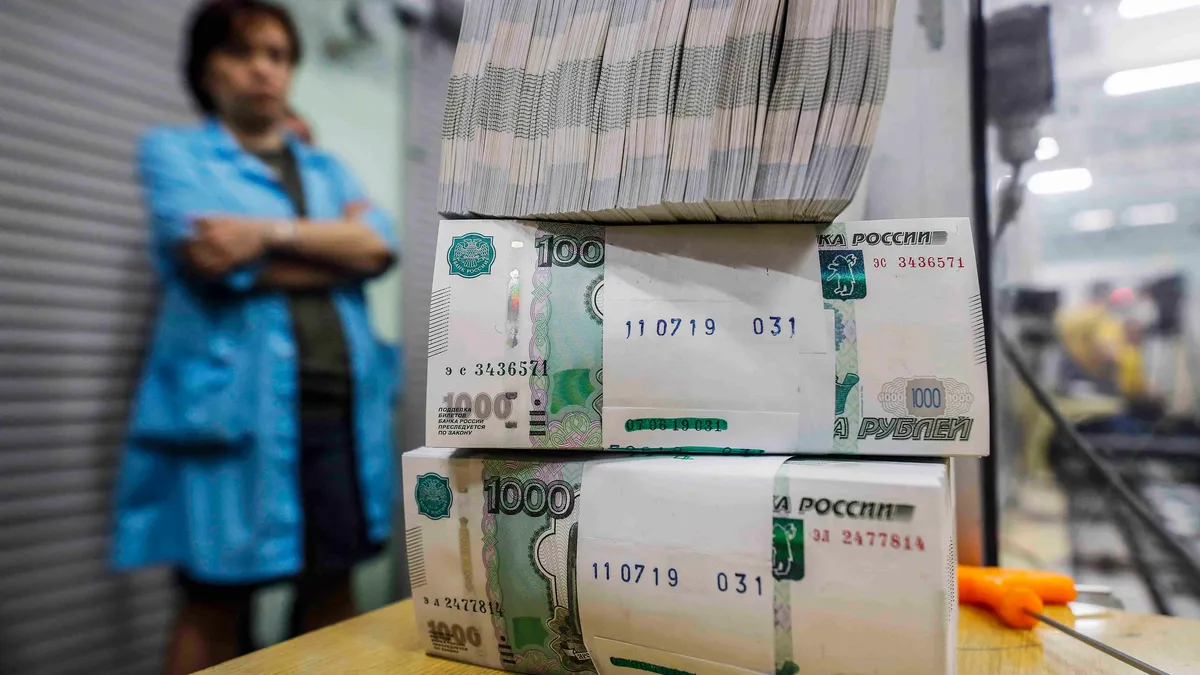
In February, the Central Bank of Russia reported that the amount of money in the economy increased by 25%per year. The amount of money in the economy can be measured in different ways, and depending on the question that the economist is trying to answer, it makes sense to take into account different indicators. However, in February 2023, the main indicators, the “ monetary units ” M1 and M2, both grew by the same 25%. Will this lead to acceleration of inflation in 2023? This is a difficult question. However, more often one has to hear another question: "Did the Central Bank begin to print money?"
"Printing of money" is an outdated metaphor
Once upon a time, in the words “printing of money” there was a simple meaning. Decades ago, the money was necessarily tied to something-for example, to the amount of gold stored in the cellars of the government. “Printing money” meant “refuse to bind”. This gave, on the one hand, the opportunity for the government to spend more than it earned, and on the other hand, led to inflation. Because when there is more money, and there are as many goods remain, prices should grow.
Now the government affects the amount of money through many different channels - and any of them separately can be called "printing money." Most of all, the following process would be like the “printing of money”. The Ministry of Finance issues new debt obligations, and the Central Bank buys them. The Ministry of Finance has new rubles that he adds to the money in the economy, paying for the state order, paying salaries to civil servants, etc.
This could be called "printing money" if this had not been accompanied by any other actions. If the Central Bank is doing something else (for example, sells currency to banks for the same amount that the Ministry of Finance paid), then no change in the amount of money does not happen at all. This will not be “printing of money”, but “expenditure of foreign exchange reserves”.
What has changed in the economy as a whole? The Central Bank has fewer currency reserves, and the Ministry of Finance bought goods and received civil servants. The number of rubles remains unchanged.
The National Welfare Fund was, while there were currency reserves, the “stag”, which was in the currency. Formally, it is counted in rubles, but the government cannot be in principle, it decides how much to draw rubles. The Central Bank does not store any rubles and cannot store them-we can assume that when he buys something, he draws new money, and when he sells something by rubles, he simply burns them.
Due to the war of foreign exchange reserves, the Central Bank has few. 300-350 billion dollars set in the “well -fed” years are blocked by the USA, EU, Great Britain and other issuers of the most reliable world currencies. But while the Chinese yuan remains, there is the opportunity to spend money without affecting the amount of rubles and, therefore, on inflation. The lack of foreign exchange reserves, of course, makes the Russian economy extremely vulnerable to possible external shocks - what if there is a recession in China or the USA? - But, as they say, having removed their heads, they do not cry through the hair.
Once again: if the Central Bank simply bought debt obligations from the Ministry of Finance, and the Ministry of Finance spent rubles, this is “printing of money”. And if he did something else-for example, he sold reserves or raised a key rate-then no.
In other words, in order to say that the Central Bank “printed money”, you need to look at all the measures of monetary policy.
The Central Bank can influence the amount of money in the economy in different ways. You can reduce or increase the interest rate on short -term loans. You can change the reserve requirements for banks: if the bank is forced to postpone an additional share of deposits to the account of the Central Bank, this reduces the amount of money in the economy. And vice versa - if you reduce the requirements for reservation, it increases. The Central Bank can simply buy some financial assets, promotions or bonds in the market, “releasing” new money in this way.
Finally, not only the Central Bank affects the amount of money. Other government bodies can also influence him. For 2023, a budget deficit of 2% of GDP is planned-expenses that are higher than income will need to be somehow financed. The fact that a budget deficit is planned affects the prospects of inflation. If in parallel to an increase in the deficit, which is financed by borrowing from the Central Bank, the Central Bank increases the key rate or sells currency, then it fights inflation. But if the Central Bank does not take “response” measures, then the budget deficit is “printing of money”.
To complete the picture, it should be noted that government bodies affect the amount of money in the economy, but do not determine it. Say, if entrepreneurs look at the prospects of the business pessimistic, they do not take loans - and this is an obstacle to an increase in the amount of money in the economy.
The Central Bank can reduce the rate to zero, then start buying assets, but if other factors interfere with business activity, the amount of money will grow slowly.
In the other direction - in the direction of reducing the amount of money - it is difficult to influence for a different reason. Of course, the Central Bank can stop the rise in prices at any time, but this probably will have such a high price in the form of a stop of enterprises and layoffs, which cannot be stopped.
What is worth following
If no specific action of the Central Bank can be called “printing of money”, then what should you follow? How to find out if the Central Bank has moved to a less conservative, more risky policy in an intensifying crisis?
In 2022, the Russian GDP did not formally fall strongly, by 2-3%, but other indicators indicate a significant drop in the standard of living (the same story was in the years that preceded the collapse of the Soviet economy in 1991: even the Muscovites were already in lines for bread and eggs, sugar, alcohol and tobacco were on coupons, and the official GDP was still growing). What reflects growing difficulties in the actions of the Central Bank?
It is necessary to follow the same thing that the Russian Central Bank is watching and the inflation. In normal times, observers - both internal and external - can rely on models connecting changes in cash indicators and the following inflation. The growth of the money supply (M1, M2 aggregators) by 25%, as in the last year, would lead to a jump in inflation, without a doubt.
But the models that economists use are poorly working at the moment when the economy goes through a transformation as the Russian economy now. The coefficients of these models, if anyone is interested in technical details, are calibrated not in terms of indicators similar to the current ones, but according to the previous years, when economic relations were qualitatively different. It is possible that inflation in 2023 will decrease: the fall in production and, moreover, the fall of incomes of the population, the effect of deflational itself.
So the Russian Central Bank in 2023 will learn about the consequences of its policy in the same way as the public - in real time.
Now they are looking at the results of surveys of the population and businessmen about “inflation expectations” (they are high, 12–13%) and are afraid to reduce the key rate.
If you look at the increase in the money supply, then it will have to be raised at all. Or to change the target indicators for inflation, which is also possible - from the beginning of the full -scale Russian aggression of the Central Bank subordinates all its actions to the needs of the government conducting hostilities (the target indicator for inflation was chosen, at least in theory, in the interests of the Russian economy and citizens).
Ultimately, the Central Bank will have to “finance” any expenses for which there will not be enough income. Inflation will be high. And when it will be high, economists will finally not go into difficult explanations of what modern money is, but calmly and briefly answer: "Yes, the Central Bank began to print money."