
Original Material
Will the war in Ukraine end in year two?
Halting Russia’s invasion before 2024 is possible, but only if the West learns to be bolder and more decisive
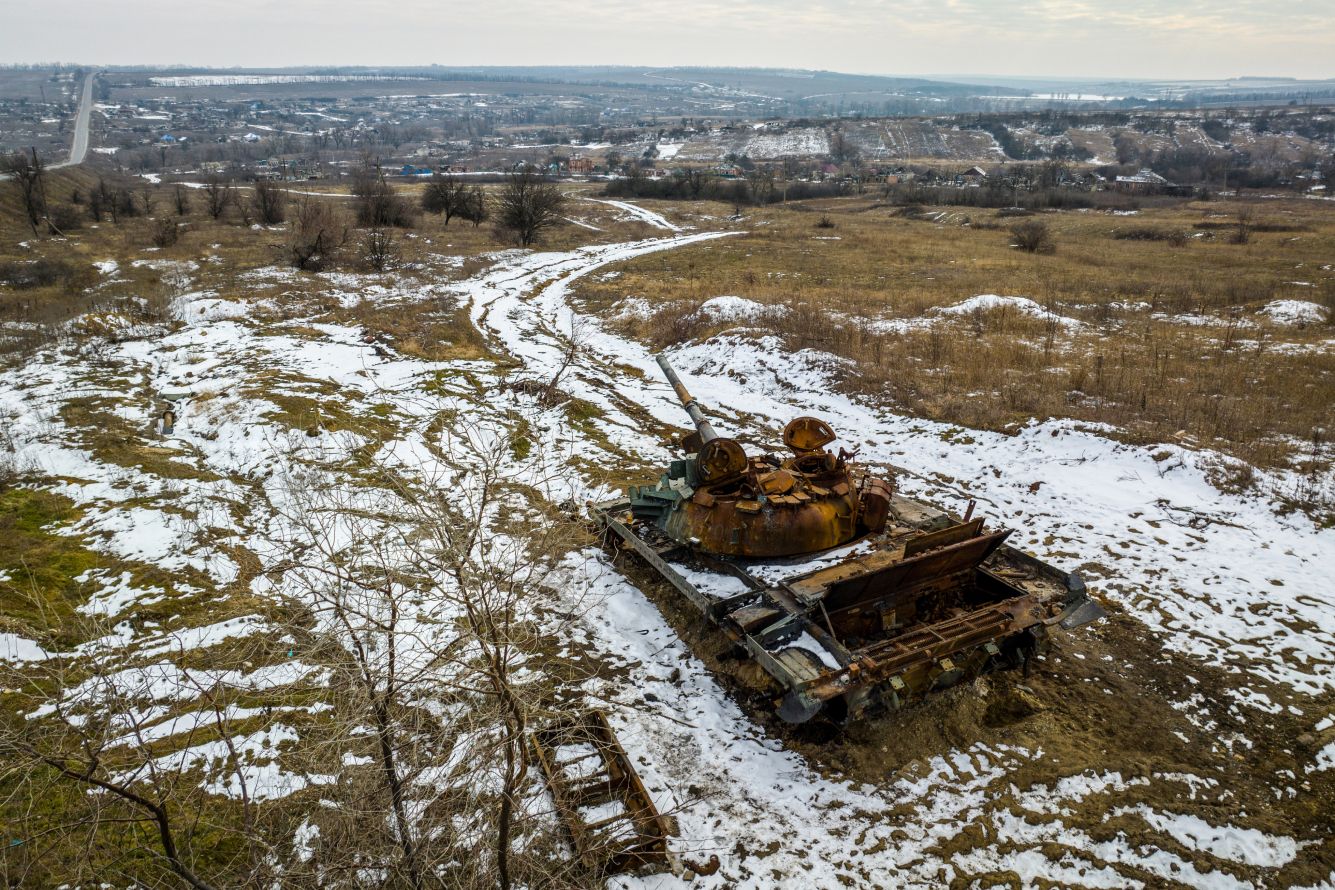
Russia’s full-scale invasion of Ukraine is now a protracted war that looks likely to devolve into a stalemate. Given what we know about the conflict’s combat dynamics and force structure, however, it’s unclear if either side would ever admit to being stuck. A definitive military victory looks just as unlikely for Ukraine as for Russia, but ending the war with a relative sense of success is far more probable for Kyiv and its Western partners, though it remains hypothetically possible for Moscow. Meduza explains why this is the case.
Defining victory
Ukraine’s Western partners continue to play a significant role in this conflict. While siding with Ukraine’s military interests, they also bring to the table their own ideas about preferable outcomes of the war. These objectives don’t always coincide with Kyiv’s vision, but in its dependence on the West, Ukraine cannot but take them into account. Without ongoing powerful infusions of military aid in the coming months and years, Ukraine won’t be able to avail itself of the needed equipment and ammunition.
Russia’s nebulous goals
Before the Russian army was defeated outside Kyiv, Vladimir Putin’s speeches brimmed with confidence about Ukraine’s imminent capitulation. But since March 2022, Russia’s military goals have been vague. In the absence of any clear statement of goals from the Kremlin itself, here are the plausible objectives that can be surmised on its behalf:
- Between the time of its withdrawal from the Kyiv region and fall 2022, Russia’s only distinct ambition was to “liberate the Donbas,” which likely meant advancing all the way to the borders of the Donetsk and Luhansk regions.
- Russia’s second plausible goal is to maintain the Donbas–Crimea corridor across the Kherson and Zaporizhzhia regions.
- After the phony annexation “referendums” in several southeastern regions of Ukraine, controlling those regions became another likely aim of this war. Letting go of what’s now considered Russian territory would require nothing less than a revision of the Constitution and would be tantamount to defeat. Meanwhile, on February 21, 2023, Putin told the Federal Assembly Russia will never entertain defeat, let alone accept it.
- Putin’s Security Council deputy, Dmitry Medvedev, has made clear that Russia will use any weapons at its disposal if needed to forestall a “strategic defeat,” possibly including even its nuclear arsenal.
What remains unclear, though, is to what extent the Kremlin might be committed to defending the Kherson and Zaporizhzhia regions. In this regard, Moscow might be, in fact, prepared to show some flexibility. With respect to the Donbas, however, all flexibility was forfeited just before the invasion, when, after a brief hesitancy, the Russian government recognized the independence of the Donetsk and Luhansk “republics” within their proclaimed 2014 borders (identical with the borders of Ukraine’s Donetsk and Luhansk regions).
In reality, achieving “victory” (even in some limited sense) would still be a defeat for the Kremlin. After the war, Russia will inhabit a world far more hostile than the one it knew before the invasion:
- The basis of Russia’s wealth in energy exports has crumbled.
- The Russian army has revealed its weaknesses.
- Ukraine has moved closer to the West, both in political and military terms.
- Russia, meanwhile, has acquired an unresolved military conflict with an extremely hostile state across a shared border.
Even gaining four Ukrainian regions and a corridor to Crimea, while hypothetically achievable, would hardly offset these political and economic losses.
A partial “victory” along these lines is Russia’s best hope of cutting its losses in the coming months and years. Even a qualified win, however, may be a distant and fraught prospect. The Russian army has proved that it can force Ukrainian defenders out of urban agglomerations, albeit slowly and with losses so significant that it must mobilize reinforcements from the general population.
The first chapter of this kind of drawn-out gradual displacement of the Ukrainian formations (from Sievierodonetsk, Lysychansk, most of the Luhansk region, and Lyman) ended when Russian forces were turned back outside Kharkiv and Kherson. Judging by its tempo and the recorded losses, the second chapter of Russia’s Donbas offensive differs little from the first.
Russia’s unconditional victory (the Ukrainian military’s complete defeat) is possible only if either Kyiv or its Western partners decide to abandon all resistance, but both Ukraine and the West remain committed to winning the war in some form, even if they understand victory somewhat differently
What Kyiv wants
After the Russian army withdrew from the Kyiv region in late March 2022, the Ukrainian authorities came to a consolidated view of how they understand victory: it means fully restoring Ukraine’s sovereignty over all of its territory as of 1991, including the Donbas and the Crimean Peninsula. At first, there were some doubts about Crimea and whether it should be returned by force or negotiations. Later, an influx of Western weapons helped the authorities in Kyiv reach a consensus: Ukraine would retake Crimea through military force. The Ukrainian army’s combat successes have also reinforced this maximalist ambition.
Ukraine’s successes on the battlefield don’t promise an easy victory, of course, but the course of the war has emboldened Kyiv’s hopes of liberating all of its internationally recognized territory. This precludes peace talks based on territorial concessions from Ukraine.
The view from the West
Rhetorically, the West expresses solidarity with Kyiv and endorses the expectation that Ukraine’s territorial integrity will be restored in full. But different politicians understand the specific mechanisms for achieving this goal differently. The one apparent area of consensus is that Putin shouldn’t be allowed to win, and that he must be held responsible for starting a war of aggression (as a warning to other dictators). The Western coalition (chiefly the United States) also views denying victory to the Kremlin as a condition for maintaining the West’s global influence.
Preventing Moscow from reaping any rewards from the invasion means that the West’s minimal condition for peace is that the Russian army must retreat behind the February 2022 “line of contact.” In this scenario, the return of Crimea and parts of the Donbas occupied earlier could be addressed through talks. This is how both London and Washington framed their objectives in late 2022, following Kyiv’s fall counteroffensive.
“Punishing” the Kremlin more radically runs against the grain of the West’s (chiefly the United States’) strategy of non-escalation. The Western coalition supporting Ukraine has tried, from the invasion’s very start, to keep tensions under control. The U.S. and NATO seek to escalate only in response to the Kremlin’s aggressive initiatives. After the mobilization and the formal annexation of four Ukrainian regions, for example, the coalition abruptly increased the volume of aid to Ukraine, also expanding the range of supplies being sent.
If unprovoked, the West has no desire to keep climbing the escalation ladder, believing this could lead to uncontrollable developments. At the same time, NATO seems less concerned about hints and explicit threats of nuclear war (from the likes of President Putin and National Security Council Deputy Chairman Dmitry Medvedev, respectively) and more worried about the conflict expanding beyond Ukraine’s borders. For example, if Moscow is confronted with imminent defeat, there are fears that Russia might strike at the East European NATO bases that supply Ukraine, effectively bringing the world to the brink of nuclear war and forcing the West into direct talks with Russia.
Washington has likely made clear to Ukraine that military aid would be reduced if Kyiv were to embark on recovering lost territories beyond the prewar contact line. The expectation is that any initiative to recover Crimea or the entire Donbas needs the approval of Ukraine’s partners in the West.
The result: drawn-out warfare
A year into the invasion, the aims of both sides boil down to controlling certain territories. Forced to give up its ambition of liquidating Ukraine as a state, the Kremlin has failed to declare any coherent new objective to the war. In truth, the Russian military doesn’t have enough power to attain even the “modest” goal of capturing all of the Donbas. Kyiv, meanwhile, is committed to restoring Ukraine’s sovereignty, even if its dependence on partnerships with the West precludes satisfying this ambition at the moment. Meanwhile, Western partners’ cautious sluggishness likely denies Ukraine the resources it would need to liberate all the territory lost in 2022. In all probability, this forecasts a protracted war of attrition that won’t be over in the next year, either.
But there is at least a slim chance that the fighting could end before February 2024. Here’s what it would take.
Peace within a year
The war of attrition raging for the past months in Ukraine could lead to several outcomes:
- One side is confronted with a critical shortage of resources, relative to the adversary. This can happen if either side is critically depleted, or, on the contrary, gains access to resources significantly exceeding the adversary’s. In either situation, the losing side would be forced to seek peace by offering concessions or capitulate.
- Both adversaries deplete their resources, or else realize that expending them will not pay off with improved outcomes. The conflict is frozen.
- One side develops a strategy for using resources far more effectively than the adversary or for reducing the adversary’s resources. A clear asymmetry would resolve the deadlock, ending the war of attrition as such. The winning side would then demolish its opponent.
Given the stalemate we’re witnessing on the frontlines, Russia’s and Ukraine’s current resources are approximately equal, and the conflict seems to be edging towards a freeze. While both adversaries have some opportunities to resolve the deadlock, their chances aren’t equal.
Russia’s chances of ending the deadlock
Mobilization has solved the main problem Russia’s military faced in the war’s first year: namely, its disadvantage in numbers, compared to the Armed Forces of Ukraine, where the first round of mobilization had largely been completed by mid-summer. After Russia’s reciprocal round of mobilization, the Ukrainian military could no longer advance the way it did in September and October in the Kharkiv region and in Lyman (when it broke through Russia’s weak first line of defense and advanced by dozens of kilometers, encountering almost no resistance).
But mobilization has also presented Russia with a score of new problems:
- The army, now comprised mostly of new draftees, is clearly unready for effective organized offensives. This became evident in early February 2023, when the Marines and the motorized infantry of the Eastern Military District (recently bolstered with new recruits), suffered a defeat when conducting an offensive on Vuhledar.
- Units comprised of newly mobilized troops do perform better when defending their lines. Yet, in spite of the overall success in late fall and early winter of defensive operations near Svatove and Kreminna, there’s some doubt about these units’ ability to hold back a more forceful Ukrainian offensive. And even soldiers positioned around Svatove and Kreminna have experienced some local trouble.
- The Russian army has lost its main warfare instrument since spring 2022: artillery fire, reliant on vast reserves of ammunition. This applies equally to Russia’s offensive and defense operations. “Ammunition hunger” is now a constant refrain among the war’s participants, military bloggers, and self-styled “war correspondents.” This shortage is a product of reckless expenditures in 2022, coupled with the Ukrainian strikes on Russian ammunitions depots. Given rates of production, Russia’s defense industry cannot currently offset the resulting shortages. Although the true scale of the problem isn’t yet clear (in the absence of data on production rates, their possible acceleration, and the remaining ammunition reserves), it seems unlikely that the Russian side would run out of ammunition outright. Still, firing tens of thousands of projectiles a day (compared to a few thousand fired by Ukraine) is no longer feasible for Russia.
- Artillery is also the basis of Russia’s defense. This is what stopped the Ukrainian offensive in the Kherson region and let Russia avoid a complete collapse on the Svatove front last fall. But where artillery matters even more is Russia’s offensive. Sources in the Ukrainian units now fighting around Bakhmut note that Wagner Group’s assault tactics are based on using artillery to suppress Ukrainian defenses. Conversely, the Russian troops who took part in the failed offensive on Vuhledar chalked up their failure to insufficient ammunition supplies.
- Wagner Group is the only Russian formation presently conducting a full-fledged offensive. Its effectiveness is based on the profligate use of resources, going well beyond ammunition. The paramilitary cartel is equally reckless in expending personnel, organized into assault groups that storm the Ukrainian defense lines. This particular tactic cannot be scaled up to the rest of Russia’s armed forces, the regular army being far more sensitive to losses. There’s also some doubt as to whether the modest gains achieved by Wagner Group are commensurate with their human cost (even if those gains will ultimately include Bakhmut).
The only resource that Moscow has not fully utilized (and that could, in theory, tip the balance in Russia’s favor) is military aviation. Russia’s Aerospace Forces still have several hundred modern aircraft, which have proved their effectiveness in Syria. But neither Islamic State nor Al Qaeda had the kind of anti-aircraft missile systems present in Ukraine, despite Russia’s efforts to demolish these defenses early in the invasion.
Since March 2022, when its aviation was first bruised by heavy losses, Russia has been reluctant to expose its aircraft to the Ukrainian missile systems. Moscow has rarely used its warplanes at mid-range altitudes and hardly ever beyond the Ukrainian frontline. As a result, the Ukrainian command can continue supplying its formations and moving reinforcements to any vulnerable segments of the front.
Last fall, Russian forces began launching “strategic strikes” on Ukraine’s energy infrastructure in another attempt to suppress the country’s air defenses, believing that Ukraine can’t afford to lose these vital facilities and will be forced to spread its air-defense installations nationwide, pulling systems from the frontlines and burning through precious ammunition. In addition, Russia hoped to use its anti-radiation missiles to target air-defense systems with working radars.
If successful, this strategy could restore Russia’s aerial warfare, but the West has countered by supplying Ukraine with even more anti-aircraft systems. Given NATO’s own shortage of these systems, however, the Russian military still had a fair chance of winning this particular battle in the overall war of attrition.
Since the New Year, the intensity of Russian strikes on Ukrainian energy facilities has decreased. It’s unclear whether this might be due to drone and missile shortages or to the Russian command’s disappointment with the prospects of disabling Ukraine’s air defenses. All we know is that General Sergey Surovikin, who had championed the idea in the first place, has been demoted and is now just second in charge of Russia’s “special military operation.”
There’s little evidence that Russia’s army can advance in the conditions of an ammunition deficit. Moscow’s current efforts to move forward might only hurt it in the long run: By wasting resources without major gains, Russia could weaken itself, just in time for a Ukrainian counteroffensive.
Still, if there is one area where Russia enjoys an undeniable resource advantage over Ukraine, it is the number of people who can potentially be drafted into the army. Russia’s reserves here are several times greater, and Moscow is likely to tap into its human reserves again, having failed to crush Ukraine at the front. This makes a new round of mobilization in Russia highly probable.
Even this major advantage, however, does not guarantee victory for the Kremlin. An army requires not only troops but also trained officers, sufficient production capacities to supply equipment and ammunition, and, finally, money (which tends to evaporate from Russia’s budget without making the slightest difference where intended).
Ukraine and its partners
The Ukrainian military command appears intent on repeating what it did last summer and fall, when it first depleted the Russian army, forcing it to exhaust itself in the offensive, only to attack it with freshly assembled reserves. What gives this impression is the fact that the Ukrainian command is careful not to send all available forces into action, not even in a strategic battle like Bakhmut. Many of the brigades involved in defending that city are only partly present. Meanwhile, rumors circulate about new units being formed deep behind the frontline.
Ukraine’s strategy of pulling its punches comes with significant risks. Last summer, while waiting for the Russian army to run out of steam, Ukraine lost the Sievierodonetsk–Lysychansk urban agglomeration, as well as Lyman. Although later it was able to take back Lyman, Lysychansk is still under Russian control and serves as an important base for the Bakhmut offensive. Today, Bakhmut itself is under threat, together with a vital fortified point in Vuhledar, which plays a key role in the entire structure of Ukrainian defense west of Donetsk. There’s also a risk that the Ukrainian forces could be pushed back from Kreminna, losing the greater part of their bridgehead by the Oskil and Siverkyi Donets rivers — an area needed to execute existing plans for a counteroffensive into the heart of the Luhansk region.
These risks could be justified if Ukraine manages to escape the current stalemate and crush the Russian formations in Zaporizhzhia.
Last fall, the Ukrainian army conducted two very different operations:
- In August, the Ukrainian side launched a pre-declared counteroffensive on the Russian bridgehead on the western bank of the Dnipro River by Kherson and Beryslav. Key to this operation were strikes on the crossings over Dnipro, which had started back in July. Because the Ukrainian military made no attempt to conceal its preparations, Russia’s Armed Forces were able to prepare, too, by moving combat-ready paratrooper regiments and brigades to the eastern bank, where these units succeeded in preventing a Ukrainian breakthrough. Ukrainian units also took major losses due to artillery fire and Russian airstrikes (conducted by the Aerospace Forces).
- A more successful counteroffensive took place in October to the north of Russia’s bridgehead, where occupying troops were already suffering from supply shortages. Russian artillery fire and mine fields here also halted Ukraine’s counteroffensive and inflicted significant losses on the advancing enemy. Still, Russia’s presence on the bridgehead became increasingly risky in the absence of reliable supplies, and Ukraine was ultimately able to suffocate Russian troops here even though it couldn’t crush the Russian grouping. In November, Russian forces withdrew from the western bank of Dnipro and Kherson (the only large urban center they’d managed to capture since the start of the invasion).
- In the Kharkiv region, the Ukrainian reconnaissance uncovered a weak segment of the Russian front. Although the Ukrainian command could not conceal its preparations for attack, Russian forces (largely tied up in Kherson) had no reserves left, and Ukrainian brigades (likely more than 10) broke through the frontline around Balakliya and rushed towards the flank of the large Russian grouping, as well as deep into its core. Faced with the prospect of being surrounded, the grouping that had spent the whole summer trying to advance towards the Donbas from Izyum retreated beyond the river Oskil, abandoning a great deal of its equipment. Once again, Russia had no reserves around Oskil and Siverskyi Donets to halt Ukraine’s counteroffensive, allowing troops to liberate Lyman and advance towards Svatove and Kreminna in the Luhansk region. Only afterward did significant Russian reserves (including units formed from untrained draftees) begin arriving at this segment of the front.
Following Russia’s mobilization, Ukraine will likely have a harder time finding similarly vulnerable segments of the front. This is even less likely in the Zaporizhzhia region, where Russian commanders have assembled significant reserves and erected a second line of defense with concrete fortifications, trenches, and mine fields. The situation in the region resembles not so much what was happening by Kharkiv in the fall but, instead, what things looked like in August on the right bank of Dnipro: Russia is getting ready for defense, and the open flat landscape is advantageous to this. (Artillery and aviation advantages also favor Russia.)
Still, by the spring, the Ukrainian army will also be stronger than it was last summer. Since January 2023, Kyiv’s Western partners have resolved to supply Ukraine with hundreds of armored vehicles and tanks. (Not all of the promised tanks will reach Ukraine by spring, however.) Based on the range and quantity of the promised equipment, Ukraine’s Armed Forces will add multiple maneuverable assault formations. Still, despite the Russian forces’ “ammunition hunger,” the Ukrainian side will not be able to gain a fire advantage, and its new maneuvering formations will have to advance under the conditions of Russian artillery superiority.
Western military experts think Ukraine should abandon its Soviet-style approach to artillery (which Ukraine and Russia actually have in common), in which the adversary’s defenses are suppressed by profligate quantities of ammunition. In NATO doctrine, fire should be aimed at specific targets (hence the use of high-precision guided ammunition), and formations on the ground should rely not on fire power but maneuvering, the way NATO armies do.
The problem with this idea is that NATO armies advance under the cover of military aviation, which destroys most enemy targets. In this regard, Ukraine is even more behind Russia than in the artillery numbers. Meanwhile, the West is not in a rush to send military planes to Ukraine, for fear of provoking an uncontrollable escalation from Moscow.
Ukraine has one additional proven strategy: striking at Russia’s vulnerable logistical links. For the Zaporizhzhia front, these are the Crimean isthmuses that tie the frontline to supply depots and remote warehouses all the way in Mariupol (which is itself situated on the thoroughfare going to Russia’s Rostov region). The Chonhar isthmus (about 120 kilometers, or 75 miles, from the front) is out of reach for Ukraine’s rocket artillery, but only for now. The U.S. is presently preparing to deliver long-range HIMARS ammunition to Ukraine, including Ground-Launched Small Diameter Bombs (GLSDBs) with a radius of up to 100 miles.
The takeaway: boldness is everything
In the spring, Ukraine will likely try to combine two main strategies:
- Suffocate Russian forces using long-range strikes against logistical centers and depots.
- Use new mechanized formations, created with the latest imported Western equipment, to strike deep behind frontlines at the core of Russian forces.
Judging by the sum of the available factors, Ukraine’s Armed Forces will have a harder time advancing this spring then they did in the fall. But a counteroffensive now is necessary to deny the Kremlin the time it needs to resupply, draft, and train more soldiers. Giving Moscow this breathing room would prolong the war without eliminating the risks of uncontrollable escalation that so much trouble Ukraine’s Western partners.
A bolder Western approach to military aid (for example, supplying fighter jets) could potentially help Ukraine through this stage of the war. True, the time it takes to train pilots means warplanes wouldn’t join the Ukrainian arsenal until summer or later, but it is largely the Western countries’ decisiveness and boldness that will determine the progress made by either Ukraine or Russia (and what conditions they might be able to impose on the other).
Translated by Anna Razumnaya