
Translated material
Hackers, barbarians and Amazons
Vasily Vladimir - about the novelties of translation science fiction
The British futurology of the mid-1970s, the “solid” American NF of the next decade and the heroic fantasy about the ancient state of the Earth, which you most likely have not heard anything: Vasily Vladimir represents the novelty of translated fantasy.Starting from February 24, 2022, we were all in the face of the advancing barbarism, violence and lies. In this situation, it is extremely important to preserve at least the remnants of culture and support the values of humanism - including for the sake of the future of Russia. Therefore, the editorial office of Gorky will continue to talk about books, reminding our readers that the world remains in the world and fiction.
John Branner. On the wave of shock: Roman. M.: AST, 2022. Translation from English Sergei Ryumin / John Brunner. The Shockwave Rider, 1975
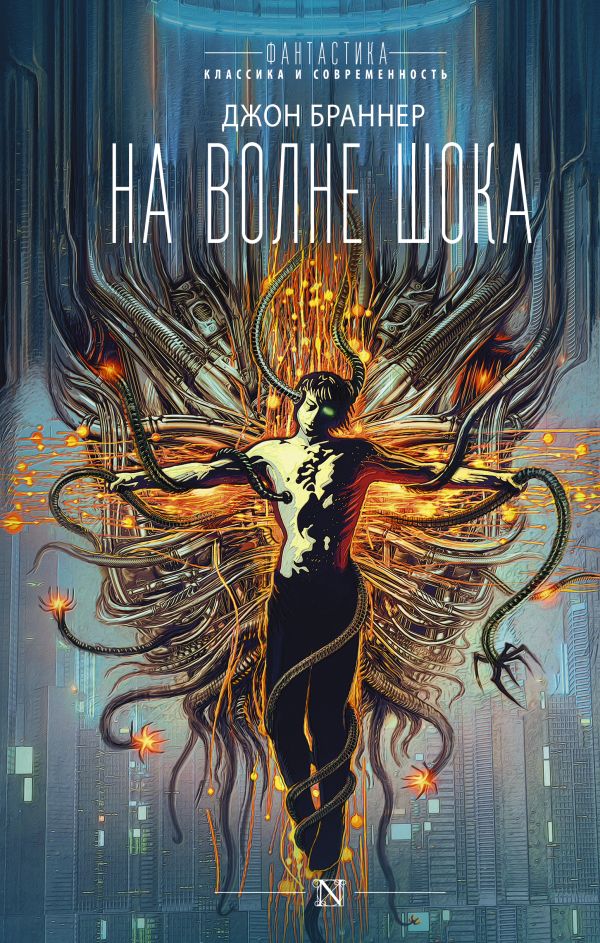 It is not difficult to guess that the name of this book is a direct reference to the Future Shock) Elvin Toffler, one of the most high -profile futurological works of the seventies of the last century. And so that there are no doubts even among the tights, John Branner expresses gratitude to Toffler on the very first page of his novel. Actually, the “shock of the future”, mass stress and disorientation as the speed of technological and social changes grows is one of the central topics of “The Shockwave Rider”. In the Braniner world of the future (that is, around our days), people are "surrounded by such an abundance of opportunities that they are confused and fall into alarming neurosis." But there are those who are ready to saddle this wave. One of them is Nikki Haflinger, a young genius, an outstanding hacker, a hameleon man, a “hero with a thousand faces”. A fugitive from the closed government center for the development of intelligence, where a weapon of victory in the race of reason, who has replaced the arms race, is poured from gifted teenagers. He masterfully changes the masks, pretends to be either a priest, a financier, then a social engineer and quite comfortably feels in the cracks and folds of society. But at some point he understands that he successfully hiding from the pursuers to the end of his life is not the goal that a person with such abilities strives for.
During his forty -year -old career, John Branner released about seventy fantastic novels, covering almost all the sunshines, from space opera to heroic fantasy. True, there are only three left in history: “Standing on Zanzibar, 1968), not yet translated into Russian“ The Sheep Look Up ”(1972) and“ In the Wave of Shock ”(1975). Commentators muttered that Branner’s novel is outdated - and from a purely engineering point of view there is a grain of truth in this. Not all forecasts came true: the British science fiction writer definitely overestimated the prospects of biotechnology and the space industry, but underestimated the IT sector. The global information network in the Wave is not very similar to the Internet familiar to us, and what we would call a computer virus today is called computer worm in the novel. The concept of Toffler is also vulnerable to criticism: it turned out that people are much better to adapt to changes than it was considered half a century ago - or simply successfully ignore the changes (which, however, can also be called an adaptation method).
But, if you do not demand from the author the maximum accuracy in the description of all the rivets without exception, the novel “In the Wave of Shock” largely overtook his time. Paranoid fear that scammers will gain access to confidential data; The struggle for freedom of information, including secret files about the crimes of governments, special services and transnational corporations - quite real trends of the 21st century, greetings to Edward Snowden. But the main thing is that the writer painstakingly explores the conflict “The averaging vs. Diversity ”, this is one of the plot rods of the novel. “In other words, the surf, wiping pebbles on the beach, provides them with an invaluable service, because being tidy and smooth beautiful than being rough and uneven,” says the hero of Branner, crucified on a high -tech torture table. - The stones on the beach do not care what shape they are. And a person does not care. Each tide on your beach reduces the variety of forms that a person is able to take. ” It is strange to consider an outdated book that consists of such maxims a little less than completely.
If anything can be blamed for the author, it is excessive optimism and the ending on the verge of a Hollywood happy end. But just such good in modern fantastic books, more than enough.
John Warley. Blue champagne: stories, stories. M.: AST, Neoclassic, 2023. Translation from English Andrei Novikov, Natalia Nesterova / John Varley. Blue Champagne, 1986
 John Varley is a superstar of the Renaissance of the “solid” science fiction, which happened in the United States after Watergate and the end of the Vietnamese War. Genre awards with a jamb, an invitation to prestigious anthologies, enthusiastic reviews of critics - Varley called the voice of a generation and a “New Heinlin” in a good, flattering sense of the word. However, after the triumph of 1985, when his story “Press the“ Entry ”” took at once “Hugo”, “Nebuil” and “Lusu”, a stream of bonuses and nominations. And although the most fresh novel of the writer is dated 2018, today mostly recall the historians of the genre: “Do you remember, there was once such an author? ..”
A sudden take -off and equally rapid overthrow of idols, perhaps one of the most interesting phenomena of the “current literary process”. The collection “Blue Champagne” makes it possible to figure out: what clung in the works of John Varley fantasy lovers in the 1970s-and why it sharply stopped clinging ten years later. The book included a full cycle about Anna-Louise Bach (first-a lifeguard from the orbital resort for multimillionaires, and closer to the final-the head of the municipal police of the New Dresden, the largest metropolis of the moon) and a couple of novels close in the spirit. Not that a complete selection of the main hits of Varley, but the texts are quite characteristic. The author is convincing and reliably (although, perhaps too verbose) talks about the high technologies on which this “beautiful world of the future” rests. He is absolutely relaxed when describing the daily life of his heroes, including the most intimate spheres, and gives preference to simple dramatic plot stories. Love is sold for money (the story “Blue Champagne”), the girl slowly dies at an abandoned orbital station (“Tango Charlie and Foxtrot Romeo”), the desire for equality and uniformity leads to a series of brutal murders (“Beat Barbie”), etc., etc. In other words, Varley is equally far from the simplest optimism of the “golden age” Anglo-American science fiction, and from radical experiments of the "New Wave". I would venture to assume that this approach looked new, original, attractive from the point of view of the fandom of the seventies. But the trouble is: in the 1980s, new heroes appeared at the gates of the city, reckless cyberkovboys in mirror glasses, which were able to do everything the same-only better.
William Gibson, Bruce Sterling and took into account the lessons of the authors of the "solid NF" - and moved on. In the era, when the description of technology became an instrument for the study of social and psychological depths, a new means of artistic expressiveness, John Varley with his straightforwardness obviously did not stretch competition. He did not abandon to write, did not even lose his form (evidence of this, the stories of 2003 “trifle” and “sunset suns” included in this collection), but his novels and stories today look dry and boring: even in the best there are not enough artistic skill, dexterity of execution, literary grace. However, of course, it is not worth putting the cross on the author: Varley became one of those who warmed up the audience before going to the Hedliner scene, prepared readers for the appearance of a “shitmate” and “neuromant”. What is valuable in its own way-at least for historians of the genre, exploring turns and swirls on the path of development of the NF.
Samuel Dileni. Story by Nevorion: Roman, Tales, Stories. M.: AST, 2023. Translation from English Natalia Vilenskaya / Samuel Deleany. Tales of Nevèrÿon, 1979. - NEVERYYX, Or: The Tale of SIGNS and CITIES, 1983.
 Nenorion is the oldest state on Earth. Older than Babylon and Schumer, Chinese Shang-In and Vietnamese Vanlang, ancient Egypt and the Cretan kingdom. The first empire in the world, the prototype and the matrix of all the other empires, the ancestral of crafts and trade, the source of ancient wisdom, Atlantis, Lemuria and Mu in one bottle. In general, the dream of any historian, anthropologist or linguist is if you forget about one annoying nuance: there is a neurion only on the pages of the same cycle of stories and novels by Samuel R. Dileni.
By and large, the world of unborn is collected from the same cubes as the Universe of any heroic fantasy. All according to the classics: forests, desert, seas, noisy cities, variegated crowded markets; hefty barbarians, unbridled Amazons, young riders in dragons; Aristocracy is fighting for power, freedmen and fugitives from mines - for the abolition of slavery, merchants trade, pirates are pi -pirate. No wonder: the authors of the "New Wave" (and Dileni, although he did not like to admit it, of their number), were always indifferent to pop-cultural cliches. Michael Murkock and Harlan Ellison deconstructed the image of James Bond, Roger Zhelyazy resuscitated the dock by Savija, Philip Farmer dragged the psychoanalyst of Tarzan himself into the bed. Well, the “Nevorion” clearly echoes the Robert Howard’s cycle about the Haiborian era (and the era of the Turi): Conan-Warvar, red Sonya, Kull from Atlantis and all that. However, what does Dileni do with this “antediluvian” setting, it is difficult to call the deconstruction - the writer is more likely to give us a lesson in restoring historical justice.
Robert Howard and his followers were delighted with barbaric simplicity and naive cruelty of the ancient world, straightforwardness and lack of reflection. The intellectual Dileni, familiar with the works of leading historians, anthropologists, linguists and culturalists of the 20th century, on the contrary, emphasizes: this world is not more simpler than the modern American metropolis. “In the cobblestone on every street, in every crooked lane, in every stucco cornice, in salt drums, letters are made on how we lived here before, about why we now live just like that” - we only have to be able to read and understand them. The ancient world is not only insidious intrigues and bloody battles, it is inhabited by not only galvanized slaves and noble gentlemen who cut the throats in the alcoves of ancient castles. This is a complex web of relations between peasants and townspeople, fishermen and hunters, merchants and artisans, multi -layer stratification of metaphors, symbols, signs connecting everything with everything. The old fisherman from the southern islands tells about the basics of semiotics, psychoanalysis and political economy, a hefty uncle in a slave collar discusses the connection of violence and power, an elderly merchant-about social elevators and lumpen industry (without using, of course, these words, but sapienti sat). In fact, the "Nevorion" is a story about the flowering complexity of the ancient world. And if the “antediluvian” society seems primitive to us, poor details and not worthy of attention, this speaks not so much about him as about us.