
Translated material
Crypt in the package
Binance's largest crypto -tank forbade Russians to buy and sell dollars and euros. We tell you how to now take rubles abroad
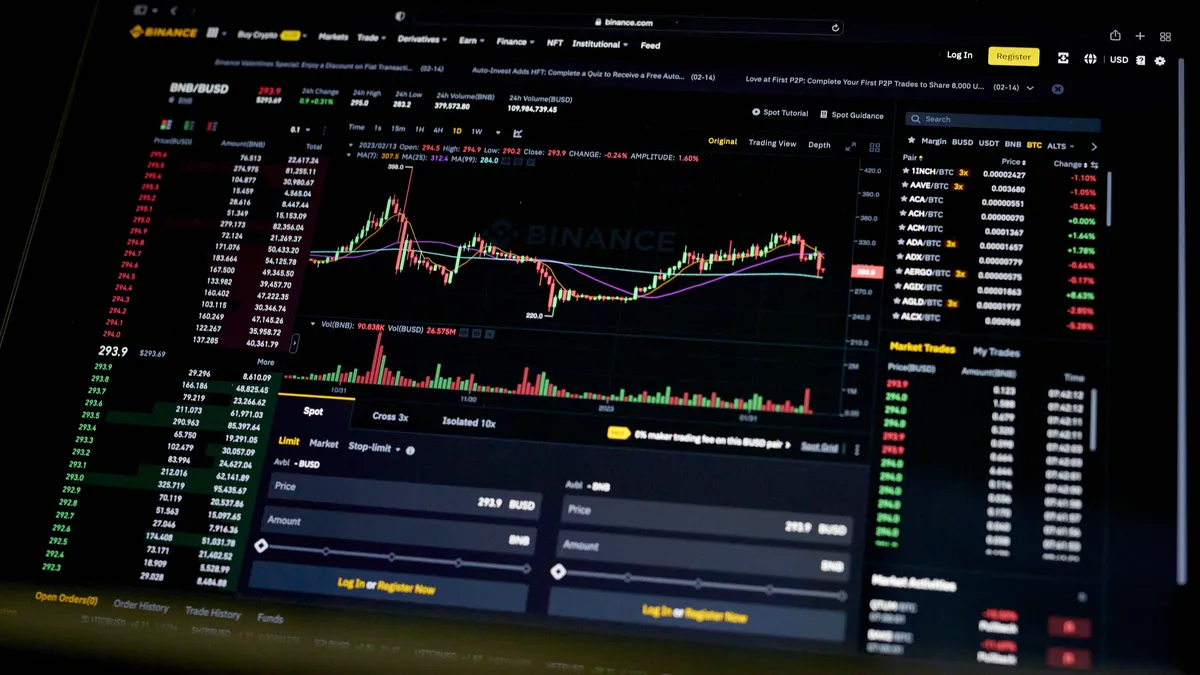
Last week, the Binance cryptocurrency exchange announced a ban on transactions with dollars and euros through its P2P platform for Russians. This was an extremely popular opportunity - for example, it was possible to bring your ruble salary to a foreign account with minimal losses (or, conversely, transfer foreign income to Russia). But there are other sites that remain accessible to Russians even in conditions of sanctions. Novyevropa collected the most popular alternatives and talked with experts about what was waiting for Russians on crypto-rhizas in the future.
Without dollars and euros
The ban on the purchase and sale of dollars and euros through its P2P service for Russians and citizens of other countries living in Russia on March 9, Russian Forbes reported on the ban on Binance. The exchange representative told the publication that at the same time the European Union citizens were banned from conducting operations with rubles. At the same time, users can choose any other available fiat currencies.
How does this work
Similar P2P platforms for the sale of cryptocurrencies are available on most large cryptocurrencies. They allow you to conclude transactions for buying and selling directly between two users, without the mediation of the exchange itself, with regard to the transfer of a fiat currency (cryptocurrency that is involved in the transaction, it can be stored in a spoon of exchange-it is used to store assets during trade).
After the start of the war with Ukraine in February 2022 and the subsequent imposition of sanctions against Russian banks, such services have retained for Russians the opportunity to withdraw money abroad. So, through the P2P platform you can purchase cryptocurrency (for example, USDT or other Steabelcoin, which is tied to the dollar), transferring rubles to the Russian card of another user. Then, for the obtained crypto -stomachs, you can purchase dollars, euros or any local currency on a card released abroad.
Closing for Russians access to the purchase of dollars and euros was explained by the tenth package of the sanctions of the European Union, which was adopted on February 25. True, in reality, this package does not talk about tightening cryptocurrency operations - in fact, such sanctions were adopted in the eighth package adopted on October 5, 2022. One of the points of this regulation prohibits "providing the services of a wallet, account or depository of crypto acts to Russian citizens or individuals living in Russia, or legal entities, organizations or bodies created in Russia."
This at that time became a sharp tightening of the rules: earlier Russians were allowed to store cryptocurrency within the equivalent of 10 thousand €. The rule, in fact, does not concern non -codial cryptocurns (for example, Metamask or Exodus) - that is, those in which only their final owner has full control over assets, and not a third party, for example, a crypto -rope.
However, in both cases (a limit of 10 thousand € and a complete ban on storing cryptocurrencies) among the crypto -streaks themselves there was no unity in the approach to the fulfillment of requirements - this is especially true for those whose main business is not based in the United States or the European Union and does not depend too much on these regions. So, if part of the largest exchanges (Coinbase, Kraken) has stopped working with the Russians by October, others still ignore the most stringent requirements of the EU.
Alternatives Binance
The Binance decision to limit Russians on their P2P platform coincided with the release of a resonant article in the Politico publication at the end of February. There, among several exchanges allowing Russian citizens to bidding on P2P, Binance was also mentioned. At the same time, experts surveyed by Politico called the presence of such ways of currency exchange a direct violation of the sanctions of the United States and the European Union.
The volumes of transactions of Russians through Binance were really significant, but dozens of other large crypto -rhizas have similar interfaces and a set of services, confirms the senior analyst Bestchange.ru Nikita Zuboriev. Among the most popular and at the same time loyal to the Russian market segment, he is highlighted by BYBIT , OKX , Huobi and Gate.io.
It is Huobi, as well as the Kucoin exchange fell under the most close sight of Politico. The publication reported that both exchanges allow the use of cards of Russian banks, including a suchance Sberbank, to trade on their P2P platforms (while the exchanges themselves, like almost all the others, do not directly accept payments from Russian banks).
Kucoin and Huobi are registered in the Seychelles - a popular hub for crypto companies - and were founded in China. Kucoin previously said that the sanctions adhere to the requirements of Seychelle legislation. The company also confirmed the Novo-Europe, while emphasizing that the exchange itself does not make it possible to deposit and withdraw money from Russian cards, and is ready to cooperate with regulators in the event of any suspicious transactions.
In Huobi, after the adoption of the eighth package of the sanctions of the European Union, they directly stated that "the services of Huobi Global in the Russian Federation will not suffer in any way." At the end of February and early March, the administrator of the exchange community also answered users that the new package of sanctions would not affect its policy, and the possibility of trading currencies through the P2P platform will remain.
Bybit is founded in Singapore and is now registered in Dubai (UAE). In November, the Getblock publication, citing a source within the company, reported that the Dubai registration would allow the exchange not to join the sanctions and maintain “equal access to the platform” for all users.
Another OKX Seichelska Exchange founded in China was blocked in Russia in October 2022 at the request of the Prosecutor General’s Office: the site found “information related to the activities of financial pyramids” and unlicensed financial services. You can use the exchange from Russia through the VPN-although theoretically it can create problems with the account work due to the security systems of the exchange itself. The administrator of the OKX official group in the CIS recently confirmed the possibility of using the Russian Bank card with the P2P platform of the exchange.
Gate.io, founded by a Chinese businessman, is also registered outside the United States and the European Union - on the Kaiman Islands. Her community manager also confirmed that the exchange "does not fall under the sanctions."
All this is far from the latest market participants. The mentioned exchanges confidently enter the TOP-20 in turnover in the world (CoinmarketCap data ).
Behind the currency in the exchange
Other alternatives remain, except for Binance direct competitors. For example, there are P2P platforms without reference to specific crypto-rhms, Nikita Zuboriev points out. In recent years, large crypto -rhins are actively replaced from the market, but the options still exist: for example, Paxful or Hodl Hodl . True, such sites can take “unpopular, politically engaged decisions,” the analyst notes.
Decentralized exchanges (in them all trade occurs directly between the participants, while user cryptocurrencies are not stored on the exchange servers, but remain in personal users' wallets; the two largest exchanges - Dydx and Uniswap ), according to Zuboruev, are not suitable for working with fiat currencies, as they allow only to work with tokenized assets.
You can buy or sell currency through exchange offices. Contrary to popular belief, this is not necessarily a “window in the gateway” or businessmen in Moscow City: there are many specialized sites offering exchange without intermediation of the exchange.
About 400 sites have a good reputation and make an exchange in many directions, including electronic payment systems like "Yumoney" or Qiwi. “In fact, an exchange point is something like an ordinary seller on a P2P-foreigner, only with enormous experience, a large margin of money, a separate site and a long-term reputation,” the expert says.
If we are talking about large amounts, for example, about the revenue from the sale of an apartment, then you can either withdraw it in parts or contact offline exchanges, the expert in the field of distributed and decentralized services Roman Nekrasov adds. However, the offline exchange is associated with a high risk: “They can either throw, or the coins will be toxic, that is, noticed in illegal activity. Then no exchange will accept them, ”he says.
There is also an “old kind scheme”: buy bitcoins directly from miners, who are plenty of in Russia. “These are clean coins without any dirty train in the past. But this scheme is not available to the majority, since here you have to be familiar with miners, and they do not operate with small amounts. This is the most popular scheme for those who withdraw large sums - from $ 1 million and higher, ”the expert says.
But for those who left the Russians, the main problem is not how to buy a crypt, but how to sell it in another country and go into a fiat currency. “Probably the simplest thing is to sell cryptocurrency in Georgia, there, right in the center next to Rustaveli, there are exchangers where, at a personal meeting, the amounts from $ 20-30 thousand exchange the amount of $ 20-30 thousand. And in European countries, to get out of some significant amount in cryptocurrencies is a whole story,” he argues.
In this regard, the scheme can be widely used using accounts registered on “drops” (dummies - intermediaries) on Binance, but this will simply complicate the withdrawal scheme and increase the cost of withdrawal from the Russian Federation.
What to wait for in the future
You can expect tightening crypto regulation around the world: American regulators are slowly but confidently moving to take control of the main trading platforms. The rest will be easy to crush - to force those exchanges that agreed to play according to the rules of American regulators, not to take coins from high -risk exchanges.
But private traders who change fiat money for cryptocurrencies and vice versa will remain in the market even in the most negative set of circumstances, Zuboruev is sure. And the real probability that absolutely all market players will massively introduce similar Binance restrictions, in his opinion, strives for zero: the market is too heterogeneous and competitive, and "there will always be the one who will come in between all the sanctions."
Therefore, there are no serious risks for cryptocurrency assets after a new ban yet - only difficulties for the expanses that used Binance as the easiest way to transfer currency into rubles and vice versa. But they will “almost painlessly switch to other sites and continue to exchange funds, as before,” the expert believes.
In the meantime, you can only give a standard advice: just in case, not to store funds in the accounts of the crypto -rhines longer than it is necessary. That is, immediately after the exchange, they take them to non -kastodial wallets - for example, Metamask, Electrum and others.