
Translated material
The French were ignited
On the streets, riots began after the president’s decision to carry out pension reform without voting in parliament
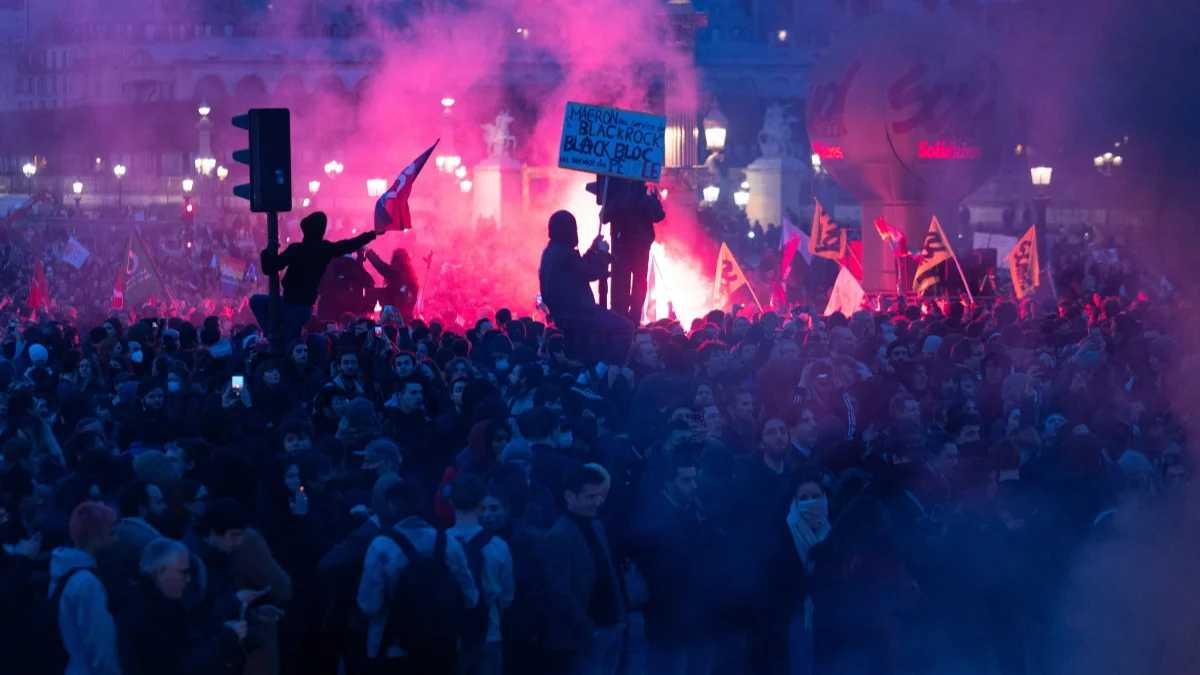
Late in the evening of March 16, cars were burning in the streets in the center of Paris, the police used vodtetes and tear gas to disperse the protesters. In the capital, 258 people were detained, in total in the country - 310. But this is only the beginning. Protests against the decision of President Macron to hold a law on pension reform without voting in the lower house of parliament - it will clearly continue and, probably, on a more significant scale.
On March 16, for the law on pension reform according to the plan, they should have voted first in the Senate (in the morning), and then, in the afternoon, in the lower house - the National Assembly. But there was no vote in the National Assembly: Macron at a special meeting of the Council of Ministers decided to carry out a law on pension reform not through voting in parliament, but with the help of a “special” article of the Constitution 49.3 (which allows us to adopt laws without such voting, but gives parliamentarians the opportunity to declare a vote of mistrust with subsequent abolition and the law itself).
The Macron decision was made due to the fact that the ruling Center Party “Renaissance”, along with the “fellow travelers” from the right-wing party “Republicans”, according to preliminary estimates, did not gain the right number of votes in the lower house.
As a result, and so unpopular - judging by the surveys, as well as the highest protest activity of citizens since 1995 - pension reform was carried out bypassing normal democratic procedures, which could not but increase the degree of boiling on the streets.
In the evening, as the unions and representatives of the left opposition threatened a few days before, the first serious riots began on the streets.
In Paris, several thousand radical activists gathered on the consent Square - across the river from the Bourbon Palace, where the National Collection sits. The palace itself was cordoned off by the police. On the streets adjacent to the squares of the streets were cars, motorcycles, garbage tanks ... The clashes of manifestos with the police were in other cities: Marseille, Renna, Nanta, Lille, Amiens, Grenoble ...
The head of the Macron faction (“Renaissance”) in the National Assembly of Orozh Berget on Thursday in the evening turned to the head of the Ministry of Internal Affairs of Gerald Darmanen with an appeal to “mobilize public services” to “protect parliamentarians” of the ruling majority.
The leader of the main opposition parliamentary power of NUPES (new folk ecological and social union) Jean-Luc Melanshon, in turn, called people to "spontaneous street mobilization." He emphasized: “This text does not have parliamentary legitimacy,” and therefore “we have the right to rebel.”
The inter -professional coalition appealed to the conduct of “local rallies” this weekend and a nationwide day of strikes and demonstrations next Thursday, March 23.
In a separate statement, the Student Trade Union L'Alternative called on students to hold general meetings on Friday, “block places of study”, as well as “nearby roads, stations, ports and airports to support workers”.
On the morning of Friday, March 17, hundreds of activists of the largest CGT trade union partially blocked traffic on the Paris Ring Road (Périphérique). The tracks were also blocked in Renna, Sherbur, Havre ...
Today, in parliament, the opposition intends to make a question about the vote of mistrust to the government to vote. In this case, the vote itself will most likely happen on Monday.
Despite everything that was happening, the “profile” Minister of Labor Olivier Dussopt said on Friday morning that “the use of Article 49.3 was not a mistake.” The French “central” and regional press, almost unanimously, gives opposite assessments, calling Macron’s decision “failure”, “disaster”, “circus”, etc. Similar opinions are anonymously expressed by individual representatives of the ruling majority. The president seems to have to face the most serious political crisis over six years of his reign.