
Translated material
Nailed interest
Will the bankruptcy of the Silicon Valley Bank become a trigger for the financial crisis
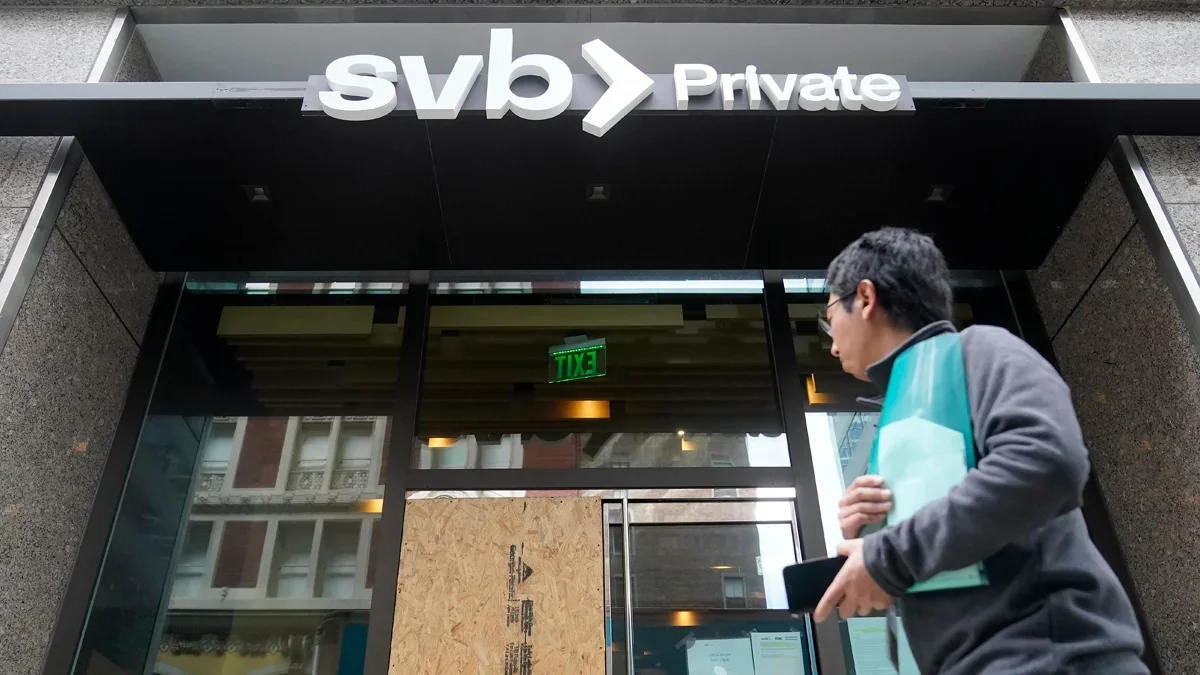
A week ago, on March 10, the American Silicon Valley Bank (SVB) was transferred to the administration of regulatory authorities that arrested his assets. SVB-16th US Bank with assets of more than $ 200 billion and deposits of more than $ 175 billion.
The problems of Silicon Valley Bank have become the reason for the largest banking sales and panic among IT startups-the main customers of the bank, which in turn gave rise to fears about the second Lehman Brothers, the collapse of which in 2008 brought down the entire world economy. What happened?
Good bank for good people
SVB - was conceived as a bank for startups. SVB opened accounts for them, often earlier and faster than other large banks did.
Bank deposits grew rapidly-from $ 44 billion at the end of 2017 to $ 189 billion at the end of 2021. But the bank should not only accept deposits, but also issue loans - and this was worse: at the same time, the SVB loan portfolio grew from $ 23 billion to $ 66 billion.
Since banks earn money on the difference between the interest rate, which they pay on deposits (sometimes very small), and the rate that borrowers pay for them,
The presence of a much larger deposit base than a loan portfolio is a problem for the bank.
But why did the bank not issue loans to its customers - startups? Don't they need money?
We need, but ...
Firstly, startups do not really need credit money. How does the modern "startup from the valley" work? He takes money from venture investors, spends it on his project, takes it yet ... and so on until the conditional “Google” or “Amazon” buys it (or until the startup has an operating room or even net profit).
Secondly, formally, startups are unreliable borrowers, and any bank can give them loans only to a limited volume.
Therefore, SVB had to purchase other assets that bring interest. And what is more reliable than the US Treasury bonds - the so -called Trezheris? So banks bought them.
By the end of 2021, the SVB-bank invested $ 128 billion mainly in mortgage bonds and trezelris (US Treasury securities).
Dear money - cheap bonds
But then everything changed - when the Fed began to fight inflation, acting with the classic method - increasing the key rate.
In just a year, in March 2023, an effective rate on federal funds (on which banks credit each other taking into account the Fed’s rate) increased by more than 50 times, from 0.08% to 4.57% (the target rate of the Fed for the same period increased from 0–0.25% to 4.5–4.75%).
The rise in the cost of money reduced the desire to risk investors in startups, which led to the disappearance of the main source of financing for them - the initial placement of shares.
Startups-the main customers of SVB-because of the need for money began to withdraw money from deposits. As a result, they decreased from $ 189 billion at the end of 2021 to $ 173 billion at the end of 2022.
To finance the outflow of funds, the bank had to sell assets- they mainly consisted of medium and long-term treasury bonds of the United States.
But the price of interest on fixed profitability is associated with the interest rate of the federal reserve inverse dependence. The higher the rate, the lower the prices of the papers, and vice versa.
Due to the increase in bets, the profitability of the state units increased: the SVB government proposal brought an average profitability of 1.79% with an average deadline for paying papers of 3.6 years, while the current market yield of 3-year-old bonds exceeds 4.5%.
Who will buy bonds from the bank, when exactly such bonds can be “bought from the government” - only with more profitability?
Rather, they will be bought - but with a large discount. Against the backdrop of the growth of the Fed’s bets from 0.08% in early March 2022 to 4.57% in early March 2023, treasury bonds for a period of 10–20 years and more than 20 years-lost about 25% and 30%, respectively.
SVB was able to sell papers from his portfolio, but with a large discount, having received losses, the coating of which required pre -capitalization. The bank tried to do this by announcing on March 8 to sell its own shares, but the value of these shares collapsed due to fears that the gap between assets and passions in the bank would grow.
The depositors went to withdraw their funds, but there was no money in the bank - and SVB had to close.

No one is to blame?
The most interesting thing is that all market participants are bank customers, its managers and the Fed act, in general, correctly - “how they taught”.
The customers ended with sources of external financing - they came to pick up their money from the bank.
Bank managers acted strictly within the framework of regulations - here are deposits, here are reserves, here are investments in papers of the highest degree of reliability. The bank management ruled customer money and, in general, the bank, exactly, as required by state regulations. (And there was no talk of any refusal of the government at the face value - the bonds will be paid, but at that time, which, relatively speaking, they are indicated on them - not later, but not earlier. And SVB was needed “here and now”.)
And the Fed act as it should have acted: we see an increase in inflation - we increase the key rate. If the rate is not raised, then accelerating inflation will bring down the economy faster than the rise in price of money. Another thing - and many economists are talking about this now -
In its struggle against prices, the Fed’s leadership was too much in a hurry, not paying attention to other economic factors.
In addition, they resemble economists, the government sells bonds to banks (as it was with Silicon Valley Bank) and then pays for these bonds with banks by removing resources from the economy through taxation. At the same time, banks buy bonds, assuming the preservation of their price or the possibility of its forecasting. But in this case, the Fed acted "too fast."
Complex question
The question is, does the current crisis of the stability of the US banking system are threatened?
It seems that there are no, in any case, the authors of the latest ( published on March 13, 2023) research “Monetary Tightening and US Bank Fragility in 2023: Mark-to-Market Losses and Uninsured Depositor Runs?” ("Tighten monetary policy and instability of US banks in 2023"). It was made by a group of economists from the University of South California, North-West, Colombian and Stanford universities.
With an increase in interest rates, the fall of the bank’s assets value can lead to its collapse through two channels: losses and panic of depositors - this happened with SVB, the researchers explain. But the problem is not in deposits in general, the economists say, but in the non -controlled deposits (that is, exceeding the amount that falls under the guarantee of the safety of deposits, in the USA it is $ 250,000).
Silicon Valley Bank, showed the analysis of researchers, was not the worst in terms of loss of assets. But the share of “undigested deposits” for SVB was 92.5%, in their ratio with SVB assets was worse than 99% of other banks, and it was the flight of depositors to collapse.
But what will happen if the owners of unhlassed deposits decide to withdraw them at once, will the US banking system have enough assets in order to cover all unhlassed deposits?
Yes, the calculations of economists have shown
that almost all US banks have sufficient assets to cover their obligations on unhlassed deposits - but provided that they do not urgently sell their assets.
And this means that the leadership of the Fed is now facing a difficult choice: either to continue the fight against inflation - at the same time reducing the market value of bank assets, or stop or slow down the increase in the key rate, calming the market and avoiding the possible raid of investors to banks.
What can the history of the SVB bank teach us?
If you imagine the economy of the Russian Federation as a huge bank, all economic entities are as depositors, and the government as bank managers, then we will understand that the stability of such a bank is kept exclusively on the trust of the “depositors” to the system.
Read also
"Helicopters" over Wall Street