
Translated material
The life of wonderful bosses
Dmitry Travin - about the two -volume of Nikolai Mitrokhin (recognized by the Russian authorities by a foreign agent)
A prominent specialist in the history of the Late Soviet Society Nikolai Mitrokhin wrote a book about the post -Khrushchev economic policy of the USSR in order to reveal the essence of the “Kosyginsky” and “Andropov” reforms. At the request of Gorky, his considerations about this outstanding, such and voluminous work was shared by the supervisor of the Center for Research on Modernization of the European University in St. Petersburg Dmitry Travin.Starting from February 24, 2022, we were all in the face of the advancing barbarism, violence and lies. In this situation, it is extremely important to preserve at least the remnants of culture and support the values of humanism - including for the sake of the future of Russia. Therefore, the editorial office of Gorky will continue to talk about books, reminding our readers that the world remains in the world and fiction.
Nikolai Mitrokhin. Essays on Soviet economic policy in 1965-1989. In two volumes. M.: New Literary Review, 2023. Content . Fragment
 This, in general, is not a review, since I cannot be considered in relation to the book of Nikolai Mitrokhin with a completely independent reviewer. But the author slightly surprised me already in the preface, and therefore I wanted to understand our disagreements with him.
“The book of economic publicist Dmitry Travin“ Essays on the latest history of Russia. Book One: 1985–1999 “was published in 2010. In fact, it is an attempt to rewrite the “death of the empire” of Gaidar for a mass reader based on fragments of chaotically selected memoir literature, jokes and several random sociological polls. <...> Unfortunately, the idea of the grass “explain on the fingers” how the Soviet economic policy was formed and to, turns into the primitivization and vulgarization of the issues considered, the use of a set of stamps. ” So the opponent wrote about me, emphasizing that he was arguing with the publicist, although we are both candidates of sciences (I am economic, he is historical). But surprisingly different. In Mitrokhin’s book, dozens of links to the “death of the Empire” (it popularizes it perfectly), and in mine-only two or three. I always confirm each fact or quote with a link, but my book is thematically little intersects with that fundamental work of Gaidar. Half of my work is generally devoted not to the sunset of the empire, but by the new Russia, and besides, the policy was more interested in me than the economy. In the project “Lessons of the 90s”, in addition to my book, there is a wonderful work by Leonid Lopatnikov “From Plan to the Market. Essays on the latest economic history of Russia. ” Here it is just about the economy. But, judging by the absence of her in the bibliography of Mitrokhin, he with the difficulty of Lopatnikov is not familiar. By the way, it was Leonid Isidorovich who was the scientific editor of the fourth volume of the works of Gaidar, in which the “death of the empire” was published. It was he who was the deepest expert on this book.
As for journalism, there is nothing vulgar in it. Here, Mitrokhin, for example, on the pages of the first volume divides the staff of the party apparatus into thin ascetic priests-souvos and Jovial revisionists-spickeeping Brezhnev, who love poetry, women and alcohol. A wonderful image. I applaud. Mitrokhin and I, as two publicists, want to give the mass reader a bright image. Hundreds of pages of our books may be forgotten, and images never.
But what is still amazing. At the very end of the preface, Mitrokhin writes: “I also need to thank the representatives of the younger generation of Soviet economists and the first generation of the creators of the Russian economy - Sergei Aleksashenko, Evgeny Gontmaler, Alfred Kokha, Boris Lvin, Alexei Sitnin, Dmitry Travin, Grigory Yavlinsky, biographical conversations with whom in 2018-2019 gave me a lot of "Food for the mind". " Now I was not a vulgarizing publicist, but an economist and almost a Russian economy creator. I definitely are not the creator, and even as an economist I do not put myself on a par with Aleksashenko, Gontmacher or Koch - reformers who have known in practice much more than Mitrokhin and I could know in theory. But I can’t understand how I was so “transformed” under his pen?
I had to seriously work with the book of Mitrokhin. I wanted to find out if the author was in other cases neatly than in mine. While I read, I ran into social networks with a curious discussion of this book. He began one Libertarian, surprised by the author’s statement that it was customary to explain the Soviet model among post -Soviet economists, uncritically following the authorities, and the Libertarians in terms of protecting their “authorities” are not too different from the rest. The discussion was reduced to an attempt to find out which of the Libertarians specifically spoke Mitrokhin, since he neglected the links to the source. Alas, it was not possible to find such non -critical interlocutors. Including among those whom the author thanked for the conversations at the end of the introduction.
By reading the “Essays of Soviet Economic Policy”, it turned out that this is a serious work that deserves attention. The author collected a large, useful material, and not only from scientific and memoir literature. Mitrokhin personally interviewed a large number of Soviet chiefs. Their memories are important for understanding the Soviet Union, regardless of how one or another researcher interprets them. In general, Mitrokhin’s book is about the bosses. The author loves them, sincerely interested in them, carefully listens to their opinion. There is virtually no Soviet society in essays. But I would not call this a drawback. Each author has the right to choose the aspect of the topic that is interesting to him. Nevertheless, there are many disadvantages, from my point of view, in Mitrokhin’s book.
Explaining the reasons for the Kosygin reforms, the author very harshly evaluates Khrushchev’s activity, noting that she was “extremely illuminated in nature due to its low education, frantic temperament, arrogance, unwillingness to systematically work with documents, listen to the arguments of colleagues at meetings of the deliberative bodies, as well as over the years of frankly boorish attitude towards people in general and to members of the Presidium of the Central Committee in the Presidium of the Central Committee particular " . Khrushchev was indeed far from the ideal. If it was about writing his political portrait, it would probably be limited to black paint. But, when it comes to the country's economic policy, we must remember at the same time that the Stalinist policy that laid the foundations of the administrative system (simultaneously bringing many peasants), which Kosygin wanted to reform, was even more adventure and authoritarian. And it is also advisable to recall the adventurism of the entire Bolshevik policy to pursue a socialist revolution, after which the economy could no longer remain market. The Kosygin reform was not an attempt to "clean up" after Khrushchev. It was an attempt to create at least something decent from many years of erroneous experience. And the fact that serious economic reforms at this time were carried out in Hungary and Czechoslovakia (where there were no “terrible Khrushchev”, but there were Soviet -style economic systems) shows the importance of systemic problems, and not intra -party showdowns.
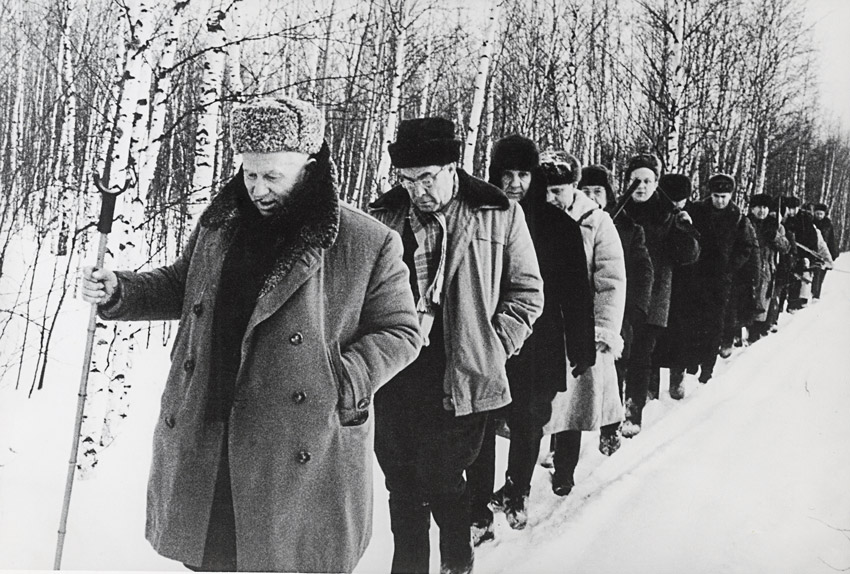 N.S. Khrushchev, L.I. Brezhnev, A.N. Kosygin and others in Zavidovo, 1962. Photo: RGASPI
In no case I do not suspect Mitrokhin of the desire to praise Stalin, scolding Khrushchev, however, due to Antihrushchev’s stiffness shown in the book, there is a displacement of accents. Mitrokhin assures that in the late Nestalinsky time , “centralized state production was supplemented by the power of the powerful (allocation of mine. - D. T.) of the private sector, that is, cooperatives (artels) and“ private traders ”(submarine craftsmen, repair masters) who bought patents.” In fact, the role of Stalin was in the elimination of a really powerful private sector that existed before the collectivization in agriculture, and what was left (and then it was finished off Khrushchev) could not be called powerful. The author does not bring data on the share of this “power” to GDP, and, I think, it is impossible to “dig up” significant numbers from statistics.
Moreover, the analysis of Kosygin’s activity in “essays” itself was carried out correctly. Mitrokhin is right, noting that “within the framework of the Kosygin reforms”, work, in which “profitability” was the main indicator, demanded the search for profitable and reliable customers who would allow a higher percentage of profit and fill the incentive funds from it. “These basics of the market economy beat on the principles of the planned economy, as well as on the principles of centralized management, thereby weakening the power of the country's leadership and its ideological service service (including many Soviet economists) <...> the country's leadership was not ready for such a large -scale revision of economic policy and decided to limit themselves to private reforms and measures.” In general, Mitrokhin’s great advantage is an approach in which opposing groups of interests are primarily analyzed. Other authors do not always pay attention to this. Sometimes it is customary to represent the Soviet economy as a kind of monolith. Supporters see in it one of the manifestations of the “indestructible bloc of communists and non -partisans”, opponents are a product of the life of the “country of fools”. But in reality, life is more complicated than abstract schemes, and Mitrokhin in different sections of his book was quite able to show this. For example, he clearly demonstrates which groups of interests were objectively interested in the success of the Kosygin reform, and which are not.
The second part of the study is good in this sense. It shows how these groups were formed in the device and what formal, as well as informal mechanisms for coordination of contradictory interests were formal. Another important advantage of this section is a clear analysis (according to points) of reasons that did not allow effective planning. Mitrokhin is right when he demonstrates a number of objective circumstances, and does not dump the problems on individual errors of individual “comrades” or a lack of computer technology that can calculate all connections better than the market. I remember that during the years of large disputes about the plan and the market, such views were popular. And I can their supporters, if any, have been advised to read the relevant sections of Mitrokhin's books. Finally, it is worth reading it in order to see how usually reforms were prepared in the Soviet bureaucratic system. The author thoroughly describes the formation of any groups, groups and commissions, each of which “scraping with a feather”, offers something, sends to a huge apparatus, where the struggle of various influential forces emits offers or completely paralyzes serious transformations. True, the reader’s enemy in this situation is a huge amount of book, where useful information must be searched in the middle of the sea, but the one who needs to figure it out in all this, I hope that the costs of energy and time will not be frightened.
Unfortunately, Mitrokhin did not dispel my fears about the accuracy of assessments. In some cases, they do not follow at all. “As is well known, this (Kosyginskaya.-D. T.) Reform was ideologically prepared in the first half of the 1960s as a result of the economic discussion initiated after the publication of the article of Kharkov (often mentioned as a“ provincial ”) economist, specialist in engineering Evsey Liberman.” Of course, this discussion cannot be called ideological preparation. The author greatly exaggerated. When the Soviet government ideologically prepared something, the scale was completely different. Say, the term “developed socialism” came “from every iron” when Brezhnev wanted to show the people that, with his “blessed rule”, our social system rose to a new stage of development. The same thing happened with the "food program." Even the publication of the Brezhnev memoirs of the imperial “Small Earth” was accompanied by such a powerful ideological campaign that the applicants of 1978 (among them) received an analysis of this work as a topic for essay at the entrance exam. As for the articles of Lieberman, they were, of course, an important document of the era, but their meaning should not be exaggerated. Mitrokhin believes that the students of Lieberman met in the Presidium of the CPSU Central Committee and they also dominated the central and Ukrainian party apparatus. The secret influence of the Kharkov professor under the author of the author grew to unprecedented sizes. But in fact, not a single professor, especially provincial, never had such an influence in the Soviet system. Mitrokhin does not give any evidence of the existence of students dominant in the apparatus. He only indicates that two high-ranking officials were once students of Kharkov universities, but even if they listened to Lieberman lectures in the stream of other students, this does not yet make them students, that is, people who took the teachings of the master who worked under his scientific leadership and ready to implement his reform plans. Mitrokhin writes about Academician Alexei Rumyantsev, who played an interesting role in Soviet ideology that he was perhaps studied with Lieberman, but does not give evidence.
In order to become an influential figure in the Soviet system, any professor had to take a high post in it. Similar examples are known, and Mitrokhin himself mentions them. Vadim Medvedev - my fellow countryman, the Leningrad Politecon, the head of the department - went to work in the party bodies and grown over time to the post of rector of the Academy of Public Sciences under the Central Committee of the CPSU. But even then he could not influence the country's economic policy. Only with the advent of Gorbachev, when Medvedev became the secretary of the Central Committee of the CPSU, and then even a member of the Politburo, he was directly involved in the preparation of economic reforms.
In general, I rather agree with the conclusion of Mitrokhin (made after 40 pages) that the Kosygin Liberman and his Kharkov group (if that was?) Not even letting the reform project. They were developed by high -ranking officials of the Stalinist call. As for the Pravdin articles, the reasons for the penetration of the provincial professor on the pages of the country's main newspaper is an interesting but private issue. Not related to the essence of reforms.
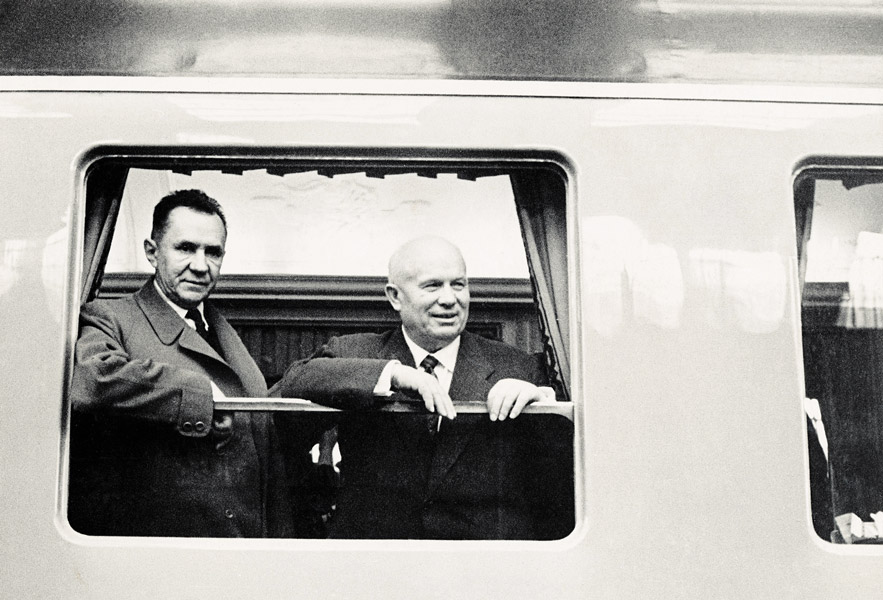 A.N. Kosygin and N.S. Khrushchev in a government train. Beginning of the 1960s. Photo: Family Archive A.N. Kosygina
Sometimes Mitrokhin uses very dubious sources. For example, notes with reference to an interview, published by such a “respected newspaper” as “Red Star”, which, by the personal instructions of Brezhnev behind Kosygin, was carried out continuous surveillance with listening to telephone conversations. This, of course, is shocking information, and I agree with Mitrokhin that it is worth giving her reader. But maybe in such cases it is worth stipulating that the probability of her veracity is not so great? In another place, the author gives a link to one St. Petersburg television journalist. I can, as a Petersburger, inform you that it was a very cute, pleasant person in communication. He repeatedly interviewed me. And once, in the interval between the filming, he enthusiastically told me about how the Putin leadership claims his key decisions in Washington. Honestly, I would not refer to the information of this journalist in any case. Better on the Red Star.
The back of the same problem of Mitrokhin is the lack of links to a source in those places where they are necessary. The author assures us, for example, that Brezhnev publicly, albeit in a narrow circle, transferred the authority in the field of economic planning after the death of Kosygin. This is very interesting. I would like to know where the author of the book became known to the author of the book in the narrow Brezhnev circle. But there is no link at all. Maybe only a joke?
The entire third part of the book is devoted to various theoretical scientists and journalists who, according to Mitrokhin, made up “groups that influenced economic policy in the 1960-1970s” . It was interesting for me to read this part, because it tells about political officers, whose works were forced to teach on a student bench. One of my colleagues shuddered when he saw in the table of contents the name of the odious Moscow Professor Tsagolov. But the fact that most of this audience at least really influenced something, except for writing books and setting assessments to students, Mitrokhin did not convince me at all. One of his heroes said best of all: “University political students can really talk very noble, say, the distribution of the total public product or national income, but few of them saw with their own eyes how a new cost is created.” I’m not sure that such a detailed story about the “near -economic” public, among which there were many frank charlatans, earned inclusions in the already large monograph.
All the "scientific" discussions of the times of my student youth were a storm in a glass of water. The brightest “storm” was the defense of the doctoral dissertation of the only faithful Lenin at the Economic Faces of LSU Mikhail Vasilievich Popov. The largest audience of the faculty was crowded. People "hung on chandeliers." It was still far from perestroika, but all our “traders” gathered then to cut down the anti -header Popov. And he organized the phenomenon of workers of the Kirov plant, who asked for words and claimed that the work of Mikhail Vasilyevich called “democratic centralism - the basic principle of managing the socialist economy” greatly helps them fulfill the plan. In general, who was on that defense, he does not laugh in the circus. And Popov to this day is creatively active. Goblin himself writes to his many books. Любопытная получается эволюция верного ленинца, не оказывавшего, к счастью, влияния на экономику. Если я хочу развлечь своих слушателей, то привожу на лекциях пример с Поповым, но не делаю вид, будто эта «наука» имеет отношение к экономической политике.
Но раз уж Митрохин написал о науке, необходимо исправить некоторые его ошибочные оценки. Так, например, характеризуя клиентелу советского идеолога Ричарда Косолапова, автор включает в нее Станислава Меньшикова, а затем делает вывод, что «это были убежденные и вполне „ортодоксальные“ по советским меркам поклонники большевизма в его радикальных формах» . Никаких доказательств большевизма Меньшикова он не приводит, кроме упоминания того, что Станислав Михайлович был сыном сталинского министра внешней торговли. Но мне это имя известно со студенческих времен. Меньшиков был одним из лучших для своего времени исследователей капиталистической экономики, сравнительно мало использовавших в своих книгах ритуальные фразы, необходимые для прохождения цензуры. Его небольшая работа «Современный капитализм. Краткая политэкономия» (1974 г.) значительно лучше стандартных учебников излагала суть рыночной экономики второй половины ХХ века. Более того, в отличие от политэкономов марксистской школы, Меньшиков старался использовать математический аппарат, характерный для западных книг. Весьма профессионально был написан его труд «Инфляция и кризис регулирования экономики» (1979). Но самое интересное: Меньшиков уже в раннюю перестройку представил советским читателям книгу своих диалогов с ведущим американским экономистом Джоном Кеннетом Гэлбрейтом «Капитализм, социализм, сосуществование» (1988) — известным сторонником конвергенции. То есть Меньшиков сделал в науке примерно то же, что Владимир Познер со своими телемостами сделал для массовой советской аудитории. Судя по отсутствию этих книг в списке литературы Митрохина, он с ними не знаком. Есть только мемуары Меньшикова, но из них невозможно сделать вывод о большевизме мемуариста, хотя, бесспорно, либералом он тоже не был.
Если Меньшикова автор незаслуженно «сдвинул» влево, то Юрия Андропова — вправо. Митрохин полагает, что приоритетом Андропова «было строительство социализма по „шведскому образцу“» . Но вообще-то, сколько бы мы ни говорили о так называемом шведском социализме, в основе скандинавской модели социально-экономического развития все же лежат частная собственность и рынок (пусть сильно дополненные госрегулированием). «Шведский социализм» гораздо ближе к капитализму, чем советская модель экономики. Нет никаких оснований говорить о намерениях Андропова реформировать советский социализм в шведском направлении вплоть до введения рынка и приватизации. Юрий Владимирович, конечно, интересовался, как умный человек, самым разным зарубежным опытом, но из фактов, приводимых самим же Митрохиным, следует, что порывать с основами советской экономики при Андропове никто не собирался. Без странного «шведского вывода» текст соответствующего раздела книги смотрится гораздо лучше. Вполне могу его рекомендовать читателю.
Хуже обстоит дело с разделом о горбачевской перестройке. Митрохин полагает, что «жажда реформ» Горбачева — Рыжкова — Лигачева «на самом деле в основном была формой лоббирования интересов отдельных групп менеджеров некоторых отраслей» . Мне приходилось в научной и публицистической литературе видеть разные оценки причин перестройки, но такого «приземления» важнейшей эпохи нашей жизни, встречать еще не доводилось. Впрочем, перестройка — настолько сложное и многоплановое явление, что здесь невозможно обстоятельно обсудить столь радикальный тезис автора «Очерков». Оставлю это до другого раза.