
Translated material
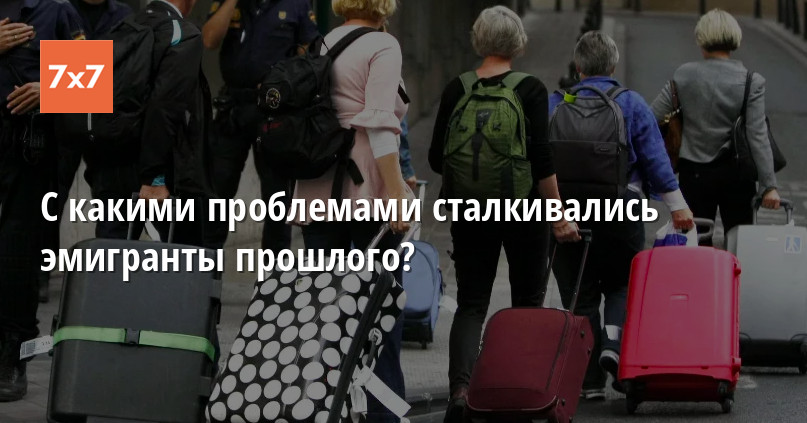
What problems were the emigrants of the past faced?
This is a personal blog. The text could be written in the interests of the author or third parties. The 7x7 editors are not involved in its creation and may not share the author’s opinion. The registration of blogs on 7x7 is open for authors of various views.
In 1917, due to the revolution, people multiplied from the collapsing imperial Russia from the nascent Soviet Union. And in the course of the 20th century, people somehow found ways to leave the USSR. The modern wave of emigration is often compared with that wave of refugees and this comparison is quite conditional.
What problems are emigrants face?
Firstly, this is an unfamiliar environment where people had to adapt to new living conditions and work on low-paid work that did not correspond to their qualifications. In principle, this parameter has not changed in our time. Well, almost nothing: the fact is that the pool of work in principle has become larger and many modern emigrants can still work remotely. And in principle, the development of labor and the sphere of services as a whole allows you to seek yourself in many more spheres.
A conditioned photographer during emigration has a chance to still remain a photographer, his work is universal. Florists, barista, marketers, programmers, organizers of events, designers: modernity increased the number of possible professions and competencies. Yes, there are still people who have a waiters from doctors, because modern medicine has become a rigidly adjustable sphere, where you need to confirm the diploma and, possibly, undergo retraining, and yet there are much fewer people.
Secondly, emigrants often came across linguistic and cultural barriers, which could complicate their integration into a new community. This is also an eternal problem and now discuss a lot about whether new emigrants will dissolve in world culture or form a Russian -speaking community. A lot of people are leaving, they can form diasporas. But there is nothing good in this: trying to preserve the usual language and culture means to constantly remain in limbo and create a cozy, but fake world. When emigrating, it is necessary to learn the language and integrate in order to build a full -fledged life, and not a hut in anticipation of a return that may not happen.
And today it is much easier than at the beginning of the 20th century. Due to globalization and thanks to the Internet, we generally know much better with other cultures and customs, they are not quite alien to us, they do not shock us. The world has become generally much more homogeneous and similar, and in most countries it is very easy to find intersection points. Everyone wear the same clothes of the same brands, and it is easy to start any resin from the discussion of the series “Game of Thrones”, which, most likely, watched in Georgia, Bali, and Israel, and in the USA.
Thirdly, they often lost touch with their relatives and friends, which created a feeling of loneliness and isolation. And we are still completely eliminated from this problem. No one is going to do with it. We can calmly maintain communication with relatives and friends and not feel thrown into an absolutely alien ocean. Now it’s hard for us to imagine how this may not be, and we can’t even evaluate how lucky we are.
In addition, from the pleasant bonuses of modern civilization: in the past, most emigrants left in a hurry and were forced to leave their property and savings. Now we have many problems with the withdrawal of money from Russia, but this is not at all the same as exchange diamond earrings for a bowl of food. It is much easier for us. It is clear that such comparisons do not greatly change life: Russian emigrants are constantly compared with Ukrainian refugees, speaking about how their problems are insignificant, and, on the one hand, this, of course, is true, on the other, this does not at all affect the person’s self -perception of the situation in which he finds himself.