
Translated material
What to read about Russian Reformation
Seven (half) books about Pashkovtsy and their faith
The history of Russian Protestantism began in the 19th century, and not somewhere, but in the highest circles of St. Petersburg society, but today we know little about this. To correct the situation, Philip Nikitin decided to talk about books that will help to better understand the movement of the Pashkovites - the followers of the teachings of the Christian preacher, the English Lord Grenville Rybstok.Starting from February 24, 2022, we were all in the face of the advancing barbarism, violence and lies. In this situation, it is extremely important to preserve at least the remnants of culture and support the values of humanism - including for the sake of the future of Russia. Therefore, the editorial office of Gorky will continue to talk about books, reminding our readers that the world remains in the world and fiction.
In 1874, St. Petersburg was visited by the Christian preacher Lord Grenville Redist. With his arrival in the capital, an amazing religious movement arose, whose participants were representatives of high society. Among them, Count Alexei Bobrinsky is the great -grandson of Catherine II and the former Minister of Railways, Julia Zasetskaya - the daughter of the hero of the Patriotic War Denis Davydova. Later, the traffic was headed by the retired guard, Vasily Pashkov, by whose name they began to call his followers. This movement could not go unnoticed - both by the authorities and the best minds of post -reform Russia. Pashkovtsy picked up the attention of Dostoevsky, Tolstoy and Leskov. The latter, by the way, wrote an essay on the Lord and his followers.
The study of Pashkovites is at the intersection of social, intellectual and religious history. They were engaged in enlightenment and charity, but the main thing for them was a sermon. Thanks to Jesus Christ and Vera, and not to good deeds, a person receives salvation: this is how they thought and so preached and taught. The Pashkovo movement demonstrates the erasure of social barriers: the princess and the count made prayers along with workers and peasants. This religious movement is associated with the imperial surname: Rydstok invited the granddaughter of Nicholas I to Russia, and the Empress, wife of Alexander III, Maria Fedorovna, was the addressee of the Lord. Representatives of the movement thought a large -scale, and directed their religious activity up to the emperor. In 1876, Grenville wrote: “We have only“ five small breads and two fish “in order to saturate this many - 80,000,000 Russians who surround us <...> pray for the emperor and his last name - so that they can soon sing a new song with the glory of an immaculate lamb with the masses of our people.”
Below are books that will help us understand what Pashkov’s movement was.
Edmund Heyer. Religious split among Russian aristocrats in the 1860-1900s: Redstokism and Pashkovshchina. M.: Icarus, 2002. Translation of Viktor Silchuk. Content
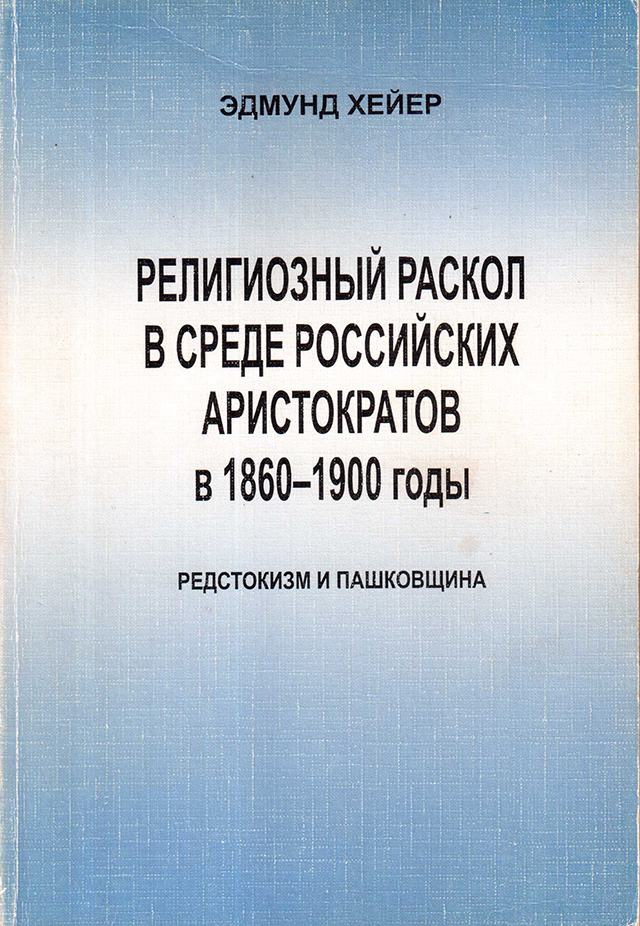 Perhaps the first solid academic study of the topic was the book of the Canadian Russianman, a professor at the University of Waterloo Edmund Heyer (1926-2004), which was published in the Netherlands in 1970.
The look at the heroes of the book is due to the interests of the author related to the study of Russian literature. In general, the reflection of the Pashkovsky movement in Russian literature of the XIX century is devoted to the largest chapter. We will have a mention of not only familiar names (Dostoevsky, Tolstoy and Leskov), but also less obvious (Meshchersky and Boborykin), when it comes to the reflection of the topic in literary texts. If you are interested in how this religious movement influenced the writing of the novels “Sunday” and “Anna Karenina”, feel free to open the book of Edmund. No one wrote about it better than him. By the way, the writer’s closest friend, Vladimir Chertkov, was Pashkov’s nephew, and his mother, Elizabeth Chertkov, was a follower of the rafstock. In the book of Heyer there is even a section: "Chertkov is the most devoted follower of Tolstoy and the connecting link between the redstocks and the novelist."
Despite the fact that over time, the work of the Canadian scientist raised a number of issues among researchers, its significance for immersion in the topic is colossal. The great merit of the author is that he conceptualizes and contextualizes the object of his study, while providing place and narrative presentation. This is the value of his work.
“The purpose of this movement was a religious update that would lead to the transformation of Russia on moral and ethical principles. These aristocrats, men and women, in the days of their youth are indifferent to faith, never stopped in search of solutions to both their own problems and Russia's problems. They believed that the solution to these problems can be based on the moral and religious principles of gospel Christianity <...> we will see that the movement in the aristocratic environment was akin to the Christian socialism of Tolstoy <...> Pashkov, for the first time, was made to eliminate the social abyss that separated the masses from the privileged classes <...> more than any of the conventional noblers, there was, concerned about religious, moral and social problems; He was more consistent in the implementation of his teachings in practice, even more than Tolstoy himself <...> for many contemporaries, he was a truly repented nobleman. "
Cheryl Corrado. The philosophy of the ministry of Colonel Pashkov. SPb.: Bible for everyone, 2011. Translation of Marina Karetnikova. Content
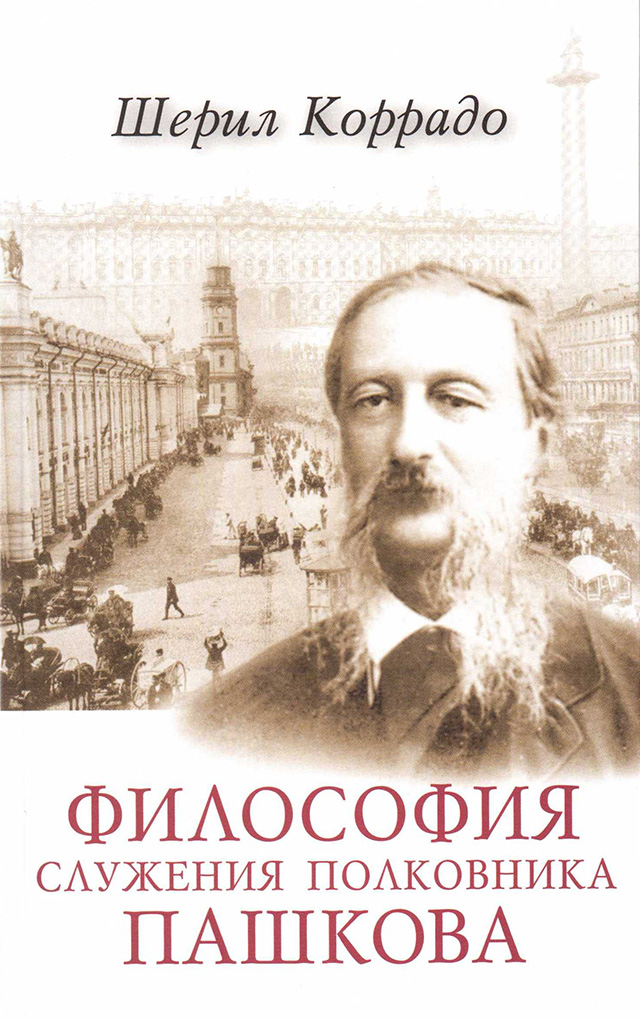 My acquaintance with the Pashkovsky movement began in the 1st year of study at the Institute of History of St. Petersburg State University. The work of Corrado was one of the first I picked up. She became my guide in the subject. This book is the translation of the master's thesis, which Cheryl defended in 2000 at the Whiton College (USA). Now she is teaching at the Department of History at the University of Pepperdine (USA).
The nature of the work was influenced by the fact of its writing in a Christian educational institution. This can be traced at the level of rhetoric and sentences of the author. Despite this, the book of Corrado is filled with interesting thoughts and abundant actual material based on attracting accessible sources and literature in Russian, English and German. By the way, according to our observations, it is Christian historians (we are talking about personal religious identification of the authors, and not how it manifests itself in the methodology of their work) made the greatest contribution to the study and popularization of the Pashkovsky movement.
The book of an American researcher can no doubt be called classics at least in Russian -speaking space. She withstood two editions and did not lose her influence and significance. It is from this book that I would recommend starting familiarization with the topic.
“Brotherhood between different nationalities and social classes was the determining factor in the Pashkovsky movement. Being in a sharp confrontation between the social norms of that time, this unity of more than anything else attracted the newcomers to the movement, at least out of pure curiosity <...> one can consider the Pashkovsky movement as a temporary social movement, religious awakening or Russian reform, but it is obvious that the Pashkovites played a significant role in the society in which they lived. Devoting their lives to the service of God and the neighbor, they crossed social and cultural barriers in an attempt to share their faith <...> many customs of modern gospel Christians-baptists in Russia are rowing in the faith of the Pashkovites and those who were connected with them. ”
Johannes Dick. At the cradle of the Brotherhood. Johann Wiler (1839-1889) and communities of the first gospel believers in Russia. Steinhagen: Samenkorn, 2017. Translation from English Oksana Beznosova, from German Daria Milancheva. Content
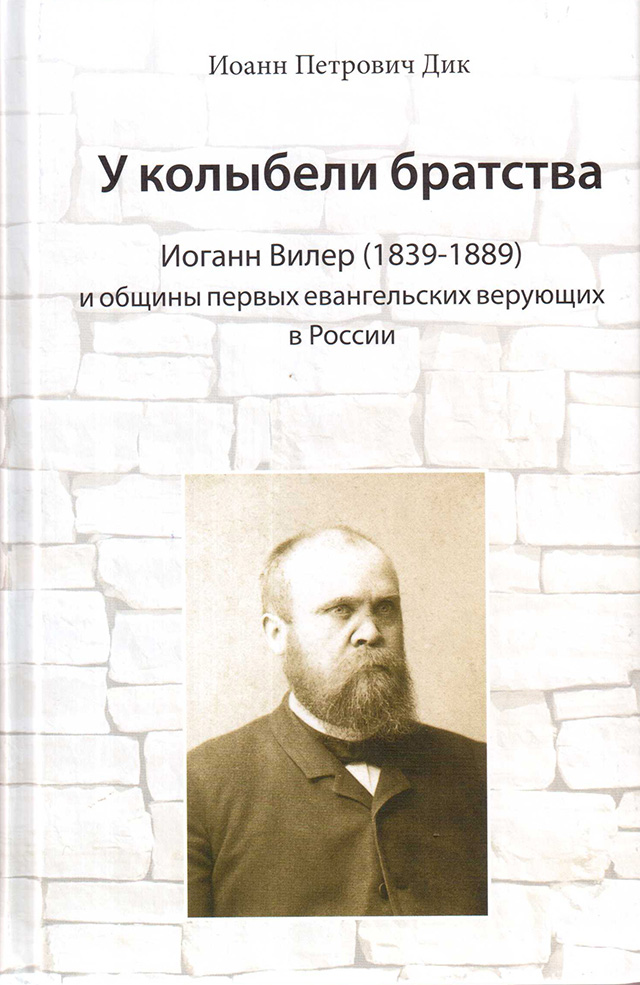 This book is the only selection that is not devoted directly to the Pashkovsky movement. There are several reasons for that, but first a few words about the author and the fate of his text.
The book grew out of the master's thesis, protected by the author in 2007. After 10 years, the text was published in Russia (exactly by the 150th anniversary of the baptism of the first Russian Baptist). In the Russian -speaking version, it is supplemented by a weighty application that is almost half of the book.
The author of the book, Johannes Dick, is now a doctoral program of the Free University of Amsterdam and a researcher at the Museum of the Russian-German Culture History. In his work, he considers the movement of the Pashkovites in the context of a larger gospel movement, part of which, in addition to the Pashkovites, were Baptists and Stundists. Moreover, the author looks at the religious movement of interest to us from the point of view of its structural forms.
Another advantage of the book is the publication of letters to Pashkov from Wilee, his co -worker in a huge Russian religious field. This is the only successful attempt to publish a rather big fragment of Pashkov voluminous correspondence, stored at the University of Birmingham.
Dick's book is characterized by generalizations and conceptualization. However, the author assumed that his text in the future would find a Russian -speaking reader and left a place for the usual narrative presentation.
“The third, completely different idea of the fraternity and the church in Russia was divided by persons who ranked themselves to the supporters of the ideals of the Gospel Alliance and who no longer considered the Church as a confessional phenomenon <...> with the direct participation of the nobility, the new movement acted and organizer of a number of basic social initiatives and gained the features of the fraternity, which gave some reason to see the beginning of the spiritual reformation in it Society <...> The idea of Pashkov is the creation of the Gospel direction within the Orthodox Church, similar to one of the directions in the Anglican Church, to which Lord Redistov also belonged, was not understood and suppressed by the Orthodox clergy. ”
Andrey Puzymin. The tradition of gospel Christians: the study of self -identification and theology from the moment of its origin to the present day. M.: BBI, 2010. Content
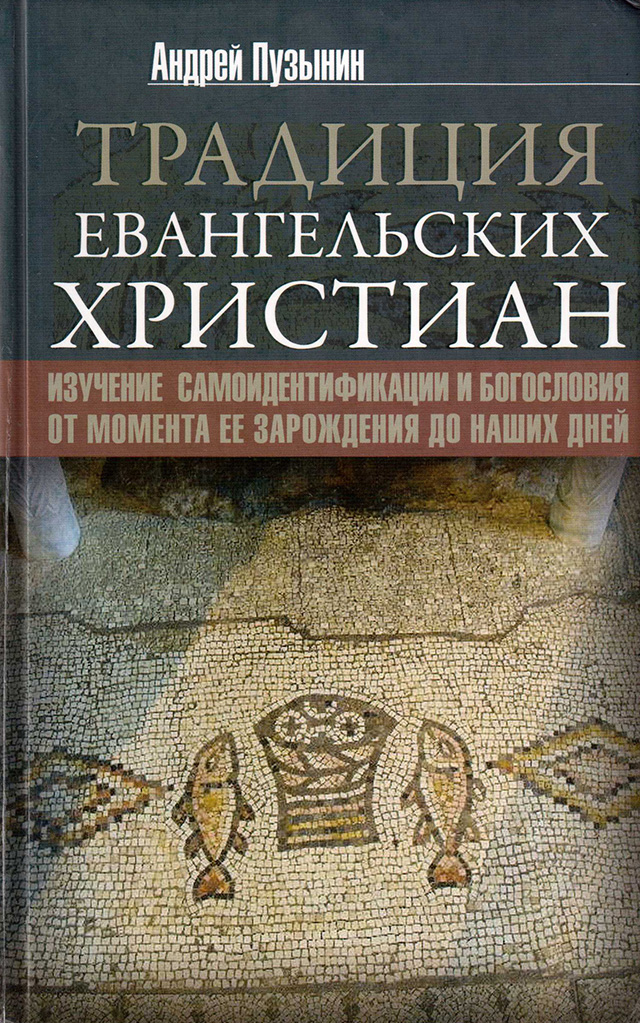 I believe that reading this book will be the most labor -cost activity, but it is worth it. The work deservedly falls on the list, and the author warns the reader about the complexity of the language in the preface. The presentation of the material is due to the interdisciplinary character and the specifics of the Western Academy. The basis of the book is the author’s doctoral dissertation, defended in 2008 at the University of Wales. In the past, Puzynin worked at the Donetsk Christian University (1997–2001), now he is a professor of practical theology at the International Institute of TSM (Austria).
This book is unusual in that the author chose a pioneer research optics through which the Pashkovo movement is considering. The work uses the concept of theological paradigms of the famous theologian Hans Kung, which represents the adaptation of the theory of scientific paradigm Thomas Kun (it was Kung who gave his recommendation to publish this book in Russian). Puzymin also involves the philosophical program of Alistair Macyntire. The author of the Mennonitsky and Lutheran theologians John Ioder and George Lindbek is also attracted.
This study is, first of all, about the theological component of the movement, especially about the religious views of Pashkov and Rydstok. At the moment, it is the best in this area. The main pathos of the book is the tradition is due to the context. The book contains a place for Westernism, Slavophilism, messianism, romanticism, as well as modernism. This is what she captures. The author, for example, notes that Vasily Pashkov saw Russia part of Western civilization. In the work, there is a place to criticize historiography. In this regard, we note that after the release, in turn, she fell into the hands of a critical reviewer .
Despite this, reading the book of Puzynin is a difficult but fascinating journey to which I invite you.
“... Pashkov’s vision had a geopolitical dimension that was either not noticed or underestimated in earlier studies. Pashkov took a pro -Western position in the debate between the Slavophiles and Westerners <...> The evangelical movement in Russia was inspired and inspired by the idea of the Messian role of the Russian nation. This performance is based on faith, painted with chiliastic motifs, widespread in Russia of the 19th century both among Slavophiles and among Westerners . ”
Modest Korf. At the royal court. Corntal: Light in the East, 2018. Translation of Maria Vince. Content . Read
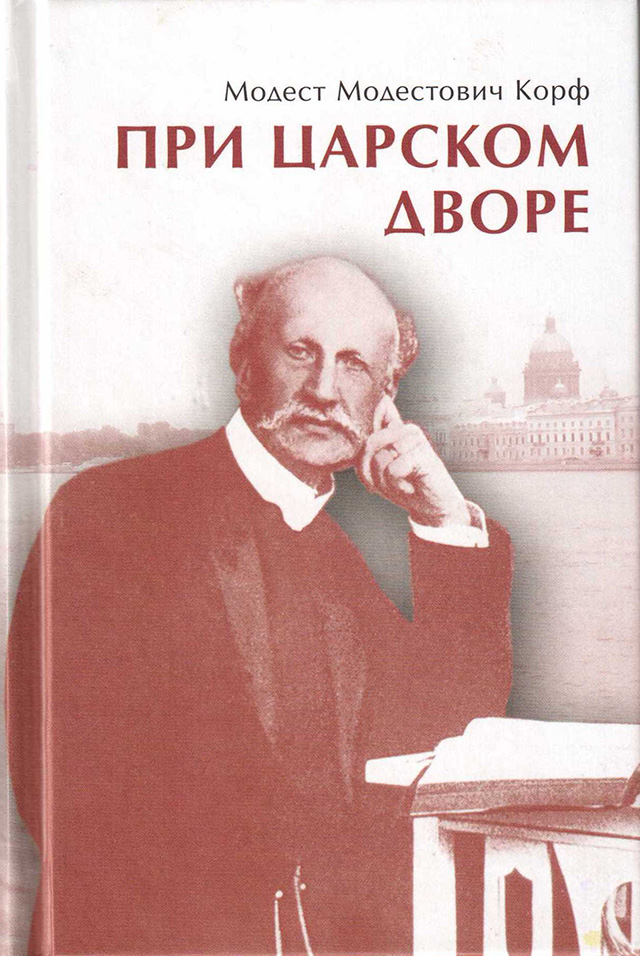 The followers of the Rydstok and Pashkov were wealthy and influential people. One of them was Count Corf. His father, a graduate of the Tsarskoye Selo Lyceum and classmate Pushkin, was a bright statesman of the Nikolaev era, director of the imperial public library. At the age of 18, the modest entered the public service. He was at the imperial court and rose to the rank of Hoffmarshal. In his memoirs, he notes that he was close to the imperial family.
Korf will write about his religious appeal in the magazine "Christian", which was published by the successor of the case Pashkov Ivan Prokhanov. In the memories of this, a place is also given. In 1874, the modest became a follower of Lord Redstock and is included in the active life of the Pashkovsky movement. In 1876, with his co-religionists, he establishes the “Society for the Promotion of Spiritual and Moral Reading”, the task of which, according to the Charter, was to provide the people with “the opportunity to acquire at the very cheap price of the book of the Holy Scriptures of the Old and New Testament and the composition of the spiritual and moral content”. Together with his friend, Pashkov, Modest in Tea, preached to the cabrs, and was also the director of the St. Petersburg Ladies Committee of the Tower Society for Prisons.
In 1884, he was given an ultimatum: either he significantly limits his religious activity, or leaves Russia. This is how Korf recalls this.
“And I answered the minister:
“I know the emperor.” I appreciate and deeply respect him. I know him as an honest and kind person, with a wide soul. I know that His Majesty respects people. But I can not act against my beliefs and against my conscience.
“In case of non -signed,” the minister replied, “the emperor ordered you to send you from Russia.”
“I obey the will of my master and remain his faithful subject.” I will love him with all my heart and until the end of my days I will preserve a sense of respect for him. ”
Korf lived in Switzerland, where in his declining years he sat down to write memories that allow us to plunge into the history of this amazing religious movement.
Sophia Liven. Spiritual awakening in Russia. Corntal: Light in the East, 2016. Content . Read
 Another witness to the Pashkovsky movement, which published memories, was Princess Lieven. The Livenov clan, who has a long and glorious story, left his mark on the Russian land. For example, Anatoly Liven was a participant in the white movement and commanded the Liven detachment. Of the living representatives of this kind, the brothers Anatoly and Dominic Liven should be called. The first is a political scientist, the second is a historian.
Sophia's father was a statesman and had the rank of secret adviser. Mother is an active participant in the Pashkovsky movement. Her house is located on Bolshaya Sea Street. The architect Montferrand, the main creation of which is completely nearby, put his hand to him. This house is closely connected with the history of the movement itself. Later, the Italian embassy is located in it.
Sophia tried to leave the USSR in the 1920s, but she was able to do this only in the next decade. Abroad, she actively collaborated with the Missionary Union "Light in the East."
Her book was written in a lively and fascinating language and has been reprinted more than once in Russian. Reading it, as if you yourself find yourself a participant in those events.
“I was born when this movement has already begun, and the first years he flowed in my early youth. In childhood, you pay little attention to important incidents. Nevertheless, the stories of the elders, my relatives, were imprinted in my heart and left in memory a clear idea of how Russian society persistently searched for Christ as their personal Lord and Savior. Later, I was also given participation in the Russian Gospel movement, and therefore I have the courage to write about what I remember <...> Vasily Alexandrovich was not limited to meetings, he went to hospitals and prisons, so that the patients and prisoners to bring good news of Christ. There were amazing appeals among criminals, as well as healing patients by faith <...> the kindness and generosity of Vasily Alexandrovich Pashkov were fabulous. They say that the controller of his estate asked him to reduce his generosity. In the vicinity, it became known that this landowner helps everyone who appeals to him with need. As soon as they found out that Vasily Alexandrovich was on his estate, petitioners immediately flocked to him from all sides. ”
Philip Nikitin. V.A. Pashkov (1831-1902): Life and Service. Corntal: Light in the East, 2020. Content . Read
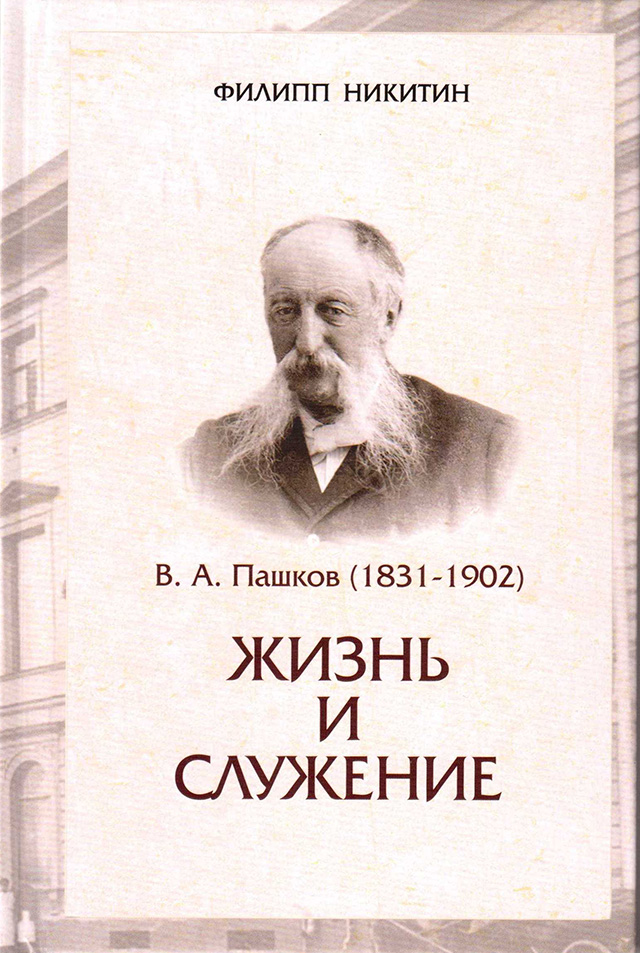 It’s a little embarrassing to recommend my book, but it turned out that at the moment it is the most thorough study of Pashkov’s life and activity. In the form of a book, this is his only biography. I will not be verbose (especially since four reviews came to it). For me, it is valuable primarily by the abundance of factual material. I tried to cover the literature on the topic as much as possible and various historical sources. In this book, I seem to have first raised the topic of historical memory. Chapter "V. A. Pashkov in the historical memory of the modern gospel community ”is one of my loved ones.
Pashkov believed in the quick coming of Christ. This was probably encouraging him to write a brochure “taken by surprise”, published in the book in the form of an application. Если коротко, она о готовности людей к этому событию.
В этой брошюре Пашков находит место и для разговора о книгах.
«Пусть ответит совесть каждого. Живет ли он ежедневно в общении с Богом, в общении с Отцом и Сыном, так, что пришествие Иисуса Христа будет для него осуществлением того, что он предвкушал верою? <...> Читает ли он такие книги, которые при первых лучах появления Господа в славе он с ужасом бросил бы в огонь?»
В 2031 году исполнится 200 лет со дня рождения этого религиозного и общественного деятеля. Хочется верить, что к этому времени будет издана более обстоятельная биография чем та, что написана мной.
PS Я не могу хотя бы коротко не упомянуть про готовящуюся к выходу книгу «Пашковцы: сборник статей и документов по истории и богословию движения (1874–1920)». Ее подготовил Владимир Степанов, на мой взгляд, лучший на данный момент специалист по пашковскому движению. Я написал предисловие к этой книге, и с разрешения автора оно доступно по этой ссылке . Прочитав его, можно сделать некоторое представление о книге и ее значимости. Книга должна выйти уже в этом году.