
Translated material
In the stupid maze of censorship and power
Interview with the historian of literature Svetlana Voloshina
Why did Nicholas I close magazines like “domestic notes”, although he would like to get rid of them? Why did the head of his secret police write reports reminiscent of a criminal-erotic novel in places? And does Satan spread a stench smell when he comes to tempt an invisible way of the Minister of Education? Last year, the Publishing House of the RANEGS released a large study by Svetlana Voloshina, dedicated to how literature and journalism were professionalized in Nikolaev Russia in the conditions of severe censorship. At the request of Gorky, Timothy Anufriev spoke about this book with her author.Starting from February 24, 2022, we were all in the face of the advancing barbarism, violence and lies. In this situation, it is extremely important to preserve at least the remnants of culture and support the values of humanism - including for the sake of the future of Russia. Therefore, the editorial office of Gorky will continue to talk about books, reminding our readers that the world remains in the world and fiction.
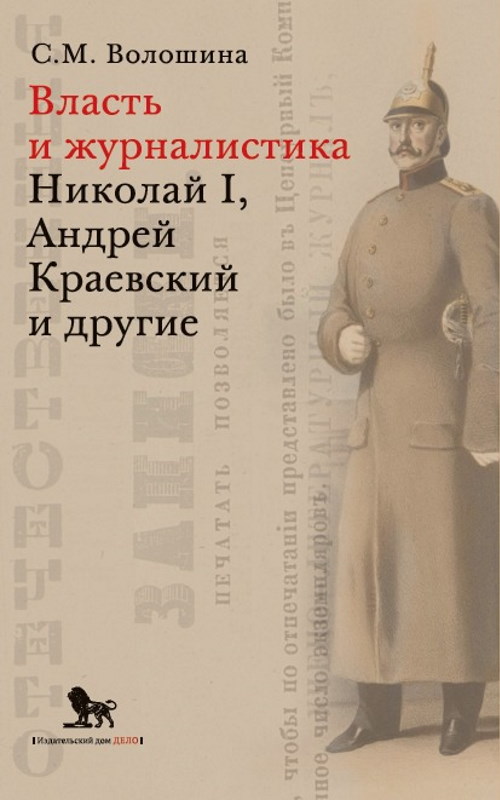
Svetlana Voloshina. Power and journalism. Nicholas I, Andrey Kraevsky and others. M.: Publishing House "Delo" RANEPA, 2022 . Content . Fragment
 - Your book is dedicated to journalism in the Nikolaev era. How did you come to this topic and why did you consider it deserving close attention?
- I came to this topic quite by accident. Initially, I was engaged in revolutionary democrats: Herzen, Ogarev and did not join them Pecherin, my candidate dissertation was dedicated to them, I wrote the book “Utopia and Life” about Ogarev. In the laboratory of historical and cultural studies in the RANEPA, where I work, I now have a project related to Herzen. It seemed to me that I would continue to move in about the same direction, but when I began to delve into the details, I found a lot of interesting things in the era of Nicholas I. I was interested in the status of magazines and newspapers of that time.
I began my studies with Nekrasov, but I didn’t like it as a person at once, besides, many people wrote about him. So I switched my attention to another person, undeservedly bypassed by attention - to Andrei Alexandrovich Kraevsky. In his publications, including in the journal "Domestic Notes", for example, almost all of Lermontov and the doctorship Dostoevsky were published. This magazine itself became a long -liver in its category, but when it comes to Kraevsky, they usually do not pay attention to this. In Soviet historiography, they write about him as an opportunistic publisher and an exploiter who drank the blood of everyone he could reach, and then there are some terrible details like the one that when Belinsky wrote for Kraevsky, his hand “dumped”. The nuances - for example, that Belinsky played cards for most of the month and did not write anything or that his editor had to “conduct” a whole thick encyclopedic magazine, printing a lot of not the last authors, as a rule, they fall.
Having become interested in Kraevsky, I decided to write his biography and went to St. Petersburg to study the archives, but there was disappointment. It turned out that Kraevsky did not write anything about himself. He was a completely closed person. Where in his letters begin (or rather, should begin) and gossip about relations with writers or incidents from life, Andrei Alexandrovich breaks the text and makes a postscript: “We will talk about all this at the meeting.”
Then I went to other archives, RGIA and GARF, to look at censorship. There it became clear to me that a completely different look at the problem of magazine was possible - not only from those who were engaged in journalism, but also from those who tried to limit it. So I switched “to the dark side” of censors and those in power.
And the deeper I went in the censorship-loud system, the more I tied there. Firstly, we are talking about a large amount of completely unexplored information, and secondly, in this abundance begins to see the contours of how our power is arranged. Thus, my attention gradually shifted from the personality of Kraevsky to the general picture of the interaction of the press and power.
Initially, I planned to cover not only the Nikolaev era, but also part of the reign of Alexander II, since it was at this time that Andrei Alexandrovich published one of the most popular liberal newspapers - Voice. However, there was so much material that in the end I abandoned this idea: the study already happened huge.
Some of the materials of my book is already known to researchers, but it has not been reprinted since the beginning of the twentieth century, and something was put into scientific circulation for the first time. For example, the diaries of M. A. Korf. They have already begun to publish, but, unfortunately, the matter is going very slowly. Meanwhile, Korf was not only the State Secretary and a member of the State Council, but also included a considerable number of committees, including the Committee on Supervision of Censorship, or rather both committees. He described his work in these committees in detail in the diaries.
- What gives the researcher a view of the history of journal from censorship and power? Which of the representatives of the power structures was most interesting to you in this regard and why?
 Svetlana Voloshina
- This approach allows us to understand how the authorities perceived their subjects in general: most of private initiatives - even at the level of articles and cautious issues - not only annoyed it, but were perceived as an attempt to usurp the sphere, which, the authorities, considered its inviolable property. Veright models of thinking and decision -making mechanisms are clearly visible. For example, constant extrapolation: if the article expresses dissatisfaction with the postal department (letters go for a long time, are lost), then the author undermines the foundations. The postal department is a state structure, and you, criticizing it, will soon reach the criticism of the autocrat.
In addition, in the middle of the 19th century, the authorities have not yet developed a sufficient number of streamlined standard chancellery, its tongue remained very figurative and in its own curious. He is curious, in particular, by the fact that sometimes with almost Freudian frankness expresses the fears and desires of the authorities, that is, its agents. For example, in one official document of 1847, “the desire of some authors to excite the unbridled impulses of patriotism in the reading public,” is cautious. Or, for example, the order, how in the periodicals the events that occurred in the revolutionary Paris of 1848 should be described: "In the bright colors of the disgust that they deserve." Symptomatic is also a suspicion of formulations from Western philosophy and science, not entirely understandable to the authorities and therefore subject to the prohibition: “The spirit of the former foggy philosophy and, if it is allowed to express this magazine, which gave the intentionally unclear of ideas and a set of words a wide field to arbitrary reasoning and application.” What?
As for interesting representatives of the authorities, now I have two favorites: Leonty Vasilievich Dubelt and the modest Andreyevich Korf - smart, educated, very observant (“close -looking”, as Dostoevsky would say), angry. More precisely, not angry, but related to the human race with the interest of a passionate entomologist, and to gossip-scientifically analytically. In addition, a person’s extremely ambitious, most of his time in a dramatic state: there were rumors that this or that ministerial post was being sent to him, but in the end they took another, of course, fool and mediocrity to the ministers. And Corf is the “track record” of the next “mediocrity”, starting with his professional qualities and ending with personal inclinations. And since Korf clearly dreamed of the place of the Minister of Education, the reader of his diaries will learn a lot of his diaries about current ministers and backstage intrigues. Including, for example, that S. S. Uvarov dyed his hair about his erotic inclinations prohibited in the territory of the modern Russian state, and so on. And about the next minister, P. A. Shirinsky-shochimatov, Korf reports how he “asked one bishop to the question: when Satan comes to tempt someone invisible, then the stench smell spreads from him?”
My second favorite, L.V. Dubelt, is the manager of the III department and the head of the headquarters of the gendarmes corps, officially a second person in the political police, in fact, the main one. He knew literally everything that was happening in the state, pursued exclusively his own interests, which included cards, actresses, money and other joys, was smart, polite, was friends with writers and, in particular, helped Kraevsky “put on his feet” his magazine - Kraevsky, unlike F.V. Bulgarin, did not provide retaliatory services of the secret police. And what Dubelt composed the reports-almost criminal-erotic novels were obtained! I think I will write something separately about him, the country should know its heroes.
- What was Russian journalism at that time, what was its role in public life and culture, and also how it correlated with fiction?
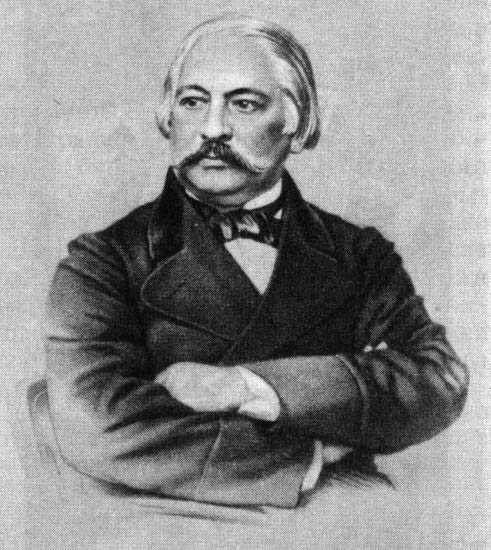 A.A. Kraevsky
- Since we are talking about the 19th century, we are talking about the eyelid of magazines. Literary works were first printed on their pages. Thick encyclopedic magazines were guides to the world of literature, as well as popular science. The independent publication of their books was expensive and ineffective. There were problems with distribution, because at that time most of the readers lived in the province. These were the nobles who did not understand the trends and new products very well, but they wanted to read, so they simply signed the magazines that came to them once a month with mail. There was everything in these magazines: here you have a piece of the novel, here the critic will tell you how to perceive it, and then you can do the tips on the household, and in the end - fashionable pages that were cut out by wives or daughters. Therefore, everyone preferred to be printed in magazines.
It is worth making a reservation that there was no division into “critical” and “protective” publications then. There could not be even approximately opposition journalism under Nicholas I: every hint of discussion was perceived as an encroachment on the authority of power. The unofficial and often opposition was only manuscript literature, which has always existed. She did not give in to censorship and remained the headache of the state, which unsuccessfully tried to fight her.
It is interesting that in the 1840s, especially after the “spring of the peoples” of 1848, the magazines were not prohibited directly. Of course, the authorities wanted to get rid of them, but only indirectly prevented the release of objectionable publications. Several times I came across the correspondence of power persons, in which the possible negative consequences of such prohibitions were discussed: after all, readers will immediately run to watch what they banned, lifted the old numbers, and will find opposition statements even where they are not at all. Therefore, under Nicholas I, prohibitions rarely happened (cases from the 1830s were widely known, when the authorities collapsed to the magazines “Moscow Telegraph” and “Telescope”). Even during the "gloomy seven years" they tried not to prohibit anything directly.
In general, there were not so many magazines in the Nikolaev era. The first to come to mind is the “Reading Library” by O. I. Senkovsky, who began to go out in 1834. Senkovsky was a historian-military man and a man of indefatigable energy. He regularly rewritten or prescribed other people's manuscripts, and also quite generously paid for the work of his authors. In his journal, fiction, criticism, and articles on various other issues were published. Criticism, however, was completely frivolous, because Senkovsky aimed himself the goal of entertaining the reader.
The second magazine was actually “domestic notes”: Kraevsky in 1839 rented a decrepit edition from P.P. Pvinin. The fact is that the new periodicals under Nicholas I appeared extremely rarely - the usual autocrat’s resolution on incoming petitions was “already a lot” or “already a lot of nonsense is printed”. Therefore, it was necessary to rent existing publications from their happy owners, and for a lot of money.
So, the magazine "Contemporary" in 1846 was rented by P.P. Pletnev by N. A. Nekrasov and Co. At the same time, Belinsky and several other authors passed there from the “domestic notes”. However, after 1848, “Contemporary” was in the same position with Kraevsky’s magazine: with an almost complete impossibility to print foreign literature, for example, French novels, new numbers looked rather pale. Therefore, Nekrasov with his mistress Avdotya Panaeva, the wife of his co -editor, themselves wrote chubby novels like the Dead Lake or Three countries of the world.
There was also a magazine of the conservative direction of Moskvityan. The cartridge of his publisher, M.P. Pogodin, was the Minister of Education S. S. Uvarov, and therefore he was allowed a little more than the rest. However, Moskvityanin had a different problem: it was poorly published from a purely technical point of view. Pogodin, in comparison with the same Kraevsky, was extremely stingy, and therefore it was doubly difficult for him to ask the authors to take the texts on time.
As for newspapers, they were mainly state: “St. Petersburg Vedomosti”, “Moscow Vedomosti” and so on. There was only one private newspaper - Northern Bee, but its publisher F.V. Bulgarin worked closely with the III department. More precisely, with an individual person from there: when the department passed into the hands of Dubelt, who did not like Bulgarin, these unofficial relations were noticeably cooled. Despite the engaging and protective rhetoric “bees”, the newspaper was very popular with the educated public.
If we talk about the relationship between journalism and fiction, then they were certainly very close. In the absence of journalistic platforms, the literature had to speak out on socio-political topics. Belinsky laid down at this approach, then he turned into “real criticism” of Chernyshevsky and Dobrolyubov and is still preserved. It seems to many today that fiction is obliged to reflect the social agenda and work with it.
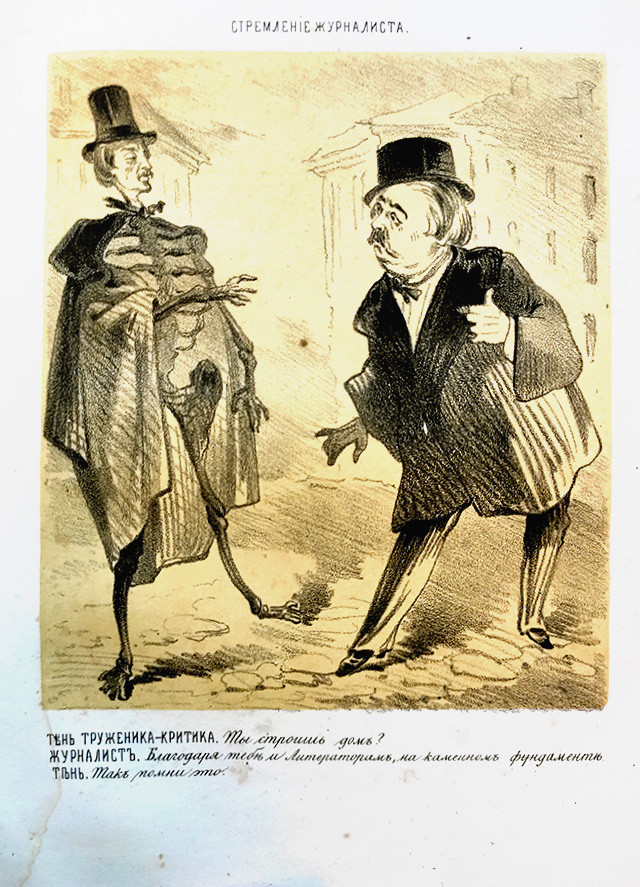 Caricature on A.A. Kraevsky
- What kind of person was the main character of your book Kraevsky and how did he become who he became?
- Andrei Aleksandrovich is a unique person in his way. He was, so to speak, hereditary illegitimate-the illegitimate son of the illegal daughter of the famous Moscow chief police chief N.P. Arkharov (the word "Arkharovites", as you know, is formed from his last name). Kraevsky had nothing: neither origin, nor connections, nor money, nor at least any social elevators, and all his success was the result of independent accumulation of social capital.
The heads of the book dedicated to Kraevsky are the point of entering the journalistic, social and political history of the 19th century, despite the fact that we still do not know much about him. It was already said above that he was extremely reluctant to write about himself, so about his personal tragedy-the early death of his wife (by the way, the sister of the same Panaeva), because of which Kraevsky literally almost lost his mind from grief-we will learn from Belinsky’s letters.
You can tell a lot about the relations of Kraevsky with the authors. First of all, he paid for their work well, but at the same time was extremely demanding of them. Therefore, the Wedorian writers, for example, were indignant when Kraevsky, paying them fees, then persistently demanded to take texts on time. However, this indignation was explained not only by the social affiliation of the authors, but sometimes their characters, as it was in the case of Dostoevsky. I devoted a whole chapter to Kraevsky’s relationship with him.
He was still not very fond of the fact that he almost did not build horizontal relations with people. If Nekrasov organized dinners for writers, then Kraevsky worked and talked with the writers rather dryly: politely, but without a panrabic. This offended writers, because they are used to close relationships in their circle.
All this determined the attitude of the authors to Kraevsky. In their minds, there was a break between free creative self -awareness and the requirements of the editor not very pleasant in personal terms.
In the next era, it is difficult to imagine such problems. The raznochintsy treated the working process differently: it was much easier to interact with them due to their position and self-awareness. The same Nekrasov in the 1960s already perfectly understood that it was easier for him to agree with Chernyshevsky and Dobrolyubov than with the same Turgenev. The first worked a lot and handed over the materials in time - the choice was obvious.
As for the accusations of Kraevsky of opportunism, then everything is much more complicated than it might seem at first glance. Andrei Alexandrovich served for some time in the Ministry of Education, that is, he had real experience in power structures. Therefore, he perfectly understood how the state system is valid, and developed techniques for bypassing various restrictions. Kraevsky made manifesto-Loyalist statements, received approval and necessary papers from the highest ranks, and then allowed himself to publish extremely bold materials-such as, for example, an apologetic article about Fourier and his teaching. And when he got for this from the censors, he reminded them of his “right” statements and gestures.
That is why he sometimes had to write protective texts. Так, в 1848 году он опубликовал статью «Западная Европа и Россия в настоящую минуту», в которой воспроизвел погодинский дискурс, причем гораздо лучше в плане стиля. В его оправдание можно сказать, что статья была написана после прямой угрозы закрыть журнал и расправиться с ним лично. Краевскому сообщили буквально, что поступят с ним как с «государственным преступником».
В долговременной перспективе такой механизм взаимодействия с властью работал, хотя понятно, что после 1848 года печатать в журналах интересные материалы стало совсем сложно.
— Как в целом складывались его отношения с властью?
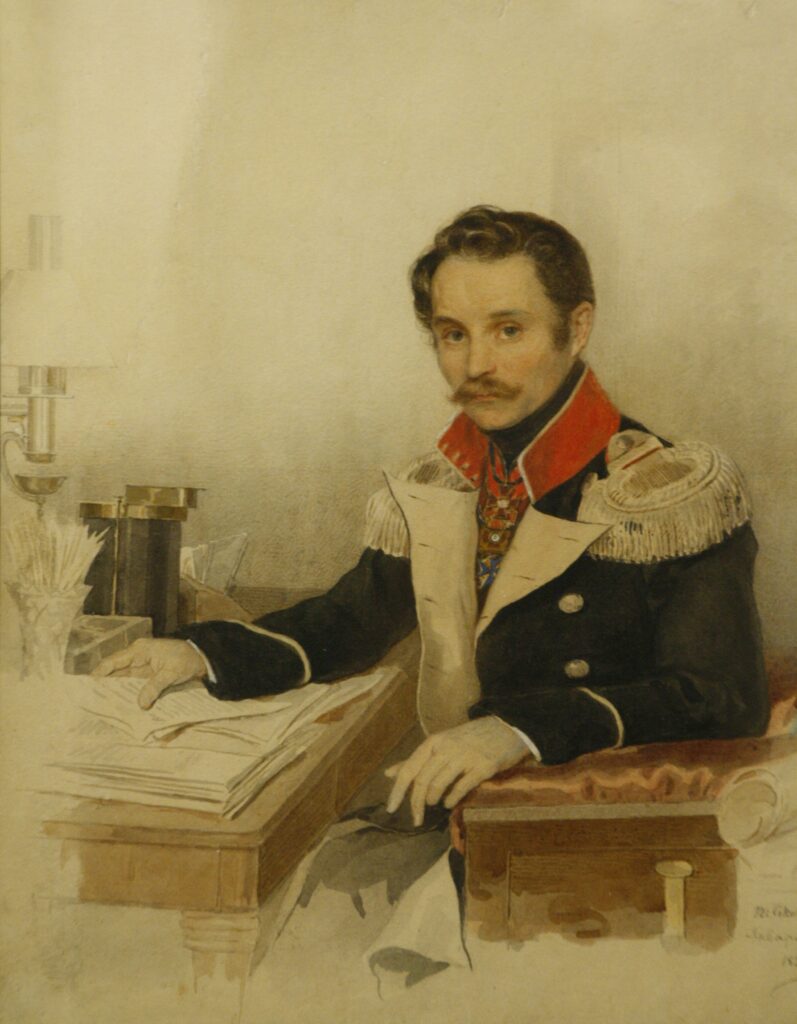 L.V. Дубельт
— Нельзя сказать, что у Краевского были серьезные официальные или неофициальные отношения с властью. Хотя известно, что он был в хороших отношениях с Дубельтом, вторым лицом после А. Х. Бенкендорфа и после графа А. Ф. Орлова. Видимо, именно Дубельт был автором многих документов III отделения, занимался литературой и общался с издателями. Главноначальствующие такими делами почти не занимались. А. Ф. Орлов и вовсе характеризовал работу в цензуре так: «ведь это значит всю жизнь возиться в навозной куче... для того, чтоб выудить, что больше всего в ней воняет».
Отношение власти к журналистике вообще заключалось в формуле «лучше бы ее не было». Это связано со взглядами Николая I на роль государя: у него было душевно-патриархальное восприятие своих взаимодействий с подданными. По его логике, такие отношения должны быть прямыми, непосредственными, а журналистика в этой картине мира занимает промежуточное положение — она может неправильно толковать слова императора или даже доносить до людей «крамольные» идеи. Да и сама фигура литератора, находящегося вне официальной, то есть единственной (с точки зрения императора) иерархии, была Николаю I непонятна. Поэтому он рассматривал журналистику как вынужденную необходимость и ограничивал рамки, в которых она могла действовать.
Интересно также, что в то время власть была предельно персонифицирована. Мы хорошо знаем всех властных акторов николаевской эпохи, ведь до нас дошли их официальные и неофициальные документы, включая личные дневники. Николаевскую эпоху выделяет и то, что власть тогда еще не перешла на дубовый бюрократический язык, не сформировала общие формулы, поэтому, как уже говорилось выше, во властных документах, касающихся журналистики и литературы, можно увидеть родовые психологические черты нашей власти. Это тоже крайне интересная тема. В ходе изучения документов власть имущих с какого-то момента я стала интересоваться ими больше, чем записями журналистов, что можно заметить по содержанию книги. Отчасти это объясняет огромное количество кейсов, которые приводятся в моей работе. Я специально решила не пересказывать их, а цитировать, ведь если бы я выбрала и описала отдельные примеры, то стороннему читателю могло бы показаться, что мой выбор пал на особенно дурацкие и анекдотичные — хотя на самом деле они все плюс-минус такие. Формулировки в подобных документах порой не поддаются рациональному объяснению. Возможно, оно и было, но власть не сумела артикулировать проблему и почувствовала «крамолу» скорее сердцем.
Проблемы возникали не только в рамках основной, официальной иерархии, но и при экстраполяции одной иерархии на другую. Почему, например, охранители так сильно не любили Белинского? Потому что он посмел критиковать сложившуюся литературную иерархию, а от ниспровержения одной иерархии до сотрясания другой — рукой подать.
К тому же, как уже говорилось выше, общественная роль литераторов была высшим чинам не очень ясна. Даже в середине XIX века считалось, что дворянам зазорно заниматься такой «гадостью», как писательство. Однажды, например, В. И. Даля, впоследствии составителя знаменитого словаря, а пока просто литератора, поставили перед выбором: или ты пишешь, или ты служишь — заниматься и тем и другим одновременно считалось неприличным.
— Как представители конкурирующих изданий, особенно идеологически разнонаправленных, реагировали на работу друг друга?
— Как я уже говорила, журнальная полемика в эпоху Николая I была полностью запрещена. Любые попытки ведения даже скрытых дискуссий между журналами довольно серьезно отслеживались. В итоге журналисты разве что придрались к мелочам. Например, «Современник» мог написать, что у «Отечественных записок» хуже технические параметры, качество бумаги, например, или помериться с журналом-конкурентом количеством страниц.
— А насколько выгодным было положение людей, непосредственно следивших за тем, чтобы никто ни о чем не дискутировал?
— Жизнь цензоров легкой тоже не назовешь. С одной стороны, их по понятным причинам не любили авторы, с другой — они несли ответственность перед Цензурным комитетом за пропуски того, что позже оказывалось крамолой, и иногда даже попадали на гауптвахту. Скажем, цензор Н. И. Крылов в 1844 году пропустил в печать повесть о войне на Кавказе, в которой узнавались вполне реальные лица и события. За это его препроводили с жандармами в Петербург, в III отделение, причем Крылов серьезно опасался, что в тайной полиции его могут высечь.
— После «весны народов» в 1848 году в России началось «мрачное семилетие». Как оно повлияло на журналистику?
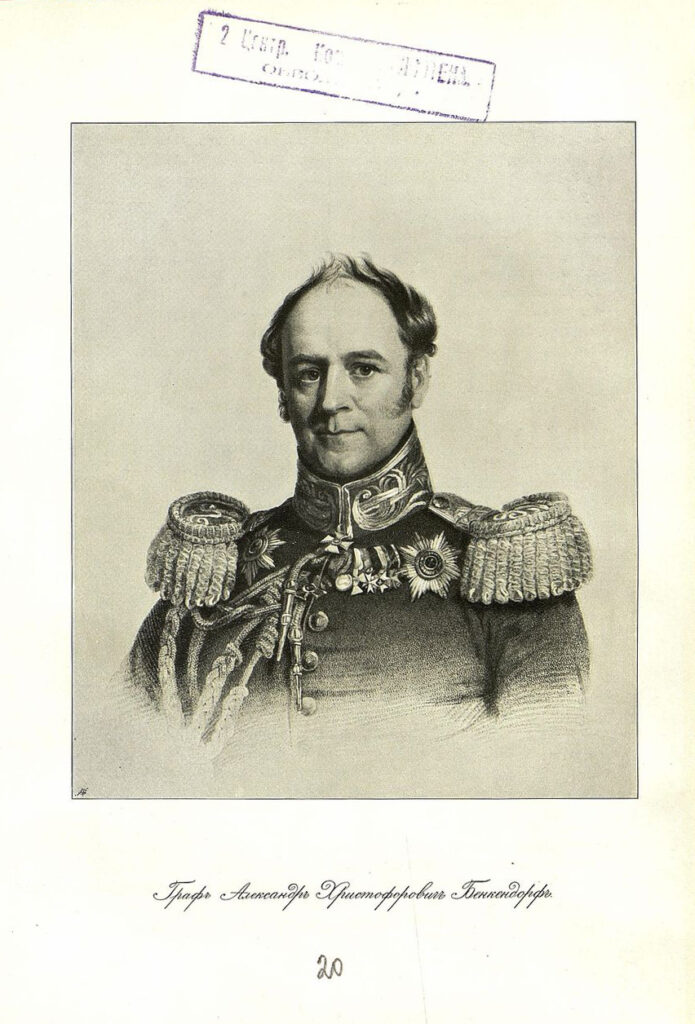 OH. Бенкендорф
— После 1848 года продолжили развиваться тенденции, наметившиеся еще до этой даты. Некоторые запреты датируются уже 1847 годом. Сначала, после получения вестей из Франции в феврале 1848-го, вообще ничего не публиковалось, поскольку было неясно, что писать, а затем цензура резко ужесточилась.
Довольно быстро организуются Меншиковский, а затем Бутурлинский комитеты, названные по фамилиям их первых (в случае Меншиковского — единственного) председателей. То, как Д. П. Бутурлин понимал функции цензуры, хорошо иллюстрирует такая цитата: «Если б Евангелие не была такая известная книга, конечно, надобно б было цензуре исправить ее». Возможно, эта фраза — всего лишь шутка или апокриф, но она все равно весьма показательна.
Немного позже станет очевидным, что никакой угрозы революции в России не существует — однако складывается впечатление, что Николай I к тому времени вошел во вкус. Ему нравится усиление контроля, нравится круговая слежка, и он старается сохранить сложившееся положение. Если после 1848 года всем стало хуже, то император, кажется, наконец почувствовал себя по-настоящему комфортно: даже тени оппозиции, в том числе в печати, не было видно. В 1849 году разгромили кружок петрашевцев, а принцип «надзирать и наказывать» становится в Российской империи повседневным и повсеместным. Проявляется это даже в незначительных частностях госуправления: когда министр Уваров уходит в отставку, Николай долго не назначает преемника и с наслаждением наблюдает за тем, как придворные томятся в ожидании и делают ставки на разных кандидатов.
Деятельность Бутурлинского комитета сильно мешает печатному делу. Журналистам приходится проходить и обычную цензуру, и последующую цензуру этого комитета. Но нехорошо и самому комитету: его участники вынуждены постоянно обнаруживать крамолу в печати и регулярно докладывать о результатах своей деятельности царю. В итоге журналы комитета наполняются анекдотическими делами: цензоры ищут шифры в нотных записях, проверяют старые книги пророчеств, запрещают переиздавать басни XVIII века. С началом Крымской войны усиливается военная цензура: писать о событиях на фронте запрещено всем, кроме официальных изданий. Впрочем, и сами власти порой не до конца понимали, что именно там происходило.
Вся эта цензурная машина проработала в таком режиме до смерти Николая I в 1855 году и потом еще какое-то время — по инерции. Смерть императора стала совершенной неожиданностью для всех. Многие писали в воспоминаниях, что были уверены: Николай переживет даже их внуков. Не пережил.
— Какова, на ваш взгляд, должна быть в идеале задача-максимум у тех, кто занимается сегодня журналистикой XIX века? Нужно ли писать принципиально новую историю журнального дела Российской империи, отбросив концептуальные наработки советского времени, или же устоявшиеся в науке представления более-менее адекватны и требуют не ревизии, но просто дальнейшего приращения знаний за счет работы с архивными документами? Как вы относитесь, например, к радикальным шагам вроде полного пересмотра репутации Белинского , на необходимости которого настаивает Алексей Игоревич Любжин?
— Мне бы не хотелось говорить в императивном ключе: пусть каждый пишет так, как считает нужным. Но вообще, на мой взгляд, нашей истории литературы и журналистики до сих пор не хватает социологического уклона или просто культурологического. Конечно, есть исследования А. И. Рейтблата, О. А. Проскурина, но в целом буквально чего ни хватишься, того у нас и нет. Хотя это, наверное, относится уже не столько к тому, о чем мы говорим, сколько к отечественной истории вообще. Хороший пример — недавно вышедшая книга Михаила Велижева о «деле Чаадаева».
И конечно, хорошо бы активнее публиковать эго-документы — мемуары, дневники и прочее. Разумеется, их публикуют, но очень мало. Например, дневники многократно упоминавшегося М. А. Корфа до сих пор так и не изданы полностью.
Насчет полного пересмотра чьей-либо репутации — думаю, такое имеет смысл, если у читателей остается вообще хоть сколько-то цельный образ того или иного писателя либо публициста. В случае Белинского большинство помнит только его имя, так что можно уже начинать писать о нем заново.
Вот чего бы мне действительно хотелось, так это переоценки деятельности Добролюбова и прочих представителей «реальной критики». Честно говоря, понятия не имею, как можно о них интересно написать, но хотелось бы, чтобы кто-то покончил наконец с порочной и до сих пор живой традицией оценивать литературные произведения с точки зрения их «пользы» и отражения «реальности».