
Translated material
The first circle of hell is loaded
What are semantic digital publications and what they are
In the recent material, Gorky spoke about the project “The Word of Tolstoy”, one of the examples from a relatively new and rapidly developing area called semantic digital publications. What is it and why are they needed? About this - the material of Olga Zhukova.Starting from February 24, 2022, we were all in the face of the advancing barbarism, violence and lies. In this situation, it is extremely important to preserve at least the remnants of culture and support the values of humanism - including for the sake of the future of Russia. Therefore, the editorial office of Gorky will continue to talk about books, reminding our readers that the world remains in the world and fiction.
To begin with, a little terminology. Digital publication is in a broad sense any form of representation of the text on a digital medium. If you take a picture and post all the pages of “War and Peace” on the site, this will fully meet the concept of “digital edition”. The only possible action with such a text is, in fact, viewing. A simple recognized text gives a few wider opportunities: copy fragments of the text or look for specific combinations of characters.
The digital environment can offer much more advanced tools for working with text than viewing and copying, but for this the digital edition should be semantic . In this case, the texts are subjected to additional processing, individual words and structural elements are assigned identifiers - tags. The result may look something like this:
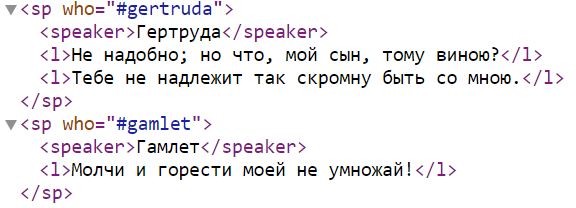 The passage of Hamlet in the database of the Rusdorkor project is a corps of dramatic works and their translations in Russian
Here, structural and semantic elements, such as the beginning and end of the lines or paragraphs, the names of the characters, are marked with special symbols. Marking makes the text machine -readable, that is, allows the computer program to navigate in its content. In this case, the user shows only those elements that are intended for humans.
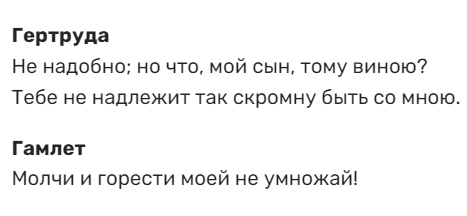 The same passage is mainly a user interface. The marked version is available in a separate tab
The transformation of the digital publication into semantic is a laborious process, but this opens up the broadest opportunities for processing text, research, creativity and simply ease of reading in the figure.
To understand what semantic publications are capable of and why people use them, despite unusualness, we will again turn to the “word of Tolstoy” . The creators of the project took into account that their potential audience is great and heterogeneous: these are schoolchildren, teachers, and professional researchers, and simply readers who are interested in Russian classics. So, a universal resource is needed, on which users of all categories will feel comfortable.
On the site slovotolstogo.ru not just posted a complete collected works of the writer. Many additional sources are available to the user, including copyright, comments, dictionaries and reference books. Thanks to the use of a marked, semantic publication on the portal, it was possible to implement a simple and convenient navigation system. The materials are connected by a system of hyperlinks, and one of the central elements of the interface is the window of a “smart” search with many parameters.
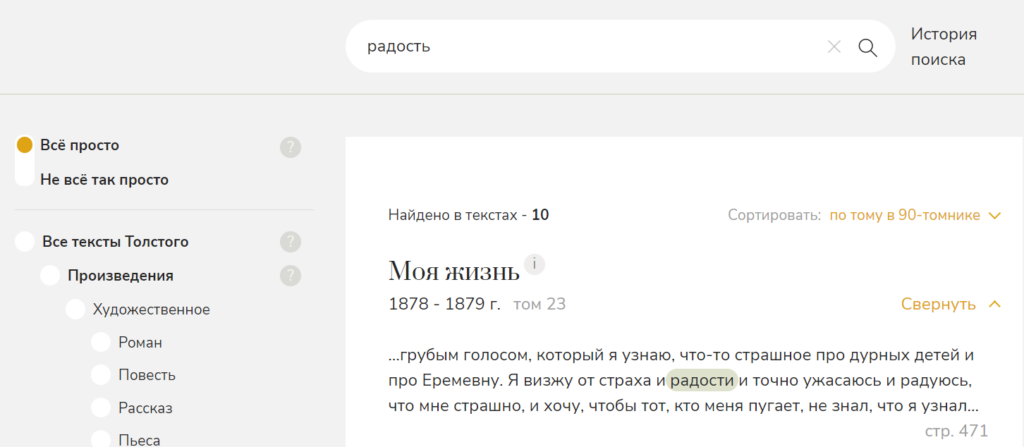 "Joy" in Tolstoy's texts using the Autobiographical filter
The developers did a huge work on the semantization of the publication. Not only the texts themselves are marked, but also the types of works, names, dates of writing, draft options, the old and new spelling is correlated. On the site you can check the quote, find out what the author wrote on a specific day, or find a specific word only in the non -artistic works of Tolstoy. A reference book of the works of Tolstoy, Person and rare words has been compiled. It turned out a multi -level system of interaction with Tolstoy’s legacy, comparable in informationalism with a serious academic publication, but in format a much more democratic, equally accessible to scientists and readers.
Semantic publications are relatively young phenomenon, and their unified classification does not yet exist. “The Word of Tolstoy”, in fact, is simply a well-structured storage of books, that is, belongs to the editions of bibliots. This format of digital publications appeared one of the first. Philologists have been using a resource called “Fundamental Electronic Library”, or FEB for more than 20 years. This is a huge storage of the texts of Russian classical literature and folklore, as well as literary materials, research, analytical and critical articles - everything that scientists wrote about each of the works. There are also encyclopedias, reference books, language dictionaries, up to musical works. One type of starting page causes a reverentwe over the scale of knowledge.
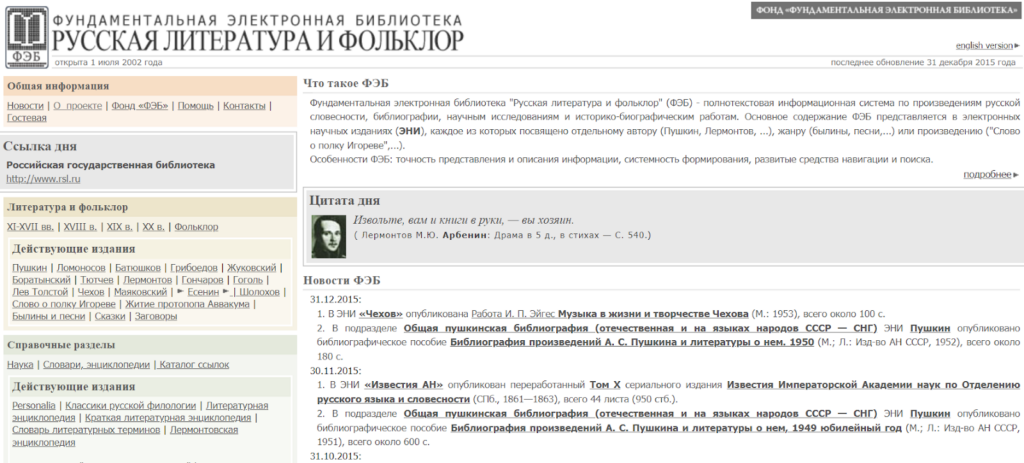
The main challenge for the visitor here is not to get lost in the array of information. If in the “Tolstoy’s Word” navigation resembles the use of a search engine, then a more academic and much earlier that appeared FEB is built on the principle of a database. The library has a clear hierarchical structure, there is a navigation panel on the side, and the materials are connected with each other with a system of hyperlinks. The site has a search for keywords, authors, temporary periods. For the most fearless and demanding readers, there is a section “Catalog of Links”, in which more than 800 literary Internet resources are listed.
Bibliotext resources based on semantic publications are good primarily advanced navigation and search capabilities. Some resources also offer tools for highlighting and preserving the text fragments, and sometimes collective work on them. For example, in the digital archive of the English poet of the 18th century, Thomas Gray Gray ( Thomas Gray Archive ), users can leave constituent notes and comments on the works, as well as view the notes of other readers. Such a research social network. In general, the process of reading on the resource “Library” is not very different from working with a paper book. But the library is far from the only form of the digital publication.
The very concept of "book" with the development of digital technologies was subjected to a significant revision. This is no longer necessarily the pages of the text, sometimes with pictures. The digitized, and even more so Digital Born, that is, the book created in the number can include interactive elements, audio and video clips, even games. Digital reading compared to paper has also changed: it is less linear, and the reader’s attention easily switches between the elements of the text and its environment. Many of modern digital publications are not copies of paper predecessors, but independent objects that suggest other scenarios of interaction.
Semantic publications can offer the reader a functionality atypical for a traditional book. The same “Rusdorkor” , which was discussed at the beginning, knows how to build columns of interaction between the characters of the plays. This is what Chekhov’s “Seagull” looks like.
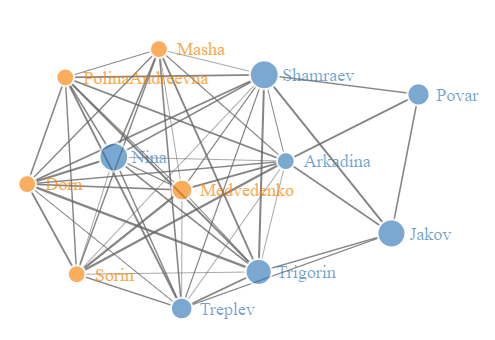
The size of the node is the activity of the character, the frequency of his entry into the statistics of interactions. Such a tool will be interesting primarily to researchers. By the number of ribs and the position of the nodes, we can make assumptions about the significance of the characters for the plot, about the author’s plan and much more. Thus, the semantic digital publication offers the reader a new look at the work, sometimes leading to curious discoveries. For example, in the Pushkin play “Boris Godunov” the central knot, connecting the majority of the rest, the character “People” turns out to be. Professor Litigate Sergey Bondi wrote about the central meaning of this character back in the middle of the 20th century, and the XXI century technology gave this a quick and very clear confirmation.
Another example: on the already mentioned website, Thomas Gray Archive, a poetic size, rhyme scheme and other formal features are indicated for each poem. They can come in handy for literary analysis: some of us remember from school that the YAMB is “spoken and simple” size, and amphibrahs are “valcing and elegant”. Apparently, on the website of Thomas Gray, sizes and circuits were made manually, but there are computer programs that do it automatically. Unobtrusively highlighting such things, the digital edition acts as a teacher, offers to see the work from another angle.
In semantic publications, a computer program can not only operate with elements inside the text, but also compare fragments of different texts. This is very convenient if the text exists in different versions and the user wants to compare them. The resource “ The Word about Igor’s Regiment” : the parallel translated corps is dedicated to the famous ancient Russian text, over which generations of Russian high school students suffer and which became the reason for the innumerable set of research, artistic interpretations, translations and fantasies on the topic. On the site, the user can choose all the versions of the text and specific fragments of interest to him and see them on one page.
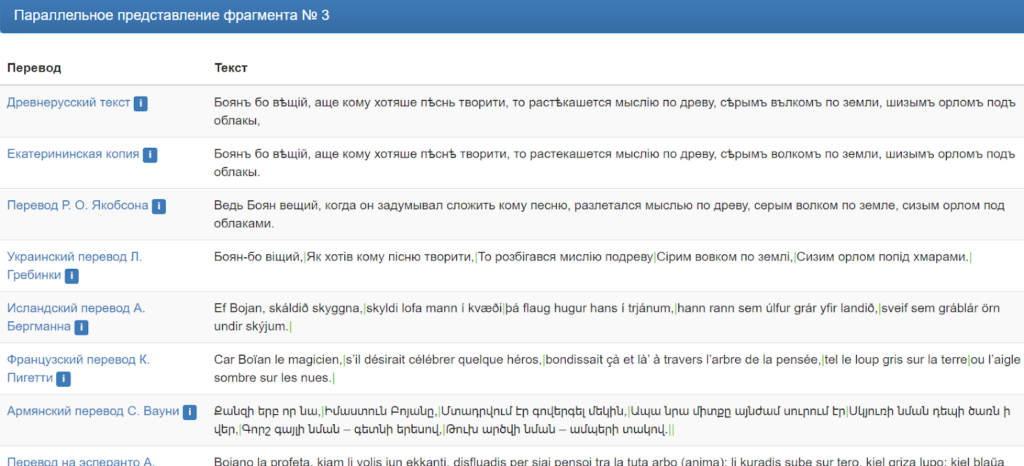
The texts themselves are filled with links to explanations and comments, pop -up hints and other auxiliary elements. A pretty, although not too functional addition, meets the user on the title page - a color cloud of keywords.
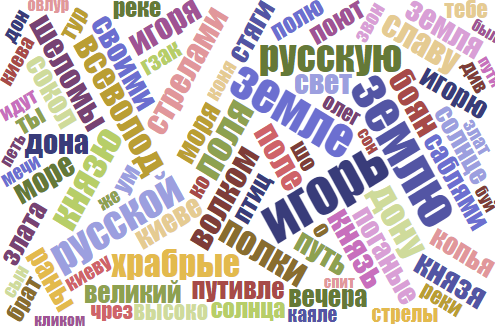
By the way, a similar tool for quickly familiarizing the reader with the content of the book is used by Google.books and some other reader services. This is not a retelling in a full sense, but gives a general idea of the subject. “Over the abyss in rye” is this about agriculture? By keywords, we understand that there seems to be not.
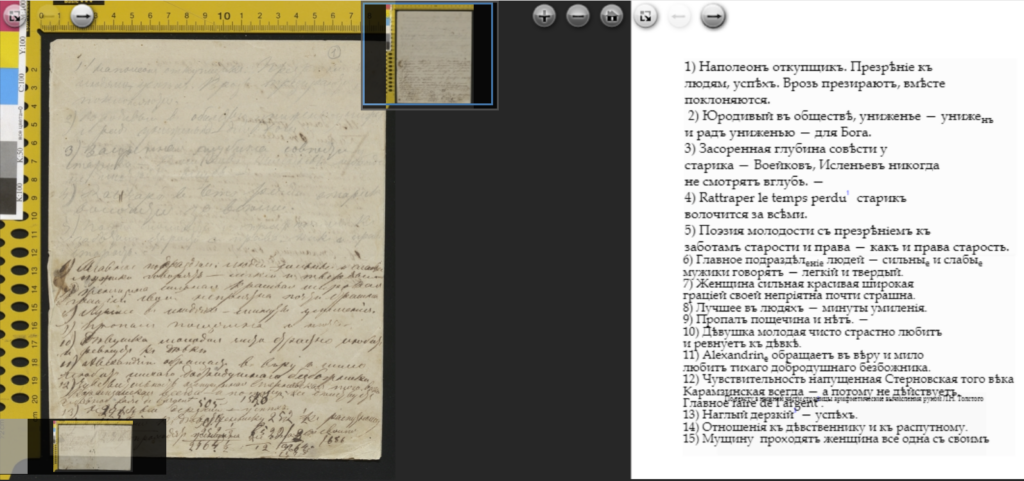
Thanks to the possibilities of parallel comparison of texts, semantic publications are indispensable for working with manuscripts. By crossings and changes, notes, emphasizing and blots on the original source, you can trace the path of the author’s thoughts or find out something about the history of the document himself. The tool for processing the manuscripts "Textograph" in parallel displays a photo of the manuscript page and the decoding of the text.
Not only philologists are interested in manuscripts. Often fragments of manuscript text can be found on sites dedicated to the life and work of one author. Firstly, it is simply beautiful, and secondly, it gives material for reflection on the character and personality of the writer. The sweeping careless handwriting in the letters of Mark Twain leaves a completely different impression than neat (when the whole paragraphs are not crossed out) exquisite curls Jane Austin .
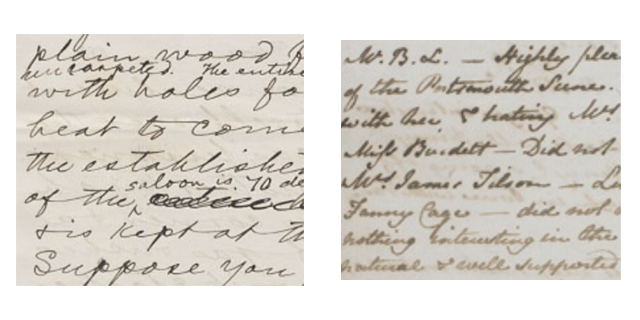 Left - twen, on the right - Austin
Marking and here allows you to correlate handwritten fragments with printed ones, saving the reader from the need to disassemble the handwriting himself and turning the manuscript into a semblance of illustration to his own text.
Another interesting resource from the Institute of Russian Literature of the Russian Academy of Sciences (Pushkin House), who turns to the personality of the writer through the manuscript, is called Pushkin.Digital . There are no complete works on this site (there are a lot of them in the institute’s electronic library), and it is not based on any paper edition. "Digital Pushkin" introduces the reader to the living creative process. The materials are neatly sorted, the drafts are transcribed into printed texts, comments and explanations are added to them. The works laid out on the site can be read both in the usual form and with the history of copyright corrections.
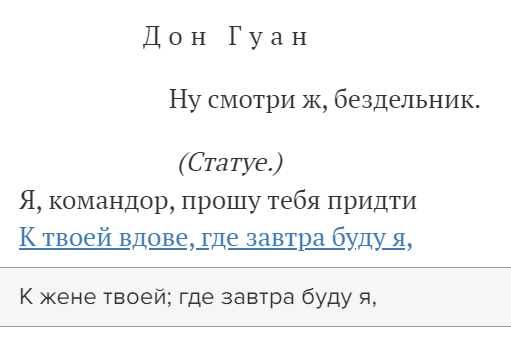
The project team calls the site multimedia encyclopedia. The resource does not claim originality and comprehensive completeness, but immerses the reader into the atmosphere of creating works, shows the path of author’s thought from the plan to the final version. Viewing the exhausted drafts encourages at least to think about whether this path was so direct.
Some resources are not limited to texts and strive to give the reader a comprehensive picture of the writer's life. “The Dostoevsky World” introduces the visitor in detail with sign places, friends and enemies, events and life impressions of the writer. Here everything is bright, mobile, carried away. The creators of the site tried to gather every grain of the world in which the writer lived, thought and created: from the scheme of his children's apartment to the famous picture of Holben “Christ in the coffin”, the impression of which was reflected in the famous episode of the “idiot”. The site invites you to several “worlds” at once, which I want to investigate as new locations in a solid game universe.
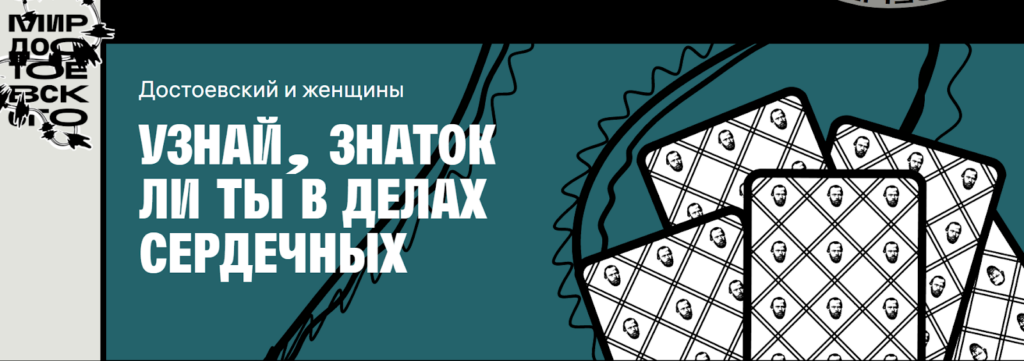
There are no texts of Dostoevsky’s works on the site at all. But after his visit, a desire to find them may appear, and this is the main thing. After meeting with numerous personal documents (letters, diaries) of the writer and the memories of his acquaintances, it begins to seem that Fedor Mikhailovich is almost your personal acquaintance.
There are many “worlds” of individual writers or works on the Internet. Some rely not on effectiveness and not on volume, but on the originality of the approach. The site “Chekhov. Dijal” from advanced functions is only a search, but unusual. It allows you to find out in which contexts the writer used different words. For example, Chekhov used the word “muck” for such phenomena as spoiled food, indecent laughter, jealous behavior, almost any weather (heat, cold, rain, cloudiness), various ailments, and also a bureaucratic language. Of these details, a living and vivid idea of the character of a person grows.
Sometimes in the focus there is not a writer, but a specific work. Often these are difficult, large texts that equally attract the attention of many researchers and repel the simple reader with complexity. In this case, semantic publications again make it possible to give the user convenient and useful tools to handle text. A clear example is a site dedicated to the collection of novels Giovanni Bokaccio " Decameron Web ). Although this book itself is a collection of light short stories, it is saturated with a huge number of references and allusions, contains many references to people and events incomprehensible outside the context. The site immerses the reader in the reality of that time: it has materials about religion, geography, historical events. The text itself is neatly divided into chapters and presented in two languages: the original Italian and in English translation. Each paragraph has a hyperlink, which also leads the paragraph in another language. All this does not save the reader from a large amount of additional reading and labor, but at least he does not need to look for information on the side. Everything necessary is at hand to understand the phrase: “Montferratic marquise, a man of high valor and the Church Gonfaloner, went for the sea in the general armed walk of Christians ...”
A resource dedicated to another work that everyone knows, but few read it, has been arranged in a completely different way. There are many resources about the legendary "divine comedy" of Dante. On one of them - “Amor Mi Mosse, Che Mi Fa Parlare” - instead of a complete text (difficult to perceive even an advanced reader), the user sees the thesis of the plot, support quotes and from time to time historical or biographical comments. But the main thing here is amazing visual solutions that turn to view the site into aesthetic pleasure. The developers made a bet not on comprehension and analysis of the work, but on the emotions and effect of immersion (which, taking into account the specifics of the work, sounds a little ambiguous). Squeezing down an endless tape in ominous black and red tones, the user literally falls through the circles of Dante's hell. However, switching to purgatory or paradise is easy, for this there is a small menu button in the upper right corner. Atmospheric illustrations, photographs of the pages of ancient publications, mobile elements (which are the opening gates of hell) create an unlike experience of reading-travel. On the site you can linger out of simple curiosity, and closing it, with surprise to discover that in general I remembered the plot and many bright images from the work that would not have otherwise master beyond the first page.
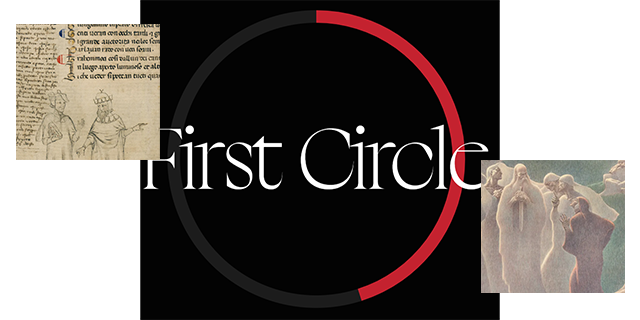 The first circle of hell is loaded
A review of digital solutions related to reading and literature can be endless, and this is not a figure of speech. New ideas are embodied literally every day, many of them remain on local servers of universities and small creative teams, but slowly get to the general public. At the same time, recommendation systems are being improved (for example, a very beautiful project “Ocean Books” from Google: writers - “Islands”, their size depends on representation on the Internet, and the proximity of each other is on the frequency of joint references). All this is also the result of semantization, computer processing of publications.
The time when your favorite book can be discussed qualitatively with a virtual interlocutor, has not yet come, but it seems that it is no longer around the corner. Already today, computers are able to help the reader at almost any stage of interaction with the book - from motivation to turning the first pages to the interpretation of complex words and searching for reference materials. So far, some developers are experimenting with the reader's functionality of publications, others are working on recommending services. What is definitely not expected in the near future is the disappearance of the concepts of “book” and “reading” as such. In a world where convenient and effective recommendation services will lead to beautiful and functional publications, it seems that you should not be too worried about the future of reading.