
Translated material
Horse structural equivalent
From the "visual glue" Andrei Gorokhov
Andrei Gorokhov is known primarily as a musical journalist and author of the iconic “Muzposvta”, but his professional interests also apply to fine art. The basic principles of its creation are devoted to the book “Visual Glue”, which the author himself proposes “to consider a treatise on shaping, design textbook or a preface to the drawing textbook”. Gorky publishes the head of the “visual glue” called “fast rewind”.Starting from February 24, 2022, we were all in the face of the advancing barbarism, violence and lies. In this situation, it is extremely important to preserve at least the remnants of culture and support the values of humanism - including for the sake of the future of Russia. Therefore, the editorial office of Gorky will continue to talk about books, reminding our readers that the world remains in the world and fiction.
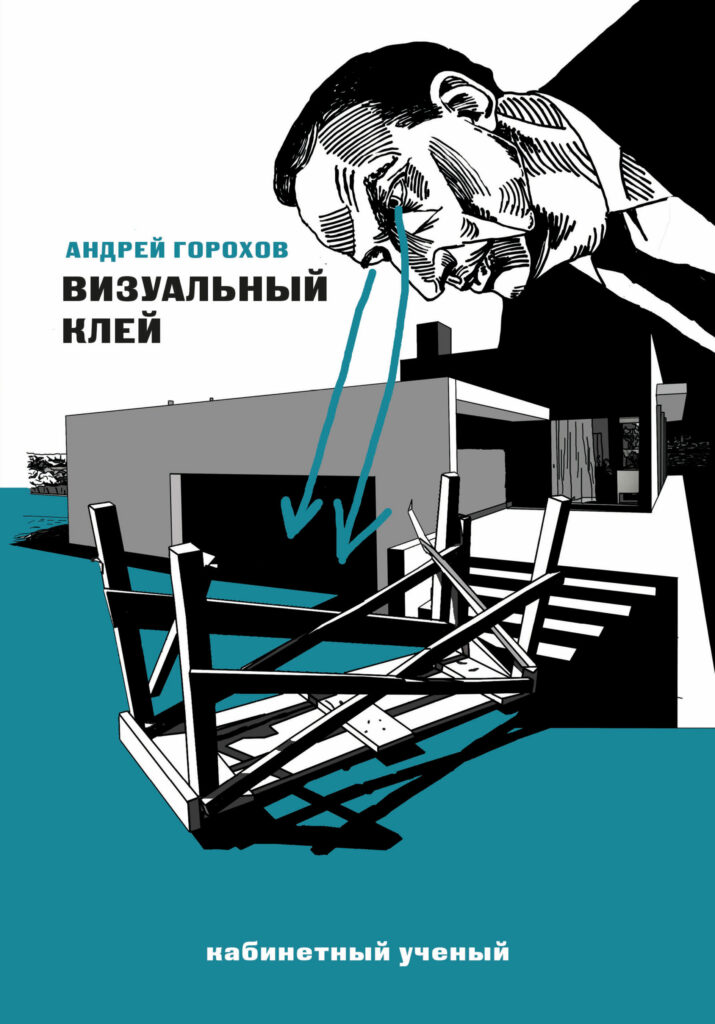
Andrey Gorokhov. Visual glue. Yekaterinburg: Cabinet scientist, 2023 . Content
 I will try to repeat in two words, which, in fact, claims what the doctrine consists of.
At the fundamental (lowest) level, the “picture” consists of objects of two varieties: “centers” and “axes”.
The center can be the intersection of sticks, the center can be a massacre (there is a cross-country intersection), the center can be the center of some kind of spot.
The center is associated with the "Perception Hard of Perception". The frame is located around a particular center. A frame is a kind of spot of our interest, a tunnel through which we see something (and we do not see the tunnel itself). When we generally see something in the picture, we see this within the framework of a particular frame.
Graving the frame is an image recognition operation. The word "insight" is appropriate here.
Inside the lanes lives the “axis” - the axis of symmetry, but this is a trivial discovery. The axis is much more interesting when the axis of the symmetry of some kind of spot or large shape is detected. The axis also sets the frame, only elongated.
The axis may turn out to be directed, then along it there is either a “movement” or “the spread of stress”. The movement goes from the motionless end of the axis (that is, from some center) to a freely dangling end.
It seems that the dynamic effect arises as a result of the fact that the frame of perception cannot tamp up in the sense of stratification for object and background. As a result (presumably) a frame of perception, as it were, slides along the axis in the background.
Regardless of the centers and the axes, something incomprehensible nature acts, which manifests itself in the form of several ubiquitous effects or circumstances.
Different spots “stick together” into the unified “conglomerations” or “integrity”, or it can be assumed that integrity falls apart into “composite elements”. Something incomprehensible nature - “visual glue” - glues scattered pieces, certain integrity arises. We do not see glue, we see stabbed.
We perceive this as “virtuality”. Almost everything we see is virtually. Several points or strokes are glued into the line. Several people glue into a group of people. Even the trivial situation is just a white wall is already virtual: we “actually” see many almost white spots that have stuck into a single white surface.
The configuration glued together, I call it a “virtual object”, has a mysterious quality that we identify as a “character”. It is impossible to determine what it is is impossible, it is the self -object. The word "character" is excessive. We can say that the virtual object has “quality”; What is quality is also impossible to say. This is the cat’s cat, the femininity of the woman, the angularity of the crystal, the elongation of the dild, the dissolving of the Eiffel Tower.
The character is not only explained by the mutual structure of the centers and axes, but the located centers and axis correspond to a different character. Moving the centers and the axis, removing them or adding new ones, you can change the character. There is a suspicion that the character is the effect of a particular configuration of centers and axes perceived by us.
Almost the same configuration of centers and axes can be “inherent” by different pictures, this leads to the fact that different pictures are similar.
Different pictures with a similar character are “structurally equivalent”.
The problem, however, is that not everything is glued together with everything at the same time and firmly. More precisely, such an effect when everything is glued in a continuous continuous landscape around us, of course, there is also, but, generally speaking, we grab/identify one or another in any picture.
Almost always one identified is imposed on another. That is, the same element of the picture is involved in several simultaneously perceived configurations. This is fundamental uncertainty: the picture is the application or intersection of several virtual objects.
Our perception “switches” between these integrity, configurations or virtual objects. I call this switching perepretting.
Already the perception of something as an “independent element” is an example of trivial transconturation-an independent element looks on its own, but it looks as part of a larger whole. Say, we see a separate soldier on the parade ground, but we see a number of the same soldiers.
Transettructure often works in such a way that one virtual object seized by our gaze does not exhaust the entire picture, there is some excess, we are trying to include this surplus in the frame, and-Chick! -The structure switching occurs: we grab a new virtual object in which the former surplus is included, but something else is not included in the previous structuring.
The interesting transceptic picture is interesting. That is, the character does not just correspond to the geometric location of the centers and axes, but the character has both a private virtual object, and virtual objects imposed on each other (praised). The nature of the transconturation is important for the nature of the whole.
If there are always a lot of competing transceptorization, then some kind of virtual object or virtual quality (severity, massiveness, three-dimensionality, roundness) can be more noticeable, “identified”. Here they recall the mysterious law of prelassed, which says that the most “simple” of possible virtual configurations is perceived (most manifested).
Virtual objects and their characters can be manifested with different power. The line can be not only more or less straight, it can be more or less than the line. And this applies to any quality, property and effect in the visual sphere. Say, structural equivalence can be egregious (Pinocchio’s nose looks like an awl and a pencil) or may be far from obvious: the legs + the boy’s stick turn out to be a structural equivalent of the horse.
Virtual objects are collected from simpler and more small virtual objects. This is a fractal situation, but not hierarchical: since virtual objects intersect and switch, it is often impossible to say unequivocally what is part of what.
To make a more complex virtual object with its own character, the picture should be “more complicated” and “more cunning” is arranged. It is hardly possible to formalize this complexity and trick. However, it can be determined in a negative way: a new complex character arises when there is no flagrant “additivity”. Additivity does not allow a large nature to gather together.
Additivity is such a state of the picture when there are many small virtual objects and they are assigned to each other. You can imagine shelves in a closet, a chessboard or puddle on the asphalt.
We can assume that the additive picture has its own strange character, this is the character of a patchwork. Of course, there are many different manifestations of additivity, and it is impossible to completely defeat additivity, therefore the present, but not dominant additivity affects the nature of the whole.
Inside, both “abstract” pictures, and “figurative” acts the same mechanism.
In a figurative picture, we learn something real, familiar to us from our lives-some kind of object or landscape or some scene. Why? Apparently, because the recognized plane, people at the table, the Niagara waterfall-is a character of a high level, “stored” in our “memory” (what is “memory” is unknown, and it is not clear how something is “stored”) and when it is manifested enough, it is easily identified. So the new complex character, which supposedly arises when overcoming additivity, may turn out to be a structural equivalent of something well known to us-from the letter “x” to something figure, say the face of a person.
This description is not exhaustive: it is not clear how it is all implemented at the level, so to speak, Hardver and why it works just that. There are many private, but annoying ambiguities, for example, the so -called optical illusions.