
Translated material
Firmness in soft protest
Civil activist Alexei Lakhov lives in Russia and fights with the war with official letters to the authorities. What did he achieve?
For more than 20 years, Petersburger Alexei Lakhov was associated with the Humanitarian Action Foundation, which helps drug addicts and people with HIV. At first, as a well -being, and having cured, he became its development director. In the spring of 2022, Lakhov quit so that the fund would not suffer because of its political and anti-war positions. Now he is a civil activist who has found legal ways of resisting war. It helps those who were fined for the “fakes” and “discrediting” of the army, Ukrainian refugees, and also writes one after another official letters to the authorities, demanding to stop the use of Liters Z and V. What is the meaning and effect of this bureaucratic struggle, Lakhov, at the request of Kholoda, explained in the author’s column.
In order not to miss the main materials of the "cold", subscribe to our Instagram and telegram .

Appeal as a protest
I began to write appeals to various authorities almost immediately after February 24, 2022. For almost 15 years I have been working in the field of charity , and for me this is a familiar and understandable way to communicate with officials. Including in order to convey their position to them. In this case, disagreement with what they call a “special military operation”.
The first letters went to the Federation Council. Since it was this body that gave the president permission to use the armed forces outside the country, I asked for the Russian army to immediately leave the territory of another sovereign state - Ukraine. The answer was concise: "The information set out in [appeal] was taken into account."
Then, in St. Petersburg, the Latin symbols Z began to appear everywhere, which at some point suddenly turned into the symbols of “sucker”. There were especially many of them in the subway - on lightboxes on escalators and advertising shields on the walls. Moreover, this letter is laid out of the St. George tape - which, in my opinion, is blasphemy in relation to the memory of people who gave their lives in the fight against real, and not invented by Nazism.
I wrote about this to the metro management, demanding to dismantle “these advertising media” on the grounds that, from my point of view, “insult the memory of veterans of the Great Patriotic War”. The result was said: "The indicated ... social advertising depicting patriotic symbols ... does not contradict the legislation of the Russian Federation, which means ... there are no grounds for dismantling these materials."
In addition, I turned to various city committees, as well as directly to the governor Alexander Beglov. Here I have already changed tactics and began to engage in outright satire. Here is an excerpt from an appeal to the Committee on External Relations dated 03.28.2022. Due to a letter in which the head of the committee tried to explain the meaning of using letters Z and V according to the Ministry of Defense :
“...“ The phrase “for victory” is encrypted in the letter Z, the letter V means “Power V (c) truth” and “The task will be completed,” ”the letter says. I report: this document introduces the governor into the Zabbeling.
The fact is that I failed to detect such a unit of measurement of force as the truth. In physics, force is measured in Newton, and if we are talking about current strength, then in amperes. The letter V, in turn, the tension can be indicated. In this regard, I propose to interpret the clarification of the committee as “Voltage V (B) Pravda” ... ”
According to the answer received from this committee, "the meaning of these symbols today has become generally accepted and easily recognizable in Russian society." It is curious that literally a few months later, in the answer to another appeal, the same committee said that "these signs are not official military symbols and do not carry special loads, which is known to the leadership of St. Petersburg."
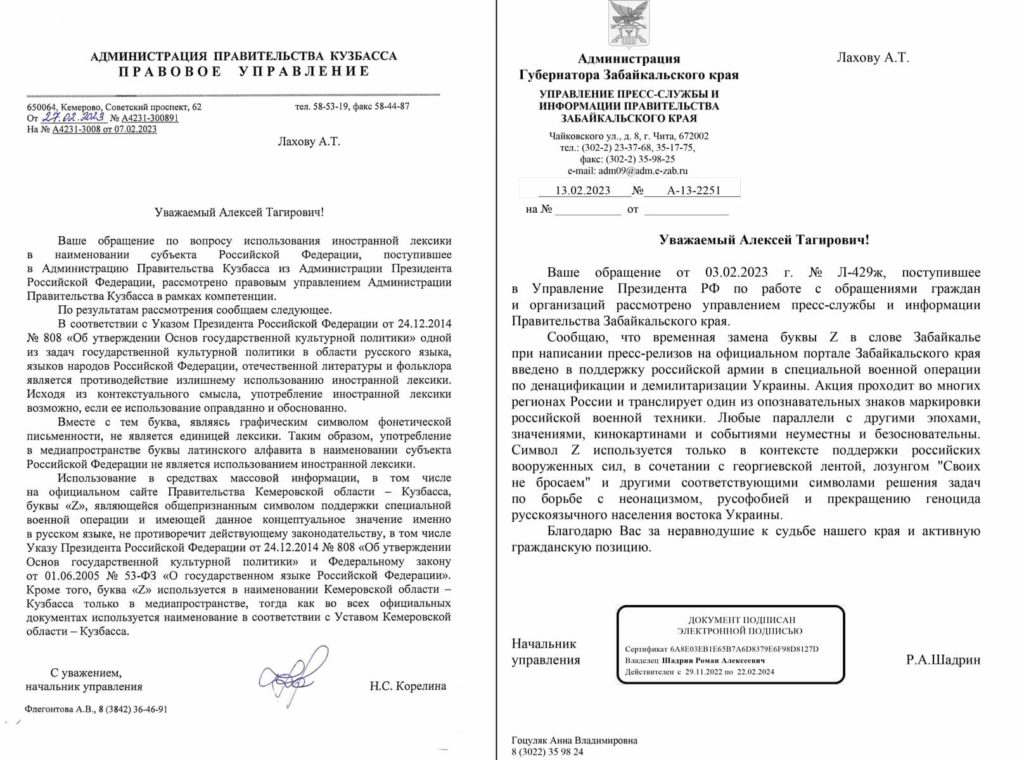
In February of this year, I complained to the presidential administration of the use of letters Z in the official names of Russian regions such as Zabaikalia and Kuzbass, on the grounds that such a spelling contradicts the course on “Combating the excessive use of foreign vocabulary”, the decree on which Putin recently signed. The answers came from the regions themselves:
These are the answers
The author’s opinion may not coincide with the opinion of the editorial office.
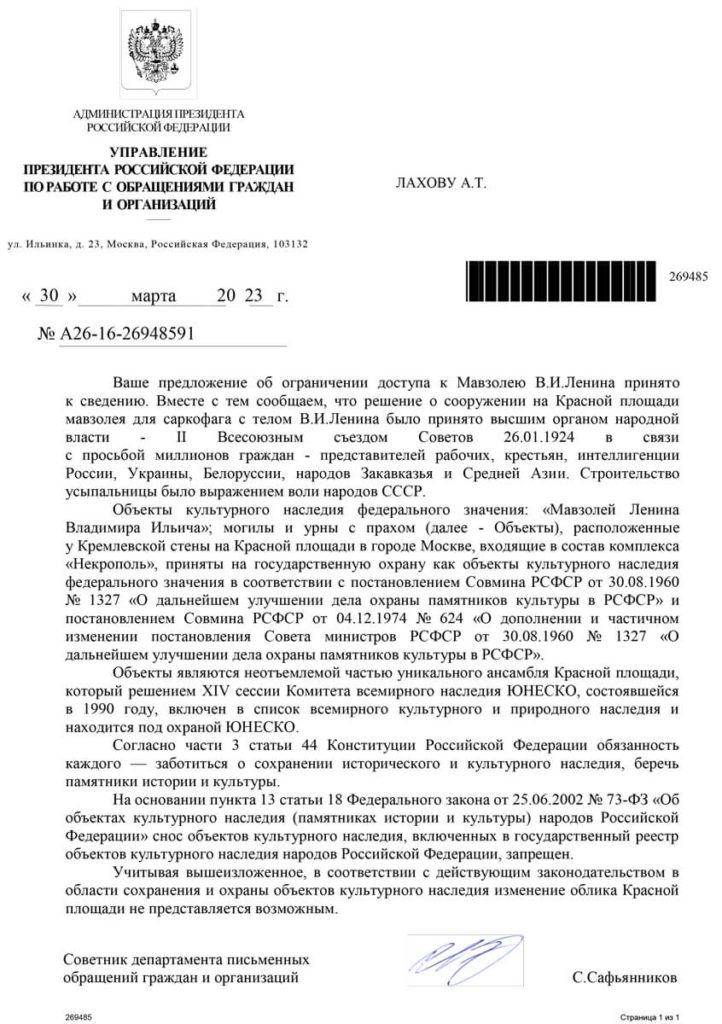
The latest appeal concerns the absurdity of the interpretation of the law on the “discrediting” of the Russian army and fines for “Vobla”, “*** *****” and “peace - peace”. It was sent to the Moscow City Hall with a demand to limit access to Lenin’s mausoleum, because, in my opinion, “free access to the sarcophagus with the body of V.I. Lenin, as well as the very fact of its presence in the immediate vicinity of the office of the President of the Russian Federation V.V. Putin, who gave an order to conduct a“ special military operation ”in Ukraine and expressed the disapproval of the actions of V.I. Lenin, are“ discrediting the Russian armed forces Federation "". The answer, which has already come from the presidential administration, turned out to be detailed:
The response of the presidential administration
The author’s opinion may not coincide with the opinion of the editorial office.
What managed to achieve
If we consider these appeals from the point of view of KPI and effectiveness, it may seem that I was in vain I spend my time: hundreds of letters are written, and the letters Z were hung in the subway and hang; "Svo" continues; Lenin is still in the mausoleum. But I know for sure that it is important for Ukrainian friends and colleagues to understand: the answer to the question “whether the Russian wars” will be unequivocal: “ Not all. Not all . " Various media, public and telegram channels wrote about these appeals: The Village, “Paper”, “7x7-Horizontal Russia” and others,-after which people came to me, especially those who stay here in Russia, and they also wrote letters against Z that it was important for them to see: they are not alone in their disagreement with their own and total policemen countries. Finally, personally, these appeals help me maintain my own protest potential and believe that civil activism is able to change the country - albeit not now, and not even five years later, but will certainly change.
And, it seems, the ice was already starting: even the Z-channels in Telegram began to admit that it is not possible to unite the whole society under the Zvo Znam, and even more so under Litera Z,. Here is what the Channel “ Commissar disappears ” : “The letter Z as a political symbol is a very unsuccessful idea ... And it’s not even that the national feeling is indicated by the Latin letter, moreover, it is known that reminiscent is unpleasant, but God with him. It is more important that the stupid letter gave the other side to the other side not to call Russian patriots Russian patriots, but to call Zetovtsy, Z-activists and so on ... ” Yegor Kholmogorov echoes him:“ The main problem of this symbol is that he does not bite to anything ... and the symbol must oblige to be Russians. This is the point ... In 2022, they worked a little on the question, and in the first few months nothing Russian slipped at all ... "
"Soft power"
I am close to the philosophy of non -violent protest, which does not stop, despite the fact that it does not seem to bring tangible results. For example, the creator of the “Soft Power” movement municipal deputy Julia Galyamina , sociologist Natalya Forerat , the Croatian-Bosnian activist Igor Blazhevich and the editorial office of the cold itself are very well told.
Here are just a few ideas of quite safe actions that allow such a protest to continue:
- In many Russian cities there are streets and commemorative places with Ukrainian names . There you can lay flowers in memory of the people who died in Ukraine.
- On the sites of state authorities and institutions there are electronic receptionists through which you can convey to officials their disagreement with “Svo”-for example, demanding to remove the Z-Simvolic, to end the manifestations of Nazism in Russia itself, etc. There are special instructions on how to correctly compile such letters. In addition, the civic project “ Reception ” is working, which significantly simplified the sending of appeals to the authorities on issues of issues such as, for example, “stop nuclear escalation” and “require a decree on the end of mobilization”.
- There are many initiatives and organizations that help Ukrainian refugees, including those who travel through Russia to the EU. They need donates, reposts and volunteers.
- On the online platform " At the same time " you can help people fined for the "discredit" of the army. Donations are also collected by other human rights projects- the OVD-Info , the coalition “ Call for conscience ” , “ Public verdict ” and many, many others.
Finally, you need to read. Wagon, on the way to work, in line in the clinic. Fortunately, over the past few years, a number of books have been published and reprinted in Russian that have helped other countries that have passed through authoritarianism and dictatorship to comprehend modern Russian experience: “The question of guilt. On the political responsibility of Germany, ”Karl Yaspers,“ a mobilized nation. Germany 1939–1945 ”by Nicholas Stargardt,“ uncomfortable past ”by Nicholas Apple,“ end of the regime. As the three European dictatorships ended ”Alexander Baunov,“ XX century. Working on the past. Practices of transitional justice and a policy of memory in former dictatorships ”Evgenia Lezina.