
Translated material
They tried to poison Vladimir Kara-Murza twice, and now they want to imprison him for 25 years
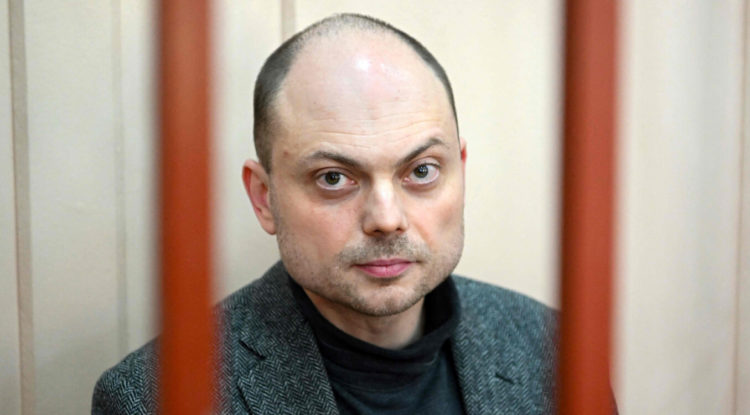
Why did he infuriate the Kremlin so much?
Vladimir Kara-Murza is a Russian politician, historian and former journalist. From his first years in politics, he opposed the power of Vladimir Putin, was a close friend and adviser to Boris Nemtsov, and actively promoted sanctions lists of Russian security forces and officials in the West. Kara-Murza survived two poisonings, but despite this, he continued to engage in politics. On April 6, the prosecutor’s office requested 25 years in prison for him: he is accused of distributing “fake news,” treason, and participating in the activities of an “undesirable” organization. We will briefly tell you why the politician was displeasing to the Kremlin.
In order not to miss the main materials of “Cold”, subscribe to our Instagram and telegram .
Was against Putin already in 1999
Vladimir Kara-Murza's political career began during the 1999 Duma campaign. He was only 19 years old then. He worked for the newspaper Novye Izvestia and interviewed the then 40-year-old Boris Nemtsov, who headed the democratic party Union of Right Forces. Despite the difference in age and status, they quickly found a common language.
As a result of the elections, the party managed to gain 8.5% of the votes and take a seat in parliament. Young Kara-Murza became Nemtsov’s adviser in the Duma. He noted that the politician had a tremendous influence on him.
Kara-Murza did not support the Russian government or Vladimir Putin personally even before he came to power. In a conversation with Meduza, he said that already in 1999 it became clear to him: after Putin won the elections, Russia would move from democracy to authoritarianism.
“I understood well who is Mr. Putin and where he will lead our country - this was December 20, 1999. Day of the Chekist. On that day, Putin (then prime minister) unveiled a memorial plaque on the Lubyanka to the “outstanding statesman” Yuri Andropov, the man who participated in organizing the invasion of Hungary and created a special department in the KGB to fight dissidents,” Kara-Murza wrote in a letter "Medusa."
He was in close relations with Nemtsov until his death on February 27, 2015. After that, Kara-Murza made a film about his dead friend, and three years after the murder he opened a square in Washington, which was renamed in honor of Nemtsov.
Convinced Western politicians to introduce the “Magnitsky list” - sanctions against Russian officials and security forces
Sergei Magnitsky is a Russian auditor. In 2008, he managed to uncover a corruption scheme organized by officials and security forces, thanks to which they managed to steal $230 million.
Magnitsky testified to investigators and revealed details of the crime to Bloomberg Businessweek journalist Jason Bush. In November 2008, Magnitsky was accused of tax evasion and then arrested. In the pre-trial detention center, he was repeatedly subjected to ill-treatment and did not receive medical care, despite the exacerbation of pancreatitis. A year later he died within the walls of his cell.
In the summer of 2010, the US Congress passed a bill according to which 60 security forces and officials involved in the murder of Magnitsky and the theft of funds from the Russian budget were banned from entering the country, and their assets were frozen.
At this time, Vladimir Kara-Murza headed the Washington bureau of the RTVI television channel. He organized a meeting between Boris Nemtsov and the co-authors of the law, Senators Benjamin Cardin and John McCain.
According to Kara-Murza, Nemtsov proposed expanding the law to everyone who violates human rights in Russia, and making it a universal tool in the fight against impunity. Kara-Murza himself took up the promotion of the “Magnitsky law” in the States. On June 7, 2012, the law was adopted. Following the US, it was approved by the UK, Canada, Lithuania, Latvia and Estonia. Both Nemtsov and Kara-Murza have repeatedly emphasized that this bill is not directed against Russia as a country, but against specific people. According to politician Ilya Yashin, they explained to Western parliamentarians that imposing sanctions against Russia would allow Vladimir Putin’s regime to rally society around itself.
In addition, long before the war, Kara-Murza was lobbying for US sanctions against Russian officials and security forces. Mikhail Khodorkovsky in an interview with DW noted that “many” representatives of the Russian elite were dissatisfied with his work.
Immediately after the adoption of the Magnitsky Act, the Russian Embassy in the United States revoked Kara-Murza’s journalistic accreditation. He was soon fired from RTVI, where he worked for eight years.
Collaborated with "undesirables "
After leaving RTVI, Kara-Murza took a job as a senior adviser at the Institute of Modern Russia, an organization led by Mikhail Khodorkovsky’s son Pavel. In it, the politician organized events dedicated to the problems of Russia and published articles by opposition authors.
In December 2013, after being released after a 10-year sentence, Mikhail Khodorkovsky founded the Open Russia movement and invited Kara-Murza to become its coordinator.
Kara-Murza then returned to Russia to work on creating a large regional network of activists. He held meetings, lectures, and seminars throughout the country. In 2017, both organizations with which Kara-Murza collaborated were recognized as “undesirable.”
After this, Kara Murza began working for the Free Russia Foundation, an international organization that helped political prisoners and emigrants and combated propaganda.
As the foundation’s president, Natalia Arno, told Meduza, “many Russian opposition leaders called [the foundation] an informal embassy of pro-democratic forces in the West. When we met with the Foreign Ministries of different countries and the US State Department, everyone joked about it. And in our team, Volodya [Kara-Murza] played the role of such a minister of foreign affairs, an ambassador of an independent free Russia.”
Kara-Murza left Free Russia two years later, after collaboration with “undesirable” organizations was criminalized .
Actively opposed the war, but remained in Russia
Vladimir Kara-Murza spoke out against Russian aggression in Ukraine back in 2014; he called the annexation of Crimea a “crime of the regime.”
At the time of the start of the full-scale invasion, Kara-Murza was in Moscow. On February 27, he, along with other opposition leaders, joined the Russian Anti-War Committee, and some time later he left for the United States for his daughter’s birthday.
On March 15, Kara-Murza spoke in the Arizona House of Representatives. He said: “We all see what Vladimir Putin is doing to Ukraine. Cluster bombs in residential areas, bombing of maternity hospitals , hospitals, schools - all these are war crimes.”
Despite the danger and warnings from friends, Vladimir Kara-Murza returned to Russia. According to the politician, he did not have the moral right to engage in Russian politics while abroad.
On April 12, Kara-Murza gave an interview to CNN, where he called the regime of Vladimir Putin a “regime of murderers” that “started a war right in the middle of Europe.” Within a few hours he was detained near his home in Moscow.
During his arrest—Kara-Murza has been in custody for almost a year—he wrote a column in The Washington Post with the headline “Russia will be free. I’ve never been more sure of that than I am today.” The investigation opened three cases against him: the politician is accused of spreading “fake news”, treason and working for an “undesirable” organization. On April 6, his lawyer Maria Eismont reported that the prosecutor's office had requested 25 years in prison for Vladimir Kara-Murza.
Another confirmation that Kara-Murza has long irritated the authorities: he was persecuted by the same people as Navalny
On May 26, 2015, after lunch in one of the Moscow restaurants, Vladimir Kara-Murza’s condition worsened sharply. He started vomiting, and after a while he lost consciousness, and all his major organs began to fail. After hospitalization, the politician spent a week in a coma; he was discharged from the hospital after a month and a half. He returned to the United States for rehabilitation and spent four months with his family. After the poisoning, his peripheral nervous system was damaged - his left leg and left arm did not work. However, this did not prevent him from returning to Russia in November of the same year.
In 2017, Kara-Murza was again hospitalized with similar symptoms. The diagnosis is “poisoning with an unknown substance.” The politician was put into an artificial coma and spent 10 days in intensive care. Kara-Murza appealed to the Investigative Committee with a demand to open a criminal case under the article “Attempted Murder”, but the department refused to consider both poisonings.
According to an investigation by Bellingcat and The Insider, the same intelligence officers who were behind the poisoning of Alexei Navalny were involved in the poisoning of the politician.