
Translated material
Why are we such?
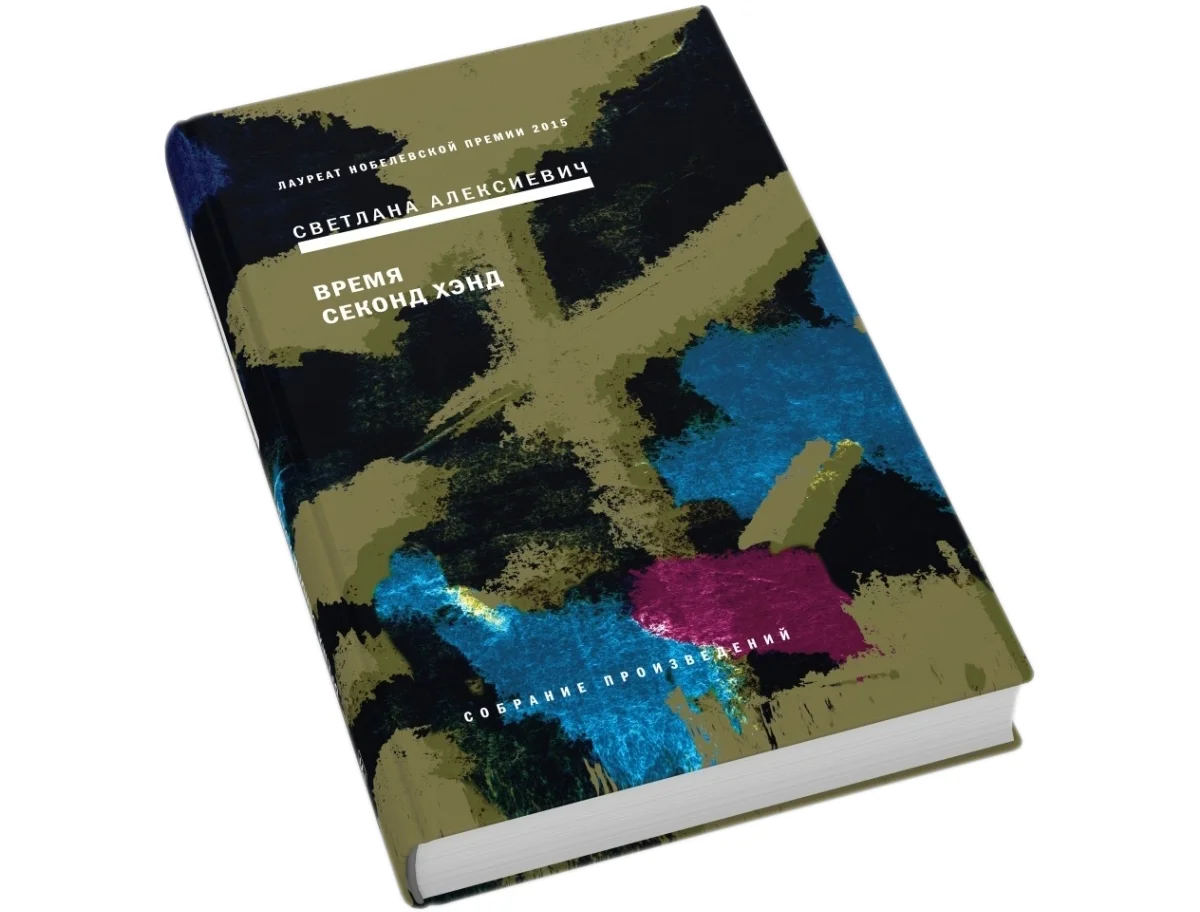
Svetlana Aleksievich-about her new book “Time of the Second Hand” and the experience of the 1990s (the material was first published in 2013)
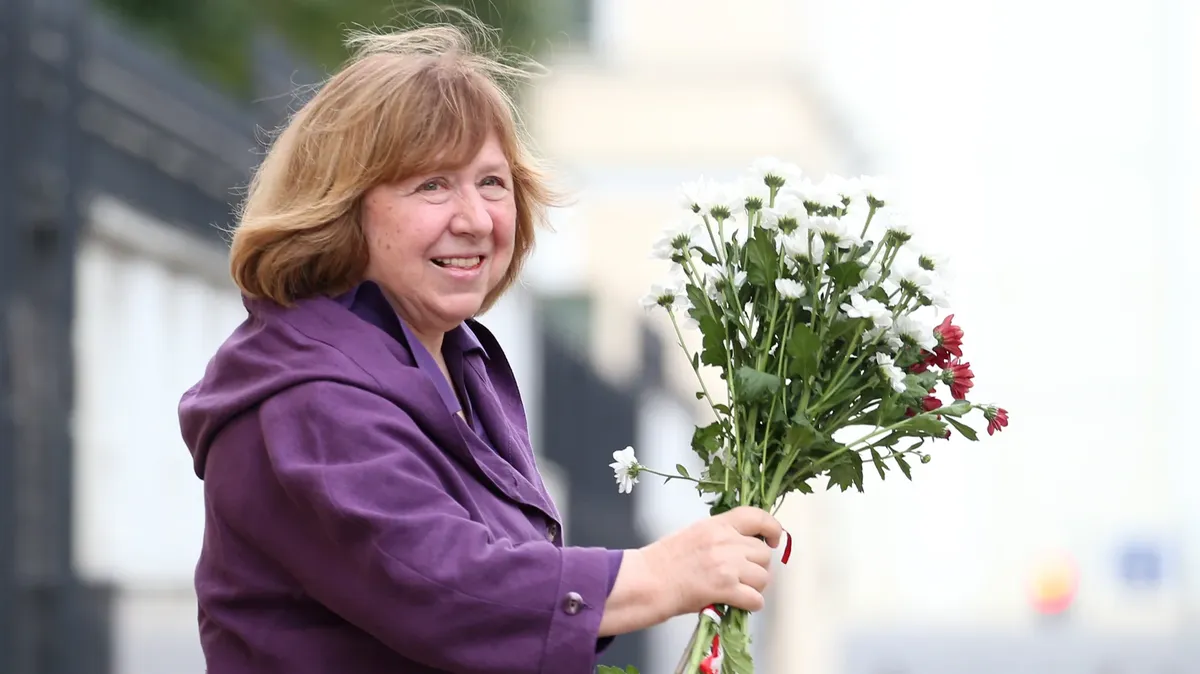
Svetlana Aleksievich. Photo: Natalia Fedosenko / TASS
This material was published in No. 95 (2090) of August 28, 2013. We published it in an anniversary issue. You can buy it here
-The time of the second hand is the end of the 1980s, when did we delight with democracy? Or the current one, when nostalgia for the USSR reigns, and the grandchildren of the dissidents of the 1970s, as it is told by you, read Marx? When we are again - according to your formula - “went not to the world, but from the world”?
- Both. And the worn ideas that we collected all over the world and tried on ourselves - and our Soviet, socialist. Well, we don’t have new ideas: it is striking. My first chapter is called the “consolation of the Apocalypse”: it seemed to us at the turn of the 1990s, that destruction is already an update. It didn't work out.
And the revival of the Communist Party came in some version, the dictatorship of a small number of people in some version. Again we took out with the mezzanine what was worn.
- How do you explain the entire twenty -year zigzag of our special path?
- The heroes of the book often say: “In the kitchen, everything was so beautiful. And when they left the kitchens ... ”After all, the intelligentsia, which made this revolution, was not ready for changes in this scale. Neither politics nor economists.
Most of the evidence collected in the book nevertheless confirms: a small part of society made perestroika. It was a revolution from above.
The bulk of people simply did not expect and did not understand that she would wake up in another country.
In another Tajikistan, another Belarus, another Russia. And people were absolutely not ready for this. But people are active, educated people - they also extremely vaguely understood where they would wake up. It is also important ... One of the heroines very accurately says: "Everyone shouted about freedom - but there was no free man anywhere."
And no one was able to make a “new world” not a slogan, but a process: a slow everyday movement. After all, freedom is black work every day. People work with each other, people talk. Write. Considerable. We do not have this culture. Television in the 1990s should have been the University of New Life. And the bazaar became the University of New Life.
This ends in the same way as the Bolsheviks ended-twelve-fifteen years later, twisting the nuts. Which is happening today: although not in such a terrible option.
So far, not so terrible. But in the last part of the book, the hero formulates very well: people again felt - especially young people - how quickly the Stalinsky machine starts up. It seemed that this could never be. But I watched in Belarus in recent years: as soon as the team was given to grab demonstrators - they began to grab, humiliate, mock. Fill autosaks like "funnels." Screaming to students: "Mord in the snow, bitch!" As if Stalin did not leave.
There is such a second handle ... There is a lot of Stalin in general, a lot is scary in our conversations.
- You describe a huge period. The book breaks from those votes, contradictions. And at the same time-dozens of pages are given to the testimony of the 1930-1940s: camps, war. Why?
- And because we are from there. And I did not ask the topic. These people in their stories say, say-and suddenly return “there” in order to justify their thought about “here”. Because when a person begins to think about life, he is looking for origins: why am I? Why are we such? And goes in those years - or even further. Sometimes he realizes that the executioners and victims were very similar in our country. Tightly connected. Always ready to change roles. And we are grandchildren and executioners and victims.
And the price of human life in our civilization is almost the same as then.
- The book has a lot of confirmation. Compatriots flee to Russia from the Caucasus, from Central Asia in the early 1990s-and live in Moscow at stations. A rural teacher with three children walks in the evenings to the bakery - "smell the bread." The relationship of soldiers in the barracks ... attitude to migrants in the capital ... Old people in garbage dumps. The executions of businessmen in the entrances. The office of the head, where there are barrels with pickles: they need to be made up, the profit will go to the salary of teachers (so the degradance of science began and began). I do not know another book in which the testimonies of troubles, confusion and injustice of the 1990s are so fully collected.
But you give a word to those who have reached the limit of despair. There are almost no people who have passed the path of personal modernization, which put on their feet in the book. And in life there is.
- For me, a person’s attitude to the “red idea” is incredibly important. I tried to explore the consciousness of those who tightly connected themselves to the “red project” - and as if I died with it.
After all, from the book to the book I investigated the idea of “domestic communism”, totalitarianism: what is it? How did we live here? What came of it? And in order to focus the topic, I took the most extreme options, and not “positive examples”.
Of course, they are. Of course, many people did not succeed in the country - so at least redo themselves. And this is a guarantee that it is not necessarily to end with a revolution. Weak, but the hope that Stolypin’s words will come true: “Give the state to the state twenty years of the rest of the internal and external - and you will not recognize Russia.” What now we must pray day and night ...
But I have been writing for thirty years, I write down a single “red encyclopedia”. “The war has not a female face”, “last witnesses”, “zinc boys”, “Chernobyl prayer” - its chapters. “Time of the second hand” is also a chapter. Final.
I am exploring the idea that flooded the country with blood. Precisely because this idea did not leave: it seemed to us that it would leave easily and quickly. But this virus lives in the ground for a long time, like a Siberian ulcer. And I want to tell what this was the experiment on a huge number of people. The topic is huge. That's why I chose this extreme point of view. How death reveals the truth of human life, the truth of everything that we said - so I chose. Let's see with these eyes. Because without death, after all, nothing can be understood ... what is worth it. After all, this is not only a social portrait. This is a "naked man on naked earth."
“You have a phrase:“ I believe that the pain is a bridge between people, a hidden connection, and another time in despair I think that this is a gap. ” Still: a bridge or an abyss?
- I could not understand for myself why overcoming evil, why the experience of pain did not make us cleaner, stronger, better. When the archives of the 1930s opened when
Families spoke - it became clear what we survived. And then - again slavery, again fear. I can't understand this.
And yet, in my opinion, we are civilization of suffering ...
- Still? Or is this project completed? And something is replacing him?
-Elena Caesarevna Chukovskaya once told me how they printed and distributed samizdat in the 1960-1970s. With great risk - but also with the hope that people will read, think, they will change - and this will be another Russia. In the 1990s it became possible to read everything. But it turned out to be more important not to read - but to try. Travel. Buy clothes. Change the tile. It became a dominant.
I quote again, but very accurately one of the heroes says: “Live! Try everything, lick, bite off ... and do not burn and burn, do not run all the time somewhere with a torch and ax. ”
- Do you condemn the bite? Or is the fact that the ancient tragedy of the “project of the USSR” ended with a rally “Fields of Miracles” live?
- I never take the right to judge and condemn. I'm trying to understand. And perhaps it was this desire to lick-oatmeal that saved us from the civil war. People rushed to build cottages and buy cars instead of cutting each other. Which was also quite possible: in some parts of the former USSR we saw this.
It seems that this is the term Yuri Levada - “a person who tries”? He replaced the "simple Soviet." At least it seems so on this day.
- In what languages did the book be released before the Russian edition?
“I finished her in May.” But the translators began to work without waiting for the end. "Time of the Second Hand" was released in Germany, in Sweden. In early September will be released in France.
- And what is the reaction? After all, everyone has favorite common places. In particular, there is European truism: the 1990s were a time of freedom and heyday for Russia.
“I remembered the words from the Swedish review:“ The stunning picture of what actually happened in this huge country during its monumental disappearance. ”
- How did you choose heroes?
- Well, it was hellish work. Still, the book was written for many years. There were many meetings, trips, conversations. And during the years of perestroika. And ten years later, when it became clear - a miracle did not happen when we began to live with a sense of defeat, when young people spoke after Limonov that we had a great era ...
People were discovered by accident: on trips, in conversations. Everything was weaved for ten years. Even if you do not do what I do, you meet thousands of people. And when the idea formed, I got out of everything made earlier - I began to ask everyone questions: “How do you feel about restructuring?”; "And to what is now?" And about this - touch any person, he will speak. We are all witnesses, all participants. I gave the book a subtitle “Notes of the accomplice”.
- And why do you need the story of the crazy village beauty Lena, who abandoned three children and her husband for the sake of a great love for the killer with a lifelong term? How is she connected with the era?
- Why, this story is one of the main ones in the book! She is very important. In front of her, three hundred pages go all this lava! All we lived: intelligentsia, student ... All hopes, all dramas, humiliation, August 1991, October 1993. How "shuttles" in trains argued about Shalamov.
How later everyone was lifted up to read, because they implicitly felt: and the books were betrayed.
... And here we are going to the village. And there-they still write to prison. Still pity convicts. There, in the pool of folk life, the deepest, nothing has changed. Gorbachev? Yeltsin? Swamp Square? Leave, everything is different here. Here they are looking for badger fat to prison.
We scream here in Moscow or in Minsk ... And you look at any procession: what faces! After all, nothing, nothing has changed over the centuries. I once walked past the line to the miraculous icon brought to Minsk - and it seemed to me that I was in the 15th century. These white scarves, these bent shoulders, these beards ... We have no idea what it is - real Russia. Or Belarus.
You understand, the whole real life, which we know-it settles somewhere in large places. In Moscow, in Minsk.
And there, in tens of thousands of villages, there is a completely different life that has no idea about us. And the feelings of the "common cause" with us are not there. And it cannot be.
This is very, very much to think about.
And in fact - here is the main reason what is happening to us. Because there is no soil on which another life can grow. There was not the slightest hope that this monolith would understand and accept the "new".
I have been writing people for many years. And I have a very strong feeling: we do not know what Russia is - no power knows what Russia is. This monolith did not set in motion. Perhaps it is fortunately. No one knows what is cooked in this boiler.
- With this thought, you read your book: vapors of resentment, injustice, bitterings are accumulating. And they are articulated: “I go to different parties. To the patriots, nationalists ... I am listening. There will be time, and someone will definitely give me a rifle. And I'll take it. " At the same time: no one in twenty years clearly preached on the world that the only reliable social staircase is education. And that it is impossible to go on her overly ...
- But one of the darkest features of time is the impossibility for ordinary people to learn children.
And the intelligentsia stopped talking about it. The intelligentsia now not only does not know, not only does not want to know what is happening - but herself is completely not influential. Even the former popular respect for a book person has been lost. But this is a very big mistake - that the intelligentsia does not talk to the authorities. And no less is that the intelligentsia does not talk to the people. Either she is afraid of him, or she lost the qualities necessary for conversation. And the person is left alone. At a confrontation with a shadow of poverty, with shining clothes in a window, with a used foreign car. And with the same rifle that someone will give.
I believe that the intelligentsia should speak. But the older generation was gone. And forty -year -olds ...
- You have a clear formula in the book: "The elites have not done their work."
- No, we did not do our job. We, too, were not ready for events. No one expected that everything would fall apart so quickly that a person would change so sharply. And that soillessness will drag on so long. Because power is ideas. And no one could fill the void.
One thing is clear to me: about what happened, about what is happening, we have to talk about us.
Under the text
In 2015, Svetlana Aleksievich became the Laureate of the Nobel Prize in literature "For polyphonic creativity - a monument to suffering and courage in our time."Now, together with his people, the dictatorship of Lukashenko is opposed.
And for Lena Dyakov, the editorial office fought for several years. Before the death of cancer, she managed to write a wonderful book about her family and revolution. We are preparing it for publication. And the first copy will receive Sveta Alekseevich.