
Translated material
Like money, but not quite
What is a digital ruble that the Bank of Russia wants to introduce and what does the copper penny of Tsar Alexei Mikhailovich have to do with it
Photo: Alexander Kazakov / Kommersant
It was planned to start testing real payments with digital ruble from April 1, 2023, however, a package of digital ruble bills has currently been held in the State Duma only the first reading. The digital ruble will be introduced gradually and will not replace the cash and non -cash forms of the Russian currency, said Olga Skorobogatova, first deputy chairman of the Central Bank of the Russian Federation. But why and who then does a digital ruble need at all?
Find the differences
If the digital ruble is different from the usual one, then only for the better, the financial regulator insists. There are many pluses of such a ruble, and the main among them are quick and safe payments for citizens and business 24/7. With low commissions, not higher than in the system of quick payments. At the same time, it will be possible to contain smart contracts on the platform of the digital ruble. They allow you to accelerate, simplify and make transparent a variety of transactions, explains the Central Bank. For example, when buying an apartment, the digital rubles of the buyer of real estate will automatically go to the seller as soon as it is registered for the new owner. Or through a smart contract, you can purchase goods: the supplier will receive payment for his products immediately after it reaches the buyer.
Reliability, safety and protection, but the main thing (and the Central Bank of the Russian Federation did not hide this) - the technology of the digital ruble allows you to label the means to use strictly for specific purposes. This can be a useful tool both for monitoring social benefits and for controlling the pocket money issued by parents to the child - they can only be spent on what is allowed. Well, the government will be able to improve control over the spending of budget funds, the financial regulator explained, emphasizing that such functionality can be useful for both the financial market participants and for business. But on April 6, the first deputy chairman of the Central Bank of the Russian Federation Olga Skorobogatova said that digital rubles will not be “painted”, for the Central Bank this is the same payment tool as cash and non -cash rubles.
Olga Skorobogatova
First Deputy Chairman of the Central Bank of the Russian Federation
“No, we are not talking about the topic of staining and that the digital ruble will be some other, in contrast to cash and non-cash rubles. Once again: this is the same money. For us, this is mainly a new payment tool. If a person himself, for example, wants, as is being done now, to establish a periodic payment to a specific recipient, then in digital ruble using a smart contract we will give such an opportunity, but he will choose whether he wants to pay in this way, automate his payments, or does not want to. ”
Then how will the digital ruble still differ from the usual non-cash ruble? Only the fact that the “numbers” will keep records of the Central Bank of the Russian Federation? Or by the fact that the digital ruble is akin to cryptocurrencies?
"Number", but not a crypt
No, a digital ruble is not a cryptocurrency, says the Central Bank, and it is true. Crypt is actually a digital record, protected by a cryptographic algorithm, a hack of which will cost more than the cost of such an entry in the market. But cryptocurrency itself is really not quite money, but rather an asset used for exchange speculation. Yes, these assets can be accepted for payment for goods and services (if you want), but let's clean: what is the main motivation of people who exchange rubles or dollars for a variety of beds today? Only the hope that someone will come to them tomorrow who will buy this thing from them much more than they paid for it.
And from this point of view, the digital beds are no different from the tickets of MMM JSC (yes, yes!).
And as in the case of MMM, the geometric progression in which the CRIPTOINTOR buyers or “MMM partners” should be reproduced, sooner or later it will fall into the number of people: a) people; and b) money (it is no coincidence that Bitcoin was valued precisely when the Fed reduced the rate and banks increased the money mass).
But Bitcoin has a property that allows the layman to call him money: he really looks like cash - from the point of view that he does not need intermediaries who ensure a test of his authenticity. Non-cash money is records on bank accounts, and in order to accept them on payment, we need a bank confirmation that they have a payer (remember SMS messages “on your card is not enough funds”?). Whether the matter of the bill (although we also check its authenticity, albeit by eye). Bitcoin in this sense is closer to a bank ticket than to cashless currency.
Our debts are difficult
But why then do we not say that credit money (the same ruble, euro, dollar or yuan) is not a financial pyramid? After all, modern money is, simply put, debt receipts taken into account in one way. And so, someday these receipts can become too many?
Here we need to make an excursion into the history of the economy. Once upon a time (in fact, only a few hundred years ago), the predecessors of the usual paper money began to pay written obligations to pay some liquid goods (for example, gold) at a solid rate. So they wrote: I, the name, undertake to give this 100 gold coins to the head of this. In fact, these were road checks that allowed medieval importers not to take up a place in the holds of their ships for the transportation of gold coins or ingots. Such checks were issued by the debtor to the creditor, and the creditor, of course, took the risks that his debtor could not pay for his obligations, but the business is a business - instead of 100 gold coins in cash, he could ask to write an obligation at 110 - as a fee for his risk.
Subsequently, such obligations began to be taken into account by banks that took over the risks of non -return of such debts (of course, not free) - and at the place of debt receipts that one person gave to another came “unified” debt receipts of banks.
Today, the owner of the Bank of Russia ticket or Federal Reserve Note (in fact debt receipt, only standard) and has no idea who specifically should be - it is enough for him to know that he can exchange this receipt at any time for goods.
Moreover, many, holding a bank ticket in their hands, think that the Bank of Russia or the Fed and “print” such debt obligations. Not really. And the central banks (and banks in general) are just intermediaries between end borrowers and creditors, as well as accountants of their mutual obligations.
But no real money, or assets providing credit money, no longer exist. Just the “borrower” assumes the obligation to pay its debt with the same credit money, i.e. compensate him for lending to other borrowers.
Money from the air
That is, money is really created “from the air”: every time someone appeals to the bank for a loan, the bank evaluates the borrower's ability to repay a debt with interest-and creates money for him. Rather, he writes in himself that the debtor of the bank (for example, taxi driver Ivan Ivanovich Ivanov) will have to transfer a certain amount no later than a certain date.
How to return it? Well, this is the problem of Ivan Ivanovich. After all, he took a loan in order to buy something for this money (say, a car)-that means he will transfer them to Peter Petrovich, who would sell him a car. He, in turn, will pay this money for his debt obligations - for example, he will pay for his employee Semen Semenovich. And Semen Semenovich will spend this money in a taxi, which Ivan Ivanovich will sit behind the wheel.
It turns out that the bank can create any amount of money (issue any amount of loans)? In principle, yes. And this is the key problem of credit money: when debts are unified by the banking system, this means that creditors instruct control over the quality of borrowers to the bank. This can lead to irresponsibility of both banks and borrowers: it happens that neither people nor banks can correctly evaluate the solvency of the borrower - and we get a lot of poor debts and a banking crisis.
But, on the other hand, no banks, including central, have no direct levers of creating (“printing”), they only mediate in this process.
We can say that money is created by banks at the request of people who need it and who are ready to take on the risks associated with the return of their debts. But then how to reduce such risks?
And here the financial regulator, which we call the central bank, intervenes in the case. To adjust the rate of reproduction of money, he has two tools: the key rate of refinancing and the norm of mandatory reserves (if you want to issue a loan, put some part of the issued amount to a special account). However, the Central Bank can, if it considers it necessary, and simply increase the size of credit limits to banks - take and give it out. Technically, it looks like a ransom by the Central Bank of some part of loans issued by the bank-now the regulator itself will deal with your debtors, as the Central Bank says, and you give out new loans. That is, do/print money.
And what is then cash, that is, “real money on the material medium”, which can otherwise be called deposit receipts of the bearer? Yes, today it is just a type of credit money. But banks and the government are doing everything possible to make it difficult for us to use cash. Converting from bank accounts in them within the law is possible only after fixing all tax obligations, since tax administration of cash settlements is impossible. Cash calculations, modern funds “do not see” (in any case, it is much more difficult to prove transactions in cash).
Two sides of the coin
Thus, in the modern financial system “Money” and “Credit” are just two different names of the same: assets and liabilities of the banking sector. The issuance of a loan to one economic entity also means exactly the same (according to the module, and by sign - the opposite) increase in monetary savings of another subject, and nothing else.
And here the most interesting begins. If, as we understand, cash and non -cash rubles are loans issued by banks under the control of the financial regulator, then what is digital rubles that the Central Bank is going to issue? He insists that this is just another form of the national currency, but we remember:
In order for the money to appear, it is necessary for someone to want a loan, and the bank appreciates its solvency.
And how is it going to do the Central Bank of the Russian Federation?
After all, it turns out that the regulator can release any number of digital rubles in circulation, but it will also bear all the risks, not only the non -return of these loans, but also the depreciation of the digital currency. After all, the money is depreciated not by themselves, but in relation to goods. We have observed an example of such a depreciation of credit money in recent years: as soon as banks with the approval of the Central Bank of the Russian Federation and governments began to massively distribute mortgage loans, so the apartments instantly rose in price. And the borrowers did not receive any special benefit, except for the opportunity to buy in installments sharply rising housing, which was no more affordable. Loans are issued much faster than houses are being built, so there are fewer apartments in the market than those who want to buy them.
Why can't the same story happen to digital rubles? Why will their distribution not lead to inflation?
"Thieves' money" Tsar Alexei
In general, the history of the economy gives us many examples as an attempt by the government to intervene in the process of creating money and determining their price led to the most unexpected consequences.
360 years ago, in the summer of 1662, a copper riot flashed in Moscow - a rebellion provoked by an economic crisis. And the reason for the crisis was the increase in prices caused by the desire of the authorities to create “additional money” for calculations on their obligations.
At that time, the ruble, consisting of 100 kopecks, or 200 money, was an exclusively counting unit, the real coin “ruble” did not exist, and silver pennies and half -brews (“money”) went in the appeal. These coins of silver brought from Europe were minted, and their value really corresponded to the cost of the precious metal contained in them.
The government of the sovereign Alexei Mikhailovich very much did not like this situation, because there was always not enough imported silver, and here since 1654 there was a war with Poland, which required tremendous expenses ... In general, the authorities categorically did not want to spend a scarce imported resource on maintaining the economic turnover and consumption of commoners.
And now the royal Okolnichy Fedor Rtishchev came up with a brilliant plan: let's mint a penny not of silver, but from copper and order the subjects to take them instead of silver in the course of one to one!
True, copper was also imported, but it was still much cheaper - the price of metal required for minting 10 thousand copper cents was only 160 cents of silver.
Thus, an exclusively royal decree served as a guarantee of the value of copper money. In other words, the value of a copper penny was based not on copper, but on the guarantee of the state.
But the main idea of Rtishchev was even more cunning: the authorities paid a salary and paid for “state purchases” with copper pennies, but exclusively silver was paid for taxes and customs duties.
In addition, copper kopecks were exclusively in European Russia - silver remained in Siberia in the circulation, and trade with Europe was carried out with silver money.
In principle, the government of Tsar Alexei tried to create two contours of the economy: external and internal-and offer “calculated units” with a different cost in relation to goods and with varying degrees of risks of their use (there is something very familiar in this idea).
At first, the population grabbed for copper money.
But soon people realized that if the authorities themselves did not want to accept the coins that she began to pay taxes, then something is wrong with these coins.
In addition, the government did not limit itself in its emission appetites. For five years of copper money, 20 million rubles were minted. And there were no more goods in Rus', and if in 1659 104 copper were given for 100 silver cents, then by 1660, 200 copper were given for 100 silver cents. Accordingly, prices have risen.
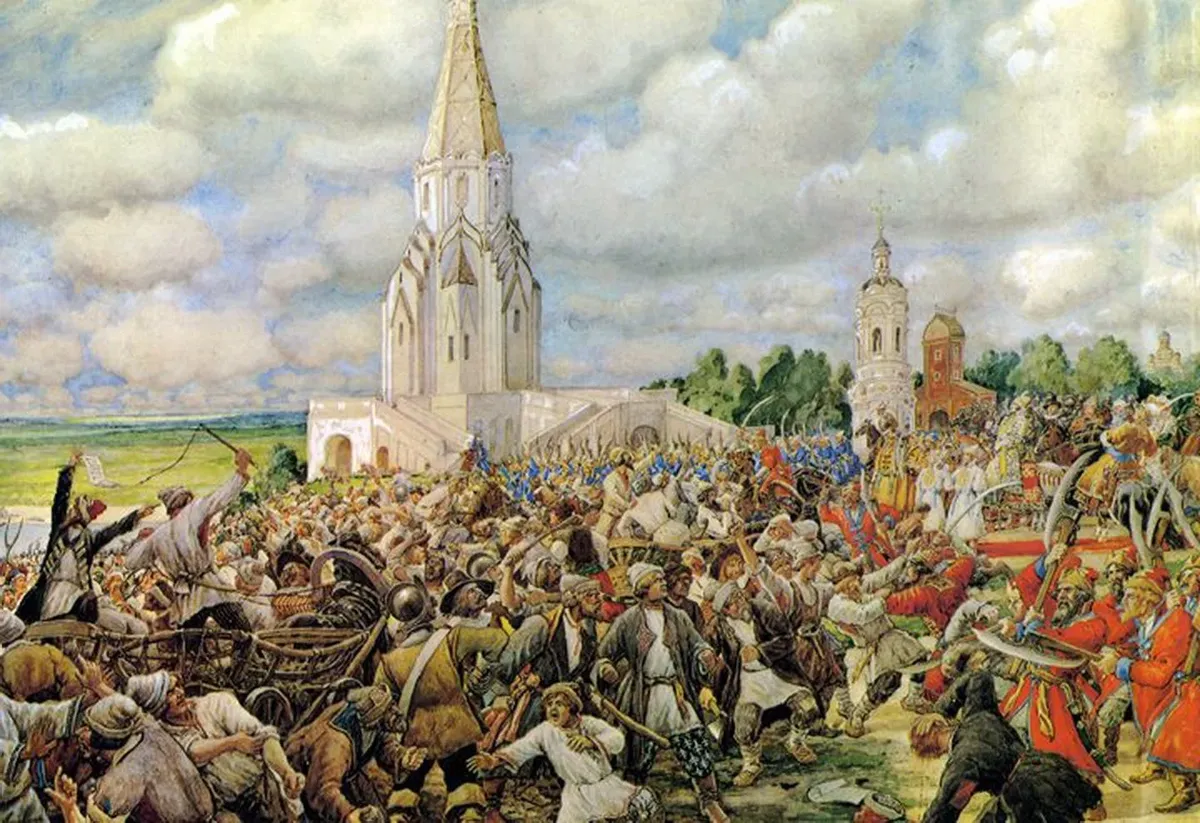
In 1662, the patience of Muscovites burst, and people massively went to the tsarist residence, carrying a petition demanding a reduction in prices and taxes ... Further, as a contemporary wrote, from 150 people who turned to the king, and the rest was a decree, tortured and burned. ” The survivors after the “investigation” were beaten with a whip, stigmatized as “rebels” and sent to the eternal link “to distant cities”, while others were drowned in the Moscow River. In total, about 1,000 people were executed for the “unaccountable petition”.
True, executions and torture still did not help to strengthen “copper money”. In 1663, 12 copper were already given for one silver penny. Despite the threats of the authorities, both peasants and “trading people” categorically refused to sell bread for copper
And in 1663, the government curled up "monetary reform." In July 1663, minting of silver money was restored and, most importantly, the payment of a salary by them.
Further, copper pennies were prohibited for use, the coin courtyards where they were minted, were closed, and the remaining copper pennies agreed to exchange for silver, but at the course ... One silver penny for 20 copper, and then one silver penny for 100 (!!!) copper. To the one who tried to mint copper pennies independently and offer them to the state for exchange, the “judicial Code” threatened to “fill your throat with those thieves' money”. Thus, the first experience of the introduction of monetary surrogates in Russia ended.
"Paper ruble" journalist Sharapov
However, analogies of digital rubles can be sought not in the 17th century, but closer to our time.
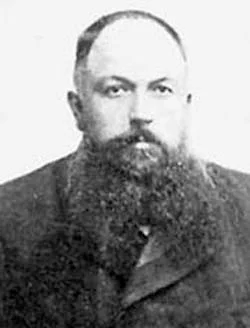
At the beginning of the twentieth century, economic journalist Sergei Sharapov published a pamphlet “Paper ruble”, in which he outlined his views on the arrangement of a financial system based on direct loans of the State Bank to small entrepreneurs.
QUOTE
Sergey Sharapov:
“Automatism of the country's monetary supply consists in a properly organized network of credit institutions based on the central regulator of monetary circulation and credit - the emission bank.
Suppose that the county of the State Bank operates in the county, in addition to independent credit operations, a whole network of small banks - parish cash desks. The accounting committees of the department and the cash desk are organized, for example, very completely. They will not letting a single credit, they will not give out the ruble not to business or in wrong hands.
Due to the obvious drawback in the signs in the county, the requirement for the money will be at first a huge ... And the county that suffered without a loan will begin to absorb working capital and put them in. At this time, the emission bank reinforces the county cash desks with the necessary amounts of money. After a short time, due to spending this money by borrowers in the form of all sorts of payments, banknotes free from immediate expenditure will begin to intensify in different hands.
In the immediate vicinity there is a cash desk, where these signs can be attributed to a contribution or current account, receiving interest for them. Начнется прилив вкладов, который будет настолько меньше их отлива из касс, насколько есть в наличных деньгах нужда.
Но вот уездная и приходские кассы кредитуют дальше… Число обращающихся знаков растет, растет количество вкладов. Наступает момент насыщения, когда количество денег, выдаваемых и получаемых сетью касс, выравнивается. Цифра, выражающая потребность данного района в денежных знаках, будет вечно изменяться, отражая состояние сделок.
Но в руках банкового управления имеется регулятор, позволяющий удерживать постоянное равновесие и производить полезное воздействие на промышленность. При застое и приливе вкладов понижается процент по вкладам и ссудам — промышленность поощряется более дешевым наймом денег. При промышленной горячке и усиленном требовании денег вкладной и ссудный процент повышаются — поощряются осторожность и спокойствие.
Верная и умелая учетно-ссудная политика может служить великолепным регулятором денежного обращения и надежной гарантией постоянства ценности бумажных денег, хотя бы не обеспеченных никаким металлом… при таком устройстве кредита и денежного обращения не может быть речи ни о каком излишнем выпуске бумажных денег.
Наоборот, через самое короткое время с развитием чековой системы и текущих счетов это количество начнет сокращаться, без всякого стеснения для народного труда и оборотов».
В то время идеи Шарапова не получили развития (он выбрал верное по смыслу, но неудачное название для своей книги, в сознании публики того времени «хороший рубль» должен был быть «золотым»). Современные экономисты скажут, что Федеральная резервная система США примерно так и работает, но… риски кредитования оценивают не чиновники государственного банка, а сотрудники множества частных банков. В идее же цифрового рубля Банка России ключевой момент — именно прямой доступ экономических субъектов к «эмиссионному центру», то, что предлагал Шарапов.
…Конечно, цифровой рубль двадцать первого века трудно сравнить с медной копейкой века семнадцатого и с бумажным рублем века двадцатого, но сходство здесь есть —
по каким-то своим причинам власть создает не столько денежную (т.е. кредитную), сколько именно расчетную единицу, оборот которой технически может жестко ограничивать.
Вероятно, власть предполагает, что цифровой рубль может стать инструментом контроля за расходами, то есть нормирования потребления людей? Или власть рассчитывает, что сможет расплачиваться этими расчетными единицами по обязательствам правительства? Ну и третий вариант: может быть, регулятор смотрит далеко в будущее и рассчитывает, что со временем, научившись правильно оценивать риски кредитования заемщиков, станет коммерческим банком, только очень большим?
Впрочем, главное, что мы должны знать о цифровом рубле, — это ответ на вопрос:
будет ли правительство принимать в цифровых рублях налоги. Вот если нет — то, значит, «цифровые деньги», это не «деньги», а «расчётные квитанции», имеющие ограниченный оборот в пределах определённой территории.
Вот как в фильме «Неуловимые мстители» (дело там происходит в Гражданскую войну) персонажи расплачиваются между собой «расписками от самого батьки Бурнаша» — так сто лет назад и бывало. Ну и плюс — дополнительное средство контроля за расходами граждан.
Но экономику не обманешь — люди всегда чувствуют реальную ценность всех денежных суррогатов и «расписок», хоть бумажных, хоть цифровых, и стараются избавиться от них при первой возможности. В «денежных делах» люди знают — если начальство само не пользуется каким-то финансовым инструментом и не верит ему — значит, и нам не надо.