
Translated material
Why did Nobody listen to Novodvorskaya?
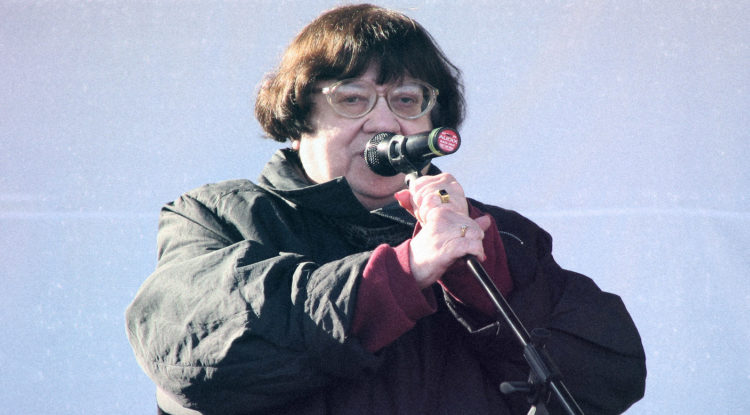
The film “White Coat” was released about Valeria Novodvorskaya. The identity of the dissident has long been in need of rethinking, according to historian Sergey Bondarenko
On the YouTube channel "Medusa" was released the documentary "White Coat"-the first screen biography of Valeria Novodvorskaya. During the life of the famous human rights activist and politics, many treated her with irony, sometimes angry: they accused of excessive radicalism, joked over appearance and manner of speaking. Director Igor Sadreev gained access to the criminal cases of Novodvorskaya, met with her associates, remembered her texts and interviews and tried to rethink her image. It is high time to do this, according to historian Sergey Bondarenko.
In order not to miss the main materials of the "cold", subscribe to our Instagram and telegram .
Many years ago, I had to spend the night in a foreign city on neighboring beds with a historian colleague. The time was depressive - and settled us together almost by force, so we spoke a little and rather from the background, implied sympathy for the silence of another. The neighbor complained that he needed to edit the works of Valeria Novodvorskaya. Without reading a single book of her, I nodded significantly, presenting hundreds of pages of journalistic graphomania. I was an ordinary smug idiot.
A few years later, when the depressive state grew into the disease, I picked up the Autobiography of Novodvorskaya “on the other side of despair” of the 1993 publication from perfect indifference. This book did not just “help me to cope” or taught me to get up in the morning, it seemed to me almost religious text, on equal terms with the “confession” of Leo Tolstoy. One place from the book of Novodvorskaya, most reminiscent of a prayer, I wrote out for the case if I ever needed to write about it:
“They defended everyone, defended the fact that they sat down nearby, in the next camera. It was impossible to protect a person - it was possible to protect the idea of human rights, having no way to protect the rights themselves. ”
***
Novodvorskaya’s talent - to bring their affairs, their thoughts to the logical end, to an existential point. This is well shown in the film - all this is a collection of jokes from life, almost the Leninist format: as Novodvorskaya went on strike in the children's sanatorium, at the age of 15 she demanded that in the Soviet military registration and enlistment office to send her to Vietnam to fight the capitalists. As I read “one day of Ivan Denisovich” and realized that “not everything is so unambiguous.”
The stories of the posttalin political protests are most often the stories of loners or very small groups and circles that arose here and there, recorded in dissident chronicles and underground almanacs. And therefore, it seems natural to imagine the Novodvorsk heroine-single, Jeanne d'Arc, Abby Hoffman in a skirt, inaccessible moral authority. Moreover, both the history of her life, and the history of her posthumous heritage seems to be flagrantly unfair (the film begins with this), a set of memes: Novodvorskaya eats a brick in a white coat and shouts “Communications!”.
But it seems to me important after the creators of the film to see the main heritage of Novodvorskaya, not in her heroism, but in her sanity, in the ability to see the main thing. This is a complex spiritual and intellectual quality, which we all have to varying degrees, but do not always decide to fully use it. Novodvorskaya was distinguished by the ability to distinguish important from the unimportant, to measure the scale of events, not to turn away from moral choice. According to its public actions and in its texts, one could mark an alternative map of Soviet life - and it was much more accurate not only than the congestive newspaper Pravda, but also than the perestroika magazine "Spark". When in the second half of the 1980s, many recent dissidents and dissenters sting their hands on their executioners and drove in the commissions, Novodvorskaya served in the departments and the KPZ its next 15 days of hunger strike. For her, Gorbachev was an ordinary Soviet functionary, and the consent of a large part of yesterday’s political prisoners to adopt new rules of perestroika - the greatest tragedy and betrayal.
Novodvorskaya speaks of the video before entering his court in 1991: “This is the only thing that is close to Soviet reality <...> everything else: advice, deputies, democratization is a larch. But this is the present. ” She is judged for insulting power and for comparing Gorbachev with Hitler. Meanwhile, around 1991 - everyone is singing an posture of publicity, the interregional deputy group breaks through reforms, the “memorial” threatens to erect a monument to the victims of repression. Meanwhile, the Novodvorskaya and its “democratic union” seem to be a bunch of extremists and almost urban crazy people who protect the protesters in Tbilisi, standing under the bullets near the building of the Radio Committee in Vilnius.
***
Why did Nobody listen to Novodvorskaya? This is the wrong question. Not accurately accurate: Novodvorskaya was listened to, she performed at large (unthinkable by current Russian standards) rallies, her prison interviews were printed in millions of circulations.
But Novodvorskaya was a woman. And the woman is strange: physically unhealthy (a consequence of torture in the mental hospital), blatantly non -sequential (which was in the patriarchal Soviet and post -Soviet society abroad of the mass cultural norm), with a strange voice and non -non -conformist position. In the history of her failure, there are also quite international features: so, next to Ebbie Hoffman was Bernardin Dorn - one of the central figures in The Weather Underground, awarded Aaron Sormin’s film “The Court over the Chicago Seven” of one minute of the screen time (there she answers telephone calls in the anti -war headquarters). In reality, the role of Dorn in the movement for civil rights and organizational influence was immeasurably large. But even in the history of the American 1960s, she was a woman, a border guard of the cultural norm.
Novodvorskaya has always been away from the dissident circle (with all the conventions and problematicity of this concept itself). She herself said that she shares many ideals of the “main” Soviet human rights activists - some of which were not even inferior to her in radical methods and practitioners: Vladimir Bukovsky, Anatoly Marchenko, - it is characteristic that they were more likely Outlaw, lonely among outsiders, unattainable samples of courage. Even inside this system and logic, Novodvorskaya turned out to be “on the other side”. Moreover, the sexist hierarchy with its own characteristics was quite applicable in relation to this, much more free and advanced community, where women were supposed to educate children alone and carry their husbands to prison and on long -term dates to the camps and exiles.
Novodvorskaya did not have a husband and children, she did not work in collaboration with the authorities, as Arseniy Roginsky (political prisoner, human rights activist, head of the Memorial. - approx. "Cold") and "Memorial" of the first years of the post -Soviet government, she did not go to the Commissioners for Human Rights, like Sergey Kovalev. Even in 2011, in the midst of the Medvedev thaw, when rallies on Bolotnaya and Sakharov were collected under 100 thousand people, and the local rallies of Yabloko-at least three thousand, Novodvorskaya gathered separate rallies-chippings for its supporters. Yes, there were few supporters. But how many people were at the first concert of Sex Pistols?
In 1991-1993, Novodvorskaya really supported Yeltsin (in one of the fragments of the film there is a piece of her performance, where she calls the “Firebird” recently collapsed from the Yeltsin bridge), and in 1994–1995 Johar Dudaev. But it is significantly important that she supported not Yeltsin - the President of the Russian Federation, but the first years of independence, who was disturbing from the CPSU and promised radical reforms, not “former Soviet General Dudaev”, but a leader in the struggle for national independence against the corrupt and militarized imperial power. And this was not a nihilistic, Pankovsky position of the denial of the establishment, it was always an attempt to affirm a different, more fair, more consistent position. And this position was inclusive, involving complicity. So, in the 1991 court, Novodvorskaya invited those who wanted to sit next to her on the bench on the bench about the “insulting greatness” of Gorbachev on the camera: “Who wants to here? There is still a place here. ”
Does this do the Novodvorsk holy, blessed, heroine-single heroine from the post-Soviet Istra? I would like to believe that no, does not. As of 2023, this seems perhaps the most pragmatic position, a sober look at reality. Another thing is that the “views” alone are not enough: in an interview that got into the film, Novodvorskaya admits that, like many around it, she believed that Soviet citizens find out the truth about the essence of their power - the system will collapse immediately on the last page of Tom Solzhenitsyn.
The well-known alternative system of measures and weights suggested that the fully printed samizdat volume of the “Gulag Archipelago” was placed in a box from under the iron. The further question is that the one who reveals this box will see: the path to his freedom or the absence of an iron.
The author’s opinion may not coincide with the opinion of the editorial office.