
Translated material
Jupiter's ice cards are the most interesting place in the nearest space. The European Juice Sound is sent to search for life
Once Russia was also part of this project
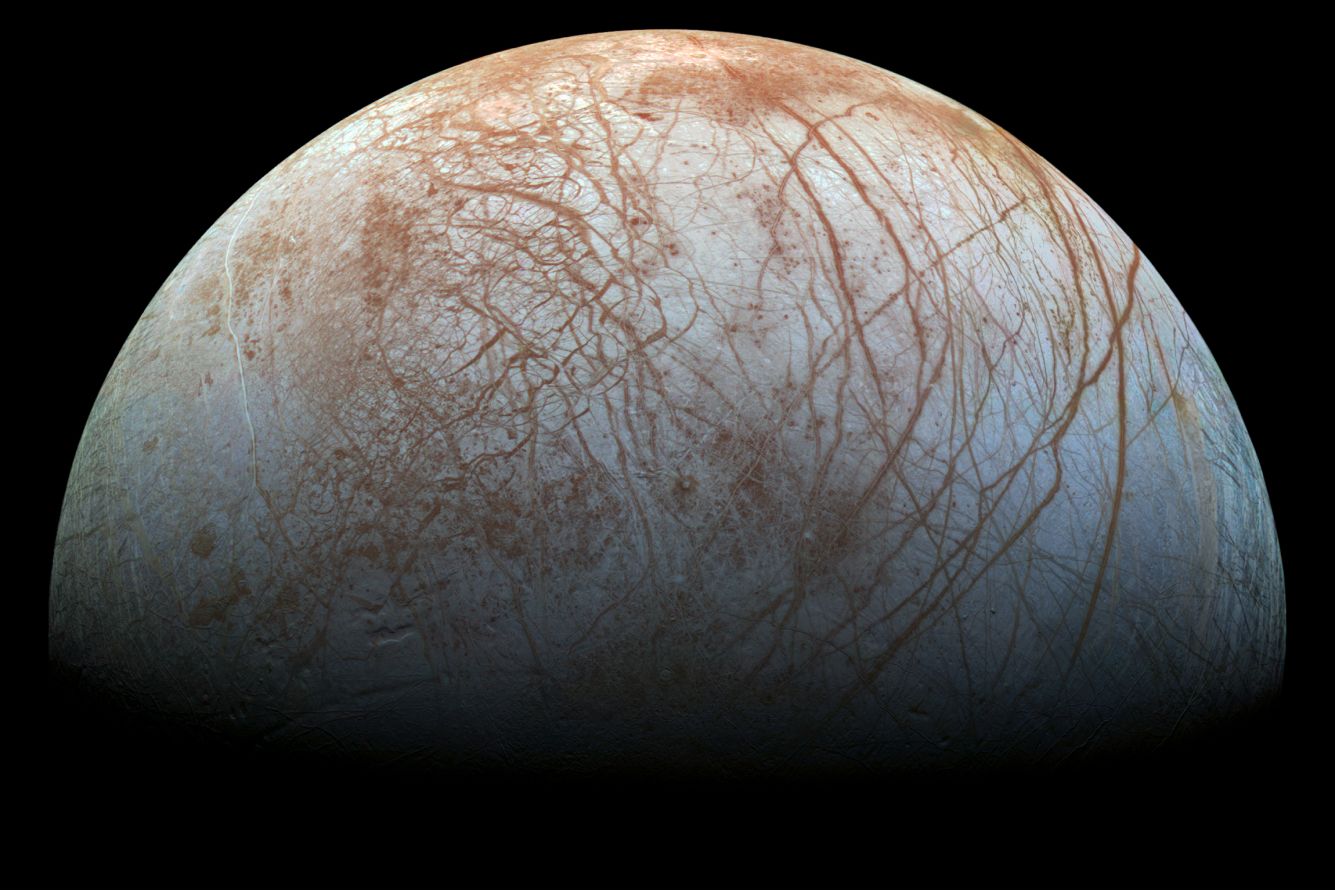
Tomorrow, April 14, the European Space Agency (ECA) will launch an automatic interplanetary station Jupiter ICY MOONS Explorer (“Researcher of the Ice Moon Jupiter”, Juice), which will explore the oceans under the surface of three satellites of Jupiter - Ganya, Europe and Kallisto. Ilya Kabanov, author of the Lifelong Channel Channel, explains why it is important what difficulties the device is waiting along the way and what prevented Russia from taking part in the project (spoiler: it was not a war).
What is Juice
The European Space Agency began to develop Juice more than ten years ago - in May 2012. As often happens in the astronautics, the deadline announced at the start of the deadline: the start was postponed from 2022 to 2023, and the budget grew from 830 million to 1.6 billion euros .
Juice was the first independent European mission to the external area of the solar system, which begins behind the orbit Mars-only American devices (and the American-European Cassini-Huygens , launched back in 1997) flew there earlier.
The new probe will go into space on the Ariane 5 missile from the Cosmodrome Kuru in Guiana in South America. Initially, the start was supposed to take place today, April 13, but it was moved due to bad weather-and the high probability of lightning entering the starting complex.
After the start will still take place, the journey to Jupiter will take as many as eight years. Although the distance to the planet is more than 600 million kilometers, Juice will have to overcome three times a large distance - 2 billion kilometers. The fact is that it will fly “roundabout”, using the attraction of the Earth and Venus to accelerate. According to Juice researcher Nicolas Altobelli, such a scheme resembles a catapult that gives the apparatus an impulse to Jupiter.
In addition, the maneuver will allow the solar panels of the probe to accumulate enough energy for a long mission. He will definitely need energy: Jupiter is five times farther from the sun, and therefore any object in his orbit receives only 4% of that sunlight that would fall on him in the orbit of the Earth. This may not be enough for full -fledged work, so part of the energy will draw from the batteries charged in the way to their final point.
In July 2031, Juice will begin to explore Jupiter and his satellites Ganeyed, Callisto and Europe. They are covered with ice and are very interesting to astrobiologists. Perhaps under their ice surface, at a depth of more than 10 km, liquid oceans are hidden. A dozen scientific devices that Juice carries should try to find signs of life on these satellites - more precisely, in their ice oceans. Immediately make a reservation that scientists do not expect to find a developed underwater civilization or any large organisms there-if life on the satellites of Jupiter exists, then, most likely, in the form of bacteria or unicellular. Among the Juice tools are a magnetometer, several cameras, spectrometers for studying the composition of the surface and atmosphere, a laser altimeter for cartography of satellites and a radar that will help determine their structure.
But even if astronomers do not receive evidence of the existence of life on these satellites (now or in the past), the Juice mission will bring many valuable scientific results: for example, about the composition of the Heisers of Europe, which was photographed by the Hubble telescope, and Ganya'smagnetosphere - the largest satellite in the solar system (more Mercury!) And the only one with his own magnetic field.
Juice will be released in the orbit of Ganyveda in December 2034. By the way, the European probe will become the first spacecraft rotating around the companion of another planet (not counting, of course, the moon). By the end of 2035, Juice will exhaust fuel reserves, will leave Ganyveda orbit and collide with its surface.
The apparatus will have to survive monstrous radiation, this is one of the main difficulties on the way to the satellites of Jupiter
On the way, Juice awaits many potential dangers. First of all, he will have to independently reduce speed so as not to slip the orbit of Jupiter - scientists on Earth will only observe him and will not be able to influence the trajectory. If the automatic station does not cope with this maneuver, the mission will end in failure.
Even if the brace of braking succeeds, the difficulties will not end there. Jupiter’s magnetic field is 10 thousand times stronger than earthly, which poses a serious threat to scientific instruments on board Juice. In addition, the super -powerful magnetic field captures and charges particles that Jupiter and its volcanically hyperactive satellite Io are thrown into outer space. As a result, the stream of ionizing radiation is created, and the level of radiation next to Jupiter is comparable to the epicenter of the nuclear explosion.
The more intense radioactive radiation, the faster the electronic systems fail and solar panels are destroyed. To protect the Juice electronic filling, scientists had to go to several tricks.
To begin with, they compiled a detailed model of radiation radiation around Jupiter based on data obtained by previous probes. This model helped determine the route of the mission, which is composed in such a way as to avoid the most dangerous areas. Although, from the point of view of finding conditions for the existence of life, Europe is most interesting, a high level of radiation around it will not allow the apparatus to stay in the orbit of this satellite for a long time. Ganyud in this regard is safer - its own magnetic field provides additional protection against the radiation of Jupiter. Therefore, it was this satellite that became the end point of the Juice route
The design of the device also takes into account the radiation danger. The most sensitive Juice electronics is located in the Bunker, the walls of which are made of carbon fiber reinforced with lead. Lead must delay the radiation and extend the life of the probe. In addition, as an additional precaution, some components are shielded by aluminum and tantalum.
Jupiter without Russia
The Juice mission could become a triumph of international cooperation in space. She replaced the canceled project of 2008 by Europa Jupiter System Mission , in which not only Eka, but also NASA, Roscosmos and Japanese Jaxa agency planned to participate. But even at the development stage, international partners refused to participate, leaving Europeans alone.
Today it is difficult to believe in this, but the Russians lasted longer than the Americans and the Japanese. Back in 2013, when the Juice preparation was in full swing, Roscosmos and Ek discussed the inclusion of Laplace - P , which was supposed to explore the surface of Ganyveda in the mission of the domestic landing module. By 2017, the Russian part of the project was turned due to the lack of funding and technical problems. The director of the Institute of Space Research of the Russian Academy of Sciences Lev Green was admitted that with the at the disposal of Russian scientists electronics to work in high radiation near Jupiter will be too difficult.
If Russia flew past the Juice mission, then Ukraine was able to become part of it, although in a secondary role: from the Airbus factory in the French Toulouse, the apparatus was delivered to the Guiana cosmodrome by the Ukrainian AN-124 ANTONOV Airlines aircraft.
What's next
In the coming years, scientists will continue to explore not only the surroundings of the Earth and the planets closest to us like Mars and Venus, but also more distant areas of the solar system.
In 2024, the launch of the American apparatus Europa Clipper , which will reach Jupiter by 2030, is planned - faster than Juice, as it will fly along a shorter trajectory. This probe will make about 50 covers in Europe, approaching its ice surface at a distance of 25 km. Its goal is to find potentially inhabited places under the satellite ice shell.
Except for the route, the “clipper” and Juice are very similar: they have a comparable mass, the power of the solar panel and almost the same number of scientific tools (the European mission per device has more than that of the American one). The biggest difference is for purposes. If the “clipper” is focused on one Europe, then Juice will be explored by other satellites, as well as Jupiter himself. At the same time, missions do not compete with each other, but rather complement: their teams regularly meet to maximize the scientific output of their projects.
In 2027, the Europa Lander mission may take place, in which the descent apparatus will drop to the surface of Europe. In the same 2027, NASA plans to send to the titanium, the largest satellite of Saturn, the Dragonfly mission with a drone on board capable of flying in a dense atmosphere.
Ilya Kabanov