Date
Author
Ольга Деркач, Владислав Быков
Source

Preserved copy
Translated material
They need it
Finland is now in NATO. What are politicians and just Finns about it
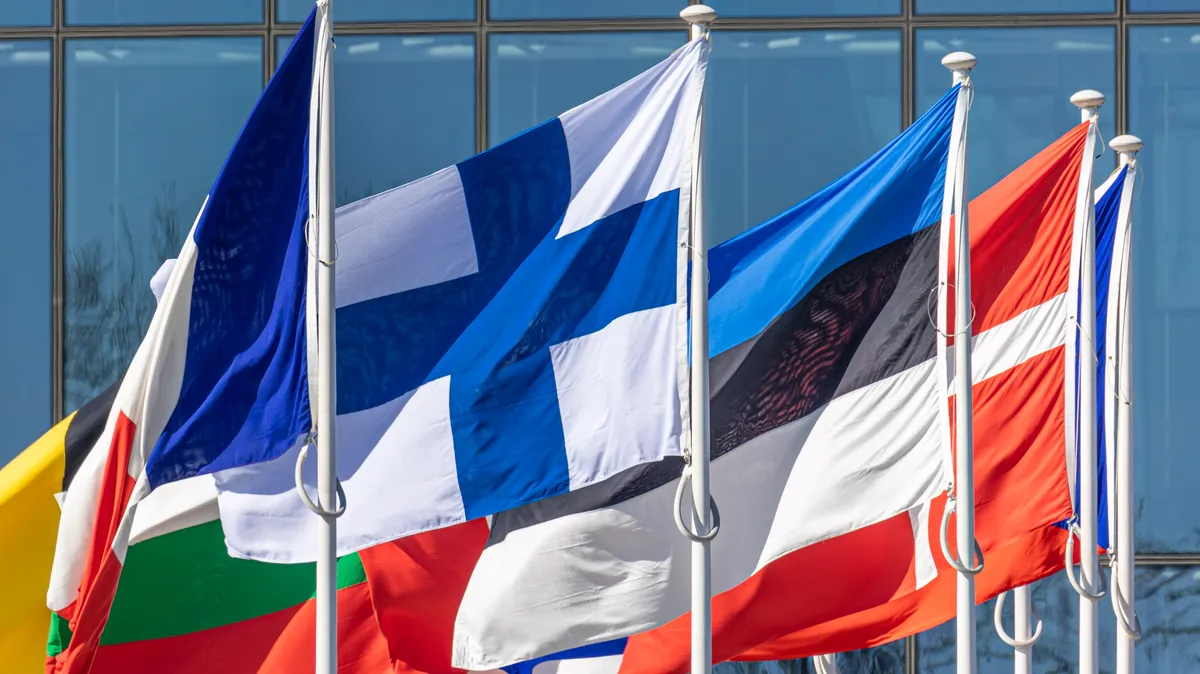
Finland flag in front of the buildings of NATO headquarters in Brussels. Photo: Nicolas Economou Via Reuters Connect
Never again
In the fall of 2021, the entry into NATO supported 26% of Finns. February 24, 2022 radically changed the layouts. When Russia attacked Ukraine, Finland felt that neutral status no longer guarantees reliable protection to the country. The dangerous neighborhood forced the authorities and citizens to revise the views, and already in March 64% of respondents agreed with the opinion according to which Finland as a neighbor of unstable Russia is better to be a member of NATO than to remain outside the military blocs.
Of those who support the accession to NATO, 96% associated their positions with threats from Russia. By March, the share of supporters of the country to join NATO grown to 76%. Having such a strong folk support, the authorities decided not to hold a referendum. On May 15, President Sauli Ninisto and the government announced that Finland would apply to NATO.
“Finland’s decision to join NATO is made so that there is never a war in Finland,” Prime Minister Sanna Marin said at a joint press conference. Two days later, the Finnish parliament 188 votes against 8 approved the application, and the process went. And unusually quickly: on July 5, 2022, Finland entered Denmark (the first of the alliance member countries), and on March 31, 2023, Turkey became the last country of NATO, which approved the accession of Finland to him. NATO Secretary General Jens Stoltenberg called the ratification process the fastest in the modern history of NATO.
Plus 1300 km
On the evening of April 3, the passengers found the Minister of Foreign Affairs Finland on a plane headed in Brussels. Instead of ordinary socks, there were woolen on it, in his hands he held a portfolio. The socks that Pekka Haavisto put on the plane called “NATO socks” with a laugh, but to the question of a curious fellow traveler, whether NATO documents were in the portfolio, the minister admitted that they were, but not yet signed.
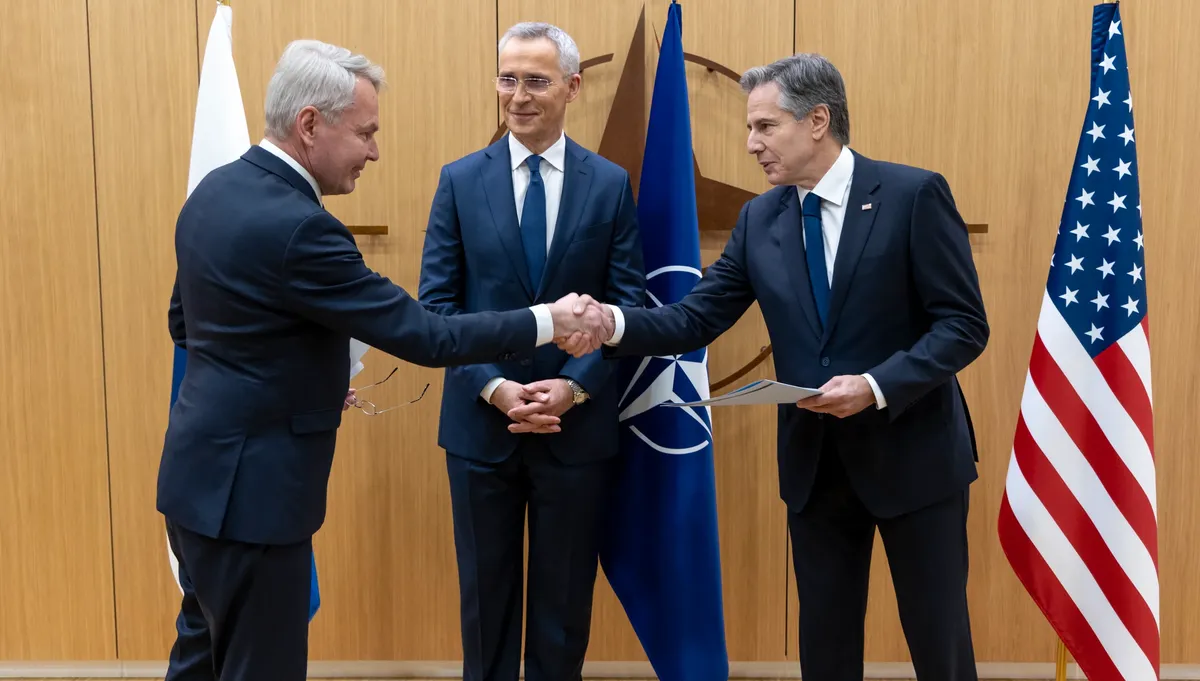
The historical day arrived on April 4, day on the day on the 74th anniversary of the signing of the Washington Treaty on the creation of NATO. About two hours in the afternoon, Pecca Haavisto signed a document on the accession of Finland to NATO.
A little more than an hour later, the letter was handed over to the US Secretary of State Anthony Blinken, and from this minute the “shield against aggression and fear of aggression”, as NATO called President Harry Truman, began to defend Finland. Under the anthem of Finland, the Finnish flag was raised over the headquarters of NATO in Brussels, and NATO flags appeared on the flagpole in front of the Foreign Ministry building. The border of Russia with NATO countries at one point increased by 1300 kilometers.
Having joined NATO, Finland strengthened defense capability and expects to strengthen the economy. Experts argue that membership in the defensive alliance increases the trust of investors and business. Finland is expected to attract more foreign investments and will be able to get cheaper loans. NATO membership opens up new opportunities for Finnish companies in the technology sector and defense materials, because small NATO countries often buy defense equipment from other alliance members. A new impetus will receive the development of Eastern Finland: in the NATO border zone there will be a need for transport, housing and services.
"Russia understands only power"
And what do they think now, after joining NATO, ordinary Finnish citizens who have not happened to express their opinion in a referendum? We interviewed a variety of Finns: pensioners, students, middle -aged people - all were unanimous. The general opinion of joining NATO literally in a two -word was expressed by a student of the University of Aalto in Espo Anina Stocklin: “Good deed!”
Sales manager working in the field of solar energy, Yukha Raiman from the city of Salo supported Finland's entry into NATO for many years and substantiates his point of view as follows:
- I perfectly understand the logic of President Sauli Ninisto: in December 2021, Russia demanded to stop expansion from NATO, that is, I tried to practically close the Finland door to NATO. Before that, we ourselves decided not to join the Union, now Russia began to dictate to us what we can do. We could not agree to this, and when Russia attacked Ukraine, we immediately began the process of joining NATO.
Behind this solution are all parties and the vast majority (about 80%) of Finns. I am proud that Finland led by Sauli Ninistu and Sanna Marin took this step.
An ordinary father of the family from the city of Salo, as he calls himself, Yukha Reiman believes that the entry into NATO ensures the safety of his family, Finland and the entire region of the Baltic Sea.
“Russia understands only power, but NATO has it,” says Yukha. -I hope that someday Ukraine will become a member of NATO. Finland has a strong own army, and we will certainly continue to be responsible for the defense of our country, but NATO is good support.
We are used to living in the neighborhood with aggressive dictatorship, we are not afraid, but we are ready.
After the collapse of the Soviet Union, I defended Russia and Russians for almost 20 years in many discussions. I believed that Russia could become a democratic country with which we will live in peace, trade, and so on. Unfortunately, I was mistaken.
"Russia included our country in the sphere of its interests"
“Finland’s entry into NATO was a direct consequence of the need to withstand an unpredictable Russian threat,” says a pensioner from Espoo Lauri Zamyo.
Lauri comes from a family from the Karelian Isthmus, from that very lost during the Winter War ( the Soviet-Finnish War of 1939-1940. - Ed. ) Karelia, and this topic is very acute for him:
- There was a great danger that Great Russian thinking would lead to the same pressure on Finland that Ukraine felt on itself, and the culmination of which was an armed attack, acts of destruction and war crimes against an independent and freely selected way of Ukraine.
In my opinion, NATO creates security guarantees for Finland so that it remains an independent state, one of the democratically controlled states of the West, which adhere to European values.
It was impossible to be confident at all: although Finland announced the neutrality, Russia still included our country in the sphere of its interests-because of the long land border between our countries and remembering its previous power before the acquisition of independence gaining. In Russia, even a public opinion began to form that it was time to end the independence of Finland. Russia began to become a threat to our country.
A student of the university in the city of Vaas Alice Salminen for 20 years, but she was already a few years ago, even before the war in Ukraine, she began to support Finland's entry into NATO:
“I think about it since the beginning of a public discussion about the country's accession to an alliance,” the future lawyer clearly formulates. - Of course, with joining NATO in Finland will become safer.
"This discussion was supposed to begin in 2014"
“I definitely for,” the common, in his own words, a citizen, engineer Esa Scotto Di Marco from the city of Salo, decisively speaks. And he explains: - Before the Russian invasion of Ukraine in 2022, I did not have a clear opinion on this issue. I thought I did not have enough information. When the public position on the entry into NATO was expressed by various expert organizations and specialists in security and intelligence, when public discussion began, even ordinary citizens were able to easily decide.
Es, by the way, believes that the discussion should start much earlier:
- I think that this discussion was supposed to take such a volume in 2014, when Russia began surgery in Crimea. In this regard, the political leadership in Finland was weak!
Now that Finland finally joined NATO, the country, according to Esa Scotto Di Marco, is safe.
- I believe that Finland became much more protected immediately after the process of joining NATO began - the presence of NATO forces in Finland and the surrounding areas so noticeable.
Anxiety, according to Esa Scotto Di Marco, caused the so -called “gray zone”: a dangerous time when membership in NATO was not yet ratified, but Finland has already submitted an application. Then it could be expected that Russia would somehow pay close attention to Finland. This could mean anything, from a hybrid threat to an ordinary low -scale military operation. However, nothing special happened.
“In the spring of this year, parliamentary elections were also held in Finland,” adds Scotto Di Marco. - At this time, I did not notice that the media reported more attempts to influence from Russia. I was waiting for them!
The engineer from Salo emphasizes that the country's threat could create a split in public opinion, but this did not happen either, since the bulk of the population was configured, speaking by his words, “Pronatovo”.
Honorary Professor of the University of Helsinki and a former leading researcher at the Higher School of Economics in Moscow Arto Mustayoki much calmer:
- The entry into NATO was an understandable reaction of Finland and Finns, although there were no particular reasons for entry. In my opinion, there was no risk of Russia's attack on Finland. Actually, the Russian attack on Ukraine even reduced this risk.
The professor-Russianist believes that in the short term, security, understood as the integrity of the territory of Finland, will not change, because there is no threat. In the long run, safety may increase.
“Acceptance to NATO can negatively affect cybersecurity,” adds Mustayoki.
"Those who threaten - weaklings"
Membership does not oblige Finland to place permanent NATO constant bases on its territory, troops or nuclear weapons: NATO member states can solve this themselves. The opinions of our interlocutors on this issue dispersed. Arto Mustayoki against NATO bases, troops and atomic weapons in Finland, since, he believes, there is no benefit to the country from them. Annina Stocklin, studying quantum physics, also considers the placement of atomic weapons not too good an idea. Esa Scotto Di Marco is in solidarity with them:
- I think that a good starting point would be that the countries of Northern Europe will be a zone free from nuclear weapons. As far as I understand, in the Baltic countries he is not there either.
The permanent bases of NATO, in the opinion of Scotto Di Marco, are also not needed, because Finland has its own sufficiently powerful defense forces and the draft army. In addition, Finland is very closely cooperating in the military unit with Sweden and Norway, especially with Sweden.
“Swedish naval and air forces complement Finland,” explains Scotto Di Marco.
Alisa Salminen, on the contrary, is sure that it is reasonable to place both the base and the constant contingent, as this will improve the security situation in Northern Europe and the Baltic Sea region.
“NATO forces, of course, will train in Finland, as was done for many years,” says Jukh Raiman. In his opinion, the permanent NATO base in Finland is unlikely to appear in the near future, but this cannot be excluded.
“Of course, I do not want nuclear weapons in Finland,” says Reiman, “but if Russia threatens to destroy the entire planet with this weapon, you should not exclude the option of placing nuclear weapons on Finnish land.”
And according to Lauri Ramo, Finland can be a place for deploying NATO troops, but for nuclear deterrence the base in Finland is not needed:
- Let the world be protected from nuclear wars. Because those who threaten are weaklings.
Salo, Finland