
Translated material
Everyone played here: red, white, Hitler
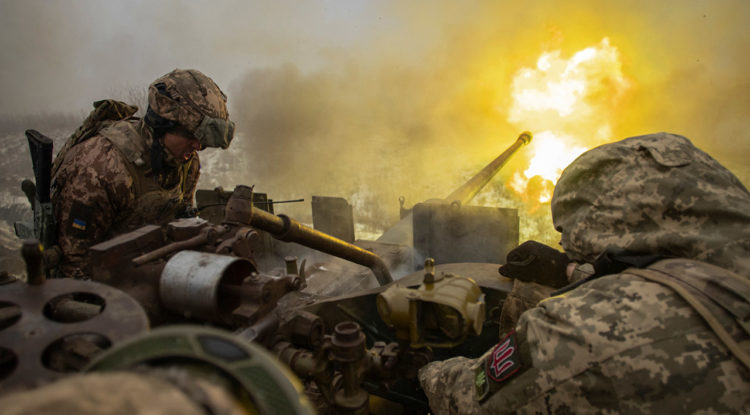
A year ago, the battle for the Donbass began. Why didn't the Russian army won it?
The battle for the Donbass is a year. On April 18, 2022, President of Ukraine Vladimir Zelensky announced its beginning in his daily circulation. The next day, the head of the Russian Foreign Ministry, Sergei Lavrov, also spoke about the new stage of the “special operation”, calling it the goal of “the complete liberation of the Donetsk and Lugansk People’s Republics” - that is, the seizure of the relevant regions of Ukraine, partially controlled by Russia since 2014. But what did the Russian army actually succeeded in and how did the battle for Donbass influenced the course of the whole war? At the request of the Cold, this is explained by a military expert, a former researcher of the Conflict Intelligence Team project, Kirill Mikhailov.
In order not to miss the main materials of the "cold", subscribe to our Instagram and telegram .
Stalingrad or Kursk arc? How Russia was preparing for the battle for the Donbass
The fighting in the Donbass went from the first day of the Russian invasion. In the first weeks, the troops of the Russian Federation and the proxy-lines of the “republics” have achieved significant success. The Ukrainian forces were forced to leave the northern part of the Luhansk region, which turned into a dangerous “pocket” between the Russian border and the territory of the self-proclaimed LPR, and in the south of the Russian troops and the self-proclaimed DPR it was possible to take the Volnovakha and close the ring around Mariupol together with the formations of the Russian 58th Army and Marine Corps that approached from Crimea. However, in the center of the contact line, which existed before February 24, the Russian side did not achieve much success.
Pro -Russian blogger Andrei Morozov believes that the main goal in this direction was to pick up the powerful Ukrainian group in the Donbass, while the Russian forces tried to occupy the rest of Ukraine. But the Russian offensive on Nikolaev, Kharkov and Zaporozhye was stopped, and from the northern regions of Ukraine the Russians were generally forced to move away, explaining this disassembled on memes with a “gesture of goodwill” . However, back in early April, the CIT research group confirmed that the troops entered in Belarus hastily transferred to the east of Ukraine, where a new stage of the invasion was supposed to begin.
By the beginning of the battle for the Donbass, both sides experienced the consequences of February and March fights. During the poorly planned Blitzkeringia, Russian forces lost a significant part of armored vehicles, including modern ones. Part of her went to the Ukrainians as trophies. The Russians suffered significant losses in manpower. In addition, the problem of “refuseniks” began to be fully manifested - many military men who had already visited the battles in Ukraine did not burn the desire to return there and filed reports to refuse to participate in hostilities.
Ukrainian losses at the first stage were also very painful - and, most importantly, the Armed Forces of Ukraine practically exhausted the reserves of artillery shells, which were defeated by Russian columns in the fields of Nikolaevschina and in the suburbs of Kyiv.
Analysts (including the author of these lines) believed that Russia makes a large bet on the battle for the Donbass. So, the Medusa involved options for the complete or partial environment of the Ukrainian forces in the east of the country or the dissection of their front. In terms of scale, it was no longer a plan of [Hitler invasion of the USSR] Barbarossa, as in late February, but the scope of the largest battles of the Second World War - for example, the Battle of Stalingrad or the Kursk arc.
However, the German military leaders mastered the skills of conducting such operations thanks to the experience of invasion of Poland and France, and Soviet - in the Gorky and Bloody School of the first years of the war. There was nothing like this in the history of modern Russia - for example, the war with Georgia in 2008 was held by the forces of one combined -arms army, and at least a dozen such armies, as well as two "republican" army corps were involved in the battle for the Donbass. Similar campaigns were not worked out on Russian pre -war exercises, which took place according to much more simple templates.
The beginning of the battle for the Donbass: unlearned lessons of the First World War and the first successes of the Wagner PMC
Russia began to advance in several directions at once: south of the recently captured raisins in the direction of Slavyansk and Barvenkovo, to the Liman and Yampol in the direction of the Seversky Donets, to Rubezhnoye and Popasnaya, where fierce city battles unfolded, as well as once again for the suburbs of Donetsk, primarily Avdeevka and Maryinka.
Many expected a blow from the south towards the supply lines of the Donbass Group of the Armed Forces of Ukraine, but it never followed: probably, the Russian forces were depleted in the battles for Mariupol, whose garrison “Azovstali” in Russian captivity only a month after the start of the battle for the Donbass were depleted in this section of the front.
In the first phase of the war, the Russian command relied on the rapid advance of tank columns. To the battle for the Donbass, it can be said to return to the origins. US analysts described the Russian army as "artillery, which has many armored vehicles." The “pre -war” Russian doctrine involved a bet on a massive fire defeat of the enemy’s positions, which then should have been cleaned by infantry and tanks. Huge Soviet reserves of artillery shells and missiles made it possible to use this doctrine literally according to the textbook. According to the deputy Minister of Defense of Ukraine Anna Maryar, Russian artillery released up to 60,000 shells per day, and the Ukrainian one, experiencing a lack of ammunition, fired 10 times less. As a result, the Donbass fields saturated with funnels soon began to resemble the Western Front of the First World War.
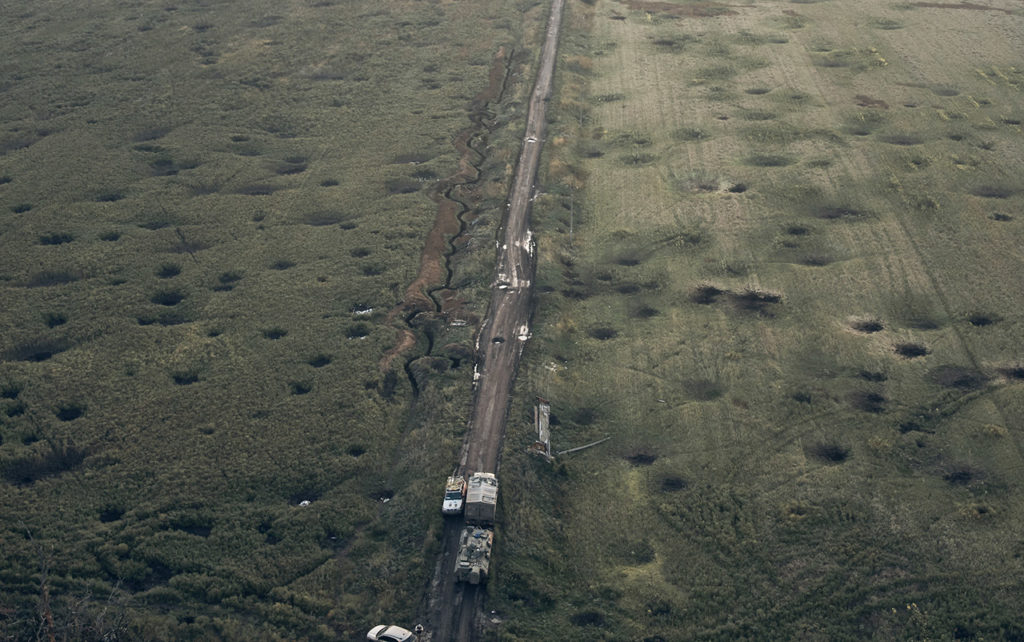
According to the Office of Zelensky, in the summer the Ukrainian side lost 100-200 people a day killed. However, the Russians could not fully take advantage of their superiority in firepower: the offensive developed a turtle step. Why? Firstly, the Russian army seems to have forgotten the lessons of the same First World War, in the first years of which it became clear that even the most dense artillery fire does not guarantee the complete destruction of the enemy’s defense.
In addition, the situation with the air exploration in the Armed Forces of the Russian Federation was catastrophic: as the deceased “military” Vladlen Tatarsky wrote , in some Russian formations there were no “Orlan” drones at all. For the most part, Russian contractors did not know how to use the modern electronic means of artillery intelligence, so that the fire was conducted in the old fashioned way - in the squares, and its effectiveness left much to be desired, and in urban battles, including the intentional destruction of civil infrastructure and the death of the civilian population.
Secondly, Russian troops almost anywhere advancing with battalion tactical groups (up to 500 people and 40 units of armored vehicles), as at the beginning of the war. Apparently, the losses of technology and personnel were affected, as well as the inability to manage major formations. The attacks were carried out by the maximum company groups (up to 10 units of equipment), and the offensive with battalions could lead to catastrophic consequences (a widely known example - an unsuccessful attempt to cross the Seversky Donets near Belogorovka, where the Russians lost dozens of tanks and infantry combat vehicles ). In addition, attacks were distinguished by extreme disorganization and the lack of interaction of tanks, infantry, artillery and aviation, without which modern battle is impossible. As an example, you can read the story of the Russian volunteer about the battles for the village of Dolgenkoye north of Slavyansk, which lasted several weeks.
Nevertheless, it cannot be said that the Russian army did not succeed at all. She managed to clean up the left bank of the Seversky Donets, taking Liman and Yampol. Wagner’s assault detachments in heavy street battles occupied the pupid - it was then that PMC first loudly declared itself during a full -scale invasion.
The Ukrainian command was forced to close individual sections of the front worse than prepared and armed units of territorial defense. The army of the Russian Federation squeezed out Ukrainian forces from the Rubezhny and Severodonetsk, almost completely destroying these cities, advanced north of Popasnaya - the LPR authorities will refuse to restore it - and put the Ukrainian forces in the Lisichansk area in a threatening position. Nevertheless, the coveted “boiler” did not work: the Armed Forces managed to withdraw from the formed “bag” most of the forces and technology.
Counterattack as a result of the battle for the Donbass
With the capture of Severodonetsk and Lisichansk and the full occupation of the Lugansk region, the first stage of the battle for the Donbass ended: Putin awarded the group commanders and declared an “operational pause” . It can be stated that the Russian side failed to fully carry out the plan of operation: Ukrainian forces in the Donbass were battered, but not defeated, and continued to hold a significant part of the Donetsk region, including large cities. The Russian offensive prematurely reached the “climax” - in the terminology of the military theorist, Clausewitz is the name of the moment when the advancing forces cease to exceed the defenders and can no longer move forward.
This was facilitated by both huge Russian losses and the unfolding supplies of weapons from the Western countries: Ukrainians received modern artillery systems, tanks and, most importantly, reactive systems of the Himars and M270 volley fire. These MLRSs were qualitatively different from the Soviet “grades”, “hurricanes” and “tornado” - primarily the presence of GMLRS controlled missiles, which allowed to accurately hit the accumulations of Russian equipment, headquarters and ammunition depots. The latter became especially painful due to the features of Russian logistics: the supply of ammunition is carried out by rail, as a result of which they accumulate near railway stations, from where they are taken to the front on trucks. Such "final unloading points" became a tasty target for Western missiles. As a result, Russia temporarily lost the advantage in artillery until it rebuilt the supply and deduced warehouses from the blow.
Taking advantage of this change in the balance of forces, as well as the complete depletion of the Russian units in some sections of the front, the Ukrainian command conducted a rapid counterattack in the east of the Kharkov region. At the forefront of him, brigades on the western and trophy Russian technology were going on, which were preparing in the rear, while the Russians spent the forces in battles for the Donbass. As a result of the Balaklaley-Kuyansk offensive operation, Ukrainians managed not only to free thousands of square kilometers of the territory and capture hundreds of units of hastily abandoned equipment, but also to eliminate the threat of Donbass from the north, from Rosyum.
"The second battle for the Donbass"
The new stage of the battle (or, as the analyst Michael Kofman calls it, “The second battle for the Donbass” ) began in the winter of 2022/2023 and continues to this day. Having replenished their ranks with mobilized and prisoners recruited in the Wagner PMC, the Russian troops went on the offensive on the Bakhmut -Soledar -Seversk line, to the settlements near Donetsk (primarily Avdeevka and Maryinka), as well as to the Ugro in the south of the Donetsk region. This stage is characterized by a more active use of drones (both civilian "Maviks" and Dronov-Kamikadze "Lancet").
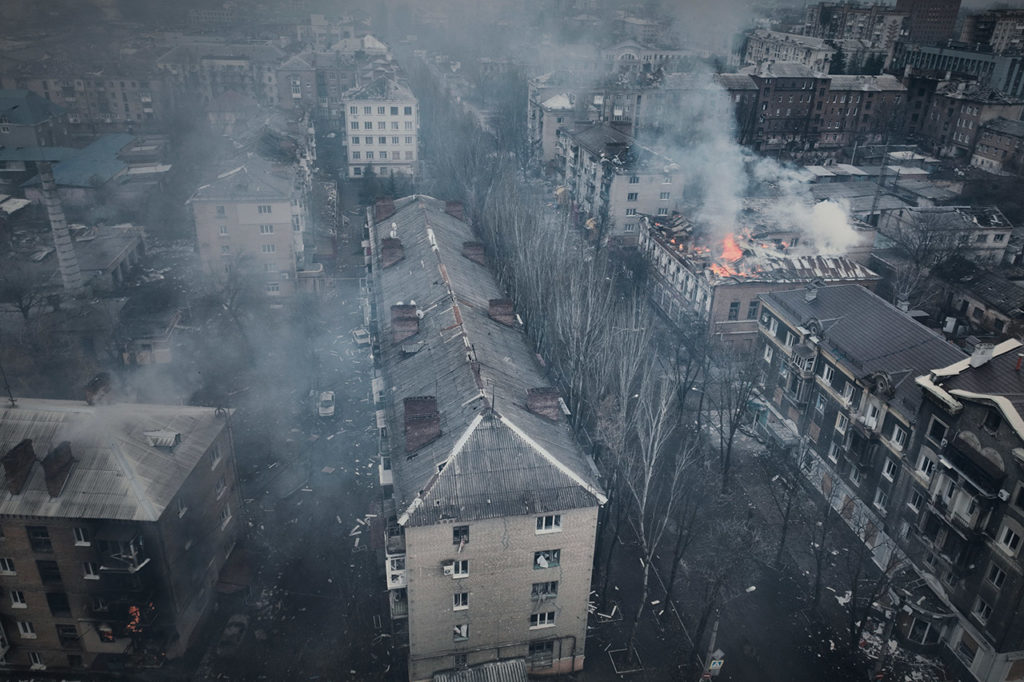
However, Russian troops, judging by many evidence, are lacking in shells: the Soviet reserves, apparently, were not at all bottomless, and the production of ammunition does not keep up with the needs of the front. The Russians are trying to compensate for the lack of artillery fire by the use of assault detachments, the purpose of which is to occupy the enemy’s positions in close combat. This tactic was invented by the Germans more than 100 years ago, trying to get out of a similar positional impasse (which they succeeded in some extent).
However, the Russians were not everywhere able to fully learn this lesson in the First World War: for example, near Donetsk, instead of the actions of coordinated and trained assault groups, former DPR officers drive Russian meat assault mobilized into bloody.
The serious successes of Russians can only be talked in the Bakhmut area, where, after many months of fighting, the Wagnerians, with the support of the Airborne Forces, managed to capture most of the city. However, even despite the fact that Ukrainians also experience a lack of shells (that they try to compensate for with shock drones) and are increasingly relying in defense on their own mobilized, nothing indicates an imminent defeat of the Armed Forces and seizes of the Donbass. If the plans of the Ukrainian command are successful, then the “second battle for the Donbass” may end in the same way as the first - exhausted Russian troops will not be able to reflect the counterattack of fresh Ukrainian formations.
What will happen next?
A year after the start of the battle for Donbass, it can be argued that the Russian strategy was erroneous from the very beginning: the offensive does not bring the desired results, and ambitious arrows on the maps are not materialized into real breakthroughs. Perhaps the Donbass itself plays an important role in this, which is actually a huge agglomeration, where the defenders can always cling to urban development and numerous industrial zones. This is the curse of the Donbass geography, which arose after the industrialization of the region at the turn of the XIX - XX centuries, stopped everyone who tried to take it “on the forehead”: from the Reds and White in the civil war to the German and Soviet troops in the Second World War . Starting the battle for the Donbass, the Russian command set itself a very difficult task, which may well be overwhelming. Nevertheless, so far, Russian troops do not refuse to capture this region - which means that its inhabitants expect even more deaths and destruction.