
Translated material
Horse, wheel and tongue
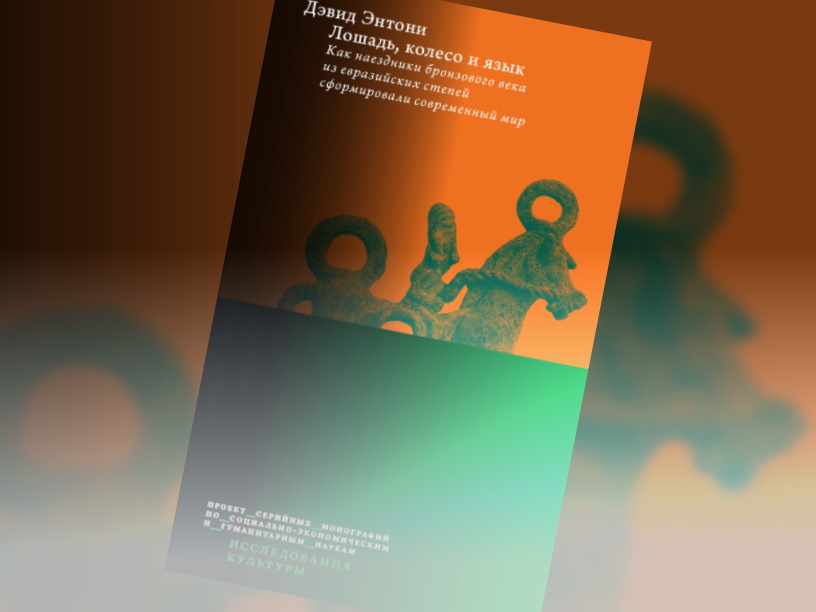
The publishing house of the Higher School of Economics presents David Anthony's book “Horse, Wheel and Language. As a bronze age riders from the Eurasian steppes formed the modern world ”(the translation of Andrei Fomenko under the scientific editors of Anton Ryabov).
Approximately half of the world's population speaks in languages leading from the common ancestor - the great -European language. But who were the carriers of this ancient dialect and how did they manage to settle in the globe? Until recently, their identity remained a mystery to linguists and archaeologists. The book “Horse, Wheel and Language” talks about how the domestication of the horse and the use of the wheel were the first Indo -Europeans to spread their language and transformed civilization.
Binding archaeological finds with the development of the language, David Anthony claims that the steppe tribes of ancient central Eurasia were carriers of the great -European, whose innovations in the use of carts with oxide sleds, riding and combat chariots turned the Eurasian steppe into a prosperous transcontinental corridor of trade and cultural exchange. He explains how the steppes spread their traditions and achieved significant success in the extraction of copper, military affairs and the formation of the political institution of clientele. “Horse, Wheel and Language” solves the riddle of the origin of Indo -European languages, which worried scientists for two centuries, and reconstructs the bright and influential civilization of antiquity.
We offer to read a fragment of the book.
Linguists have long been trying to find the name of animals and plants of such species that live in only one part of the world in the reconstructed great -European dictionary. The reconstructed great -European term *lork *s, “salmon”, became once famous as the evidence that the homeland of “Ariyevs” lies in Northern Europe. But, it seems, the names of animals and plants can easily acquire narrower or wider values. They can also be used in relation to other types when people find themselves in the new environment - so, the English colonists called the Robin (Robin), the American bird1, which has nothing to do with the raspberry inhabiting anything in England. The most accurate meaning that most modern linguists consider it possible to attribute to the term *lork *s - this is "fish like trout." Such species of fish live in rivers in a significant territory of North Eurasia, including rivers flowing into the Black and Caspian Seas. A similar history has a great -European root, denoting an beech. Since the European Book ( Fagus Sylvatica ) did not grow east of Poland, the great-European root *bháġo- was once given as evidence of the North or Western European homeland of the Indo-Europeans. But in some Indo -European languages, the same root denotes other types of trees (oak or buzin); In any case, in the Caucasus, the eastern beech ( Fagus Orientalis ) is growing, so the original meaning remains unclear. Most linguists, in any case, agree that the fauna and flora described by the reconstructed dictionary belong to the temperate climate (birch, otter, beaver, lynx, bear, horse), not Mediterranean (there are no roots denoting cypress, olive or laurel) or tropical (there are no roots denoting the monkey, elephant, palm papyrus). The roots indicating the horse and bee are especially important.
“Bee” and “honey” are very reliable reconstructions based on related words in most Indo -European languages. The word derived from the term “honey”, *medhu- was also used to refer to a hoppy drink, a mead that allegedly played a noticeable role in the great-European rituals. Honey bees were not found east of the Ural mountains, in Siberia, since trees with solid wood (in particular, oak and linden), in the hollows of which these bees prefer to arrange nests, were rare or completely absent there. Once in Siberia there were no bees and honey, which means that the homeland of the Prainduropian is not there. This circumstance excludes from the competition all Siberia and most of the northeastern Eurasia, including the Central Asian steppes of Kazakhstan. The root *ek *wo-, which denotes the horse, is also a reliably reconstructed term, and the horse, apparently, served for the great-Europeans a powerful symbol of divine power. Although in 4500–2500 BC. e. The horses lived in small, isolated areas on the territory of prehistoric Europe, the Caucasus and Anatolia, they were rare or completely absent in the Middle East, in Iran and on the Hindustan Peninsula. They were present in large quantities and had important economic importance only in the steppes of Eurasia. The term denoting a horse excludes from a serious competition the Middle East, Iran and Hindustan, but it makes us pay close attention to the Eurasian steppes. Europe remain a temperate belt, including steppes west of the Urals, and parts of Anatolia and the Caucasian mountains with a temperate climate2.
Search for the Homeland: Economic and Social Conditions
The carriers of the great -European were farmers and livestock breeders: we can reconstruct the words denoting the bull, cow, ox, ram, sheep, lamb, pig and piglet. They had many terms to refer to milk and dairy products, including yogurt, serums and cottage cheese. When they went to their herds, they were accompanied by faithful dogs. They knew how to cut the sheep’s wool, which they then wove (probably on a horizontal weaving machine). They cultivated the land (or knew those who did it) with the help of a plow, or arda, who pulled the oxes, blatant in Yarmo. There were terms indicating grain and hay, and possibly a furrow. They turned the grain they grown into flour, moaning it with manual color, and prepared food in clay pots (the word Cauldron, “boiler” came from the corresponding root, but in English its meaning narrowed and began to relate to metal dishes). They divided their property into two categories: movable and immovable; The root, which denoted movable wealth (*peku-, the ancestor of English words such as Pecuniary-“monetary”, “financial”), became the term that denoted cattle in general3. Finally, they were not averse to increasing the livestock of their livestock at the expense of neighbors, since we can reconstruct verbs with the meaning of “stealing cattle” (in the sense of stealing or taking away) that were used in the Celtic, Italian and Indo -Iranian.
What was their social life? The carriers of the great -European live by a tribal system, groups united by kinship and marriage ties. They lived “houses” (*dorkha), including one or more families (*génh1es-) and made birth (*Wei-), controlled by clan leaders, or leaders (*Weik-Potis). They did not have a word denoting the city. “Houses” seemed to have a patriarchal way. Judging by the reconstructed terms of kinship, relatives on the paternal line were considered the most important, which indicates patrilocal marriages (when the wife moves to her husband’s house). The superior group community, apparently, was a tribe (*h4erurs); The Indo -Iranian "Aryan" [Benvenist, 1995; Mallory, Adams, 1997; GAMKnessze, Ivanov, 1984].
The most famous definition of the basic structure of the great -European society was given by Georges Dumesil in the theory of three functions. He suggested that this society was divided into three main classes: priests, or specialists in the departure of rituals, warriors and ordinary cattle breeders or farmers. Each of these roles was associated with its own color: white - with priests, red - with warriors, black or blue - with cattle breeders and farmers; For each estate, there was its own type of ritual or legitimate legend of death: strangulation - for priests, decapitation or hardening - for warriors and drowning - for cattle breeders and farmers. Apparently, a number of other ritual or legal differences were applied to them. It is unlikely that three groups allocated by Dumesil were rigidly divided by each other. Probably, they were something much less defined-say, like three age groups, into which all the men of the tribe are sequentially pass, among the Masaev in East Africa: first to the group of shepherds (young men), then soldiers (adult men) and, finally, elders and ritual leaders (old people). The assessment of the military category was very ambivalent: in myths it was often represented by a character who combined the functions of a defender and a frenzied killer who betrayed his own father (Hercules, Indra, Thor). Another respected social category was made up of poets: pronounced words, whether it was poems or oaths, were considered endowed with enormous force. Praise from the poet's lips was the only hope for immortality available to mortals.
The carriers of the great -European were cattle breeders and farmers who lived a tribal system. Similar societies existed in a significant territory of Europe, Anatolia and the Caucasus after 6000 BC. e. But the regions where hunting and gathering continued to exist after 2500 BC. e., they are out of the number of possible candidates, since by this time the great -European was a dead language. The European and Siberian forests of the northern part of the temperate belt are excluded in accordance with the rule “Livestock breeding earlier than 2500 BC. e. ”, which cuts off another section on the map. Kazakh steppes east of the Ural Mountains are also excluded. In general, this rule, in combination with the exception of tropical regions and the presence of honey bees, does not allow to place the homeland of the great -European anywhere east of the Ural mountains.
Search of the Homeland: Ural-Caucasian Relations
The territory, within which the homeland of the Prainduropian was supposed to be located, can be additionally narrowed by identifying neighbors. These neighbors can be established thanks to the words and morphological structures that were borrowed by the great -Europeans from other language families or, on the contrary, by the native speakers of these other languages from the great -European. This is a little risky-to discuss borrowings between reconstructed predicted linguists: firstly, it is necessary to reconstruct the phonetic systems of each of the grases; Secondly, to identify roots with similar shapes and the meaning in both primers; Thirdly, make sure that the root in one of these languages has all the signs of borrowing from another language. If neighboring proto -linguists have words with the same roots reconstructed independently of each other, and the presence of such a root in one language can be explained as a predictable result of borrowing from another, this serves as a weighty argument in favor of borrowing. So what languages borrowed words from the great -European or, conversely, led him with their own? What language families do evidence of early contact and interchange with the great -European?
Ural contacts
The closest ties, undoubtedly, demonstrate the Ural languages. Nowadays, in the languages of the Ural family they speak in Northern Europe and Siberia, as well as in Hungary, which was conquered by native speakers of the Hungarian language in the X century BC. e. The Ural Language Family, like the Indo-European, has a wide range of distribution: in the languages of this family, residents of the northern forests of Eurasia are talking from the Pacific coast of North-East Siberia (in the Nganasan-the language of the reindeer herders) to the Atlantic and Baltic coasts (on the Finnish, Estonian, Sami, Karelian, Veps and Veps and Veps and Veps. Vodsk). Most linguists divide this family into two large branches-Finno-Ugric (Western) and Samodny (Eastern), although Tapani Salminen claims that this binary division is based on tradition than strong linguistic data. In return, he offers a “uniform” division of the Ural language family into nine branches, only one of which is Samodian [Carplan, Parpola, Koskikallio, 2001; Janhunen, 2000; Sinor, 1988; Ringe, 1997].
The birthplace of the Praural language is usually considered a forest zone, the central part of which was the southern slopes of the Ural mountains. Many believe that this homeland lay to the west of the Ural Mountains, some-that to the east, but almost all linguists engaged in the Ural languages, and archaeologists studying the Ural region agree that they spoke somewhere in the birch-salt forests between the Oka in the west (in the area of modern Nizhny Novgorod) and the Irtesh in the east (in the area in the east (in the region) modern Omsk). Today, the Ural languages that speak this basic region include (from west to east) Mordovian, Mari, Udmurt, Komi and Mansi, of which two (Udmurt and Komi) belong to the same group (Perm). Some linguists suggest that the homeland of Prauralsky is located much east (in the Yenisei area) [Napolsky, 1997] or much west (in the Baltic states), but few people are convinced by them in favor of these extremes.
The reconstructed Praural dictionary suggests that its carriers lived far from the sea, in the forest zone. They were collectors who hunted and fishing, but did not have domesticated plants and animals with the exception of the dog. The Lyalovsky culture that existed between the Oka and the Urals was the center of cultural influences and exchanges between the societies of hunters and collectors of the forest zone, with intercultural ties extending from the Baltic coast to the slopes of the Ural Mountains, around the same period, in 4500–3000 BC. e.
Ural languages carry evidence of very early contact with Indo -European. How to interpret these contacts is a discussion issue. There are two main positions. Firstly, there is an Indoural hypothesis , according to which morphological ties between the two families are so deep (common pronouns), and the commonality of the dictionary is so fundamental (words meaning water and name) that the prainduropeous and praindouralsky should inherit these elements from some very ancient language ancestor-perhaps we should call it a “grandmother's tongue”. Secondly, there is a hypothesis of early borrowing , which states that the forms of general primacious words such as “name” and “water”, reconstructed in the dictionaries of the Praural and great-European, are too similar to reflect such ancient sources. The inherited roots should have endured sound transformations during the long evolution of each of the language families, but these roots are so similar that this can be explained only by borrowing from one to another - and in all cases it was borrowings from the Praneralsky [KOIVULEHTO, 2001]. Thirdly, there is a hypothesis of late borrowing , perhaps, more often than others reproduced in the general literature. Its supporters argue that there is no sufficiently convincing evidence of borrowing related to the era of the truths; The most ancient documented borrowings should be attributed to the contacts between Indo -Iranian and late Prauralsky, which took place much later. Contacts with Indo -Iranians cannot be used to determine the great -European homeland.
At the 1999 conference, at the University of Helsinki devoted to these issues, there was not a single linguist who would defend the hypothesis of late borrowing in its radical version. Recent studies of the earliest borrowings have brought additional evidence that the contacts took place already during the existence of the prisons. This is well reflected in lexical borrowings. Koyvulechto spoke at least about thirteen words, allegedly borrowed by the Prauural (PU) from the Prainduropian (Pie).
1. "Give" or "sell"; PU *MEXE from PIE *B2MEY-Gʷ-- “change”, “exchange”.
2. "Bring", "bring", "drag"; PU *WETä- from Pie *Wedʰe/O- "Bring", "Marry", "Marry".
3. "Wash"; PU *mowe- from Pye *mozg-eye/o- “wash”, “dip”.
4. "Afraid"; PU *pele- from Pie *pelh1 "tremble", "cause trembling."
5. "Brave", "weave"; PU *puna- from PN.he/O- “braid”, “weave”.
6. “Walk”, “wander”, “wander”; PU *kulke- from Pie *kʷelh-e/o- "He/she wanders/wanders."
7. "Drill", "drill"; Pu *pura- from Pie *bhŗh- “drill”, “drill”.
8. “Must”, “obliged”; PU *Kelke- from Pie *Skelh- "be guilty", "must."
9. "Long thin pole"; PU *salka- from Pye *gʰalgʰo- "Polodeus crane", "gallows", "long pole".
10. "Products", "price"; PU *WOSA from Pie *Wosā "Goods", "Buy".
11. "Water"; PU *WETE from PIE *Wed-ER/EN, "Water", "River".
12. "tendon"; PU *Sōne from Pie *Sneh (u)- "tendon".
13. "Name"; PU *nime- from Pie *h3neh3mn- "Name".
Another 36 words were borrowed by the early forms of the Urals from various Indo -European subsidiaries before the separation of the Indo -Iranian branch, that is, until 1700-1500 BC. e. These include such terms as “bread”, “dough”, “beer”, “hang” and “pig”, which could be borrowed during the period when the native speakers of the Ural languages began to adopt agriculture from their neighbors - farmers and livestock breeders who spoke Indo -European languages. But borrowings between the prisons are important from the point of view of the location of the homeland of the great -European. And the fact that these words are so similar in form indicates that they were borrowed, and not inherited from a certain common ancestor.
This does not mean that there is no evidence of general origin related to an even more ancient era. Inherited similarities, reflected in the same forms of pronouns and endings of some nouns, could well get from a common ancestor. Forms of pronouns and declensions that share the great -European and praural languages are as follows:
Prauralsky | Prainduropean | |
*TE-nä | (You) | *Ti (?) |
*TE | (you) | *Ti (brief form of dative case) |
*me-na | (I) | *mi |
*tä-/to- | (This is what) | *te-/to- |
*Ke-, ku- | (who, what) | *kʷe/o- |
*-m | (accusative case of unit. | *-m |
*-n | (genitive case of pl. h.) | *-M |
These parallels prove that there are two types of connections between the great -European and Prauural44. Some of them, which are manifested in the pronouns, endings of nouns and general basic vocabulary, could be inherited: it can be assumed that these two primers came from some very ancient ancestor-perhaps, distinguished from many related dialects, on which the hunters who nomaded between the Carpathians and the Urals at the end of the last glacial period spoke. This kinship, however, is so distant, which is barely noticeable. Joanna Nichols called this type of very deep connection of an obvious genetic nature of the “quasi -sestrge” (Quasistock) [Nichols, 1997a]. Joseph Greenberg considered the Prainduropean and Prauralsky as very close relatives in the framework of a broader language community, which he called the "Eurasian" 5.
Another type of connections between the great -European and Prauuralsky, apparently, is cultural: some great -European words were borrowed by the carriers of Prauralsky. Although these borrowings seem strange, such terms as “washing”, “goods” and “give”, or “selling” could be borrowed from trading jargon used by the carriers of the Praural and prainduropeous. These two varieties of linguistic communication-a possible origin from a common ancestor and inter-sized borrowings-suggest that the Homeland of the Prainduropian was not far from the homeland of Prauralsky, somewhere next to the southern part of the Ural mountains. We also know that the carriers of the great -European were farmers and livestock breeders, whose language disappeared by about 2500 BC. e. Among the peoples who lived east of the Urals, pets appeared after 2500 BC. e. Consequently, they spoke in the Prainduropian somewhere south and west of the Ural Mountains-in that only the region close to the Urals, where livestock and agriculture were regularly practiced until 2500 BC. e.
Caucasian contacts and Anatolian homeland
The Prainduropian also had contacts with the languages of the Caucasian mountains, especially the South Caucasian, or Kartvelski, which also belongs to the modern Georgian. Some of these ties lead to the idea that the great -European homeland should be sought in the Caucasus, not far from Armenia, or, possibly, in the Eastern Anatolia adjacent to it. It is said that the connections between the great -European and Kartwell languages are manifested both at the level of phonetics and at the level of the dictionary, although the connections of the first type are controversial. This is due to the brilliant, but still problematic revision of the great -European phonetics, proposed by the Linguists Tamaz Gamkrelidze and Vyacheslav Ivanov and known as the GAMKRELIDZE, IVANOV, 1973; Hopper, 1973; GAMKnessze, Ivanov, 1984]. This theory partly brings together the great -European phonetics with the phonetics of Kartvelsky and even Semitic languages (Assyrian, Hebrew, Arabic) of the ancient Middle East. This means that the great -European, Prakartvel and Prysemitsky could form in the region, where they shared certain local features of phonetics. But even if the Glottal theory is true, it does not prove that the homeland of the Prainduropian lies in the Caucasus. And many linguists of the Glottic phonetics still do not seem to be convincing enough [Dyakonov, 1982; Salmons, 1993; Szemerényi, 1989].
Gamkrelidze and Ivanov also suggested that in the great -European there were terms to refer to animals such as Leopard, Leo and Elephant, as well as southern species of trees. This could be used to exclude the northern homeland. In addition, they made up an impressive list of words that, in their opinion, were borrowed by the Prakartelsky and Semitic languages. These ties forced them to suggest that the great -European developed in the region, where he closely contacted both the Semitic and South Caucasian languages. This region, in their opinion, was most likely Armenia. Several archaeologists, first of all, Colin Renfrew and Robert Drus, followed this hypothesis, borrowing several linguistic arguments from it, but localized the homeland of the great -European a little west, in the central or Western Anatolia.
However, evidence in favor of the Caucasian or Anatolian homeland of Shatka. Many terms, allegedly borrowed by the Prainduropian from Semitic languages, are rejected by other linguists. And somewhat widely recognized borrowings - the terms denoting silver or bull - could be listed along the trade and migration tracks to places that are very far from the Middle Eastern homeland of the Semites. Having analyzed the phonetics of borrowings, Joanna Nichols showed that the contacts between the great -European, Prakartvel and Prashemitsky were indirect: in all cases there were unknown intermediaries between these three famous. One such intermediary is supposed to be chronology, because, according to general confession, Prakartvelsky existed after the great -European and Prysemitsky6.
So, the Semitic and Caucasian dictionary, borrowed by the Prainduropean through Kartvelsky, contains the roots that belonged to a certain Prekartvelsky or Prakartvelsky language of the Caucasus. This language had connections through unknown intermediaries with the great -European, on the one hand, and Prysemitan on the other. It was not a very close lexical relationship. If at Prakartvelvsky they talked in the area of the southern slopes of the northern part of the main Caucasian ridge, which seems to be very likely, then it must have been the language of tribes belonging to the early Transcaucasian, or Kuro-Araks, culture dated 3500–2200 BC. e. They could have indirect contacts with the carriers of the Prainduropian through the Maykop culture of the North Caucasus. Many experts agree that the Prainduropian has adopted a number of features of the language from which the Kartvelsky, but not necessarily through direct contacts. The connection with the carriers of Prauralsky was closer.
So who were his neighbors? The Prainduropian demonstrates close ties with the Praural and weak ties with the Kartvelsky language language. The carriers of the great-European lived somewhere between the Caucasian and Ural mountains, but had deeper linguistic relations with the peoples who lived in the area of the Ural Mountains.
Localization of the homeland of the great -European
The carriers of the great -European were farmers and livestock breeders who lived a tribal system; They cultivated cereals, bred large and small cattle, collected honey, drove on carts, made woolen fabric or felt, at least sometimes plowed the ground or knew those who do this, sacrificed sheep, cows and horses to many demanding attention of heavenly deities in the firm hope that they would answer them with their favor. These details introduce us into a culture of a certain type - with wheeled vehicles, domesticated sheep and cattle, cultivated cereals and sacrificial burials containing bones of sheep, cows and horses. We should also look for a certain type of ideology. In the mutual exchange of gifts and benefits between people and their heavenly patrons, gods, the former sacrificed a certain share of their herds, accompanying them with skillful hymns for the glory of the gods, but the latter, in turn, provided people with protection from diseases and misfortunes and granted power and prosperity. The reciprocity between the patron and the client is common among the tribes led by the leaders - societies with institutionally fixed differences in the degree of authority and power, where some clans or childbirth have the right to patronage over the rest, usually due to sacredness or historical priority in this territory.
The knowledge that we are looking for a society with a specific set of objects of material culture and characteristic features of instructive power serves as a significant help in the localization of the great -European homeland. We can exclude all the regions where the hunting and gathering economy survived until 2500 BC. e. This eliminates the northern forest zone of Eurasia and the Kazakh steppes east of the Ural mountains. The absence of honey bees east of the Urals excludes all Siberia. Flora and fauna of a moderate climatic zone that appear in the reconstructed dictionary, and the lack of roots denoting the Mediterranean and tropical flora and fauna, eliminate the tropics, the Mediterranean and the Middle East. The Prainduropian discovers very ancient ties with the Ural languages along with later lexical borrowings from the Pra-European to the Prauralsky, as well as not so clear ties with the certain Pra-Cartvelian language of the Caucasus. In order to satisfy all the above conditions, the birthplace of the Prainduropian should be located west of the Ural mountains, between the Urals and the Caucasus, in the steppes of Eastern Ukraine and Russia. The internal unity of the reconstructed great -European language - the lack of evidence of radical internal variability in grammar and phonetics - indicates that the period of linguistic history that it reflects has been less than two thousand years, perhaps less than one millennium. The central segment of this period was probably located between 4000 and 3000 years BC. e., the early phase began around 4500 BC. e., and late ended by 2500 BC. e.
What does the archeology tells us about the steppe region between the mountains of the Caucasus and the Urals, north of the Black and Caspian Seas, the Pontic-Caspian region-this period? Firstly, archaeologists have discovered a number of crops corresponding to all the conditions of the reconstructed dictionary: representatives of these crops sacrificed domestic horses, cattle and sheep, at least sometimes grown grain, went on carts and in their burial rituals expressed institutionally fixed differences in the status. They occupied such a part of the light (steppe), where the sky is the most striking and magnificent part of the landscape - a suitable environment for the formation of faith in people that all their most significant deities live in heaven. Archaeological evidence of migrations from this region to neighboring, both west and east, are well known. The sequence and direction of these movements correspond to the sequence and direction, which indicate Indo -European linguistics and geography. The first established migration outside the Pontic-Caspian steppe had a western direction and took place in about 4200–3900 BC. e., which may correspond to the separation of the Preanatoly branch in the era before the appearance of wheeled vehicles in the steppes (see chapter 4). Then the movement was followed to the east (about 3700–3300 BC), which could correspond to the separation of the Tochar branch. The next obvious migration outside the steppes again went west. Its early phase could lead to the isolation of the Pregermansk branch, and the late and more noticeable separated the Preital and Pozelta dialects. Then there were movements to the north and east, which allegedly led to the appearance of Baltic-Slavic and Indo-Iranian languages. A clear correspondence between the sequence of migration outside the steppes established during archaeological research, and the one indicated by linguistics, is amazing, but it absorbed almost all the attention in the discussions about the archeology of Indo -European sources. Meanwhile, archeology also makes a significant contribution to our understanding of the culture and economy of the carriers of the great -European. As soon as the Homeland of the Prainduropian is identified on the basis of linguistic evidence, the archeology of this region offers completely new information, which makes it possible to look into the life of people who spoke in this language and trace how it has established and began to spread.
But before we move on to archeology, we should make a small pause and think about the gap that we are going to cross, about the gap between linguistics and archeology, about the abyss, according to most Western archaeologists irresistible. Many would say that language and material culture are in no way connected or connected so changeably and intricate that it is impossible to use a material culture to determine language groups or boundaries. If this is so, then even if we, using the reconstructed dictionary, set the place and time of the Indo -European homeland, it is not possible to connect this with archeology. You cannot count on any correlation with material culture. But is such pessimism justified? Is there a predictable, regular connection between language and material culture?
1. This refers to the American wandering thrush ( Turdus migratorius ). - Note. trans.
2. On “Buk” and “Salmon” as terms limiting the great -European borders of Northern Europe, see: [Thieme, 1958]. Frederick showed that the root of Beech (“beech”) in different branches of the Indo -European language family belongs to different trees - Buka, Oak and Buzin, and that in any case, in the mountains of the Caucasus, the Bukhochny Roskaz, which does not allow this word as a pointer of the North European origin of Indo -European languages [Friedrich, 1970]. In 1985, Richard Dibold summed up the arguments against Salmon as a limiting geographical term [Diebold, 1985]. For the term, meaning a honey bee, see a brilliant study of Carplan and parpols [Carplan, Parpola, 2001]. For salmon and beech, see Articles B: [Mallory, Adams, 1997].
3. This interpretation of the great-European *peku- belongs to Emil Benvenist [Benvenist, 1995, p. 51–60].
4. Yanhunen [Janhunen, 2000] offers somewhat different forms for some pronouns. Joanna Nichols in a personal conversation pointed out that the general endings on -m and -n have little to talk about; Diagnostic importance is only of the paradigm of general endings in general. In addition, the nasal consonants appear very often and, apparently, tend to arise in grammatical endings, so what is really important here is pronouns.
5. Greenberg also included Altai, Eskimoso-Aleutian, Chukotsky-Kamchatka, Korean, Japanese, Ainsky and Nivkh languages. - Note. trans.
6. Critical discussion of the Semitic and Kartvelsko-Semitic borrowings in Prainduropean see: [Dyakonov, 1982; Nichols, 1997a]. On the chronology of dispersion or the end of Prakartvelsky see: [Harris, 1991].