
Translated material
Useful defects in the diamond
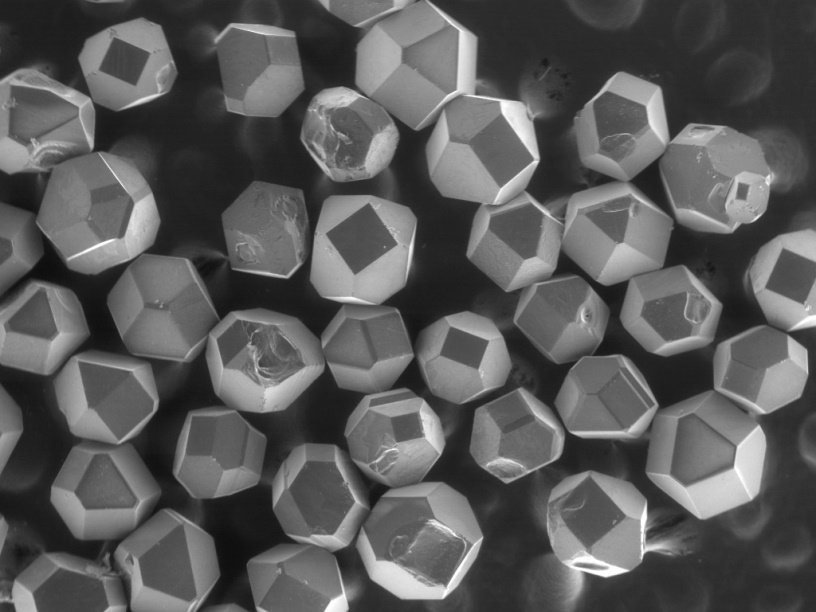
Scientists from Skoltekh, Moscow Pedagogical State University, as well as three institutions of the Russian Academy of Sciences - the Institute of Spectroscopy, the Institute of Physics of High Pressure and Physical Institute named after P. N. Lebedev - discovered a new class of defects in diamond, which can be useful for quantum processing of information and measuring temperature at a distance with super -high spatial resolution, including within living cells. The press service of Skoltha spoke about the work.
The centers of color are called defects with certain properties in a transparent crystal, in particular, in diamond. Physically, the centers of the color are various configurations of a foreign atom, for example, nitrogen or another element, in the crystalline grate of diamond and one or more vacancies - the absent carbon atoms. The name "color centers" is associated with the optical properties of these defects. The diamond itself is transparent for visible light, while the centers of coloring have the ability to absorb and effectively re -expand the light (fluorescy) in a narrow frequency range, that is, a clearly defined color, attractive in terms of technological applications. In addition, an important property is the possibility of effective radiation of single photons. There are a number of technologies for which the ability to generate single photons in a narrow spectral range is very useful.
On manipulations with single photons, applications in quantum optics and quantum computer science are tied. In particular, such radiation can be used in quantum cryptography - in theory this is the safest option for transmitting information. The sender and recipient are exchangeed with encrypted messages and keys to decode them. At the same time, the keys should be transmitted through the protected channel, and some protocols of their transmission require an effective source of single indistinguishable photons. That is, the characteristics of radiated photons - polarization, “color”, etc. - must coincide with high accuracy.
Another valuable feature of the centers of color: depending on what the temperature of the medium in which they ended up, radiation changes in a strictly defined way. Simply put, by the color of their radiation, you can accurately estimate the temperature at the point where there is a diamond with an appropriate defect. Thus, when obtaining nano -almazes with staining centers, scientists create tiny remote thermometers with high temperature and spatial resolution: they measure the temperature accurately and on a very small spatial scale. There are already studies in which, using such crystals with defects, temperature changes have recorded and studied thermal conductivity inside biological cells.
“Color centers in Diamonds have been known to scientists and have been actively examined for about 40 years. The new class of defects that we discovered has the most attractive optical properties compared to other widely known defects in diamonds: the fact is that the most radiation of the discovered color centers falls on the extremely narrow spectral range, about 10 times than those previously known. This fact, combined with a rather high stability and radiation intensity, suggests that with their use it is possible to carry out local temperatures with increased accuracy, ”his first author, a graduate student of Scoltekh, Arthur Nelubov, commented on the results of the study.
He added that the color centers opened by the team have another curious property - narrow -band excitement. They not only radiate light in a narrow range, but also absorb it selectively. That is, even the color centers of one class are slightly different from each other, and if you wish, you can contact them addressedly. For example, in biology there is a method of experimental examination examinations - multicolor visualization - for which diamonds with such defects will be very useful as specific non -toxic, non -di -active biomarkers.
So far, the scientific team has not been able to accurately identify the nature of the data of the centers. At the same time, scientists characterized them and showed the presence of a number of characteristic features in them.
“No impurities were deliberately introduced into crystals at the synthesis stage, and nevertheless, the color centers described in our article were found in samples of three different parties of pure microalmazes,” said Nelyubov. - Diamonds are made by high temperatures and pressures using Adamantan as a precursor. To confirm the presence of the same defects in diamonds of natural origin and in other methods, additional studies are needed. ”
Also, the plans for further research of the scientific team include the study of the optical properties of open color centers at very low temperatures. Just in this way it is possible to get more information about the structure of energy levels and, therefore, build theories about the origin of these defects.
According to scientists, the discovery became possible thanks to the development of a new experimental method. The authors of the work managed to combine two types of microscopy: scanning electronic microscopy and fluorescent spectroscopy. “Such an approach allowed us to mark the most interest of microalmase with color centers and conduct a series of experiments on different installations with the same microcrystals. The concentrations of detected defects in diamonds were extremely small, and they were found only due to the ultra -high sensitivity of the installations used. Thus, single impurity centers mainly acted as objects of consideration. Thanks to this, we were able to collect statistics, conduct a detailed analysis of properties and characterize the new class of emitters in the diamond, ”explained Nelyubov.
The study is published in the journal Physical Review B.