Translated material
“History is the fruit of the interaction of design and chance.” Gleb Pavlovsky's last public appearance
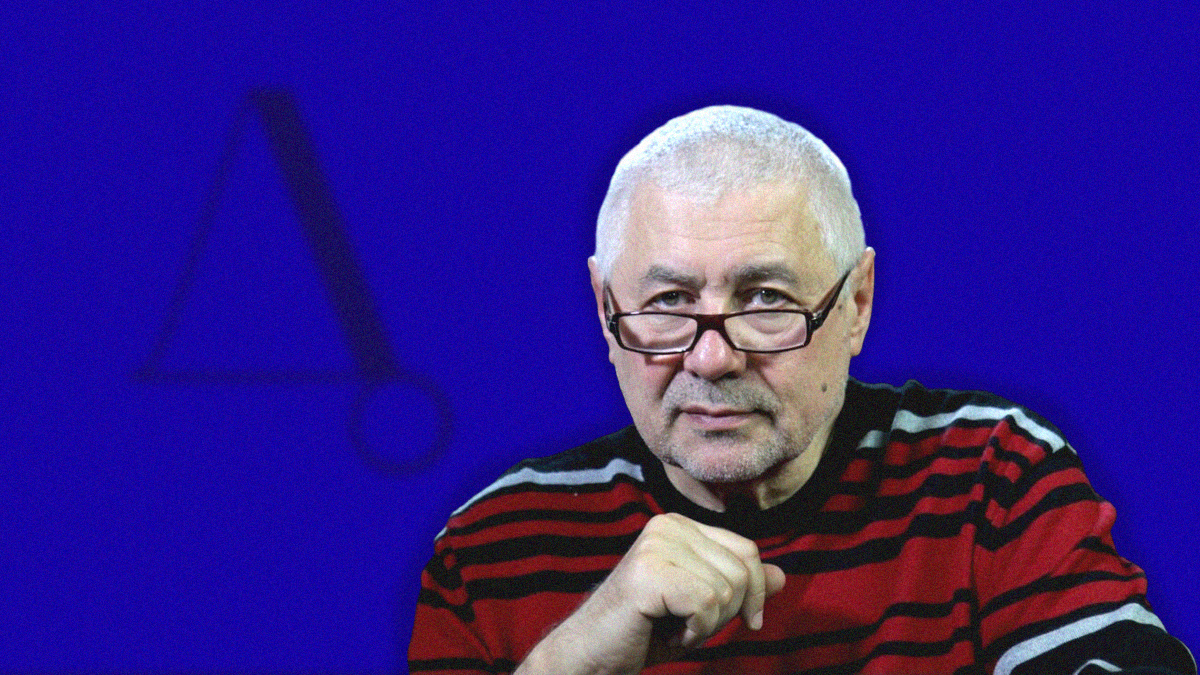
We present to you a lecture by Gleb Olegovich Pavlovsky (1951–2023), a political strategist, historian, publicist and philosopher. This is his last public performance, which took place as part of the course “Project and accidental in the genesis of the Russian Federation: the Russian system as political improvisation.”
We offer both listening to the lecture in audio format and reading its transcript.
I also think so, we can start, especially since today’s double lesson, so to speak, is objectively somewhat crumpled, since I am not sure that I will be able to return to you next week, that is, I have some procedures for the week. And that’s why I’ll start, but I’ll start, perhaps, somewhat mixedly, so as not to delay it. I have a sore throat, so I will periodically wash down the story with milk. Let's begin.
————
The idea for this course of mine was born quite a long time ago, right on the eve of the covid epidemic, since it was precisely the thirtieth anniversary of the proclamation of Russian sovereignty. And I suddenly thought, my God, what a young and random, in general, country: most of my children are older than the Russian Federation. And at first I thought of making a small book about this thirtieth anniversary, then Covid came, and when we came out of Covid, the war came, and everything was somewhat delayed, and most importantly, it changed conceptually.
It seems that I already said in some intermediate lectures explaining the pause that if we consider the origin of the new Russia, as by analogy with the origin of the Universe from the Big Bang, then theoretically everything is fine until the second Big Bang occurs. And 2022 is actually the second explosion, the second catastrophe, equal in power to the first - 1991. This means that, apparently, the concept is also changing.
On the other hand, it is a fact that we live in the Russian Federation as a new formation, in an artifact country, which was formed by subtraction from the remnants of the Soviet Union. And if the final of the USSR was very fast and unexpected, then what is it now? And how do these two events close together?
You see, I don’t see this course as the history of the Russian Federation, as modern history, as current history. I see it at the intersection of history and politics - as the historical context of political creativity. Whether it was successful or unsuccessful is another question, but there was context and there was creativity. Our task is to enter the context of Russian history as a project. And at that moment, now. This moment has arrived now and is happening now, when the Russian system is testing itself to the breaking point.
It is interesting that at this moment its properties are revealed, its structure is revealed, if you will, which I hope to come to with you as a result of this course. I want to understand and, I hope, be able to explain how Soviet, post-Soviet - now it is no longer clear what to call them people - finding themselves in free fall after the collapse of the Soviet Union, were able not only to survive, but also to put together some kind of transitional - that is, transit - survival module together. How they first despaired, and then began to moderately succeed, and only just began when it seemed to them that the main dangers were behind them. I won’t lie, I thought so too.
This is where the most dangerous part of the route began. What does this mean? This means that no one controls the mechanism within which we find ourselves, and which was designed, assembled, consciously and unconsciously assembled by different people. And yet he poses a conundrum today. He's dangerous. We don't know how to deal with him. Those who chose immediate evacuation apparently admitted this ignorance and unwillingness to wait for anything further. Now, every now and then we will encounter expert errors, errors of historical political experts, who proceed from some premise that they do not disintegrate, do not disassemble, or lay at the foundation. For example, they usually, you will see this in many texts and speeches, that the expert says “Russian society”. What is this? “Russian society”, “Russian regime” - what is it? If we were dealing with a historical nation that was changing some state and social shells, we could agree with this, but we have been in various kinds of assemblies for more than a hundred years now, in Russia, Red Russia, Soviet Russia, then the Russian Federation. And these assemblies are partly rational, that is, people wanted to achieve something, almost never got what they wanted to achieve, but nevertheless this unusual formation arose and gathered into a single ensemble.
The Russian Federation, which I quite often call the Russian system, the Russian Federation system, not because I want to show off, but because it is not a provable nation, is not a provable state. And here we, so to speak, find ourselves in Papa Carlo’s closet with a hearth painted on canvas.
The Russian Federation is largely painted on canvas and not because someone wanted to deceive everyone, but because they were in too much of a hurry, there was no time. The state collapsed, the Soviet state is a separate question, what it was, we will talk about this, whether it was a state, but it collapsed - in 1991, and people, citizens unexpectedly found themselves in a world incomprehensible to them. Then came various kinds of ideological emblems, ideological symbols. And here I must say that unlike, say, the October Revolution, which put an end to the Russian Empire, the Russian Federation was not an ideological project. The world revolution was an ideological project at the beginning of the 20th century, socialism was an ideological project, perhaps erroneous, but it existed.
The Russian Federation arose suddenly; at the end of 1989 there was no such idea, but six months later it declared its sovereignty and independence. June 12 is still celebrated as Russia Day. Even here it is now forgotten, but it is very important to remember that this was an unheard of improvisation or an accident, call it what you want, because today we are approaching a point, an area, as they say, of singularity, where we will have to quickly make decisions for which we do not have sufficient intellectual development. And that means we run the risk of improvising again and again complaining to who knows who, who knows who, that we were allegedly deceived.
You probably quite often, that is, you could often come across expert conclusions that Russia is simply a remade Soviet system. But again, this is a comforting deception, because regardless of the assessment of the Soviet system, it had a fairly complete design. The main elements are missing here, except for a certain number of people who managed to live in the Soviet Union, causing irreparable damage to themselves.
For example, in our country they often say that we are ruled by the nomenklatura, which survived the collapse of the Soviet Union and now, in a new form, continues to be active, continues its activities. But this is self-deception. Already the early entourage of the first president, Boris Yeltsin, was not built at all according to nomenklatura rules. It was built on the principle of the reverse of nomenclature. Nomenclature - what is it? Nomenklatura is a certain type of personnel conservatism. These are personnel tested for compliance with ideological and behavioral standards. But Yeltsin did nothing of the kind. He demanded only the exact opposite from those around him. Betrayal of former standards, former rules and personal loyalty to oneself is not a nomenklatura principle. But it still works to this day.
We can talk about the so-called patrimonial principle, that is, going back to pre-Soviet models of power, to the principle of the owner, loyalty to the owner. And Yeltsin himself, of course, thinks of himself as a master. By the way, there was such a funny moment: in history you need to look closely at the details, because the details usually show at the breaking point the work of strategic patterns, strategic mechanisms of the new system. Here is the end of 1991. Gorbachev was removed from his office. The USSR flag will soon be lowered over the Kremlin. Yeltsin’s loyal associates gather in Gorbachev’s office, and one of them says: “What real estate they grabbed!” - referring to the Kremlin. He does not think like a state, he thinks like a realtor, like an aggressive realtor who has carried out a successful operation and acquired new opportunities. True, Yeltsin stops him. Different people are named here. I don’t want to offend anyone - as a rule, they deny it. But this was because Yeltsin objected, and this is also known: “They didn’t seize real estate, but they seized the economy of the whole of Russia.”
That is, he now thinks of himself as a master, and not as just a temporary elected president. And this will continue to manifest itself more and more. These details are important because they show that non-statehood began to take shape here, when there was nothing that could be called a political regime.
By the way, another, I won’t say deception, but such a popular illusion, a popular common place is the concept of “regime”. You will see him very often. But the concept of “regime” came into use not so long ago.
In general, everything that seems to you has always been there, you can confidently assume that it arose recently. Maybe even quite recently.
At the end of World War II, when the creation of the organization for post-war cooperation that we know as the United Nations was planned, it met for the first time in 1945. Who was the leader of the largest state in the world then, do you think? The largest state in the world was the British Empire, led by Churchill. It was larger than the Soviet Union. But Roosevelt proceeded from a different principle, from the principle of equality embedded in the new United Nations. And therefore it was fundamental for him that, say, the island of Vanuatu is a nation and the Soviet Union is a nation. As a result, Stalin used this moment to push as many as three votes into the United Nations, adding Ukraine and Belarus. But the British Empire was not taken there. They took only individual states, members of the empire. So, this concept of “nation” has transformed over time. All nations are in some sense legally homogeneous. And when the concept of “regime” became central - authoritarian, totalitarian, democratic - all regimes also began to be typified.
And the best way today, if you want to enrage a political scientist, especially a political scientist with a degree, is to tell him that there are some nations or states that do not correspond to the concept of “regime” in the ordinary sense of the word. This usually infuriates them because they are afraid that the principle of inequality will be resurrected under the guise of the principle of uniqueness.
But what to do? The Soviet Union, after a completely unique Bolshevik revolution - another question is whether it was as useful as it seemed at the time, but it was a revolution that plotted to establish a world communist order on the entire planet - gave birth to a strange formation after 1917, that same Red Russia, and then it suddenly collapsed. We will work on this topic, I'm just mentioning it now.
It collapsed, and those nations that were already nations before, entering it, such as the Baltic countries, like the Moldovans, like the Georgians, the Armenians - they did not experience such a big shock, they simply turned to their usual format. But Russia has never been (the Russian Empire even after its destruction) a national state, so people found themselves in a void. They, like Carroll’s Alice, fell into a hole and for some time simply did not know whether they would survive or not, whether they would remain alive, whether they would have a job or not, because the reset was almost total.
And it makes sense for me to remember, again, not for the sake of fun, but in order to understand that this was not some kind of, I don’t know, villainy, as many of them later began to consider, a crime, a cunning conspiracy against the Russian people. Who is to blame that the Russian people did not build a state and did not engage in nation building? What did they do? They survived, they used the remnants, the capable remnants of the Soviet Union, the resources, as they say, in order to assemble them into some new viable module under the umbrella of the “Russian Federation”.
As I already said, this umbrella itself was a decoration, a temporary support. Now they would say that Russia was a PR project on the eve of the New Year of 1990, and this PR project, from a whole series of accidents, turned into a substitute for the state. And then the natural process of improvisation began. Well, just imagine, after a shipwreck you would find yourself on the open sea like Robinson, but Robinson, however, was washed up on a rather fertile island.
And finding themselves in an incomprehensible space without a defined horizon, without soil under their feet, people began to combine.
And these combinations turned in their eyes into state building. But they did not build a state. They were building some kind of complex of means of survival, at the center of which, as they believed, power should be. What kind of power exactly is unknown. In the early nineties it was believed that this government would be democratic. Nobody objected to this. And here again there is some kind of trap. Everything that looks like a trap is actually some kind of bunch of possible scenarios, each of which had a chance to be realized, of course, at the expense of the others. Some of them were implemented. Why? We don't know yet. But the scenario that is always realized begins to appear as the only possible one. And here we fall into the most famous historical trap. The fact is that unrealized scenarios, potentially alternative ones, do not disappear into nowhere. People chose between them, consciously or not, smartly or very stupidly, in this case it doesn’t matter, and then a certain thread arises, they move on to another scenario and it thickens.
But what was possible, other paths - they do not disappear, they are present as latent communication channels, waiting for their place, their crisis. In many cases, the choice of script is almost unconscious and unnoticed because it is not discussed. For example, in the fall of 1993, after the shooting of the White House in Yeltsin’s office in the Kremlin, experts were discussing options for a new Constitution. The same one that we know as the Constitution of 1993, in any case, in its part, is still in force today. The experts there are those who consider themselves democrats, and Yeltsin also considers himself a democrat. Experts wrote a model of the Russian president for Yeltsin, according to which power is distributed across several branches. You know: legislative, executive, judicial; and the president is placed outside these branches. And as one of the participants in this discussion said: “Boris Nikolaevich, you will rule like the Queen of England” (at that time no one doubted what kind of Queen of England Elizabeth was). That is, the president has representative functions. He doesn’t really govern, he doesn’t lead the country in the usual sense of the word. Yeltsin doesn't mind.
And now this discussion comes to an end. We don’t even know exactly what day it was, what the date of this discussion, which had immeasurable consequences. And he says, I really like everything, but it’s imperative that I have the right to issue decrees that have the force of law. Experts even then could not object to the president that he was breaking the model. It’s the same as if the Queen of England will make legislative decisions for Parliament. But they did not object to him. This was written into the Constitution. And this point is located somewhere around November 1993, and on February 24, 2022, the Russian President wrote a decree on the start of the war. The right to which he received thanks to that same alleged misunderstanding in the fall of 1993.
I think accidents and details matter. In principle, some kind of unanimous opinion of experts that you can’t joke with the Constitution like that would probably provide some other choice. I don’t know, this choice could also lead to some kind of dead end, but different. It wasn't predetermined. Therefore, moving forward in politics or in history, which is approximately the same thing, you must remember that all the time you will not have some atomic facts, but facts that are the result of someone’s choice. And they are capable of change. And sometimes change in a terrifying way, and sometimes in a positive way.
After all, Yeltsin had the opportunity to save the Soviet Union and remove Gorbachev, who was an eyesore for him. But to do this, he just had to think a little more about the possibilities that he had. Legislative possibilities. Legal, not some kind of intrigue. After all, if Yeltsin had created a Council of the heads of the republics, Ukraine and others, and left Gorbachev the role that he had, the head of the Supreme Soviet of the USSR, then in fact he would have created, almost without changing the Constitution, another form of power, another model, in which, perhaps - this needs to be checked, looked at - there was no possibility for a split between Russia and Ukraine, which ultimately led to a modern bloodbath. But, of course, they could quarrel. When you make a choice within this bundle of alternatives, you have no guarantee, no insurance, that the choice you made, even if it looks better today or tomorrow, will not turn out to be more dangerous the day after tomorrow.
There are quite a lot of books on the so-called parallel history, where it always turns out that something bad does not happen due to random reasons, and then people find themselves in some kind of magical garden where their desires and dreams are satisfied. But that's not true. Of course, the Soviet Union could have been preserved in various ways, I even think in numerous ways, in 1991. But it does not at all follow from this that in 1992 or 1993 this surviving Soviet Union would not have turned out to be unviable again. The alternative does not provide a guarantee. The only thing it does is it opens the way sometimes to a more positive strategy.
An example here is the United States of America, which after the American Revolution relied on the constitutional model and strict adherence to this model, and although it went through a lot of terrible and bloody events, many of which America itself initiated, they generally developed a certain route to follow, which, unfortunately, cannot yet be said about Russia. Russia time after time, for a reason still unknown to you and me, I hope it will become clearer in the course of the course, loses the opportunity to find this safer, more profitable, more prosperous course. That’s why those same unkind political scientists even have such an expression as “Russian track.” It is assumed that Russia always gets, and maybe will always get into some kind of trouble, and this is written down somewhere, like some kind of program, like a software bug introduced into its software, into its device.
I said, I said the word “alternative”. This is a term belonging to Mikhail Gefter, a historian and philosopher who died a long time ago, in 1995, at the end of the 20th century. He insisted that history is the product of the interaction of design and chance. You can never design everything in it—sometime, by someone, one day. The construction never turned out the way it was planned; chance intervened. Therefore, when you hear, for example, that if Bolshevism was a totalitarian doctrine (and it undoubtedly carried a totalitarian element within itself, there is no dispute here), then Soviet totalitarianism is necessarily deduced from this. And from Soviet totalitarianism, which, by the way, many consider to exist continuously to this day, with some short interruptions, everything else is derived - Stalin’s terror, camps, prisons and the like.
There are several catches here. What is Soviet totalitarianism? The classic who developed this concept was Zbigniew Brzezinski in his works very long ago, in my opinion, the early 50s. Although the very concept of totalitarianism belongs, as is known, to Benito Mussolini, who viewed it as positive. But already in the early 60s, 10 years later, Brzezinski abandoned it as a scientifically empty concept that does not explain anything. This has not stopped political scientists, especially Russian ones, from still using this word. And to this day, Russian liberals are fighting totalitarianism, which was disavowed by his father Brzezinski 70 years ago.
Gefter sharply objected to any idea of mechanically following uncontested processes, recalling that the author of the idea of no alternative in the Soviet Union was none other than Joseph Stalin. Joseph Stalin really believed and pursued this idea that from one era flows the next era, from the machinations of the enemy it follows that the enemy has always been an enemy, starting almost from school and certainly from youth. And, strictly speaking, this is a version of the famous Stalinist criminal trials of the late 30s, where the participants, they were all practically shot, seemed to be ascribed with some kind of sabotage intentions from the times of their early youth, which did not exist, but which are easy to admit.
Gefter said that a fact is always a construction, inseparable from rational choice, but, of course, also from the corruption of rational choice, since people are not gods, they are not omniscient.
Well, for example, we have vivid examples in our history. The most striking example is the Kornilov conspiracy at the end of August 1917. Besides the fact that the whole conspiracy was a complete misunderstanding, Kornilov, of course, had the goal of crushing Bolshevism and destroying its leaders in order to continue the war, which in fact the soldiers no longer wanted to wage. And this conspiracy began to be carried out, but it led to the fact that due to a series of misunderstandings, errors of understanding, in particular on the part of Kerensky, a conflict arose between Kornilov and Kerensky, and as a result, all the benefits from this conspiracy or putsch, as we would say today, were received by the Bolsheviks and no one else. The Bolsheviks, who had just fallen into decline at the end of the summer of 1917, were perhaps easy prey. And now they find themselves in the position of their opponents. They were no longer conspirators; Kornilov and the Kornilovites were conspirators.
If you remember something from 1991, also from the end of August, almost the same days, the same thing happened: then Gorbachev’s opponents opposed him, acted incompetently, failed and buried not only themselves, but after some time Gorbachev and the Soviet Union. Which they certainly didn't want.
History consists of a scattering of such cases, which are collected from trifles into an ensemble of colossal power.
And here comes the time for politicians who may or may not master this process, get involved in this process, evaluate the opportunities that arise in it, and apply them. But I will say again that this is also very dangerous.
Here I already have some of my own experience in the 90s, when I and my colleagues, a circle of my colleagues, decided to correct something in Russian history, using the new opportunities that elections, election campaigns and the new role of the media in Russia provided. Namely, that’s when the Internet emerged. It arose a little earlier, but came to Russia in the mid-90s in a new capacity, as a worldwide network. And we can say that a rather vague circle of intellectuals decided to intervene in what we saw as the collapse of the Russian state. And to correct something in what is happening. Of course, we had no intention of doing anything illegal, much less breaking anything, and, of course, declaring war on anyone.
The Union collapsed, we did not want to restore it, but the new statehood of the Russian Federation was so fragile, so unstable that it seemed that it needed to be strengthened, and strengthened quickly. We had the war in Yugoslavia before our eyes. How can you quickly strengthen it? For example, by speeding up something, cutting some corners, as Russian peasants say, by combining elections with a picture, if you like, a spectacle of the rapid strengthening of the central government.
But there was an error here that we did not notice, because central power in Russia is not quite the same as power as such, not quite the same as not only democratic, but simply even local power. The central government in Russia is a rather paradoxical entity, which precisely replaces national identity for the Russian people.
Hence the concept of “Russian” as an adjective. Why, strictly speaking, should national identity be expressed as an adjective? Whose Russian is it?
The center of power, having formed a special level of government of the country, incomplete, limited, but monopolizing the distribution of goods, is very convenient for identification. We see this today. We see how people, sometimes very intellectually sophisticated and educated, do not think about identifying themselves with the authorities. Why exactly? Where was their rational choice here? There was no choice, because the center itself excludes the idea of a real choice.
And in the 90s, it seemed that if we quickly, at an accelerated pace, strengthen the Moscow center of power, the Kremlin, as they often say, but it was quite weak, now even you can hardly imagine how weak it is, then you can create a temporary situation, a transitional government that will maintain the security and integrity of the country while a new generation grows up, political and simply age-related.
It seemed almost an obvious idea. It was only necessary to build a mechanism, an election machine, a machine to influence the voter in such a way that he would elect leaders with the desired state agenda, not random people. And you know, it was a success. The car was built in the second half of the 90s. I took a noticeable part in this, but we did not take into account a trifle. A small trifle: there is no state, and the government will strive to absorb, draw into itself any existing mechanism, since it needs support.
Of course, this mechanism, combining, as we said then, media-political control of consciousness, was drawn in and turned into one of the institutions of power, but not of the state. And to this day it has developed into a rather monstrous apparatus for suppressing consciousness. This is not even propaganda in the usual sense of the word, because ideas are not needed here. Pressure on consciousness is important here. The headquarters of this mechanism is located in the same place, on Zubovsky Boulevard, where a long time ago, 20 years ago, our Effective Policy Foundation occupied two floors. That is, you can succeed in correcting history, but if you succeed, you risk running into the butterfly effect, as Ray Bradbury called it. That is, a completely unexpected distortion of possible reality in such a way that you begin to think: Oh damn! It would be better if we did not interfere in this process!” This is also a mistake, because without intervening, you could end up in another dead end of history, in another lost world, in another “Jurassic Park”. So you will not find a safe situation in Russia.
I spoke sharply and unequivocally about the possibility of non-participation in history. But today we do not have such an opportunity, although not long ago we had it. If you take the history of the French Revolution, many of its contemporaries in 1789, on July 14, watched how, in the midst of the revolutionary uprising in Paris, calm fishermen sat on the banks of the Seine and caught fish, completely not participating in this great world-historical episode. But we in Moscow saw this quite recently, on October 4, 1993, on the square in front of the White House, I saw several fishermen sitting under the bridge on which tanks were standing and hitting the White House and also catching fish. They were closed by a bridge and the fragments could not get there. They apparently did not want to interrupt their favorite activity before they finally left. Alas, we did not have mobile phones with cameras back then. But even world wars, the first and second, could not reach everyone on the planet, although they were called world wars.
Some were lucky, some were unlucky, but with the advent of nuclear weapons, anyone can be killed. This means that the task of managing, controlling alternativeness and managing alternative behavior by political means arises. I'm not talking about a conspiracy. And today, to give up this means to give up everything.
You cannot give up all participation in politics and understanding where it leads and then become a victim of it. Therefore, today we are, I would say, in such a state of a very strange war with the whole world, where the goals are unclear and unknown. And today, when this very disaster has become possible, because over 30 years people in Russia have brought themselves to a state where they do not influence decision-making, and this cannot be explained only by authoritarianism, I will also talk about this. Now today they are approaching the line, the red line, where they will have to make instant decisions, and there will be no time to learn. Dot. Estimate the distance. Quite recently, according to historical concepts, 30 years ago, on the 23rd, if I’m not mistaken, August 1991, several thousand Muscovites observed the overthrow, careful, delicate, but overthrow of the monument to Dzerzhinsky on Lubyanka, which then, it seems, was also called Dzerzhinsky Square. They were a little drunk, many of them, but they were joyful, because they had defeated not just anyone, but a seemingly almighty power and went home as winners. How are these people different from the Parisians on July 14, 1789? These were mostly, by the way, intelligent, educated people, not some Parisian butchers and janitors. So, they differ in that the Parisians took the Bastille on July 14, but these people, Muscovites, did not take it, but left it to the authorities, whom they didn’t even really know everything about, they knew Yeltsin, and who else was around - it doesn’t even matter. They left it to the authorities to take the Bastille so as not to get their hands dirty. They did not seize or occupy the then practically unguarded Central Committee of the CPSU; nearby, on Old Square, is now the presidential administration.
And again, a small event, and events that did not happen, are extremely important in history. Not only the events that happened, but sometimes even more important are the events that did not happen. They separated, took a farewell photograph of Dzerzhinsky in a loop over the square, and found themselves at the mercy of the authorities and their plans. That is, they, unlike the French, did not make a bid to create a new democratic nation. And this is also very, very important, and it cost them very, very much.