
Translated material
How the war in Ukraine came to Petersburg
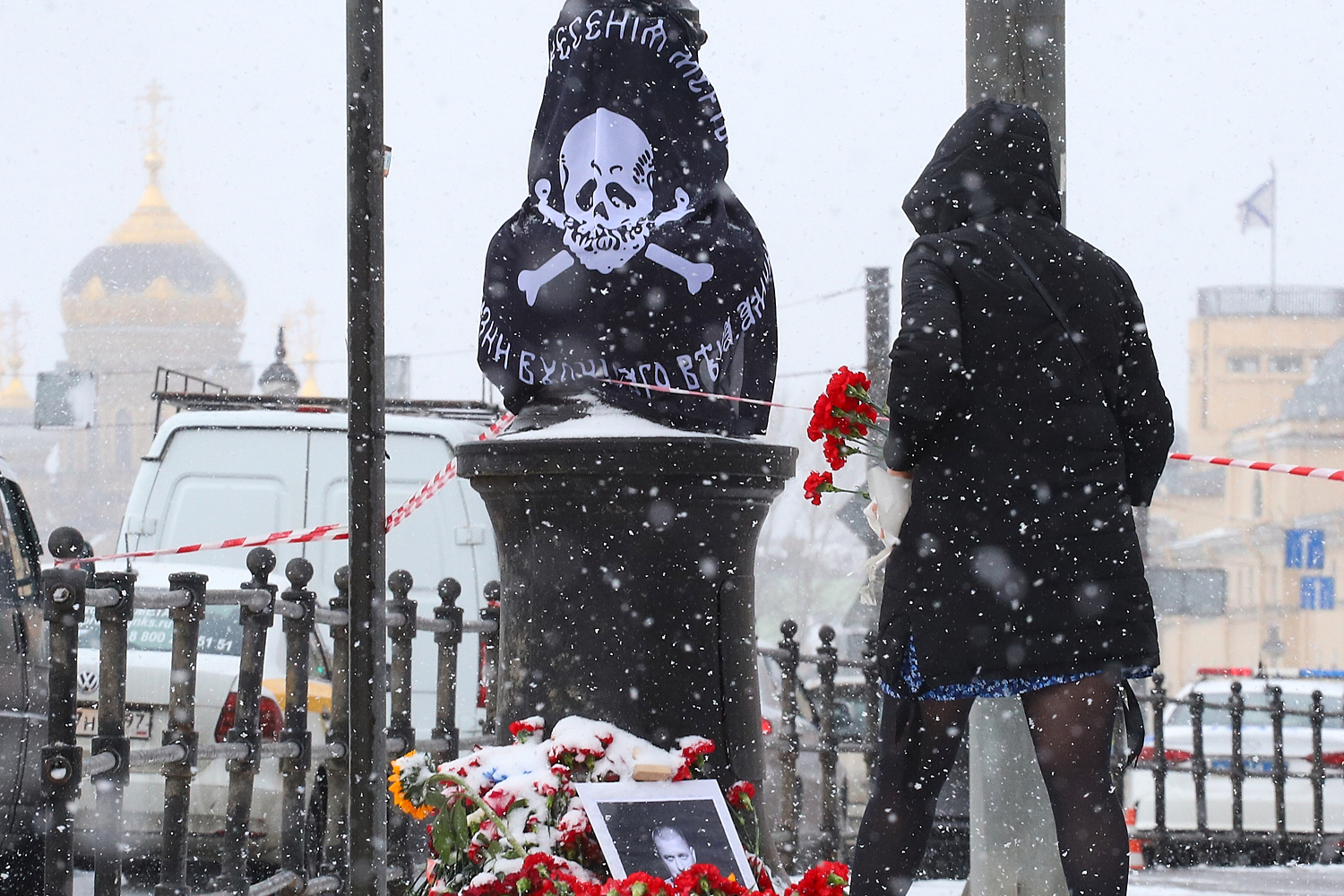
After the start of a full -scale war in Ukraine in St. Petersburg and the Leningrad region, almost every month there are reports about attacks on state or objects related to war. People suffered only in one case - during an explosion on the university embankment. In it, investigators suspect Ukrainian special services.
In other emergency, the Ukrainian trace is not obvious, but they are also connected with the war: the arson becomes an expression of protest, the legal forms of which disappeared after the introduction of censorship. “Paper” first calculated all the incident associated with the war, collected their chronology and main information about the motives of their perpetrators.
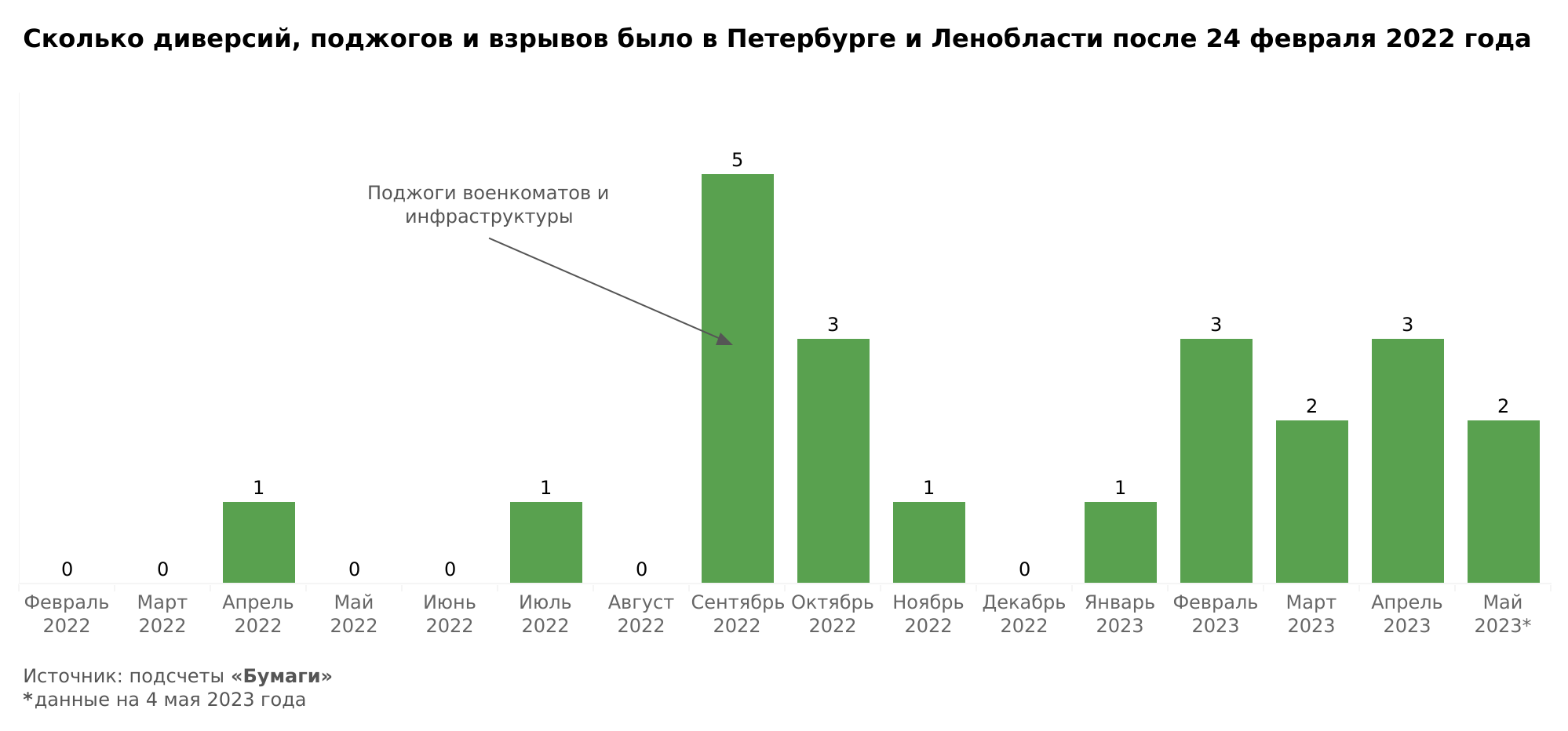
The material is updated on May 4, taking into account information about the explosive devices found in the Leningrad region, as well as the arson of the relay cabinet in the old village. We also added infographics.
Explosions
Since the beginning of the Russian invasion of Ukraine in St. Petersburg and the Leningrad region, about a dozen large explosions have occurred. Some of them in social networks associated the possible response of Ukraine to Russian aggression.
Officially, only two explosions were associated with military operations: an explosion on the university embankment, who killed the military commissar Vladlen Tatarsky, and undermining the support of the power line in the Gatchinsky district of the Leningrad region. The first explosion of the FSB qualified as a terrorist attack, allegedly organized by the Ukrainian special services, the second as a sabotage (Article 281 of the Criminal Code of the Russian Federation), the alleged organizers of which the security forces did not call.
This is how the chronology of large explosions in St. Petersburg and the Leningrad region looks, which in any form associated with military operations in Ukraine. Fat is highlighted cases in which the connection is officially confirmed:
The first major explosion in St. Petersburg, which was also covered by the Ukrainian media, occurred in April 2022 in a house on a friendly prospectus. However, in this case, the security forces did not find any “Ukrainian trace”. Four accused, according to the investigation, tried to kill the Streamer who lived in the house, with whom they had a conflict. Stremer was not injured, and the accused are now in jail.
Another major explosion occurred at the gas pipeline in the Vsevolozhsk district of the Leningrad region in November 2022. Due to the fact that the gas pipeline belongs to Gazprom Transgaz, the media and social networks discussed the possibility of both Ukrainian sabotage and provocation from the inside. But no confirmation of these versions appeared. Officially, the cause of the explosion was the destruction of part of the pipe.
At the end of April 2023, an explosion occurred in an abandoned boiler room in Pavlovsk. Local residents wrote about the possible attack of the drone, but there were no evidence of these rumors. Nevertheless, military drones have recently reached the Moscow Region. And on May 3, the Kremlin announced the attack of drones on the presidential administration.
Simultaneously with the incident in Pavlovsk, evidence of a possible explosion in Kolpin appeared. But the authorities did not publish official information about the second explosion.
Demolation of the power lines in the Gatchinsky district of the Leningrad region is so far the only incident in St. Petersburg and the Leningrad region, which the security forces have officially qualified as a sabotage. It is known that next to the place of undermining another explosives were found on another support for power lines.
Subsequently, reports appeared about other explosive devices found in the same area. "Fontanka" on May 2 wrote that three more non -detonated devices were found nearby.
On May 3, RIA Novosti, citing the regional authorities, reported that when examining the power lines, six items similar to explosive devices were found. However, the press service of the regional administration later said that they did not have such information, and the publication of “unconfirmed” information about six suspicious subjects was “hasty”. The publication “78”, despite the statement of the press service, insists that on three supports of power lines, experts discovered six explosive devices.
On May 3, the explosive device was found in the village of Bugrs of the Vsevozhsky district of the Leningrad region, 47news reported. To whom it belongs and why it could be used is unknown. Explosives were found among concrete slabs 300 meters from a residential massif on Parkova Street. Experts destroyed the device on the spot.
Provocations of telephone scammers
No less than 17 cases of arson and arson attempts in Russian cities are united by a similar script: the arsonists previously became victims of telephone scammers, who somehow mentioned Ukraine or war. “Mediazona” told about this in detail. Three such cases occurred in St. Petersburg.
On October 12, 2022, the 71-year-old pensioner “Molotov cocktail” set fire to the carpet in the Sberbank office on commandant Prospekt. She did this, according to eyewitnesses, shouting: "Glory to Ukraine!" And after the arson, he allegedly said in the phone: "I completed the task, now take me from here." The “paper” did not find official reports of accusations against the woman, but the Fontanka mentioned that the pensioner became a person at the case of hooliganism.
On March 16, 2023, the 22-year-old student of ITMO tried to set fire to the ATM at the Continent shopping center. During the interrogation, as the publication “78” wrote, the young man said that a woman who had submitted a police officer called him. She said that from the student’s account they transferred the money of the terrorist organization and he would be accused of Gosizman if he does not transfer the money to her account.
The student transferred all his money and took several loans. After the fraudster sent him instructions for arson of the ATM, saying that he was equipped with a device for transferring money to terrorist organizations. Eyewitnesses stopped the young man when he doused the ATM with gasoline. Whether a criminal case has been opened is unknown.
On April 26, 2023, the 26-year-old graduate student of the Polytechnic tried to set fire to the historical and literary museum in Pushkin. As Fontanka wrote, the young man told investigators that two unknown people called him and said that the “criminals” had issued loans in his name. They promised to save the graduate student from loans, and then stated that the scammers made up the summons to the military registration and enlistment office in his name, and offered to “take revenge” by the military enlistment office arson.
According to Fontanka, the young man refused to set fire to the military registration and enlistment office, but agreed to set fire to the museum and, before the detention, "managed to shout a Ukrainian patriotic greeting." According to Fontanka, the graduate student expected that after the "code words" his "on a successful mission would be congratulated in the FSB." The investigation qualified actions as hooliganism.
Who is behind such schemes and why scammers turn to the topics of war and Ukraine is not known exactly. The FSB in December reported that such calls of scammers come from the territory of Ukraine. The arson of ATMs “under the threat of coercion of telephone scammers from Ukraine” was talked about in February in “Savor”. In March, Sberus warned customers that fraudsters extort money under the threat of an accusation of the Stateizer.
Attacks on military registration and enlistment offices, military facilities and infrastructure
In total, at least four military commissariats were subjected to attacks in St. Petersburg. The same is in the Leningrad region: in Kirovsk, Priozersk, Sosnovy Bor and Senkelevsky settlement. This follows from the calculations of the "Paper" and the data "Mediazons".
The investigation qualified two such arson as an attempt on a terrorist attack. Maxim Asriyan is accused, despite the fact that at the last moment he changed his mind to throw the Molotov cocktail into the building of the military enlistment office of the Frunze district. The case of the 16-year-old schoolboy Yegor Balazyukin, who threw the Molotov’s cocktail at Kirovsk, after the death of his uncle at the front, was also resonated-he is also accused of trying to attack the attack.
In most cases, attacks on military registration and enlistment office are qualified under an article on intentional damage to property (Article 167 of the Criminal Code of the Russian Federation). The exception is the case of a young man who, in July 2022, abandoned the military commissariat in the Kirovsky district with bricks - an administrative protocol on petty hooliganism drew it up. It is not known how the security forces qualified the arson of the military registration and enlistment office in a pine borus.
It is one thing about arson in the Leningrad region is connected with a series of sabotage on railways. In March, the security forces detained a 19-year-old student for arson of the relay cabinet. He was charged with intentional damage to property by arson. As Mediazona wrote , relay cabinets often become the goals of sabotage on railways, as they contain equipment important for the movement of freight trains, while their destruction is not dangerous for people in passenger trains. "Mediazona" also noted that often such cases are later qualified as sabotage.
On May 4, it became known about the arson of the relay cabinet in St. Petersburg - on the stage between the new village and Lakhta. There is no information about the initiation of the case or the detention of suspects in arson.
There are three more atypical cases. In early September 2022, the FSB announced the prevention of arson of the building in the Leningrad region belonging to the Ministry of Defense. The security forces qualified this as an attempt on a terrorist attack, but almost nothing is known about the case, except that three residents of Vyborg detained it.
In January, a man was detained in St. Petersburg, trying to set fire to the warehouses of the Russian Guard and the Machine of the Ministry of Internal Affairs - he was charged with intentional damage to the property. According to the telegram channel “VChK-OGPU”, the man explained his actions with a protest against the war in Ukraine. At the end of January, the court in Priozersk sentenced the year to set fire to the building with the office of the local newspaper Red Star - presumably, the man confused it with the newspaper of the Russian army. Later, the punishment was tightened up to two years in prison.
Here are a complete chronology of attacks and attempts to attack the military and infrastructure objects of St. Petersburg and the Leningrad region:
What else to read:
Photo on the cover: "Paper"