
Translated material
"The fate of the dollar may have already been a foregone conclusion." Why is everyone talking about dedollarization again?
This material (information) has been produced and widespread by a foreign agent The Bell or applies to the activities of a foreign agent The Bell. 18+
In the last few weeks, everyone began to discuss the deadllarization with renewed vigor. The reduction in the role of the dollar as the main currency of international settlements and, as a result, the main world reserve currency can hit all assets nominated in dollars. We tell you why they again spoke about deadllarization right now, whether the countries that are afraid of sanctions were really denied the dollar and what should happen so that the dollar actually lost its status.
What's happened
The stars of American TV from different political poles - Farid of Zakarii on CNN and recently dismissed by Tucker Carlson on Fox News - devoted whole programs to the status of the American currency. The popular YouTube show for private investors “money is not sleeping” from Tinkoff Investments in recent weeks also actively covers the topic of deadllarization.
According to Globaldata, the discussion of the same problem on Twitter and Reddit in the first quarter increased by 600% compared to the last three months of 2022. The Goldman Sachs data (The Bell has a report) clearly shows that the topic of deadllarization is now experiencing a second and stronger surplus mention compared with the freezing of the Bank of Russia reserves on Twitter (important social networks for financiers) and media.
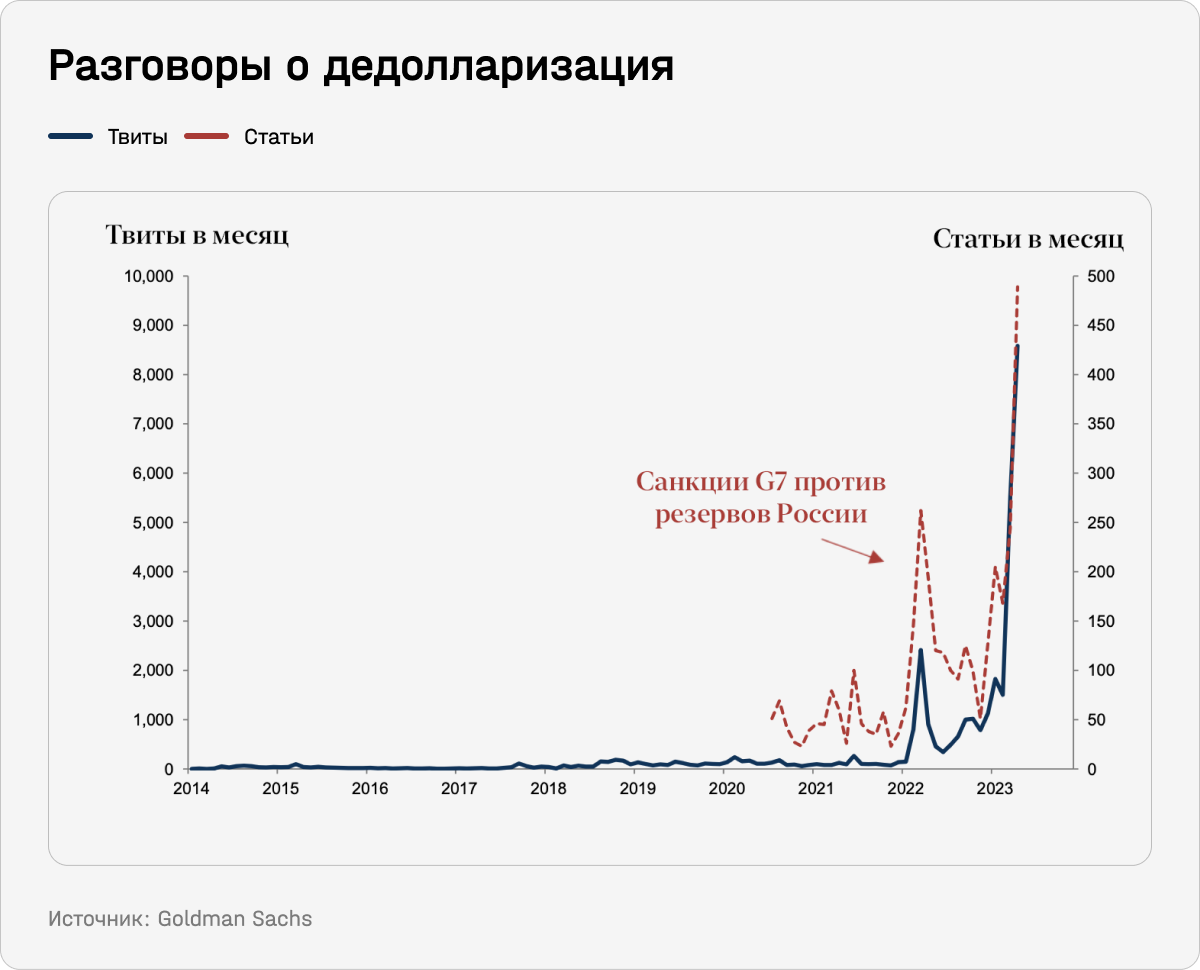
The theme of deollarization has been raising with enviable regularity from at least 2001, when China joined the WTO, notes Brent Donnelly, President of Spectra Markets. Google NGRAM, indexing books, shows local bursts of dedollarization in 2005, 2010 and 2015. A similar picture is drawn by the analysis of search queries in Google.
But in fact, the story began even earlier: about the moment, in 1965, Valery Zhiskar D'Esten, the Minister of Finance of France, called the status of the dollar as a reserve currency "exorbitant privilege".
Why now everyone was talking about deadllarization again
In recent weeks, several high -profile statements of politicians have been made at once.
- French Prime Minister Emmanuel Macron on the way from China said that Europe should stop focusing on the dollar as a currency of settlements. At the end of March, China first sold the LNG of the French company Totlenergies for Yuan.
- A few days later, Brazilian President Lula da Silva called for abandoning the dollar's monopoly in world trade. Previously, he already proposed to discuss the possibility of creating uniform currencies for operations between the countries of Merkosur and BRICS. At the end of March, China and Brazil agreed on the transition to settlements in national currencies between countries.
- After a meeting with Xi Jinping in Moscow, Vladimir Putin announced that he was ready to maintain a transition to Yuan (and not at all rubles, as he spoke many times earlier) in foreign trade calculations with the countries of Asia, Latin America and Africa.
Some analysts and commentators saw in these statements the likelihood that "this time everything will be different." Here are just a few examples:
Peter S. Earl of the American Institute of Economic Research writes : "The fate of the dollar as a" lingua franc "of world trade in the long run is already a foregone conclusion." Earl, like many other commentators, accuses the US sanctions policy of other countries to refuse the dollar as a means of calculation and, as a result, the currency of reserves. According to Bloomberg, sanctions against Russia have made more to promote the yuan than the Chinese government has achieved over the past 10 years.
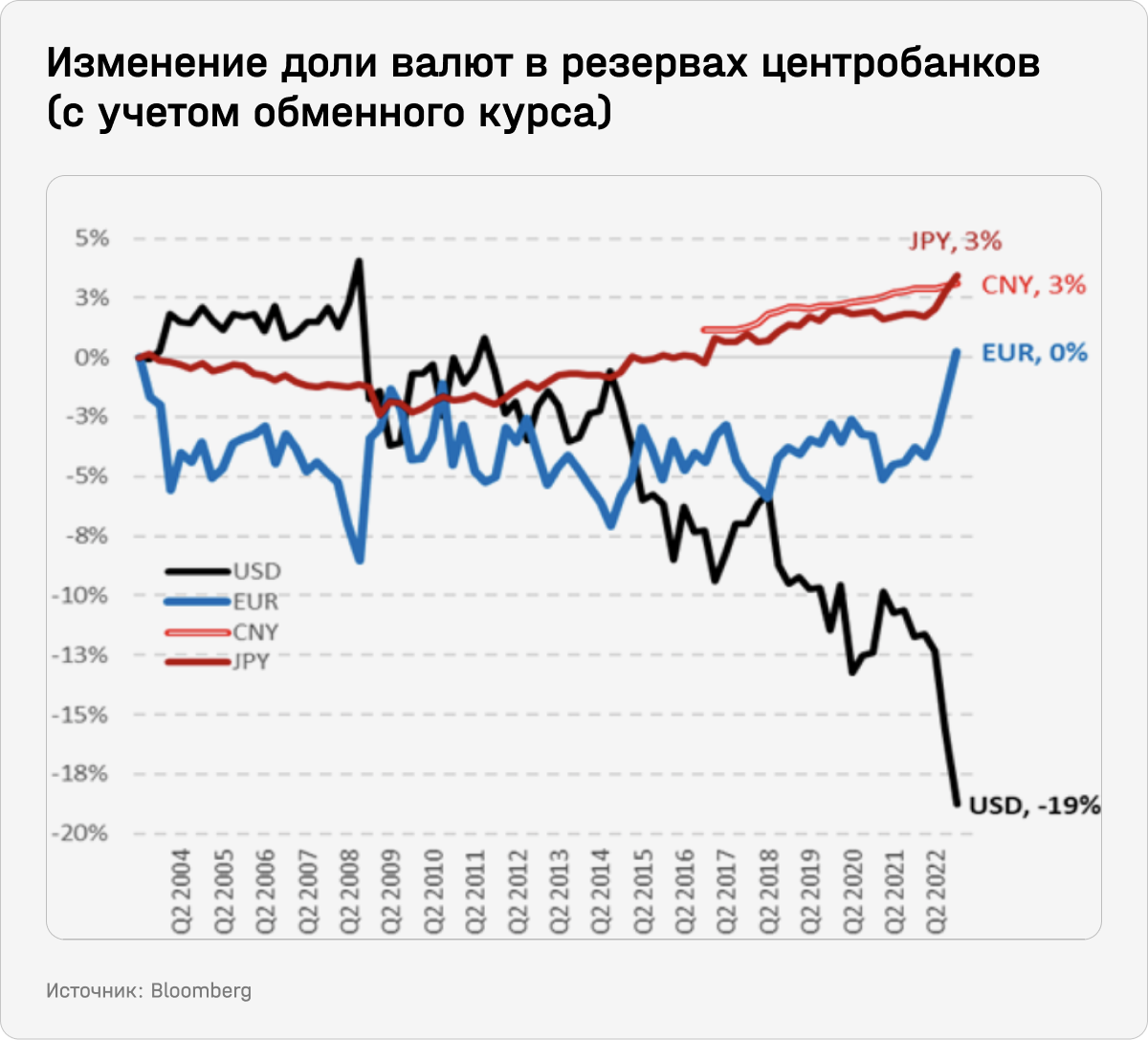
According to Stephen Jen, while working in Morgan Stanley, he came up with the term “dollar smile” , the dollar loses its reserve status faster than it is common, since many analysts did not take into account the sharp jumps in the exchange rate last year. According to his calculations, taking into account the exchange rate, the share of the dollar in international reserves decreased from 73% in 2001 to 55% in 2021 and 47% in 2022. That is, last year, the rate of refusal of the dollar increased 10 times. Analysts, including the IMF , use the nominal values of reserves - and get slightly large values, but similar dynamics.
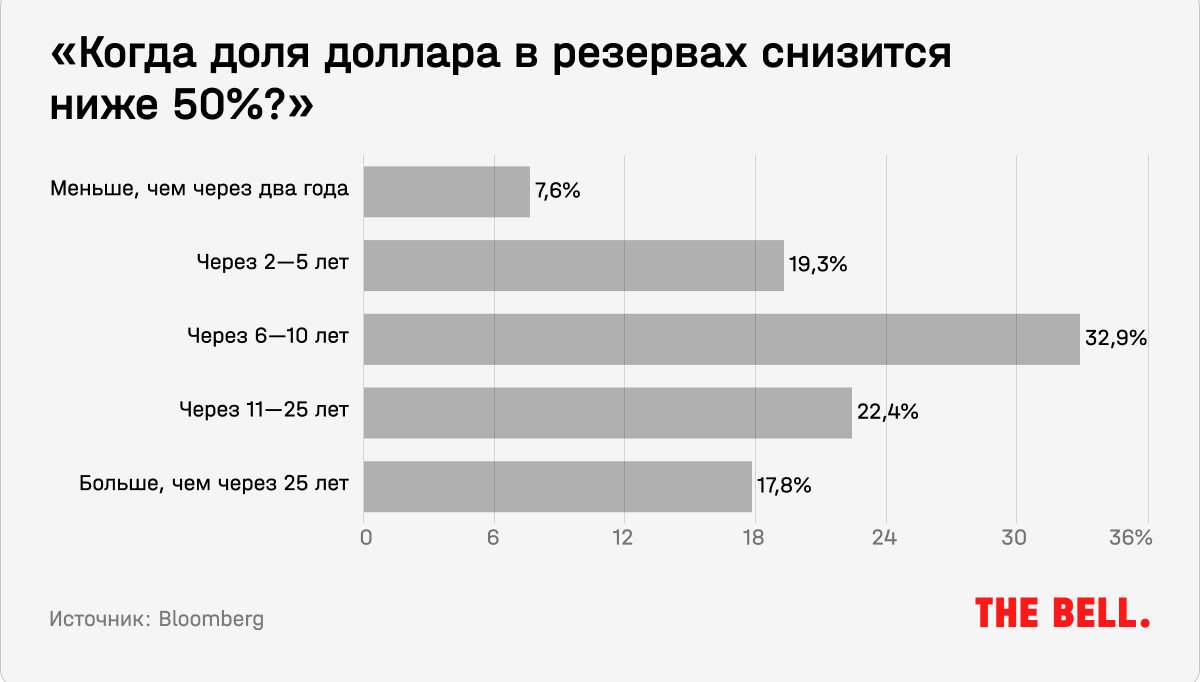
All these conversations already affect the market participants, who seriously consider the possibility of deadllarization. According to the April survey of Bloomberg readers, most respondents believe that the share of the dollar for 10 years will be less than half of the world reserves (against 58% in 2022).
Inflation in the USA could also influence the mood of investors regarding the dollar. Typically, talking about deadllarization is intensifying when the dollar loses its value, they note in GS. Since the beginning of the year, the DXY dollar index decreased by 1.9%. Among the factors, analysts also mention the ambiguity with the ceiling of the public debt and the current crisis in the banking sector, which can encourage more countries to diversify.