
Translated material
Modern Russia through the eyes of an elephant
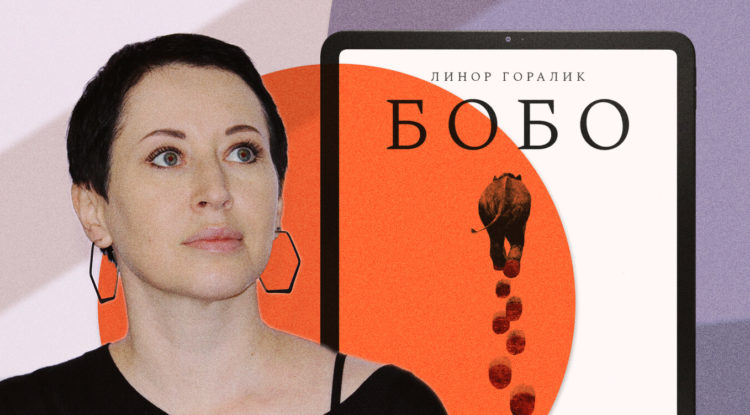
Linor Goralik laid out a novel in an open access in which the elephant goes through Russia-2022. Literary critic Leo Oborin considers him an outstanding
One of the main literary events of the year in Russia will be the new Roman Linor Goralik Bobo-this can be said even from May 2023. The writer conceived this book 15 years ago, since then I copied several times, but it was after the Russian invasion of Ukraine that she had to be about. “Bobo” is the story of the elephant, which was presented to the Russian king in 2022, and now he, an elephant, goes through Russia and sees everything that is happening in it now. The Goralik was looking for a long time in which publishing house to release the book, but in the end I decided to publish it on my website - there it is available for free download. Literary critic Leo Oborin advises everyone to definitely download it.
In order not to miss the main materials of the "cold", subscribe to our Instagram and telegram .

The Turkish Sultan gives the Russian king Elephant Bobo. The elephant is walking around Russia - more precisely, it is led to finally present the king in the Orenburg bunker. The journey turns out to be long, and the closer to Orenburg, the stronger the attitude of Bobo towards what is happening. Sailing from Istanbul, he is filled with joy, he is proud of his future service, he immediately considers Russia to be his new homeland, and calls the tricolor to him “our flag” in front of him. Orenburg will reach an elephant, experiencing all stages of horror, disappointment, indignation, anger. Such is the brief plot of the new novel Linor Goralik Bobo.
Yes, the case takes place in 2022. The previous Roman Goralik, “The name of such and such” , was also about the long journey through Russia: there during the war, the heroic doctors of the psychiatric hospital evacuated their patients. That novel was released at the end of 2020. For two and a half years, Russia has changed, and it became impossible to publish Bobo within the country - as a result, Goralik, fearing the consequences for potential publishers, simply laid out the novel in open access. The very idea of traveling has changed.
In social networks "Bobo" has already received many enthusiastic reviews; The critic Alexander Gavrilov writes that we have before us “a sort of cross of Keruak with Gogol and Fedor Sologob: the dead souls, the demons are small, whether the wheel will get, if it happened, to Moscow or not, fools on the road.” I would add another to the Russian classics. There is a seditious book, divided into chapters, which are named after settlements; The book, in the initiation of which the author says that he prompted him to the letter: "I looked in the neighborhood of me - my soul became wounded by the suffering of mankind." This is a "journey from St. Petersburg to Moscow" by Radishchev.
“Bobo” is also a novel about the wounded soul. This is the soul of an elephant-absolutely reasonable (throughout the novel, Bobo's companions aloud say that he is just a stupid animal, or even just “royal property”) and at some point even a beginner to speak. Here, Goralik refers to another of his novel - “Everything that can breathe breath”, about the animals who spoke after a certain world catastrophe.
By the way, she also wrote about the elephants - in the children's book “Martin does not cry”. The elephant, in the language of Viktor Shklovsky, is a wonderful figure of removal. He is a wonders, a stranger; No one really understands him, does not take into account that he also has a soul (except for Priest Kavratov, one of the most remarkable characters of the novel). “The elephant was taken through the streets of the elephant, / as it is known / it is known that the elephants in our face - / So the crowds went to the crowds of onlookers,” Krylov tells us, and exactly everything is happening here on the fable, except for the crowd of onlookers, as is customary in today's Russia, they provide for ordering.
And also, of course, it is important that the elephant in Russian literature is associated with good. The elephant from the textbook story of Kuprin heals the little girl with one of her presence. This is a mismatch with a fabulous role painful for both Bobo and the reader: Bobo cannot heal anyone, he is forced to observe the new Novocherkassky execution, to see the children of the mobilized ones who were killed in the war with Ukraine, to walk through the crowd of women trying to exchange soldiers' boots for their men. He learns about Buch and Mariupol, about denunciations and affairs for the “discrediting” of the army, listening to endless lies, looks at human fear, which one or another ascended to the king’s sacred figure. He talks with animals - birds in the forest (who believe that Bobo, as a person close to the emperor, knows whether he is fucking or not ") or a poor dog from the city of Dzerzhinsk:
- Do you beat you? - suddenly asked the dog.
“No, what are you,” I said in horror.
“And then you went to the blasphemy?” The dog asked in bewilderment.
To top it off, the grotesque for Bobo is carried by two tanks with formalin in case he crashes on the road - to deliver the king at least a scarecrow. There is such a concept - “McGaffin”, it denotes a certain object, which is essentially random, around which the whole plot revolves. In the romance of Gorak, at times it’s so scary that it seems that these same tanks are just the McGaffins and the path of Bobo will end in a formalin aquarium, where he will freeze the tsar, like a shark Damien Herst . To calm the nervous readers, I immediately want to say that this will not happen.
But moreover, it is scary here, here it is also ... not funny, but, as far as the material allows, Roman Goralik is an excellent satire. It is provided by several characters from Bobo's retinue: the cynical political strategist Kuzma, the sadistic Feesbashnik Sasha and, possibly, the most colorful of all Z-Poet Polite of Zorin, for which the Goralik had to be spoiled by the Z-PoESIA. I am sure that, submitted anonymously for some contest of patriotic works for children, such a thing would quite have a ride:
But what if somewhere in the distant land
Enemies hate my homeland?
But what if, to save the homeland,
will have to leave the house for a long time? ..
Darkens outside the windows, the lamp is on,
But I can’t fall asleep, and my mother does not sleep ...
Our dad is a hero, but it’s hard for us to
And even the lamp is not too light ...
But the door will open - and dad will come in,
And the beam for medals will fall,
And I will scream him: “Daddy's business
Finished - and hide and seek! It was not! .. "
Yoars with the elephant of each of these characters are transformed. In the end, we can even begin to regret them - including Zorin, which of the last forces, confused in an aggressive self -deception, tries to preserve his picture of the world. It is possible that something crossed in my head, you need to go through Russia with an elephant. This is as a well -known paradox of the Lord of the Rings: why did Frodo have to go with a ring on foot, and not fly on the eagles?
There is another group of characters here - a selflessly loving elephant Tolgat Batyovich, a professor of mathematics, who had to get a job in the menagerie of the Sultan; unfortunate employees of plants collecting mobile chapels with fasteners for machine guns; Designers, dragging boots for the elephant (some crap is obtained, which they try to prick the expeditions, hilariously using marketer jargon: a city, a professional marketer, ironizes some colleagues). There are even touching activists of the anti-war Lybertarian league of the Gus-Khrustalny and a brave young Cossack-femininist Katerina, into whom Bobo falls in love. Love-political experience is compared with a Must-aggressive excitement, making an elephant especially dangerous.
The episode with Katerina, one of the most exciting, resembles a piercing chapter from the Sorokinsky “telluria” - about a centaur who fell in love with Colombin: “And I gently galloped both lucky and carried a colombin and she is on Meniza and Smeyatszya and Pets a song. And I galloping and galloping and carrying Colombin through the Lypochet and Meniy, Ocute Oblast Oblast Oblast Oblast Among the Object Oblast Among the Object Oblast is good. ” Bobo does not explain at all like the illiterate Sorokinsky centaur: his inner speech, including love, rather reminds of the heroes of early Dostoevsky, of a person who retains his pride when the whole universe does not put him in anything.
And the "Dostoevskaya" speech is an accurate find of Goralik. Today, studying at the Dostoevsky school as a classic, raising “eternal questions”, we forget that he worked with topical material - and contemporaries perceived his texts in one information stream with a journal controversy and newspaper criminal chronicle.
The elephant goes to the tsar in Russia, speaks with him as a “little man”, shame and anger are waking up in it, he loses its naivety and innocence - each element here may seem conventional, but it is important that this is exactly what is falling into the nerve of time.
Bobo gloom, the thickening around the elephant, reminds us, by the way, that in the history of people's relations with elephants there were a variety of episodes. Bobo dreams of glorious combat elephants of India- and there was also an elephant Topsi, on which the inventor Edison tested the execution with electric shock, and the elephant Mary, hanged on the lifting tap (both executions were photographed with film and cameras). Or here is the last phrase from Averchenko’s story about how the child says goodbye to the romantic views of childhood, and finally recalls the phrase from the naive-toe adventure novels: “It is best to shoot with explosive bullets in elephants.” In theory, modern means of murder - both bodies and souls - equalize elephants, people, oatmeal, and dogs. In order to better compare the sad immutability of this fact, an elephant-macguffin is well suited, slowly moving from Istanbul to Orenburg towards fate-not only its own, but also, as the terrible final of the Bobo novel, towards the fate of the universal.