
Translated material
Due to the war and the ban on gay propaganda, many LGBTK+ people felt the growth of homophobia and transfobia in Russia-especially in the rhetoric of the media and officials
The main thing from the report of the Group "Exit" and the Foundation "Sphere"
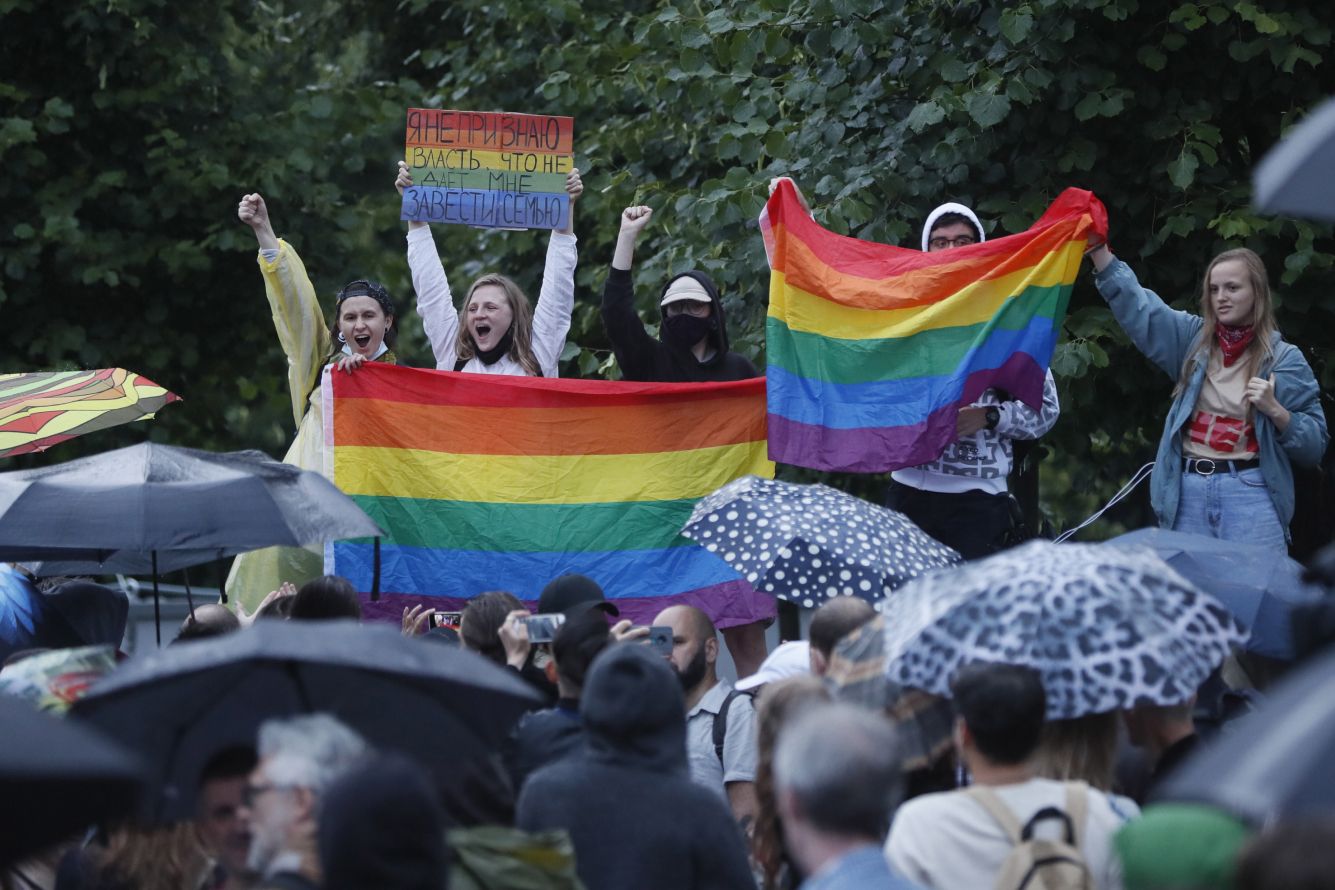
In 2022, many LGBTK+ people in Russia who are already faced with discrimination in various fields, felt an increase in homophobic and transfer aggression in Russian society against the backdrop of a full-scale invasion of Ukraine and the adoption of the Law on the prohibition of gay propaganda. In particular, they note the strengthening of the rhetoric of hatred in the media, among representatives of the Russian authorities and their loved ones, subject to state propaganda. This is evidenced by the results of a survey conducted by LGBTK+ Group "Exit" and the Film Foundation . "Medusa" retells the main thing from the joint report of these organizations on the position of LGBTK+ people in Russia.
Method and participants
The authors of the report interviewed the research participants using questionnaires, which were distributed on the social networks of “output” and “spheres”, on the website of the Khornet Quirrows, through targeted advertising, as well as with the assistance of social workers.
In total, human rights activists managed to collect 6439 profiles among respondents aged 13 to 70 years. Among them are 51% - interviewed with male gender identity, 35% of those who define themselves as women, 12% are non -war people, 2% - those who have chosen a different gender identity to describe themselves. Most of the respondents live or lived in Moscow (23%) and St. Petersburg (19%).
Cisgender people make up 82% of respondents, transgender - 18% of all respondents. 2% of respondents-Intersex-people.
Most of the respondents (62%) are homosexual people. Bisexual and pansexual people make up about a third of all research participants (32%), 3% designated themselves as asexual, 1% as heterosexual. The rest have chosen other methods of sexual self -identification.
Research participants mainly have higher education or are in the process of obtaining it (61% of the entire sample).
What position are LGBTK+ people in Russia
The degree of openness. Having studied the questionnaires of the survey participants, the authors came to the conclusion that LGBTK+ people more often make a camming out to friends than to relatives, colleagues, classmates or classmates. So, almost half of the respondents (49%) said they were open to most friends, 21% of respondents talked about their sexuality and/or transgenderness to most colleagues or classmates. Only 14% opened to most relatives. The most “open” Russian regions were Petersburg and Moscow. Among the most “closed” federal districts are the North Caucasus, Ural, Volga, South and Far Eastern.
Circle of communication. 52% of the survey participants reported that their communication circle consists equally from heterosexual cisgender and LGBTK+ person. Half of the respondents (50%) noted that the people around them are mostly friendly to LGBTK+. The largest share of those who called their environment predominantly friendly, lived or live in St. Petersburg (57%) and Moscow (55%). The lowest share of respondents with a friendly environment lives in the Far Eastern (37%), North Caucasus (39%) and Southern Federal Districts (40%).
Income level. A quarter of the survey participants said that they are on the verge of a plight and can afford only essential items. 5% reported that they are in an extreme poverty. Moreover, among transgender people, this share was significantly higher - 9%. Most respondents (72%) have a constant income. At the same time, more than half of the participants (60%) have less income than the average wage around the country. Part of the respondents (15%) believe that their sexual and gender identity affects their economic situation. More often than others, the participants in the survey from the North Caucasian and Far Eastern districts spoke of such influence.
An economically vulnerable position forces some LGBTK+ people to get involved in the sphere of sexual services: in 2022, about 5% of respondents received payment for sex, escort, work as a model in pornography or webcam models. Among them are more than half (66%) - men. A quarter of respondents who received money for sexual services are transgender people.
What discrimination are LGBTK+ people in Russia
5172 participants in the survey said that in 2022 they applied for medical help. 27% (1386 people) of such respondents said that the doctor knew about their sexual orientation and/or gender identity. At the same time, almost every fifth of them faced the discriminatory or violent actions of medical workers. Transgender people are subject to such actions more often. Most often, the LGBTK+ people in the North Caucasus, the Far East and southern Russia are discrimination in the field of medicine.
Problems with access to various commercial services due to homophobia and/or transfobia in 2022 experienced 3% of respondents, 2% came into refusal to provide public services. Among such problems, the survey participants called: the inability to make marriage, difficulties with the replacement of documents, the neglect of the employees of instances and services, a refusal to buy goods due to homophobia or transfoby, difficulties in buying Quirry Literature after the adoption of the law on the ban on gay propaganda.
Among the problems in the housing sector, the respondents noted the household homophobia of neighbors or landlords, because of which, in particular, co-living in the same house becomes uncomfortable, difficulties in searching for housing and refusing to rent apartments with an open or “readable” non-metro station pair or LGBTK+ person.
The most widespread problem of LGBTK+ people who have children (411 people among those surveyed, or 6%) were conflicts with other relatives of the child due to their transfoby and/or homophobia. According to the study, women face problems when communicating with other relatives of their child almost three times more often than men.
Among other difficulties, which LGBTK+ parents participating in the survey said: difficulties in communicating with children's educational or medical institutions, and guardianship authorities. Some respondents said that they are actually faced with a limitation of their parental rights: they cannot see their children on the initiative of the second parent or other relatives, are being checked by guardianship authorities, deprived of parental rights, and are subjected to threats that have to leave Russia. As in other cases, transgender people face problems in the field of parental rights more than other LGBTK+ people.
How often LGBTK+ people in Russia are faced with violence
Every third interviewed (30%, 1955 people) was subjected to one or more types of violence or discrimination due to its sexual and gender identity. In 2022, 476 people (7%) collided with physical violence, with threats to the use of such violence - 1320 people (21%, or every fifth respondent).
Transgender people are faced with physical violence (12%) or threats of its use (33%) much more often.
Among the federal districts, the most affected by physical violence due to sexual orientation and/or transgender is in the North Caucasus Federal District (12%). The highest share of those who encounter threats falls on the Far Eastern (27%), Siberian (27%) and Ural (26%) districts.
What types of violence were faced with:
- Sexualized violence - 8%, or 532 respondents;
- Home violence - 15%, or 945 respondents;
- persecution on the Internet - 14%, or 884 respondents;
- damage to property or theft - 6%, or 373 respondents;
- blackmail and extortion - 13%, or 850 respondents;
- "Foot Dates" - 4%, or 236 respondents.
According to the conclusions of the authors of the report, the respondents mainly do not trust the Russian law enforcement agencies. Most (75%) doubt the effectiveness of circulation, others are afraid of police (65%).
Among those who are faced with crimes on the basis of homophobia and/or transfobia, only every fifth is being addressed to the police. Most of the applicants said that they were faced with pressure from law enforcement officials. Only 9% of respondents who turned to law enforcement agencies for help said that the perpetrator was found and prosecuted.
What has changed for LGBTK+ people in Russia after the start of the war with Ukraine
78% of the survey participants noted that after the start of the Russian invasion of Ukraine in February 2022, they felt like LGBTK+ persons in a more vulnerable and unsafe position. The respondents also called the Law on the ban on Gay Propaganda adopted against the backdrop of war and the fight against “Western values”.
83% of the respondents also noticed the strengthening of homophobic and/or transfobed sentiments in Russian society against the background of the war in Ukraine. Describing what exactly this strengthening was, they often noted the growth of rhetoric of hatred in the pro -government media and among representatives of the authorities. About 39% of the participants noticed strengthening homophobic and/or transfer sentiments in their immediate environment. In particular, respondents note the growth of such moods among their relatives subject to state propaganda.
A third of the survey participants (32%) reported that the war influenced the availability of necessary drugs. Among the transgender people, the share of those who encountered restrictions on access to drugs is 50%. In particular, respondents note problems with access to hormonal therapy, antiretroviral therapy and antidepressants.
About 69% of the survey participants reported that the Russian invasion worsened their economic situation. More often than others, respondents from Moscow (74%) spoke about this, less often than others from the Far East (63%). Many respondents talked about the loss of work in international or Ukrainian companies, rising prices, reducing income, purchasing power and limiting career prospects.
At the same time, the authors of the report note that the changes in the public mood associated with the Russian invasion of Ukraine have not yet affected the growth of violence and cases of discrimination against LGBTK+ people in Russia.
About 16% of respondents (1028 people) left Russia because of the war. Basically, residents of Moscow and St. Petersburg made such a decision. At the same time, the majority (60% of the total number of those who left) decided to move after September 2022, when mobilization was announced in the country.
The respondents called strong anxiety and psychological discomfort (38%) as the reason for departure. Among other reasons: the threat of own safety (31%), tightening censorship (30%), growth of homophobic and transfobeen moods (28%), unwillingness to be in Russia, have something in common with it (28%), a discussion of the new law on the prohibition of gay propaganda (27%), the risk of being mobilized (19%). Most often, people left for the European Union (22%of those who left Russia), as well as to Georgia (16%) and Turkey (11%).