
Translated material
Putin handed over the Trinity Russian Orthodox Church to Andrei Rublev
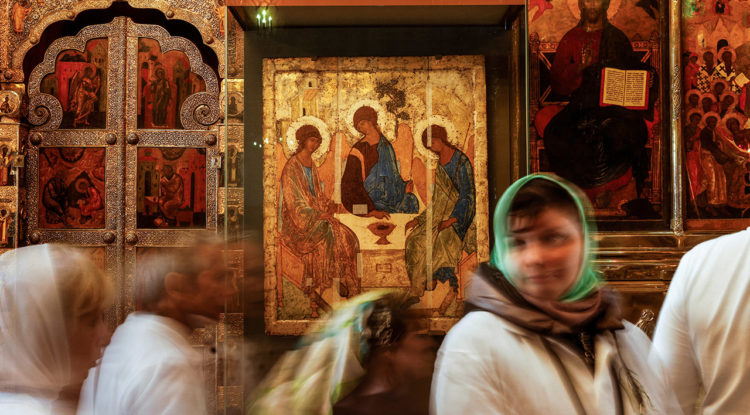
The masterpiece is in danger of disappearing, even the special representative of the president is indignant
Vladimir Putin approved the transfer to the Russian Orthodox Church (ROC) of a masterpiece of Russian icon painting - "Trinity" by Andrei Rublev. The first time the picture will be exhibited in the Cathedral of Christ the Savior, and then go to Sergiev Posad. The museum community does not support the transfer of one of the most popular Russian icons and sees in this decision the risk of losing the masterpiece. Even the president's special envoy for international cultural cooperation, Mikhail Shvydkoy, is against it. The dubious prospects of the "Trinity" - in the material "Cold".
In order not to miss the main materials of "Cold", subscribe to our instagram and telegram .
The Russian Orthodox Church persistently uses the term “return” in relation to the icon (in particular, Patriarch Kirill speaks of the “historic decision to return the icon of the Holy Trinity”). Nevertheless, from a legal point of view, "Trinity" as an object of the Museum Fund of Russia cannot be alienated from state property. The Ministry of Culture, on the other hand, avoids the word “return”, emphasizing that the masterpiece has been transferred to “long-term safekeeping”.
What's with the president?
Formally, the president has nothing to do with managing the state part of the Museum Fund: this is the responsibility of the Ministry of Culture. According to the Regulations on the Transfer of Museum Items, "Trinity" can go to "another organization" only on the basis of a special agreement concluded between the Ministry of Culture and the Russian Orthodox Church.
Patriarch Kirill chose a shorter path: in order to receive the icon, he sent a letter to the head of the presidential administration, Anton Vaino. Probably, in response to this appeal, the President instructed the Ministry of Culture to sign an appropriate agreement for 49 years.
The Tretyakov Gallery will hand over the icon to the Russian Orthodox Church until June 4 - on this day in 2023 the Orthodox Church will celebrate the feast of the Trinity. The Russian Orthodox Church claims that during the year the icon will be in the Cathedral of Christ the Savior, after which it will be sent to the Trinity-Sergius Lavra. According to the Ministry of Culture, the icon will stay in the temple only until June 4, after which the "Trinity" will be transferred to the "planned restoration process" and only after that it will be transferred to Sergiev Posad.
What threatens "return"?
Restorers and art historians, primarily employees of the Tretyakov Gallery, have repeatedly stated that the icon needs special storage conditions, which can only be provided in a museum. In July 2022, the “Trinity” was exhibited for a short time in the Trinity-Sergius Lavra, then experts discovered 61 “significant changes” on the icon. After the restoration, the icon was returned to the permanent exhibition of the Tretyakov Gallery only in December. by the professional community The transfer of the ROC icon is not supported .
Even Mikhail Shvydkoi, special presidential envoy for international cultural cooperation, is against the "return" of the icon to the ROC. “The protection of cultural monuments, their preservation for future generations cannot assume their daily use in worship. And in some cases, when it comes to such masterpieces as Andrey Rublev's Trinity, any movement from the museum space - even in the name of the highest goals - can lead to irreparable consequences that must be avoided, ”he wrote in an opinion column . noting that such a decision should take place under conditions of “public discussion”.
Shvydkoy's position is also supported by the recently appointed director of the Pushkin Museum, Elizaveta Likhacheva. She is sure that the "Trinity" may not survive the "return" of the Russian Orthodox Church. “It may simply be lost, it may fall apart: there are three boards, and they are not very well fastened together. This icon has never been presented as miraculous. “Trinity” is the main Russian contribution to Christian iconography, the main thing in it is not a religious meaning, but an art history one, ” said . she
The “lack of miraculousness” at a meeting of the Academic Council of the Tretyakov Gallery in 2008 (then the idea of transferring the “Trinity” to the Russian Orthodox Church for the first time was considered) was also confirmed by the art critic of the Andrei Rublev Central Museum of Ancient Russian Culture and Art Boris Dudochkin. According to him, neither in state nor in church documents is the “Trinity” called miraculous, there are no such records in the Degree Book of the Royal Genealogy, which tells about the baptism of the heir to the throne, the future Tsar Ivan the Terrible; it is not called miraculous either in the famous, well-known resolution of the Stoglavy Cathedral of 1551, nor is it called miraculous in the Trinity Tale of the Capture of Kazan.
We believe in a miracle
However, some representatives of the Russian museum community still continue to believe in miracles. In addition to the Trinity, the Russian Orthodox Church managed to get another “sacred artifact” - a memorial complex for the relics of Alexander Nevsky, which will be transferred from the Hermitage in favor of the Russian Orthodox Church. “At the present geopolitical moment, the connection of the relics with the tomb on the territory of the Lavra acquires a special meaning. Today, the sacred significance of a monument is more important than its artistic value,” said Mikhail Piotrovsky, director of the Hermitage, commenting on this decision.
Approximately the same rhetoric is professed by the ROC in the issue of the transfer of the "Trinity". “Being placed in churches, the shrines become open for the intensified liturgical prayer of believers, especially necessary in difficult times for the Fatherland,” said . the journal of the meeting of the Synod of the Russian Orthodox Church
In the transmission of the "Trinity" of the Russian Orthodox Church, one can find a symbolic character, comparable to the famous "procession in the sky" over Moscow in November 1941. In 2023, such a decision takes place against the backdrop of news about the preparation of the Ukrainian counteroffensive . True, the “heavenly procession”, which supposedly saved Moscow from falling, remains just a dubious legend .