
Translated material
Very strange words
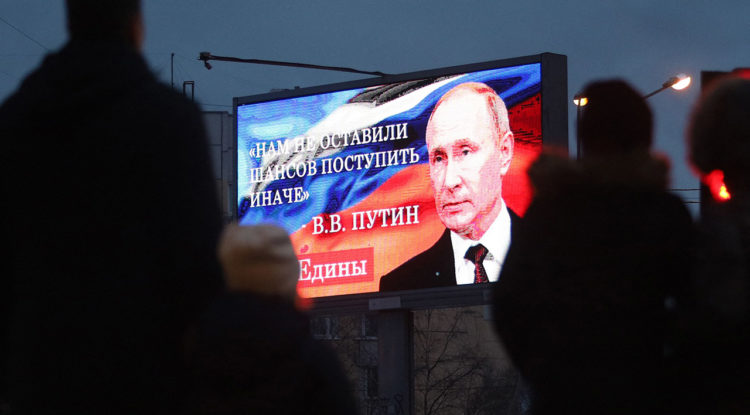
How the Russian authorities are shaping the Upside Down language
Journalist, candidate of philological sciences, member of the expert council of the "Word of the Year" competition Ksenia Turkova talks about how war and propaganda change the language.
In order not to miss the main materials of "Cold", subscribe to our instagram and telegram .
Press Secretary of the President of Russia Dmitry Peskov last week gave an interview to the ATV channel from Bosnia and Herzegovina. Commenting on the slow advance of the Russian army, he explained this by the fact that Russia "does not fight" in Ukraine. “To wage war is the total destruction of infrastructure, the total destruction of cities, and so on. We don't do that."
This quote by Peskov very accurately reflects the essence of the current Russian newspeak, which has surpassed even the famous Orwellian "Peace is war." It was the language from the very beginning of the war that became one of its main tools. In fact, we are talking about creating a new, artificial language that has formed an inverted reality, which is very reminiscent of the Upside Down dimension from the TV series “Very strange things” (“Stranger Things”) - everything in it seems to look exactly the same as in the usual us the world, but covered with cobwebs and saturated with a sense of thickening darkness, decay and mortal danger.
There are more and more portals to this parallel reality. But the tools that open them are actually not so many. Four main techniques can be called the “carrying” language constructions of this war: mirroring, euphemisms, information overload (deliberate verbosity) and, of course, hate speech.
In the Russian reality of Upside Down, everything is really mirrored: there are occupiers, enemy attacks, liberators and those being liberated, shelling of civilians. While the Russian army literally occupies Ukrainian cities, in Russia itself, representatives of the Ukrainian authorities are called “occupiers”. It was this word, in particular, that Vladimir Putin used in his message to the Federal Assembly: “The people of Ukraine have become hostages of the Kiev regime and its Western masters, who have actually occupied this country in the political, military, and economic sense.”
But "occupation" in the language of Upside Down sounds like "liberation". It is this word that denotes both the purpose of the invasion itself and the capture of Ukrainian cities. In the first weeks of the war, Russian state channels used the word especially frequently. For example, in the news of Channel One from February 24 to March 11, 2022, it sounded 110 times. “The Russian military continues to liberate more and more new settlements,” the correspondents said, emphasizing that cities were being liberated “from Nazis and fascists.” The same word, “liberation”, some time later appeared in the usual, not inverted reality, only in its direct meaning: the Ukrainians called the return of their cities liberation.
Mirroring , or the use of the same words and constructions that the opponent uses, only in the opposite sense, has become one of the most striking features of the Upside Down language. Even before the start of the war, this principle was formulated by Putin, commenting on a statement addressed to him by US President Joe Biden: "Whoever calls himself that, he himself is called that." Both Russian politicians and propaganda media strictly follow this principle.
What do you think these phrases are about? “Atrocities in the occupied territories of the Kharkiv region”, “bombing of hospitals and schools”, “people are being killed, tortured, thrown into prison”, “the regime of repression against the citizens of the country is intensifying”. You might think that all this is about the Russian government, the war it is waging, and the repression that it arranges inside the country. However, in fact, all these are excerpts from the speech of Vladimir Putin. He used all these words when describing Ukraine. Mirroring turns everything upside down, confuses the viewer and places him in another reality: the aggressor describes his own actions, but attributes them to the victim.
But the most powerful component of this language was, perhaps, euphemisms (replacing dissonant with euphonious). Only one of them would be enough for a whole dictionary. The main unit of this dictionary was, of course, the very designation of the war as a "special military operation", or SVO. And the phrase, and even more so the abbreviation, evoking inappropriate associations with the TV series “All the men of the SVO ...”, are designed to hide the essence of what is happening.
The inability to capture a city in this dictionary is denoted by the verb "block". The retreat or even the flight of the Russian army is called a "planned regrouping of troops" or even a "gesture of goodwill", as in the case of Snake Island. An explosion in Russia is called a "pop" or "loud sound" - this is the phrase used by the governor of the Belgorod region Gladkov, who received the nickname Khlopkov .
Well, if a Russian bomb accidentally falls on a Russian city, this is called an “unregular ammunition release” (the wording of the Ministry of Defense). The verbal noun (one of the bright signs of a clerk - bureaucratic style of speech, ponderous language of officials) in this phrase also plays an important semantic role. A descent is usually called something uncontrollable, beyond the control of a person, like a gathering of the blessed fire or an avalanche in the mountains. It turns out that this “descent” sort of removes responsibility from the one who did it: it just happened by itself, it happened.
Another vivid example of euphemism is the expression “precision strikes”, which has become a de facto synonym for indiscriminate and brutal Russian shelling, during which civilians are killed. The Russian Ministry of Defense uses this phrase regularly when there is an attack on a peaceful Ukrainian facility: a shopping center, a multi-storey building, a railway station, a hospital.
It is important to note that the vocabulary of euphemisms in modern Russia began to take shape not after February 24, but much earlier. Linguists paid attention to a group of words that, as it were, veils what is happening, lowers the degree, a few years ago. In 2020, this group of words was even included in the list of words of the year in the “Anti-language” category (language of lies, hatred, propaganda): “smoke” instead of “fire”, “flooding” instead of “flood”, “restrict” instead of “prohibit” , "renovation" instead of "demolition" and so on.
Euphemisms also form the Russian vocabulary of negation. “We just got lost, crossed the border by accident” – this is how the Russian Ministry of Defense commented in 2014 on the detention of 10 Russian paratroopers in the Donetsk region, and those suspected of poisoning ex-GRU colonel Sergei Skripal and his daughter Petrov and Boshirov, as you know, “admired the cathedral.”
The third important component of the Upside Down language is chattering, deliberate verbosity , the use of words in such quantity and in such context that they lose all meaning and remain only a shell. One of the main speakers of this language is the representative of the Ministry of Defense Igor Konashenkov, who reports every day about the “successes” of the Russian army. Nevertheless, the Proekt publication found out that Konashenkov sometimes invents non-existent Ukrainian toponyms, reports on the capture of the same settlements four or five times, and reports on the destruction of so many weapons that Ukraine did not have.
Deliberate verbosity is aimed at flooding the viewer with information (the text is also pronounced quickly and rather monotonously). As a result, an ordinary person has a feeling that something significant has happened, and he is unlikely to compare numbers and names. In the course, thus, there are, as it were, shells from words that actually do not mean anything.
Finally, the fourth component of this new language is the language of hatred and enmity . Everything is simple here: frankly anti-human, cruel, calling for violence, offensive language in the language of Upside Down is becoming more and more. Moreover, if earlier such statements were still rather something marginal, now TV presenters and politicians holding high positions, including Dmitry Medvedev, allow themselves to make them. For example, TV presenter Vladimir Solovyov in one of his broadcasts compared Ukraine with a cat from which worms are expelled: “For worms this is war, but for a cat it is liberation” , and RT presenter Anton Krasovsky became famous for his statement about the burning of Ukrainian children .
Once upon a time, the philologist Gasan Huseynov called the beginnings of such a language in Russia “the cesspool language”. A flurry of hatred fell upon him, they tried to force him to apologize and admit that you can’t talk like that about the Russian language. However, as time has shown, it was and is not about a normal language, but about an artificial language of another, parallel reality.
Moreover, this system is closed on itself, all new language units that arise in it are aimed exclusively at the internal consumer who lives in an information vacuum. Outside of Russia, the words "collective West", "Anglo-Saxons", "denazification" and "pops" with "munitions" are not used.
Before our eyes, a terrible newspeak is being formed (if it has not already been formed), which is spreading further and further, capturing more and more new territories of common sense. Everything is like in the series: alas, the Upside Down dimension is slowly taking over the city.
But it is still possible to resist this, in particular, in this way - by analyzing and dissecting a parallel reality.