
Translated material
Tehran-23
Secrets of the visit of the head of the Central Bank Elvira Nabiullina in Iran
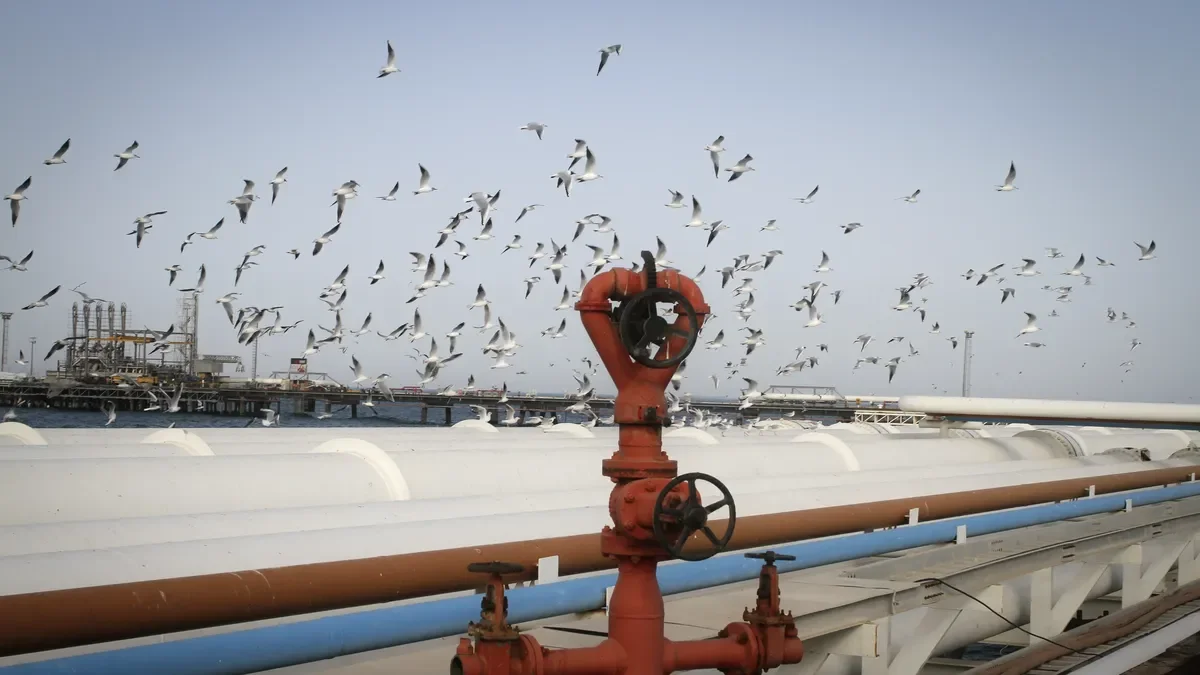
The oil terminal of the Iranian company Iranian Oil Terminals Company. Photo: Zuma / TASS
The Central Bank of the Russian Federation has not yet commented on the results of negotiations by Elvira Nabiullina with Mohammad Rez Farzin, the head of the Iranian Central Bank. Most likely, we will not recognize the real results of this meeting for a long time. Everything related to the interaction of the two financial systems that are under increasing sanctions is a too delicate topic to take it into public space.
At the same time, Iranian financiers are more likely to have an advantage in negotiations. On their side, many years of experience in life and activity in conditions of strict external restrictions and the presence of specific financial instruments at the disposal, invented for their bypass. Moreover, the problems that Iran faces are very similar to Russian. Therefore, we can assume that the delegation of the Russian Federation could ask for Iranians.
Sanctions and their results
According to OPEC, Iran has the third largest oil reserves (after Venezuela and Saudi Arabia), which make up 13.4% of the world. But the import of oil from Iran is blocked, as well as investments in its economy, and any business ties with it, primarily financial. US sanctions against the Iranian government include
a ban on the sale and transfer of cash dollars to Iran,
Trade with him with gold and precious metals,
transactions in Iranian Rialals,
operations with the public debt and the central bank,
Exports from Iranian energy resources and products of other key sectors for the country- from the automotive industry (after oil and gas production, this is the third most important industry in the country) to the production of carpets.
Of course, Iranian banks are disabled from Swift.
The list of sanctions restrictions on Iranian business and government can take more than one page, but we are interested in something else - what were the consequences of sanctions and how the Iranian authorities bypassed them.
For 1980–1981, after the first round of sanctions, the recession of Iran’s economy, according to the IMF, amounted to more than 25%, the average annual consumer inflation has exceeded 20% - and since then prices have almost never dropped below two -digit numbers. The exception was the period of abolition of sanctions in 2016–2017. After the resumption of sanctions in 2018, the Iranian economy entered a two -year recession, then a restorative growth followed, but Iran’s real GDP remained at the same level as ten years ago. If you look at the indicators of the Iranian GDP per capita, today it will be the level of 2004-2005. Strongly, the Iranian economy was affected by restrictions on oil export - and the associated chronic currency deficiency.
Three sources of money
The resumption of sanctions in 2018, which actually isolated the Iranian economy, brought down its national currency. The market exchange rate of the dollar to the Iranian Rial for six months increased more than three months, and by 2020, four to the level of 2017: from 40,000 Rials per dollar to 160,000. Inflation from 8.3% jumped by the end of 2018 to 48.8%.
Now in Iran there are three exchange rates of currencies: an official course, a course for exporters-importers and a market course.
The official rate remained at the level of 42,000 Rials per dollar - it is used to subsidize the procurement of first necessities, such as food and medicine. Another course, NIMA, is valid for exporters and importers that exchange currency under the supervision of the Central Bank: NIMA is an online currency exchange system launched by the Central Bank of Iran. Most of 2018, the dollar at NIMA exchanged 2-2.5 times more expensive than at the official rate, but 1.5–2 times cheaper than in market, then the Nima course was equal to the market.
Another mechanism for bypassing sanctions has been known for centuries - however, it was invented then to facilitate monetary settlements (in fact, this is the same system for transferring financial messages, but not formalized). This system of money transfers - Havala - is completely based on trust and personal connections.
How does this work. For example,
If the merchant in Tehran needs to pay for the goods from Shanghai, he goes to the acquaintance of the broker and gives him money for the goods. Broker calls a colleague to Beijing, and he pays with his money with a Chinese supplier. If you need to send money to Tehran from Shanghai, the process is in the reverse order.
Over time, the calculations of brokers in Shanghai and Tehran are balanced. At the same time, cross -border translations and, therefore, violations of sanctions do not occur. In addition, the commission often is either absent, or much lower than the official one. In essence, this is a “folk” clearing - non -cash payments between countries, companies, enterprises and banks for delivered goods sold to each other, securities and services provided by mutual offset
The third financial institution, which is very important for the Iranian economy, is the Tehran Stock Exchange on which Iranian companies are traded. The index of this exchange, Tedpix, in 2020–2022. It grew by about 2300% - although usually stock markets in such cases fall. But Iran has its own characteristics:
On the one hand, the authorities encourage private investors to invest in national securities, on the other hand, the exchange in Iran is practically the only way to protect their accumulations from inflation.
What Iranian experience will be most important for the Central Bank of the Russian Federation? Most likely, we will talk about the organization of monetary offices, because just at just on May 23-24 in Tehran the summit of the Asian clearing union was held.

The return of magic
It is interesting that Iran is not the first time helped by Muscovy in the development of the monetary system. In modern Russian, the term “money” used for “goods of goods”, equivalent and measure of the value of goods and services, comes from the medieval Russian word “Deng”, which designated a silver coin. Copper banknotes were called "pool". Both terms are of eastern origin and are associated with the monetary nomenclature in the Golden Horde (Ulus Dzhuchids, Veliky Ulus), and they got from Iran, Evgeny Goncharov writes, a researcher at the Institute of Oriental Studies of the Russian Academy of Sciences, in the article “The Way of Money: Iran - the Golden Horde - Russia (XIV - XV centuries)”, published by the Russian Central Bank's Central Bank, “Money and Money ” Credit ”(2015, No. 2).
Fragment from the article
"The path of money: Iran - the Golden Horde - Rus' (XIV - XV centuries)"
“The names“ Dang ”and“ pool ”came to the Russian language along with the money signs themselves. With the beginning of the circulation of silver and copper coins in Russian lands, border guards with the Golden Horde, with the establishment of strong ties between the trading structures of the Russian principalities and the similar structures of Tatar uluses, the terms are penetrated into the Russian language to refer to money. The most ancient mention of Deng in Russian documents dates back to 1381, when the Moscow Prince Dmitry Ivanovich (Donskoy) entered into an agreement with the Ryazan prince Oleg Ivanovich.
That is, in a document of this kind, a term is used, understandable and used in the territory of both principalities.
At the end of 1424, in Pskov, with the help of a master from Moscow, silver coins began to be minted with the legend of Denga Pskovskaya. It can be argued that the Persian word “Dang” became a designation of money for the whole of Rus' during the first half of the XIV century, when the stream of Juchid Dungov directed there formed and intensified.
The Russian “pool” also immediately became the name of a copper coin. The first pools <...> imitated the Horde samples, so there was no “self -name” on them. As the types of pools are added in different Russian cities (in the early XV century), the designations “Pulo Tver”, “Pulo Novgorod”, “Pulo Gorodetskoye” and others appear on them <...>. Their coinage stopped in the 1530s.
The name of the Russian medieval currency is not the only point of the Iranian-Horde-Russian interaction recorded by numismism ...
In Ilkhansky Iran, under Sultan Abu Said, in the early 1320s. There was a design of coins, where on one of the sides the elements of the legend were placed between four or three vignettes ("magic nodes").
Just as in Iran, in the Great Ulus, silver minted with vignettes fell on the highest economic and political rise in the state. Dungi were produced by huge circulations and filled not only the markets and the treasury of the Golden Horde as such, but also other state formations included in it. First of all, the border Russian principalities and territories with the Russian population, subordinate to the Tatar administration ...
Just like in Iran, the banknotes with vignettes were associated with the cash signs that had stable weight and sample, enjoyed the trust of the population, which was especially manifested in the next period
<...> during 1360–1370. In different cities (principalities), a minting of banknotes that imitated the Golden Horde Danges was organized. For models for these imitations, coins were primarily taken, the most acceptable and recognized by the population due to their saturation of the Russian land monetary fund - Dungi with four and three vignettes
From the second decade of the XV century. Specific Dengi received a “Russian” appearance in almost all principalities. But the vignettes remained in a monetary design, sometimes becoming the center of building a composition of the drawing, sometimes complementing the monetary legend. In this way, a vignette from Persia, through the Golden Horde, fell on the money of Russian principalities ...
<...> The drawing of the "magic node" is found on our money for a long time. In a somewhat transformed form, it is placed as a detail of the ornament on copper coins of 1867–1917, and also stands on bills of 250 and 1000 rubles of 1917, ”Goncharov finishes his article.
Perhaps now in Moscow they are counting on the financial magic of Tehran. True, Iran’s experience shows that the damage from sanctions can only be compensated for partially.