
Translated material
I want a miracle
Biologist Irina Yakutenko tells why the story of a paralyzed man who controls his legs with the help of an implant implanted into the brain, is not yet a breakthrough in science
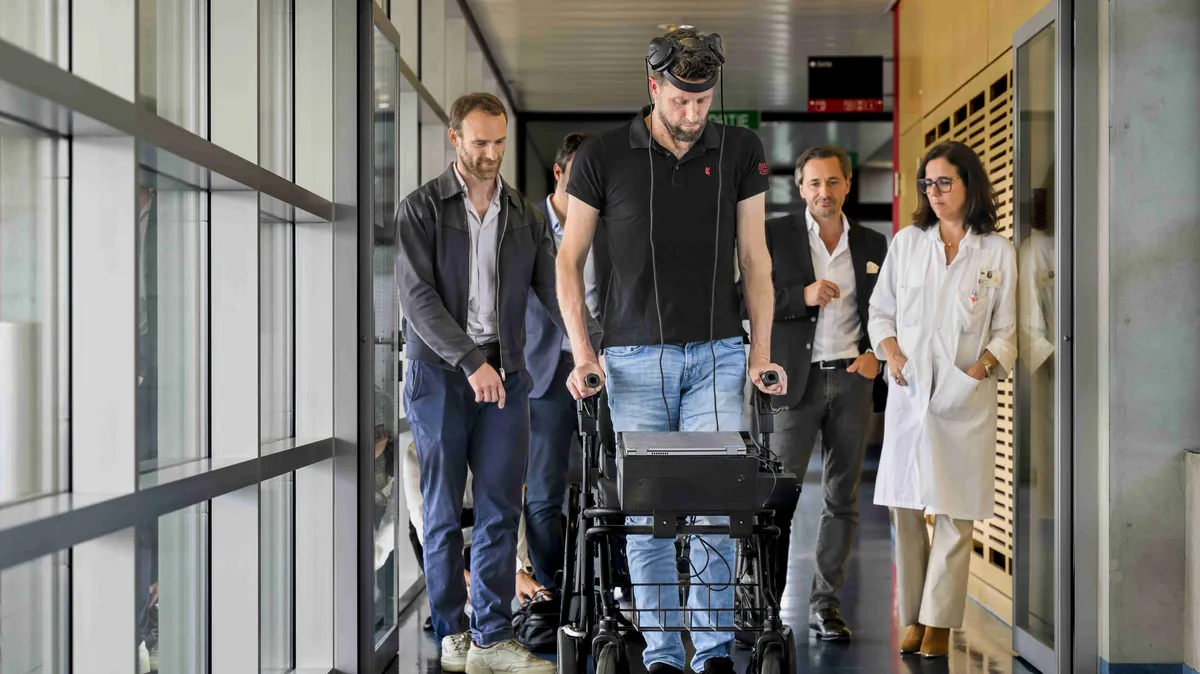
The Dutchman Gerthan Oskam, who was injured by the spinal cord, moves with an implant implanted into the brain. Photo: EPA-EFE / Jean-Christophe Bott
For several days now, all Western media reprinting the story about a paralyzed man who, with the help of implants in the brain and spinal cord, was returned to walk. Broadcast message: This is a revolution, because a patient with a damaged spinal cord controls his movements literally by the power of thought. And, as often happens in such cases, this is fundamentally incorrect interpretation that plays against science.
Distortion and exaggeration of scientific achievements give rise to false expectations from science, which sooner or later will lead to the fact that a person will be disappointed in it. Because he was sure that science already knows how to: to resurrect the dead, to return mobility paralyzed, repair DNA, grow organs - but in reality it turns out that everything is not so. In fact, science really achieved a lot, but these achievements are not enough.
The enthusiastic stories about a man who, thanks to the cunning interface “Brain - Computer”, began to walk independently 12 years after the injury paralyzing it, a visual illustration of such a harmful approach. This is a wonderful work, a brilliant example of Proof of Concept ( confirmation of the performance of the concept. - Approx. Ed. ), But before the mass healing of paralyzed we still have a very long way, and far from the fact that this is possible in principle.
The young Dutchman Gerthan Oskam damaged the spinal cord in an accident on a bicycle and lost the ability to walk. He slightly felt his legs, but could not move them. That is, the motor cortex in the brain that gives the order to walk, and the nerves and muscles of the legs executing this order were in order - the nerve “wires” transmitting the signal from the motor crust of the legs were damaged. Scientists found areas in the Oscam motor cortex that were most activated when the Dutchman imagined how to take a step.
Electrodes were inserted into the bark right above these places, which read the brain signals and transmit them to the information block - roughly speaking, a computer.
It is portable, but quite large, so that the OSKs should wear it in a backpack. The computer deciphers the signals and transcodes them into pulses, which are already transmitted to other electrodes implanted into the spinal cord of Oscam. They stimulate the appropriate motor neurons that make the leg muscles to contract.
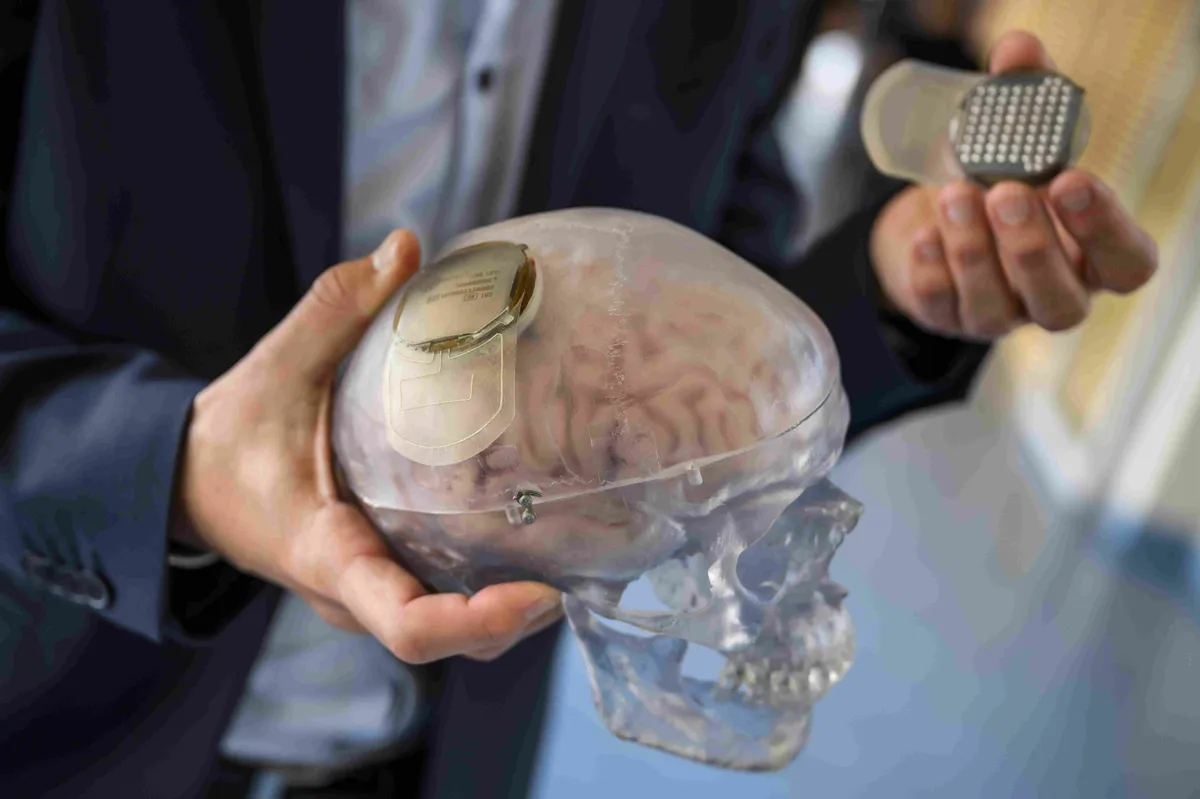
As a result, when Oscam needs to go somewhere or, say, climb the stairs, he imagines how he did this before the injury. The electrodes in the brain read the emerging signals and transmit to the electrodes in the spinal cord, which give orders directly to working neurons. That is, literally reading thoughts - more precisely, motor intentions. Moreover, after many months of training with implants to the remaining intelligent nerve fibers of Oscam in the spinal cord, sensitivity has partially returned, and now it can independently (albeit with crutches) get out of bed, walk around the apartment and get into the car even when all the implanted devices are turned off.
At first glance, the work looks like an absolute breakthrough, but there are many nuances. Firstly, the only OSKs of several patients with whom scientists worked was able to start walking again using implants. Probably, progress was so significant due to the fact that not all nerve “wires” in the spinal cord were damaged.
Whether it will be unknown to achieve the same results in people whose nerve fibers were destroyed.
Secondly, OSKs can only walk with crutches and very slowly ( here you can see how it expanded the range of movements at different stages of the experiment). That is, we are not talking about the complete restoration of functions and return to normal life. Moreover, we are not talking about running, bicycle or any other sport. Thirdly, the installation of implants is an invasive operation, and in the case of the upper electrodes-an operation on the brain. This is always a risky process. To insert implants, in the skull of Oscam, two holes with a diameter of 5 cm each were drilled, and during the experiments one of the implants became inflamed: the infection with staphylococci began, and it had to be changed. Since implants need to be worn all their lives, the risk of repeated infection of both bacteria and parasitic fungi is very high.
In addition, it is not to all zones of the brain that you can “reach”, installing implants on the outer part of the bark, as was done in this case. And deeper invasion is definitely not suitable for streaming. Fourth, so far the whole structure with a processing unit and a special helmet on the head is quite bulky. Fifthly, Oskam has been practicing stubbornly for many months and got used to a new way to walk to master the basic movements.
Each of these “but” does not seem so significant (although the first item is extremely important, because it determines whether we can help massively or only chosen lucky ones), but, folding together, they make new technology far from use in everyday life. This is a very interesting result, which shows that, in principle, the direction of “capture brain signals, decipher, transcode and send impulses based on the analysis of these data to the target organs” quite promising. Ten years ago, this was not so obvious: although the work in which the animals by force of thought controlled prostheses or manipulators were carried out earlier, then they were completely non -replaceable structures outside the laboratory like an open skull with wires sticking out of it.
The new work encourages and demonstrates that the field of “brain -computer” interfaces is very promising, but to talk about the revolution or at least the mass introduction of this technology is still premature. And of course, we are not talking about a total cyberpanca or digital singularity with rewriting your consciousness into a chip. We are talking about at least some acceptable practical application, first of all, apparently for people with various injuries. But when it becomes a routine practice for them-that is, the technology will develop to a truly high level-then, probably, it will be appropriate to talk about the wider possibilities of the method.