
Translated material
How do countries become countries?
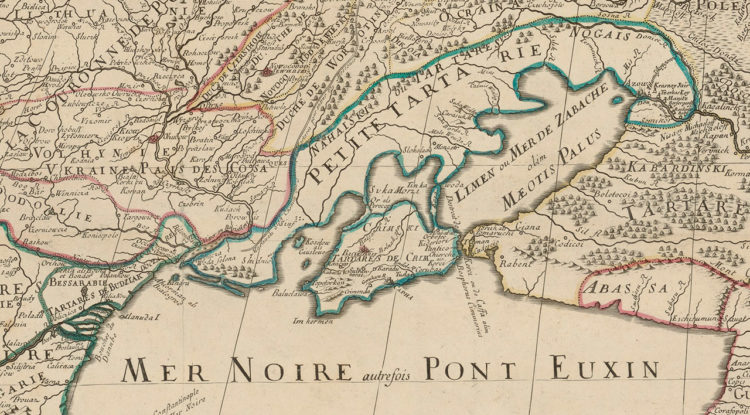
We figure out that not so with the Putin idea that "there was no Ukraine before"
"There is no Ukraine there!" - The chairman of the Constitutional Court, Valery Zorkin, joyfully declares Vladimir Putin, who found a copy of the French map of the 17th century in his bins. Putin agrees - no Ukraine existed before the creation of the Ukrainian SSR. So the propaganda theory is supported that Ukraine (like some other countries) has no right to sovereign, because it did not have it a few centuries ago. But when did the concept of state sovereignty appear? How does the history of the country affect its status in modern international politics and does it affect at all? At the request of the Cold, these questions are answered by the teacher of the RANEPA, the leading podcast “This is the Basis” Alexander Zamyatin.
In order not to miss the main materials of the "cold", subscribe to our Instagram and telegram .

In the historical policy of Putinism, an important role is played by the denial of sovereign statehood and nations in some countries and the attribution of Russia “millennial history”. Refuting this position as historically inaccurate, it should be remembered that the states and the nation as such began to appear much later than it is customary to think. We understand why, despite this, we tend to attribute universal transistoric properties to them and use them in political argumentation.
How the states were born
We are used to representing the political history of the world using a map divided by borders into individual sections with national flags denoting states. The course of global history in this case seems to be a movement of borders and the change of flags. However, this image misleads us. National states began to form relatively recently, less than 400 years ago, and occupied the most of the world only in the second half of the 20th century. In addition, this process began in the specific conditions of Western Europe and, mainly by force, was extended to the rest of the world. Consider separately two components of the national state as the main political category of modernity.
The term “state” itself (The state, l'etat, lo stato, staat) begins to be systematically used only in the XVI - XVII centuries with such political philosophers as Jean Boden, Guogo Gombresi and Thomas Hobbes. They anticipated the emergence of a political system that would begin to come true in Europe after the Westphalian world of 1648 (the result of the thirty -year war in the Holy Roman Empire, with which a new system of international relations in Europe began to formalize. - Note of the Cold) . In the next 300 years, the concept of “state” will completely capture our political thinking and will become generic in relation to any political entities (politicians). Autonomous policies existed before that, but in the form of kingdoms or principalities (REGNUM) , cities (Civitas , Polis or City) , republics (Commonwealth or Respublica) , Empires (Imperium) , etc. Now we consider them the varieties of the state, which entails some mistakes in understanding their nature.
Of course, the matter here is not only in the usage, but primarily in the conceptual content. The German sociologist Max Weber in his large -scale study “Economy and Society” identified the general conceptual core for all known historical forms of politicians - “the violent affirmation of organized domination over the territory and the individuals inhabiting it”. Among all forms of politicians, the state, according to Weber, differs in two features. Firstly, it has a monopoly on violence in some territory, that is, it effectively does not allow violence from any other groups and individuals. Secondly, this monopoly is recognized as necessary (almost) by all people in this territory, that is, it has legitimacy. This corresponds to the famous definition of the state from Weber - "a community that claims (with success) to the monopoly of legitimate physical violence within a certain area."
Applying the concept of the state to ancient Rome or the cities of the Hansa, we fall into an anachronism and risk attributing them to the properties that they could not possess. So, for example, medieval monarchs in France and England did not have the opportunity to ban the feudal lords to build castles and defend themselves from their armed forces, so they cannot be considered “heads of state”. Also, they could not hold monopolies on tax collection and justice, without which we, too, can hardly talk about the state. In this regard, certain territorial boundaries of the distribution of the supreme power of one or another ruler, with the help of which we imagine the state today, could not exist.
The emergence of such monopolies greatly changes the ideas of the people themselves about politics, therefore, reading historical documents, it must be borne in mind that their authors and contemporaries could not have ideas about the state and sovereignty, and attributing them to them distort their meaning. So, for example, the translations of the dialogue of Plato's dialogue “πολιτεία” (Latin “Res Publica”) as “state” or the composition of “Il Principe” Machiavelli as “sovereign” enjoy notorious glory among modern historians and social researchers: if the translator was mistaken in the heading, then many other incorrect translations can be expected. Inside, which significantly change the meaning of what is written. Understanding this in historical science appeared in the 1970s thanks to the works of Quentin Skinner and his colleagues, but so far it has not ended up in general educational programs for significant reasons that I will say about at the end.
Thus, the state and sovereignty were the substantial political innovation of the 17th century, and not just new terms to refer to old entities. With this maximum compressed expressive-disposal of common places from modern political theory, I want to show that discussions about any state continuity in support of sovereignty are fundamentally limited by the last three to four centuries. A similar situation has developed around the concept of a nation.
Invention of nations and nationalism
Like states, nations today also often seem to people universal entities, which have natural sources and the outgoing roots in ancient times. The category of the nation permeates the whole modern culture from jokes (“Somehow Russian, American and German come to the bar ...”) to journalism at all levels (“Will the Americans agree with the Chinese?”). Meanwhile, the nation is also a new concept and phenomenon by historical standards: the nation began to take shape in Europe only at the end of the 18th century.
At 60 years ago, the Social Sciences was dominated by a primordialist theory, according to which nation and ethnic groups are the naturally formed communities of people who arise and develop objectively on the basis of biological and/or cultural processes. From this point of view, the nation does not appear in the XVIII century, but only move into a new stage of its formation. Some nations have achieved success in this, but some have this yet. There are many different versions of primordialism that give rise to different nationalisms from radical racist to more tolerant "civilian". All of them proceed from the prerequisites for the objective existence (innate or acquired) national differences between people and put a nation in the center of political identity.
In recent decades, primordialism has been questioned by constructivists who show that many national and ethnic features have been invented and planted artificially. A great contribution to constructivist research was made by the classic of historical science Eric Hobsbaum, who introduced the concept of “invention of tradition” . The Hobsbaum showed that many attributes of nations, which we perceive as sanctified by antiquity, were designed only 100-200 years ago. The “invented” traditions include, for example, the ceremonial of the British monarchy (developed at the end of the 19th century) and many well -known elements of Japanese culture (invented during the restoration of Meiji in the second half of the 19th century).
The constructivist approach demonstrates a murderous thing for any nationalism and conservatism a thing that the Hobsbaum directly formulates: “The specifics of the“ invented ”traditions lies in the fact that their connection with the historical past for the most part is fictitious. In short, these traditions are a response to a new situation in the form of a reference to the situation of the old. Or they create a past by their mandatory repetition. ” This is especially true for post -Soviet Russia, which went through several attempts to construct a new national ideology (holidays on June 12 and November 4 - their traces) and is now experiencing another in its extremely cruel and destructive form.
From the past to the future of national states
Today it is very difficult for us to imagine the world without nations and states, except in the images of primitive prehistoric settlements. However, modern studies of the state and nationalism allow us to see that this is only a limitation of our political imagination, which gives distorted ideas about the most part of the history of mankind. If there were no states and nations in the relatively recent past, contrary to common ideas, then they may not be in the future at the next stages of human development.
One important question remains: why do national states continue to be the main categories of our thinking about politics, despite their exposure in the social sciences? The critical theories of the state and nationalism have not been included in everyday knowledge, and the provisions mentioned above still sound extravagant outside the academic walls. I assume that there is much deeper reasons for the inertia of everyday knowledge in relation to scientific discoveries.
According to sociologist Vadim Volkov (I warmly recommend his book “State, or Price of Order” as an introduction): “The modern state produces and imposes mental categories, including those through which it should be comprehended by itself. This is projection of ideas using a language, symbols, differentiations is an integral part of domination, Modus Operandi state. ” In other words, the state has not only the monopolies mentioned above - it also captured our political imagination. To comprehend it, you need to take a fairly strong critical distance, at which a radical doubt is possible in the categories imposed on it. This is available to scientists, but poorly compatible with the daily life of all other people.
Moreover, the state actively blocks the development of alternative political forms. In particular, this can be seen on the history of the planting of national states outside Western Europe and North America. The national state appeared in Europe in specific historical conditions and then exported during colonization and decolonization. Far from everywhere, artificial instruction of the national state was successful. So, for example, the “cutting” of the borders in Africa under the colonial administrations, which, after decolonization, had to evolve into sovereign states, turned into some places with chaos and violence.
Only at the end of the 20th century, post -colonial studies made it possible to formulate that difficult -to -use thought that the national state is not a crown of the political development of mankind and in general it could not be suitable for all human communities. There are many places in the world in which national states were never established, but, on the contrary, met serious resistance. Such places in Southeast Asia, for example, are described by anthropologist James Scott. But there are many more examples of power suppression of attempts to organize post -state communities. Perhaps the most dramatic we can now observe in Rozhava, where the Kurds are fighting for autonomous self -government with several states at once.
At the same time, it should be remembered that over the past 100 years there have been several high -profile forecasts of death of the state. The first large -scale project of overcoming the state was announced by the Bolsheviks in Russia in 1917, and, as we know, he turned into his exact opposite - the birth of an unprecedented totalitarian state. Which, however, did not live for 70 years. Then, in the 1990s, a strong faith appeared in globalization and supranational structures that were supposed to replace sovereign national governments. To some extent, this really happened. For example, the EU deprived his states of independence in economic policy. However, after 30 years, this can still be called the end of the national states.
Today in the world there are two global challenges that, apparently, national states cannot cope with: environmental safety and socio-economic inequality. I assume that in order to answer these challenges, humanity will have to overcome the national-state paradigm and invent new forms of political life.