
Translated material
Walk with Kabakov
And so he left, leaving us his world, to the offensive similar to the one in which we continue to live
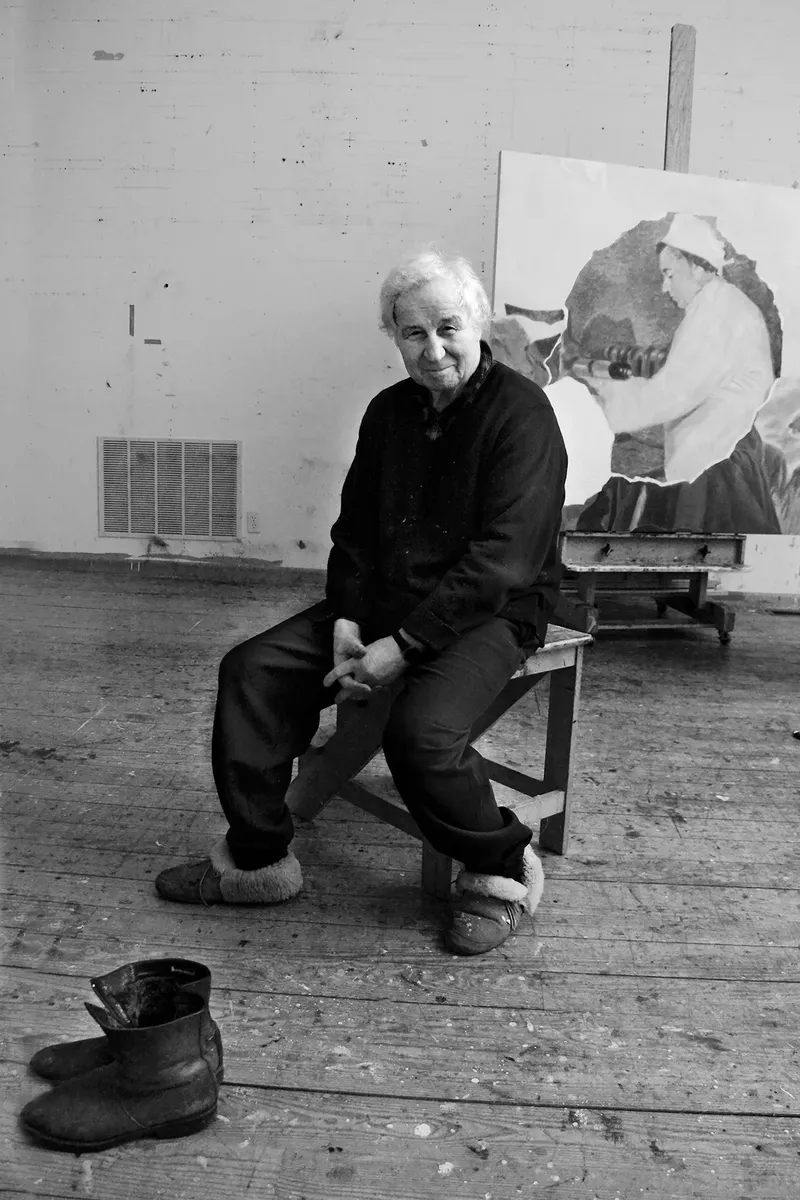
Ilya Kabakov is a witness that we lived. It is hard to believe now if we had not continued to live the same.
About thirty years ago, Kabakov sat in a workshop in the attic of the house of the Russian Insurance Society, worked from morning to night, frying “Mikoyanov” cutlets (seven cents) on the water, which almost completely consisted of crackers, and occasionally went to exhibitions to see the work of colleagues and say: “Fine, great!” - Not in order to evaluate, but, on the contrary, in order not to evaluate, not discuss and argue. He lived within himself the life of the unusually talented Akaki Akakievich, who was happiness not only in writing words, but in their creation. As if for yourself. In fact (who, however, knows what is really there) he knew his gift to brilliantly bend the scale from the ordinary, optional and random to create a new, special Kabakovsky metaphorical reality.
He lived in a country where life replaced being, survival replaced life, and the elections - a choice. Happiness was the age category. “How young we were ...” That is, how we were happy.
The words and phrases, which are an essential part of conceptual albums, objects, paintings, installations, were understandable and familiar to the population, but the meaning that he filled them was beyond the line that determined the art of the socialist Fatherland and its many inhabitants.
He himself was behind the line. Endless work, hare hat, “Skorokhodov” boots, sweaters, if winter; Sandals and a viscose shirt, if summer ... - "Fine, fine!"
But vanity and passion are to match talent.
He invented and designed projects of unprecedented installations. Spaces full of irony and sympathy for the humiliated and fascinated scoops made up the world of Kabakov. He took his world from the Soviet Union to America and enriched him with the world artistic space.
There, Ilya Kabakov, the most famous Russian artist of our time, received what he was preparing and what he deserved: the possibilities, glory and wife-right of Emilia. (I wanted to write another word “freedom”, but changed his mind. Ilya was carefully free in Moscow, and not quite in New York). And he worked, worked - from dawn to dawn. Stained with paint from a jacket, shoes, ironic eyes-shoes. Only recently, instead of “beautiful, beautiful” he said, smiling: “Awesome!”
True-amazing: exhibitions in the Hermitage, thick monography catalogs with famous installations. “Red Wagon” (Dusseldorf) is an artistic awareness of the country's communist cycle. “Red Pavilion” (Venice), “ship” (Lyon), “inscriptions on the walls” (project for the Reichstag), “Vertical Opera” (for the Hugenheim museum in New York), “Red Corner”, “Big Archive”, “Toilet”, “Concentration in the Cupid”, “The person who flew to the picture”, “The person who collected the opinions of others,” “Flies”, “hospital building”, “my mother’s album”, “empty museum”, “center of space energy”, “communal cuisine”:
(“... And you don’t argue here with everyone, you are not smarter here ...” - ... and I wouldn’t argue, I would take a bucket and endure ... - And you look that you threw it there. Look, look ”).
How much he managed ... (I listed a small fraction)!
And then he left, leaving us his world, to the offensive similar to the one in which we continue to live.