
Translated material
The holy martyr Plato is mountainous
The persecution of Soviet power to the Russian Church was such that it was not to say about their faith, but even silently follow it as a feat. The new martyrs and confessors, glorified in the face of the saints did not come: believed, prayed and meekly went to their Calvarys.
“Polit.ru” recalls those who gave their lives for faith and by whose prayers the Russian Church is alive - even if almost nothing came to us besides the name.
Publications were prepared by Kirill Kharatyan (included by the Russian authorities in the register of foreign agents).
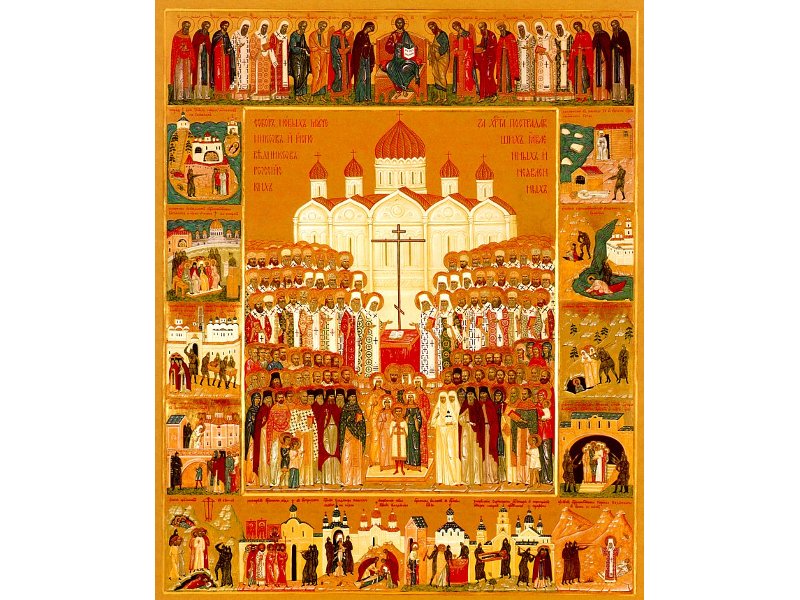
 Icon Cathedral of the Holy New Martyrs and Confessors of Russian
Plato of the Mountains graduated from the Yekaterinburg Theological School and then, in 1881, the Perm Theological Seminary - he was 21 years old. He married, was ordained a priest and was determined to serve in the Simeonian church of the village of Medvedevsky Verkhotursky district. In 1885, Plato's father was transferred to the Nikolaev temple of the village of Osintsevsky Irbit district, and in 1892-to the John-Blessed Church of the village of Timinsky of the Yekaterinburg district. In April 1894, the priest moved with his family to the village of Pokrovskoye Irbit district, in the Pokrovsky church of which he committed priestly ministry until his martyrdom.
In addition to pastoral duties, Father Plato was obedient to the missionary and law teacher.
In November 1917, the ataman of the Orenburg Cossack army Colonel A.I. Dutov entered the fight against the Bolsheviks. Father Plato blessed his son Alexander to join the army of chieftain Alexander Dutov.
In the Irbit district, Soviet power was established in February 1918. Red -Garden detachments began to form on the ground to protect the Soviets. Such a detachment was created in January 1918 in the village of Egorshinsky Pavlovsky, a locksmith in a depot at the railway station. Soon this detachment began to perform punitive functions, its number increased.
In July 1918, Pavlovsky received a report from the military commissar of the village of Pokrovsky, as if a priest of this village, Father Plato, taking advantage of his authority, undermines the villagers' confidence in the Bolsheviks. The same denunciation said that before the revolution, the priest was “the chairman of the Union of the True Russian People”, at present the Soviet government does not recognize, but supports relations with former officers of the tsarist army, merchants, and priests from other parishes. In addition, the priest communicates with the deacon of the church of the village of Trifonovo, who, under the guise of an engineer and a relative, lives a former prince, and also meets with a former police officer of Yekaterinburg and a former large height of the industry. Pavlovsky wrote in his memoirs: “Part of me [from] this bouquet shot, I often handed it to the check, and the children from the first peasant regiment were shot. <...> And part of this bastard remained, and I had to grow [s] to others. ”
After some time, the same military commissar brought to Pavlovsky, as if Father Plato was already openly opposing the Soviet regime. In the proof, the words allegedly said by the priest were transmitted: “Well, how can you now come to the council, what kind of power has gathered: a tear with dirty hands. You sit at the red table, and you can’t talk, and they don’t know how to say something. ” These words greatly touched Pavlovsky. He took several Red Guards with him and they went to Pokrovskoye before the sunrise on the trolley in order to make a search from the priest, arrest and “eliminate” him. “I ordered:“ To Semaphore! ” This meant - shoot. These were two words that stopped the life of a counter -revolutionary and freed the working class [s] from unnecessary dirty tricks that interferes with the working class to do a great business, ”wrote Pavlovsky.
In July 1918, the Red Guards entered the priest’s house when Mother was preparing breakfast. At first she was confused, but, pulling herself together, calmly and politely invited the uninvited guests at the table. The detachment commander ordered his fighters to “eat carefully”, not to be shy that “they don’t like the dirty hands of the ass and hit”. When the breakfast was eaten, the Red Guards announced to Father Plato that they had arrived with a search, as they suggest that he stored officer uniforms and weapons. During the search, uniforms, a revolver, a checker and a rifle were really found. These things most likely belonged to the son of Father Plato, who was in the Dutov troops. The priest was arrested and wanted to shoot after a brief interrogation. But when the priest began to be withdrawn, about 500 villagers had already gathered near his house. Women screamed at the Red Guards and tried to free the priest. Then Pavlovsky grabbed a saber and threatened that he would hack everyone, "who would dare ... take the [b] priest." In addition, he picked up a bomb and prepared to throw it into the crowd. But people did not disperse and asked not to kill the priest. The Red Army gave a volley into the air, quickly sat with Father Plato on Drezin and went to the headquarters at Egorshino station.
“Anger strangled me on the priest ... I wanted to finish first [b] with a priest, lowering [b] under the first mountain from Pokrovsky, but changed my mind,” wrote Pavlovsky. He decided to torment the priest, to force him, almost 60-year-old, to bring him to a drezin: "There is everything with dirty hands, and you are with pure ... Take yourself, and at the expense of you we will go too." Father Plato at first refused - for him such work was overwhelmed. “Then I took out a nagan and gave a period of three minutes, and I myself was pleased that he would refuse, because he would not be carrying [b] with him further. [I] directed the Revol [b] to him, ordered: “One ... two”, but the pop, not expecting “three”, said: “Well, I will twist the drezin.” The figure of the priest was comical. The day was hot, a tall pop. When [he] bend down, his hair scattered on his face, his hair was sweat, dust ... [he looked] to ... a savage from Africa. ”
At the headquarters, Pavlovsky hoped to obtain permission to execute Father Plato. But at the station, unrest among the workers of the depot began, many of which were from the village of Pokrovsky, knew well and loved Fr. Plato. The Commissioner of the North-Ural-Siberian Front Georgenberger came to understand the situation, who suggested letting the priest on receipt, and then shoot, at a more convenient case. So it was done - Father Plato was released.
Other red detachments also operated in the Irbit district, which also robbed the population, arrested, killed. At the end of July, Father Plato with another priest, Father Florenty Troitsky and his son, a gymnasium student, was arrested by the Latvians-Krasnoarmytsy, who, accusing them of sympathy with Bely, took them to the headquarters to Egorshino station to shoot there. Preparing for death, the priests confessed to each other. According to the memoirs of Father Florenty, it became easier on the soul, the fear of death retreated from them. But not leaving six miles to the station, the Latvians released the arrested.
Around this time, mobilization was announced in the village of Pokrovsky Reds, but the peasants accepted it very reluctantly; The subject began to hide in the forests. On August 8, 1918, at 6 o’clock in the morning, the Red Army soldered again to the priest. O. Platon fled to the forest and was hiding there until night. But by the denunciation of one of the peasants on the night of August 9, 1918, a detachment of punishers burst into the village of Pokrovskoye. Father Plato and Father Florenty Troitsky were again arrested. Having gathered the people, the punishers chose every tenth, put it against the walls of the house and, threatening with execution, demanded to show where the mobilized peasants went. This went on for several hours, then a verdict was sentenced: Plato’s father and two parishioners to shoot at the fear of others, and let the rest go.
About two o’clock in the afternoon the verdict was carried out. In a mileage of the temple, in a small forest, Father Plato was killed. Death was instant: one bullet hit the heart, the other in the right lung. Father Plato met death courageously, with his hands folded on his chest.
On August 11, 1918, Priest Florenty Troitsky buried Plato's father with other killed in the parish cemetery.