
Translated material
Orthodox brand of the USSR
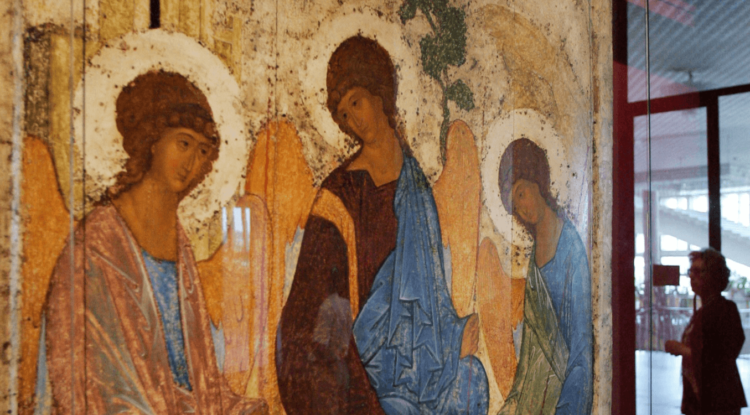
As the "Trinity" became the main icon of the Soviet Union
Andrei Rublev’s icon “Trinity” returned to the socio-political life of Russians. Vladimir Putin handed the icon to the use of the Russian Orthodox Church, which publicly began to call it miraculous. On June 4, the icon will participate in the patriarchal worship, despite the prohibitions of restorers and the risks of losing a masterpiece forever. However, the legendary status of the icon and Andrei Rublev himself received only in the USSR. Moreover, this happened by chance and thanks to the mystification: Rublev was used to draw attention to the collapsing Andronikov to the monastery. "Cold" tells about the thorny of the path of the icon to the status of the main Orthodox brand of the USSR.
In order not to miss the main materials of the "cold", subscribe to our Instagram and telegram .
On the day of the Holy Trinity, Patriarch Kirill will hold the patriarchal service together with Andrei Rublev’s “Trinity” - the cult icon will be delivered to the Cathedral of Christ the Savior (XXS), where for nine hours every believer will be able to worship the shrine. The church insists on the miraculousness of the “Trinity”, although this fact has not been confirmed in any of the available documents, including church documents.
The decision to transmit the monument to the Russian icon painting of the Russian Orthodox Church is made contrary to the opinion of the restorers: they insist that the “Trinity” may simply not survive the service, but this fact does not stop the Russian Orthodox Church - the icon will sag in the XXS for at least a year. However, Patriarch Kirill and Vladimir Putin did not stop these risks. Rublev’s masterpiece is considered the most recognizable creation of Russian icon painting, but it was not always like this: even true connoisseurs of painting, among which was Pavel Tretyakov, did not recognize Rublev’s genius for a long time. Everything changed only in the 20th century.
The discovery of the Russian icon
At the end of the 19th century, even art historians and collectors looked at the Orthodox icons only as cult objects and did not see their independent artistic value. A small collection of ancient icons, which was collected by Pavel Tretyakov, was stored in his house and was never exhibited in the Tretyakov Gallery until his death in 1898. Only in 1901, some of these icons appeared in the museum exposition.
But even then it was still impossible to see ancient Russian painting. The fact is that icon painters to protect icons from external influences covered them with olifa (varnish based on vegetable oils). Olifa really protected the image from wet air, but over time she was dark. According to the observations of restorers, the complete darkening of the Olifa layer on the icon occurs in 30–90 years, after which the image becomes practically indistinguishable and the icon is required by the according to the icon.
Putting usually consisted in the fact that the icon painter applied a new image over the old - it was not a strict copy, but a repetition of the previous plot, which changed in accordance with the ideas about the beautiful in society. As a result, most of the Old Russian painting was hidden under the later letter, which very vaguely resembled the original image.
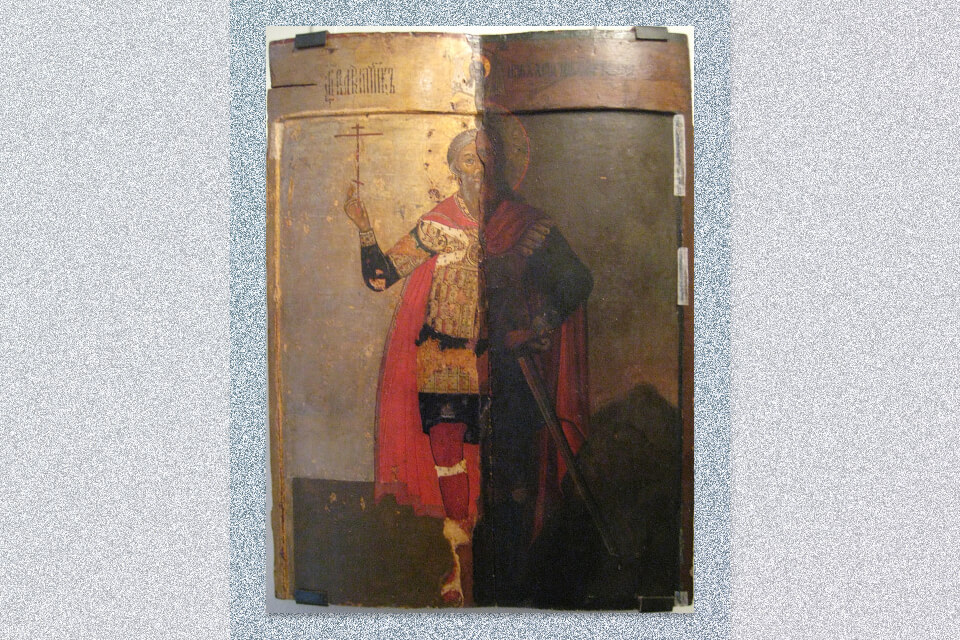
Photo: Shakko / Wikimedia
The disclosure of icons, that is, clearing the later layers in order to see the original image, began only in the 20th century. First of all, this was known to the restoration workshop of millionaire Sergei Ryabushinsky, the believer of the Old Believer, who wanted to see the ancient icons written before the church schism of the 17th century with his own eyes. This work became truly massive in 1905 , when the Old Believers received permission to openly confess their faith and open the altars of the Old Believers, sealed by the government in 1856.
The “Trinity” was opened for the first time a little earlier-in 1904. It aroused special interest, because it was associated with the name of a particular author - Andrei Rublev, who is mentioned by several medieval sources. It was not scientists who were engaged in her disclosure, but a fashionable icon painter Vasily Guryanov, whose restoration by modern standards turned out to be quite barbarly: he simply painted the part of the image, which, in his opinion, was not preserved well enough. Nevertheless, even such, not quite neat, work on clearing icons helped to see old Russian icons as their inhabitants of Rus' saw many hundreds of years ago.
Old Russian icons made a powerful impression on both Russian and foreign artists. Fine art at that time was actively looking for new forms. The Old Russian icon painting appeared in the European art world simultaneously with C amanna and the Fovism of Matisse and immediately won the place of the reverse prospect of the image and the special work with the chiaroscuro.
In 1911, one of the main European artists of the era of modernism and the leader of the Fovist, Henri Matisse , visited Russia, who was not particularly impressed with the works of Russian contemporaries, but experienced admiration for the old Russian icon: “This is where the real source of all creative searches. <...> I have never seen such a wealth of colors, such purity, their immediacy in the program. ” These words of Matisse express the mood of the artists of the Russian avant -garde who have discovered an icon for themselves.
The first full-fledged scientific restoration of the Trinity was already completed in Soviet Russia in 1918-1919, at that time it was still in the Trinity-Sergius Lavra. In 1920, the monks were evicted from the laurel, and the former monastery buildings were museumified. In 1929, the icon was transported from the Trinity-Sergius Lavra to the Tretyakov Gallery.
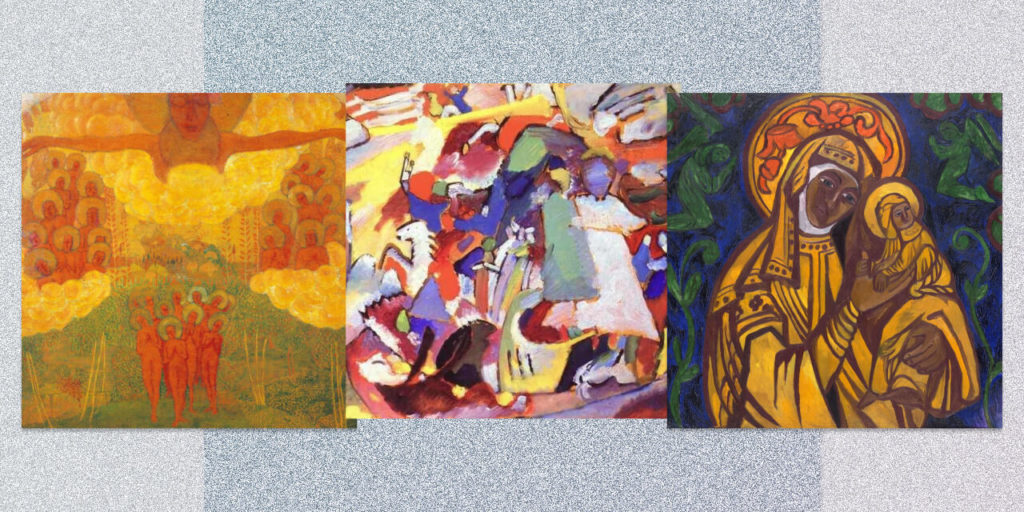
Vasily Kandinsky, “All Saints” (1911), Wikimedia
Natalia Goncharova, “The Mother of God with the baby” (1911), from the collection of the Tretyakov Gallery
Despite the closure of the monastery and the general situation of the fight against religion, the 1920s were quite favorable for the study of ancient Russian painting. The situation changed in the 1930s. Every year to publish work on the study of religious objects became more and more difficult.
In March 1938, Moscow was shot by the head of the restoration of the Old Russian painting of the Tretyakov Gallery Yuri Olsufev, the main expert on the antiquities of the Trinity-Sergius Lavra and the only Soviet researcher who, even in the 1930s,was not afraid to publish work about the Trinity. The time of studying icons and admiration for the technique of icon painting has ended. As it seemed then, for a long time.
Russian artist Andrey Rublev
Unexpected relief for art historians and restorers came after the German attack on the USSR in 1941. In the conditions of a difficult war, there was a demand for historical examples of patriotism and heroism. Specialists in ancient Rus' began to actively create popular science works, thereby re-legitimizing the topics of their research.
In 1942, the State Pilizhizdat began to publish a series of brochures “Our Great Ancestors”, in which the biography of Alexander Nevsky came out, at once the three biographies of Dmitry Donskoy from different authors and three biographies of Kuzma Minin. In the same year, outside the series, the “struggle of Russia for the creation of his state”was published by the most authoritative archaeologist of the USSR Boris Grekov and the “defense of Old Russian cities”, the still not very famous philologist Dmitry Likhachev.
The popularity of Dmitry Donskoy during the war gave connoisseurs of ancient Russian painting a chance that they successfully used. In 1943, art critic Mikhail Alpatov managed to print the brochure of Andrey Rublev. The Russian artist of the 15th century ”, the publication of which was not two years ago. In its simplicity, the definition of “Russian artist” for a long time will become the official title of Rublev in the Soviet press and state documents for a long time.
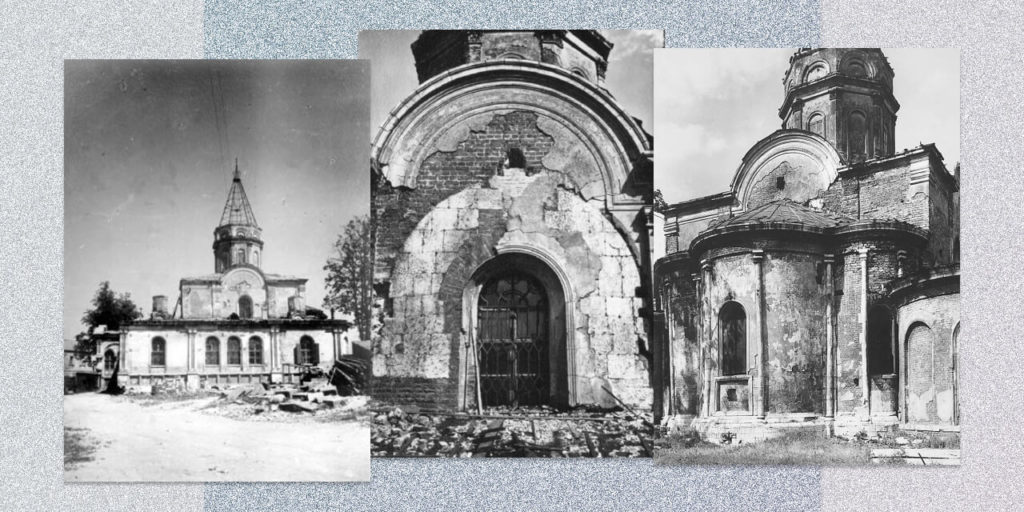
In 1947, the USSR decided to celebrate the 800th anniversary of Moscow. In fact, it was a celebration of victory in the Great Patriotic War , which was impossible to arrange immediately in 1945. The anniversary dates in the USSR were an excellent occasion to receive funding for festive projects, and restorers thought about the salvation of the Andronikov Monastery in the Tagansky district: the Spassky Cathedral, the oldest building of Moscow, was destroyed.
There is a legend that at the state level there was a plan to demolish the monastery (it is willingly told today), but in reality documents confirming this, no - at that time the monasteries fell apart by themselves, without any plan. The military archive worked in the Spassky Cathedral, the rest of the buildings were used for apartments in which the workers of Moscow factories lived, and the historical appearance of the monastery disappeared a little every year.
Under these conditions, the guardians of the Old Russian heritage decided on an adventure. On February 11, 1947, the restorer Peter Baranovsky made a sensation statement: he established the exact place and date of death of Andrei Rublev! The great Russian artist died on February 11, 1430 in the Andronikov Monastery. Moreover, Baranovsky continued, and the Spassky Cathedral itself is the “fruit of the creative genius of Rublev”, which must be museum in memory of Rublev.
In fact, Baranovsky invented this story in order to draw attention to the monastery to Andronikov. He reliably confused the path to the historical source, in which he allegedly discovered information about the date of death of Andrei Rublev. According to him, the inscription with a dilapidated tombstone on the grave of Rublev in the 18th century was sketched by historian Henry Miller. In unknown ways, this copy fell into the personal archive of the historian Nikolai Chulkov, who died in 1940, who made her copy from her, a copy of which in turn was made by Baranovsky’s wife, who worked with the Chulkov archive. Of all the copies, the restorer explained, only the one that was made by his wife was preserved.
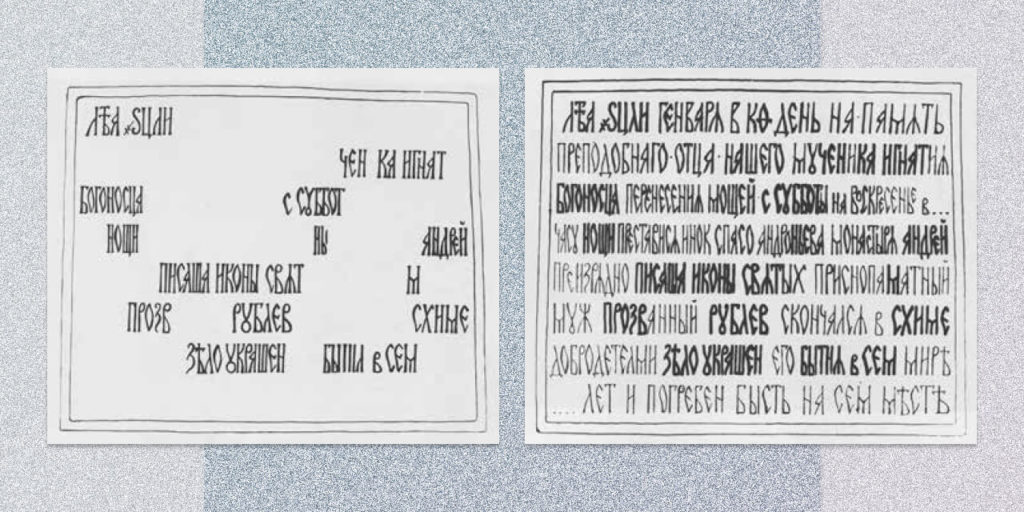
The story looked doubtfully even then, but only in 2019 a comprehensive study was published, which showed that the original inscription never existed, and its text does not comply with the norms of the Old Russian language. Nevertheless, in 1947, the idea of Baranovsky in the professional community supported.
“We are obligated to this by the sacred for us all the memory of our great artist Andrei Rublev, who put the art of our people to the highest positions of his time. Andronikov Monastery and Rublev in our view should be inseparable. And the Andronikov Monastery as a whole should be a true monument to Andrei Rublev, ”wrote Baranovsky.
He was supported by one of the most authoritative architects of the USSR, the builder of the Lenin Mausoleum Alexei Schusev. In support of Baranovsky, an article was published by the historian of architecture Pavel Maksimov, who also stated that Rublev “could be the author of not only frescoes, but also the project” of the Spassky Cathedral, and the issue was resolved.
At the end of 1947, a resolution of the Council of Ministers of the USSR on the creation of the Russian artist Andrei Rublev in the Andronikov Monastery was issued in the Andronikov Monastery. True, there has not been a single employee in the museum for more than a year. Even the director could not find : no one agreed to lead the museum, all of which was in several dilapidated buildings, which had to be urgently restored without sufficient funding.
In 1949, the director was still found - they became the Georgian art critic David Arsenishvili. According to legend , which is retold in the museum community, he was born in the same village with a driver and a trustee of Beria. Before taking the position, Arsenishvili called him and specified whether he was safely engaged in such a dubious work. The driver asked Beria the same question, received a positive answer, and Arsenishvili went to Moscow.
In Stalin's times, only five employees, including directors, worked in the museum. The director himself lived in the Spassky Cathedral and slept there at the cot in the narthex: he did not receive official housing upon arrival in Moscow. In 1951, the museum was almost closed, but Arsenishvili still managed to prove the need for its existence.
Rublevskaya thaw
After the death of Stalin, the museum’s position became even more shaky. Arsenishvili was desperately looking for lobbyists (or, as they said in the Soviet Union, pushes ), who could help advance the idea of restoring the buildings of the monastery. In 1955, Mikhail Alpatov, who had already become academician (the one that in 1943 published a brochure “Andrei Rublev”) introduced Arsenishvili to the author of the Thaw Thaw’s story Ilya Ehrenburg, who had wide acquaintances in Europe and often represented the USSR at international cultural events.
Arsenishvili and Ehrenburg quickly imbued with mutual sympathy and found a solution: to restore the monastery, we needed a good, loud anniversary, which was supposed to sound throughout the Soviet Union. The anniversaries were not planned by that time, and in principle, very little was known about the life of Andrei Rublev. He died in 1430, was born in the XIV century, but when exactly it is incomprehensible. Probably around 1370 (this date was indicated in the book of Alpatov). But if Rublev was born in the 1360th, then the anniversary of the 600th anniversary of his birth could be celebrated in 1960. The assumption was given for the truth - and preparations for the celebration began.
Alpatov and a recognized connoisseur of ancient Russian painting Viktor Lazarev began work among colleagues. The idea of celebration found a special response in the Tretyakov Gallery, where the Rublevskaya Trinity was still stored. Ehrenburg used its influence in the party and the government to explain the greatness of Andrei Rublev and what benefits the popularization of his work can bring to international cultural ties of the USSR.
As a result, in 1958, the Minister of Culture of the USSR Nikolai Mikhailov signed an order to celebrate the 600th anniversary of Andrei Rublev in 1960. In connection with the anniversary, the reconstruction of the Andronikov Monastery began, and in the Tretyakov Gallery they began to prepare the first large exhibition of ancient Russian painting in the post -war period, at which the main place was occupied by the “Trinity”.
At the same time, Ehrenburg promoted the theme of Andrei Rublev’s anniversary at the level of international organizations-in UNESCO (in which the USSR traditionally had a great influence) and the World Council of the World (international organization of pacifists, which received 90% of its financing from the USSR, and Erenburg himself was one of its vice presidents). 1960 was declared UNESCO by the year of Andrei Rublev, at the same time the grand opening of the museum in the Andronikov Monastery took place.
The prank was a success: the lines of Andrei Rublev and his time ”lined up at the exhibition. “In the hall of the Tretyakov Gallery, where the Rublevskaya“ Trinity ”is exhibited, the people have been constantly crowded,” the Neva magazine wrote in September 1960. Soviet literary and art magazines with hundred thousandth circulations of the rested articles published articles about the creative genius of Rublev and his proximity to the folk spirit. Moreover, reproductions of icons appeared in them, which was impossible to imagine 10 years ago.
“His images, contrary to church canons, were asserted by earthly, joyful human ideals. His works served as a model for Russian artists of many generations. And now, when we keep all the best with great love that was in our native culture, the work of the brilliant master shines like an invaluable gem in the treasury of Russian and world art. ”
P. Sokolov-Skal. Andrey Rublev // Science and religion. 1960. No. 9.
“A wonderful artist-submarine, going beyond the limits of church dogma, created images performed by deep nobility and beauty. Rublevsky works are covered with subtle poetry; They are amazing the harmony of delicate lines and colors. ”
E. Zetrov. Andrey Rublev and modernity // Neva. 1960. No. 9.
“The“ Trinity ”who saw at least once will never forget the rhythm of her lines and the music of her colors. The currents come from the icons of blessed strength and tenderness, purity and clarity, peace and peacefulness. The icon of the ancient monk sounds like a hymn to joy. "
N. Kuzmin. Andrey Rublev // New World. 1960. No. 10.
By the end of 1960, almost any educated and at least slightly interested in cultural life, the Soviet man knew the name of Andrei Rublev and saw the “Trinity” at least in the format of a simple black and white reproduction. Among these people was 28-year-old Andrei Tarkovsky, who had just graduated from VGIK with a red diploma of the director.
An impressed by the autumn exhibition in the Tretyakov Gallery and a visit to the newly open museum Andrei Rublev, Tarkovsky already in 1961 filed an application for the creation of the film “Andrei Rublev”. He and his co -author Andrei Konchalovsky wrote: “We do not want, and we cannot solve the secrets of his life path. We want to poetically comprehend the era in which this genius appeared in which he created. We want the poet’s eyes to see that beautiful and difficult time when he became and crept, straightening his shoulders, the great Russian people. ”
Work on the film was difficult, Tarkovsky had to overcome various obstacles associated with the theme of the film dubious from the point of view of Soviet ideology and a general change in political moods in the country: the thaw ended, a long period of stagnation began. Литературный сценарий утвердили после долгих консультаций с историками и искусствоведами (важную роль в этом сыграл все тот же Михаил Алпатов, который написал в отзыве на сценарий: «В наши дни, когда наше современное искусство призвано опираться на традиции русского народного творчества, создание подобного фильма следует признать особенно своевременным»).
Фильм, который появился на экранах только в 1971 году, завершался переходом от черно-белого мира героев фильма к ярким, насыщенным цветом иконам Андрея Рублева, которые оставались в кадре почти восемь минут. Три минуты из них занимал детальный показ «Троицы».
Прокат фильма «Андрей Рублев» окончательно канонизировал Рублева в глазах советской интеллигенции как главного художника русского Средневековья, а «Троицу» — как главное художественное произведение и символ допетровской Руси.
Рублев и РПЦ
Становление советского культа Андрея Рублева происходило без всякого участия церкви, но он повлиял и на нее. Празднование юбилея 1960 года совпало с раскручиванием хрущевской антирелигиозной кампании: началось массовое закрытие церквей.
Неожиданная слава Андрея Рублева стала для РПЦ шансом доказать, что церковь как институт полезна для общества. В юбилейный год в «Журнале Московской Патриархии», который издавался небольшими тиражами, в первую очередь для священнослужителей, сразу в четырех номерах были опубликованы статьи об Андрее Рублеве и его творчестве.
После этого об Андрее Рублеве на страницах журнала долго не вспоминали. Зато в 1972-м — через год после начала ограниченного проката «Андрея Рублева» Тарковского в СССР — в трех номерах «Журнала Московской Патриархии» снова появились статьи о «Троице» и ее авторе. Популярность Андрея Рублева в церкви росла прямо пропорционально популярности Андрея Рублева в советском обществе.
Наконец, в 1980 году «Журнал Московской Патриархии» опубликовал статью «Преподобный Андрей Рублев, иконописец», в которой впервые было сформулировано положение о святости Андрея Рублева. Любопытно, что ее авторами были не церковные иерархи, а советские интеллигенты. Статья была подписана именами «В. Смирнов» и «А. Вольгин» — это были псевдонимы доктора искусствоведения Веры Брюсовой и кандидата философских наук Николая Лисового.
Официальное провозглашение Андрея Рублева святым произошло на Поместном соборе РПЦ 1988 года. В качестве основания для канонизации Рублева было указано , что «через многие иконы преподобного Андрея, особенно через образ “Святой Троицы”, ставший совершенным выражением догмата о Триедином Боге после более чем тысячелетнего его осмысления в православной иконографии, христианское благовестие в наши дни распространяется по всему миру».
Faith in a miracle
После распада СССР государство начало передавать РПЦ церковные здания и предметы культа, изъятые после революции в соответствии с Декретом об отделении церкви от государства. Среди икон, которые в первую очередь желала получить церковь, были две. Первая — главная святыня Древней Руси, «Богоматерь Владимирская», привезенная из Византии в первой половине XII века и почитающаяся как чудотворная примерно с того же времени. Вторая — «Троица» Андрея Рублева, прославленная стараниями советской интеллигенции.
Патриарху Алексию II даже удалось получить Владимирскую икону к себе на богослужение в Богоявленский кафедральный собор 3 октября 1993 года. Чудотворную икону на день передали из Третьяковки, чтобы патриарх молился перед ней о примирении сторонников президента Ельцина и Верховного Совета.
В нынешней передаче «Троицы» РПЦ трудно не увидеть похожий символический жест: президент передает патриарху икону в надежде на чудесное вмешательство высших сил во время войны (некоторые эксперты даже видят в этом бытовой магизм). В ситуации дефицита реальных опор политический режим в очередной раз цепляется за традиции и церковь. Правда, 30 лет назад искренне верующий, дореволюционный по своему воспитанию патриарх Алексий молился за мир и привлек к этому действительно чудотворную икону, а вот сторонник войны Кирилл использует для молитвы раскрученный Эренбургом и Тарковским советский бренд.