
Translated material
Could aliens listen in on us?
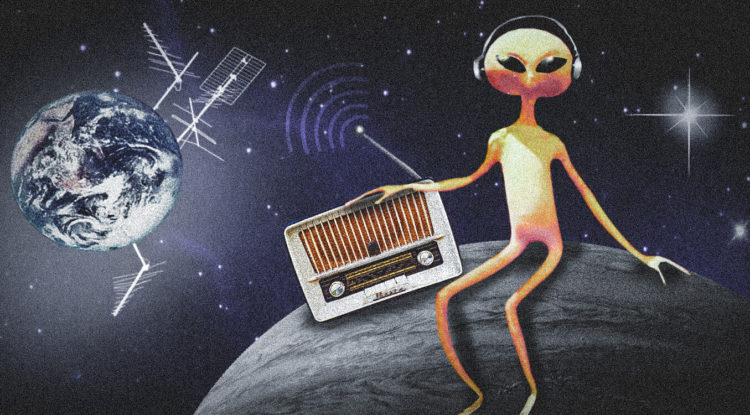
Humans have been sending radio and other signals into space for decades. Why are the aliens not responding?
News that any invention of mankind - for example, radio signals or cellular communications - can be heard from space appears in the media quite often. But which of these is true? And can evidence of intelligent life on Earth actually reach extraterrestrial civilizations, and can we hear their “hello”? We understand.
In order not to miss the main materials of "Cold", subscribe to our instagram and telegram .
In the middle of the 20th century, when radio astronomy was in its infancy, scientists were convinced that there must be many highly developed civilizations in the Universe. Why not? Our Sun is an ordinary star on the outskirts of the Galaxy, its planetary system and the Earth itself should not be something unique either. Therefore, you only need to make contact with aliens: build powerful antennas and start catching signals from extraterrestrial intelligence. Antennas were built, astronomers listened to the air for many years (and sent many messages into space themselves), but still have not received anything. The silence of the universe is called the Fermi Paradox, after the American physicist Enrico Fermi, who first asked this question: “Where is everyone?”
Among the explanations for this paradox, the most frightening is the dark forest hypothesis proposed in the 1980s. Its essence is that intelligent beings are silent, not because they do not exist, and not because civilizations that reach a sufficiently high technological level destroy themselves too quickly (Great Filter theory), but because trying to make contact is tantamount to suicide .
Imagine, the adherents of this version explain, a night forest, where numerous hunters with guns hide in the dark. If you try to kindle a fire, then bullets will immediately fly at you from the darkness. The hunters shooting at you are very rational: it may turn out that you are friendly and just want to talk, or, on the contrary, you are hostile and outperform all the hunters of the forest in their technology. The logic of self-preservation prescribes to accept the second version, because if the hunter makes a mistake and responds to the signal of a hostile civilization not with a shot, but with a response signal, this can mean death for him, that is, a loss for him will be fatal and even the slightest risk is unacceptable.
In this form, the hypothesis is formulated in the cycle of novels by Liu Cixin of the 2000s "Memory of the Earth's Past" , where the careless earthlings who sent messages to their fellow minds are trying to enslave and destroy the much more highly developed civilization of Proxima Centauri, although for the first time this idea itself was formulated back in 1983.
Perhaps you and I are living in this story; perhaps a shot from the darkness has already been made, but we will not know about it soon. Interstellar flights, even at the most fantastic level of technological development, take decades or centuries, and perhaps only our great-grandchildren will learn about the impending threat.
And it's not even that careless astronomers in the second half of the 20th century sent more than a dozen different messages to aliens. Back at the beginning of the last century, we lit a fairly bright fire, and, perhaps, they had already noticed it - we invented radio broadcasting and television.
Scientists are trying to determine how far from the Earth all the color music that we turned on can be detected, what kind of antennas and receivers the aliens will need for this, how exactly they will be able to distinguish our signals from a lot of astrophysical noise. Let's try to tell what they managed to understand.
What should you listen to and how?
Until about the mid-1960s, most of society was sure that there was an advanced civilization on Mars (and who else could lay the Martian channels discovered by Schiaparelli ?). This confidence was so strong that, for example, during the closest opposition to Mars (the moment of the closest approach of the two planets) in August 1924, scientists turned to all the owners of radio stations with a proposal to be silent for five minutes every hour and listen to possible signals from the planet, and the US military was preparing to decipher them.
After the Mariner probes sent the first detailed images from Mars in the mid-1960s, where there were no channels or signs of biological life at all, it became clear that there were no other civilizations except ours in the solar system, and perhaps life in general exists only on Earth (read about the chances in our material ). However, the rapid development of radio engineering (and especially radar) in the war and post-war period gave astronomers powerful tools for studying space radio signals, and it was then that the first projects to search for extraterrestrial civilizations appeared - SETI projects and programs.
In 1959, Giuseppe Cocconi and Philip Morrison published an article in Nature, one of the world's premier scientific journals, that essentially launched the whole program.
“Next to stars similar to the Sun, there may be civilizations that have science and technical capabilities far exceeding those that are currently available to us. For such creatures, our Sun should look like a place where a new civilization is likely to appear. It is quite possible that they have been waiting for the development of science near the Sun for a long time. We should assume that they have long since established a communication channel, which will become known to us at some point, and are eagerly awaiting signals from the Sun that will let them know that newcomers have appeared in the community of sentient beings. But what communication channel could it be? asked Cocconi and Morrison.
They concluded that this channel must be electromagnetic waves - because they travel at the highest possible speed and are not affected by magnetic fields (like charged particles, for example). In addition, the range for communication should be at frequencies where the stars do not radiate so much (otherwise they will drown out any transmission). As a result, scientists came to the conclusion that the best wavelength is from 300 meters from 1 centimeter.
But even this range was too wide for radio telescopes to listen to it all. It was necessary to understand what wavelength should be known to any astronomer in the universe. Cocconi and Morrison figured it was 21 centimeters, the wavelength of electromagnetic radiation emitted by atoms of hydrogen, the most abundant element in the universe. They considered that it was this frequency that the most sensitive radio telescopes should listen to, since on it they could obtain important information about the processes in the Galaxy. And that means that it is on it that you need to communicate.
Cocconi and Morrison calculated that existing transmitters and receivers, such as the 76-meter Lovell radio telescope at the Jodrell Bank Observatory, were powerful enough to send a signal to stars located at distances of about 10 light-years and pick up the return signal. . They set targets for listening - these should first of all be stars similar to the Sun, located far from the plane of the Galaxy (so that the background noise does not jam the signal), and even made assumptions about what should be in this signal (they believed that there should be series of prime numbers).
The SETI projects have still not yielded results: astronomers have not been able to hear any reliably artificial signal. is looking for possible transmissions of extraterrestrial civilizations . Now, in the radio noise of the Universe, the Breakthrough Listen project , launched at the expense of billionaire Yuri Milner,
But if we do not hear the signals of aliens, then maybe they hear ours? Can they eavesdrop on the stream of radio broadcasts we make for our own purposes? And what could those transmissions be?
How to eavesdrop?
First, a little physics: the earth's atmosphere has several windows of transparency for electromagnetic waves - that is, the wavelength ranges that the air shell passes through. The atmosphere is transparent, for example, for visible light and for radio waves - from centimeter to decameter, but x-rays and gamma rays pass through it very poorly. However, in addition to the atmosphere, the Earth also has an ionosphere - a layer containing charged particles, from which a significant part of radio waves is reflected. It was thanks to this feature that intercontinental short-wave radio communications were implemented in the first half of the 20th century.
But this means that a significant part of the power emitted by the radio station does not go into space, but is reflected from the ionosphere and remains on Earth.
In 1978, a group of physicist Woody Sullivan at the University of Washington analyzed possible leakages of terrestrial radio signals. They concluded that almost the entire medium wave range (AM range) in the range from 0.5 to 1.5 megahertz is "locked" - these radio waves are reflected from the ionosphere and do not go into space. Almost 90% of shortwave transmissions (from 3 to 30 megahertz) are also unable to break through the ionosphere. Much better "penetration" radio stations have FM-range (usually in the range of 80-100 megahertz), but the most promising, according to Sullivan and his colleagues, were signals from television transmitters in the range from 40 to 850 megahertz. In addition, there were quite a lot of them at that time. Finally, the most effective source of signals for aliens should be the radars of the missile attack warning system - however, there are many times fewer of them on Earth than television transmitters.
In general, wrote Sullivan and his colleagues, aliens with comparable Earth technology could detect radiation from television at a relatively short distance of 25 light years, and missile warning radars even at a distance of 250 light years.
Extraterrestrial viewers will not decipher the transmissions themselves, but they will be able to understand their artificial nature (and in addition, understand some characteristics of the atmosphere, the ionosphere, the speed of the Earth's rotation and tilt of its axis, and even build a rough map of the placement of TV transmitters on the Earth's surface).
However, these calculations referred to the end of the 1970s, the heyday of terrestrial television. And what is happening to our noise now, when communications are increasingly going into cables, fiber optics, and radio stations and terrestrial TV are losing popularity?
The mobile revolution in terms of wiretapping
40 years after Sullivan's work, physicist Ramiro Said and his colleagues state that the contribution to terrestrial radio noise from television and radio transmitters has seriously decreased. However, in their opinion, one cannot ignore the influence of millions of cell towers. Scientists built a detailed model that took into account the spatial distribution of cell towers, and came to the conclusion that audibility would be best for the vicinity of the star HD 95735, a red dwarf located 8.3 light-years from the Sun in the constellation Ursa Major, since it " looks" at the northern hemisphere of the Earth, where most of the transmitters are located.
However, these calculations are not very comforting, since they show that even from the vicinity of the nearest stars located at distances closer than 10 light years, it is still impossible to hear terrestrial cell towers, although the power of their total radiation at a distance to the star HD 95735 is about 4 gigawatts. Even the largest terrestrial radio telescopes, comparable to the 100-meter Green Bank radio telescope, will not be able to hear mobile noise at such a distance.
However, scientists write, cellular networks are still in their infancy and they are still waiting for significant growth, that is, the likelihood that they will be heard by extraterrestrial civilizations is increasing.
Thus, the picture drawn in 1978 has changed little in content: the over-the-horizon radars that scientists wrote about are turned off, but similar Russian installations are still in service, the popularity of terrestrial TV is declining, but not landslide, and cellular networks have not yet “come out”. into the space".
We can expect to be heard, at best, 250 light-years away, if we listen carefully on radar frequencies for missile attack warnings.
But here the finite value of the speed of light (it is also the speed of any electromagnetic radiation) also works against us. We invented radio too recently, and now the very first artificial radio waves (which hardly anyone will be able to hear, because the power of the then terrestrial radio stations was insufficient) are approaching the mark of 150 light years. Therefore, awareness of terrestrial civilization in the Galaxy is still too low.