
Translated material
People are increasingly dying from the heat. What next?

What are waves of heat, what are they dangerous and what to do to adapt to them
Scientists observing climate changes are increasingly fixing the so -called waves of heat - periods of extremely high temperatures that last from several days to months. Because of them, people and animals massively die, droughts and fires occur. The “cold” is versed in what waves of heat are, whether they actually began to happen more often and how humanity is fighting and adapting.
In order not to miss the main materials of the "cold", subscribe to our Instagram and telegram .
“It was the perfect storm in many ways ... a temperature of 104 degrees (according to Fahrenheit; this is 40 degrees Celsius. - approx.“ Cold ”) in combination with high humidity, but without a thunderstorm. <...> The fans helped little, and those inhabitants who did not have a house of air conditioners tried to find relief in Lake Michigan, in pools or under jets of three thousand unauthorized fire hydrants. People with chronic diseases began to feel worse, and service operators 911 began to choke in calls. <...> On the first day from the beginning of the wave of heat, they received 16,727 calls. ”
So the meteorologist Tom Skilling recalled the first day of the catastrophic heat that struck Chicago on July 13, 1995.
City services were not ready for this situation: the ambulance had to wait 10 times longer than usual. The hospitals were extremely hot, the surgeons in the operating rooms were sweating later, several cardiological patients died right in the departments, unable to withstand the foam (and only after that they put portable air conditioners in the chambers).
Doctors and firefighters received calls from worried people who could not contact older relatives. The townspeople sat right on the sidewalks and could not move on. At the same time, the mayor of Richard Daily at a press conference joked that the city was simply "falling to extremes."
The forty -degree heat lasted in Chicago until July 20. According to scientists, during these six days 485 people died from it, and excess mortality-that is, an excess of the number of dead average for this period-amounted to 739 cases, that is, more than 100 people per day died in Chicago due to reasons directly or indirectly related to heat.
Today, these events almost 30 years ago do not seem unusual or too catastrophic. We are almost used to the fact that over the summer, a wave of heat rolled on one or another city or region, we see in the news a melting asphalt, open fire hydrants, crowded hospitals and read about new deaths.
In the database of natural disasters EM-DAT, only from the beginning of the 21st century there are 160 episodes of extreme heat. A sad record in scale of damage is still belonging to Russia. According to EM-DAT, in 2010 in Moscow, the Moscow Region and several regions of Central Russia (Volgograd, Lipetsk, Voronezh regions), excess mortality during the heat period amounted to 55.7 thousand people, and the damage from the drought and fires was estimated at $ 536 million.
Climatologists confidently say that it will be worse further. Climate warming - that is, an increase in the average global temperature - does not mean at all that the temperature curve will smoothly move up from the usual values. No, it will become more “torn”: we will increasingly observe sudden thaws and extreme frosts, severe snowfalls and unexpected frosts, powerful rains and squalls, floods and severe heat. “Not so much will heat up as the climate will become nervous,” meteorologists say .
Waves of heat will arise more and more often, more and more people will become their victims. Let us explain where they come from and what can be done to protect.
What are the waves of heat
There is no official definition of the concept of Heat Wave (“wave of heat”, or “extreme heat”). Scientists talk about the wave of heat, when for several days in a row the air temperature significantly exceeds normal.
Most scientiststake the 90th percentile as a threshold for extreme temperature-in other words, if we take all temperature values measured on this day in the entire history of observations, then the temperature at the moment of the wave of heat should be higher than 90% of all measured values.
Rospotrebnadzor considers a wave of heat at least five days with a temperature above 97th percentile, and three days should be higher than 99th percentile.
Typically, the intensity of the heat is estimated by excess temperature over the average for this day. The minimum duration of the period of extreme heat is considered three days.
How do they arise?
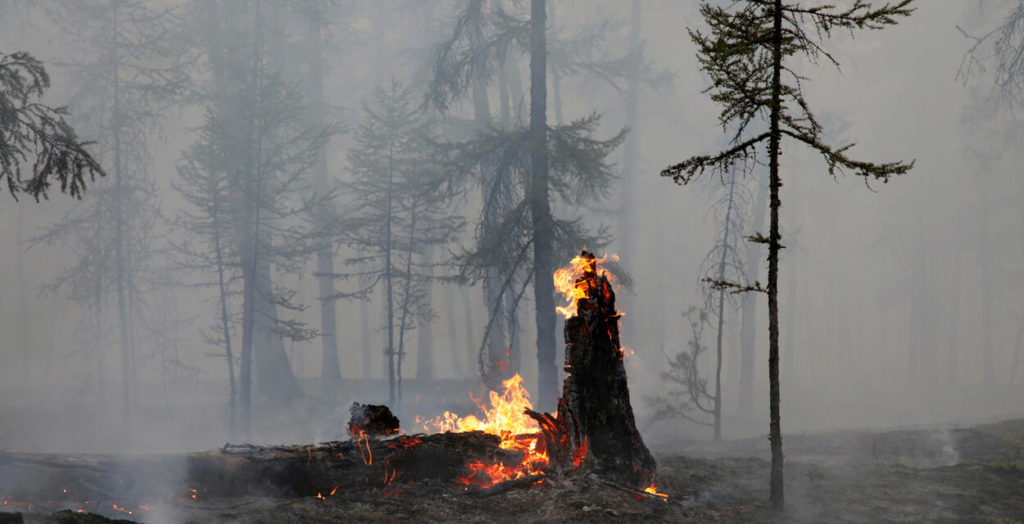
Atmospheric processes that lead to extremely hot weather can be different for different regions. In the middle latitudes, the most common cause is the so-called blocking anticyclones , areas of high atmospheric pressure, which “overlap” the Western-east transfer of air masses from the Atlantic to the Urals typical for Europe. In the area of high pressure, clear calm weather is installed, a “heat dome” occurs-the air heats up at the surface, but it cannot go up and can not cool due to high pressure, it drops down, heats up stronger. At the same time, the relatively cold and humid ocean air, going from the Atlantic, cannot break into this zone, and the territory becomes a natural solar stove.
The longer the “blocking” lasts here, the more the surface and air over it heat up. During the catastrophic heat in Central Russia in 2010, the blocking anticyclone lasted about 50 days. According to scientists, about 80% of cases of extreme heat are associated precisely with blocking anticyclones.
The probability of the heat is also affected by the condition of the soil: if there is little moisture in it, it cannot effectively cool due to the surface, heats up more under the rays of the sun and heats the stove layer of air, which in turn can flow into neighboring areas and raise the temperature there.
An abnormally high (and low) temperature of the water surface in the oceans can also provoke extreme heat on continents. For example, a wave of heat in Europe in 2015 is associated with an abnormally low water temperature in the North Atlantic. The cold spot braked the movement of the air around the pole - the so -called high -altitude jet current - the air began to “linger” over Europe, and an blocking anticyclone was formed. Waves of heat in the Pacific region are associated with El Nigno-cyclical fluctuations in the temperature of the water surface in the central part of the Pacific Ocean.
However, to the end, the mechanisms of the formation of blocking anticyclones and other phenomena that provoke waves of heat are not yet clear, and they can be predicted not earlier than a few days, but in a good case - in weeks.
Will this happen more often?
Yes, climatologists say that periods of extreme heat will happen more and more often, and with a high degree of probability we ourselves are to blame - more precisely, our emissions of greenhouse gases.
In the sixth evaluative report of the intergovernmental group of climate experts, it is said that since the 1950s, periods of extreme heat have become more intense and frequent in most regions of land (and the cold periods, on the contrary, become less frequent). At the same time, with a high probability, the main reason for these changes became precisely the climate changes caused by people. MGEIK predicts that due to the waves of heat, the number of deaths and damage from drought and fires will grow, and due to the overload of electric networks and accelerated "aging" roads, urban infrastructure will suffer. “With a high degree of reliability of the heat wave will occur with a greater frequency and will have a long duration compared to the previous decades,” Roshydromet in a report on climate changes in the Russian Federation echoes them.
According to Russian meteorologists, from 1961 to 1980 in the European part of Russia there were only three episodes of extreme heat with a duration of five days with an average temperature in the region above the 90th percentile, and in the period from 2001 to 2020, only the summer of 2004 passed without such waves.
American climatologists say that since the 19th century, cases of heat in North America with a temperature reaching 50 degrees have become more than 150 times more likely.
Apparently, periods of extreme heat will become a new reality for us.
Why is the heat dangerous?
Cold for people has remained a more significant threat than the heat. For example, the authors of the study that analyzed mortality in a number of Asia, Europe and America found that excess mortality during extreme colds is 7.3%, and in the case of heat - 0.42%.
However, as we mentioned above, the climate is changing and cases of heat become more and more frequent - and, accordingly, a more significant factor in mortality.
This is clearly visible, for example, according to Moscow data from Rospotrebnadzor. Climate warming in the winter in Moscow from 2000 to 2005 led to a reduction in mortality by about 590 cases a year, but during the same period as a result of an increase in temperature in the summer, an additional number of deaths amounted to 420 cases.
According to the doctor of medical sciences Boris Revich, the hot weather has a direct effect on the blood system: due to dehydration, the blood becomes thicker. As a result, microcirculation is disturbed, which provokes the appearance of blood clots, and hence the strokes, exacerbations and mortality from coronary disease and other causes are increased. In addition, during periods of heat, the number of ambulance calls and the number of hospitalizations in general increases.
The townspeople are worse
Waves of heat are much more dangerous for urban residents-due to the features of the city microclimate, the effect of the "island of heat" . City stone houses and streets heat up in a day much more than fields and forests, temperature differences between the city center and the surroundings can reach 10 degrees.
In addition, their own “blocking” can arise in cities: the roofs of buildings heat up much more than the streets, therefore, a heated layer of air occurs at the height of the roofs, which “locks” and does not let the relatively cold squad layer upwards.
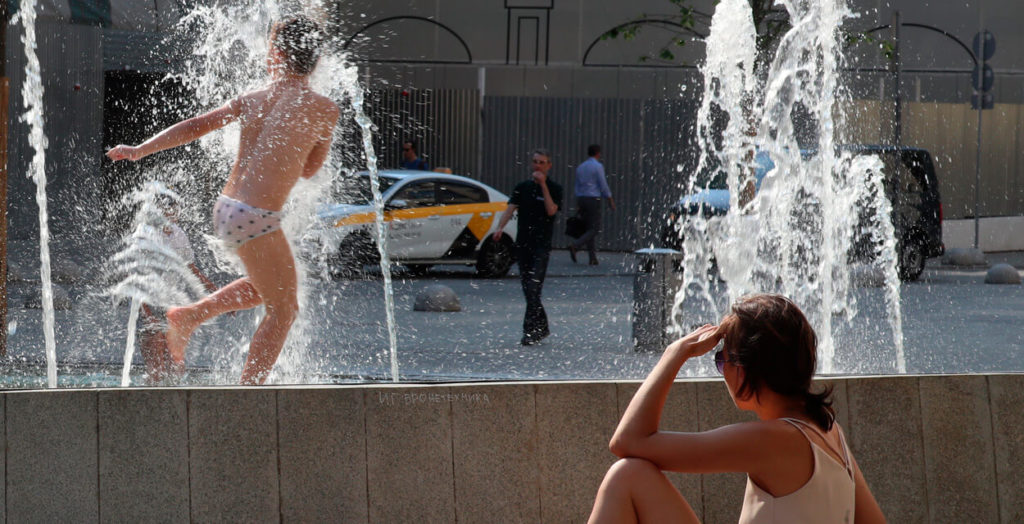
But in this river layer, car exhausts and other harmful emissions accumulate - that is, in the heat, air pollution increases significantly. The combination of heat and pollution leads to an increase in mortality - in the case of Moscow, for example, almost one and a half times .
And what to do?
The simple rules will help protect yourself during the heat: try to avoid a long stay in the sun, spend the hottest clock in a cool room, observe a siesta, avoid dehydration.
It is much more complicated to the city authorities, which will more and more often meet with the waves of heat. Since it will now be routine events, you need to try to adapt the urban environment, make it less like a stove ready for use. For example, in Athens, this is engaged in a specially allocated “Heat Specialist” - City Heat Officer.
Some steps seem obvious: expand the green zones, build fountains, install water sprayers . But in Tokyo, for example, they experiment with giant fans to ventilate the streets, in Tel Aviv they shade the streets with the help of light fabrics (which also serve as sunny batteries), and cooled pavements in Nice, in many cities they paint roofs in light tones: they heat up less in the sun.