
Translated material
Operation Hope
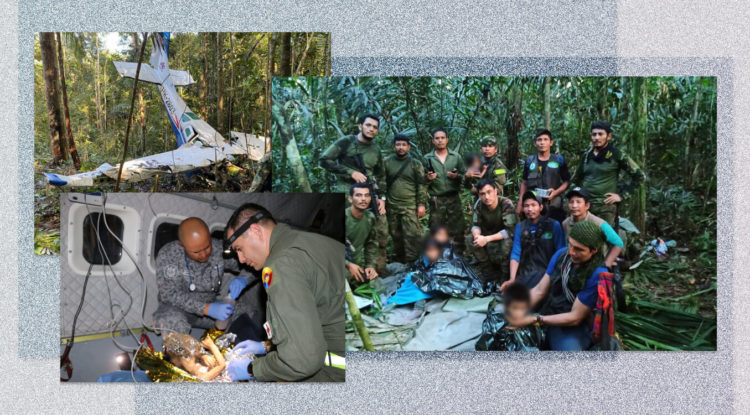
Colombian children survived a plane crash, lost their mother and lived in the Amazon jungle for more than a month
Four children are left alone in the jungles of Colombia after the plane crash that killed their mother. For more than a month they managed to survive in the wild conditions of the Amazon. They ate tropical fruits, spent the night in makeshift huts and hid from rescuers, mistaking them for wild animals. The search for "children of the jungle" was followed by the whole country. After 40 days, they were finally rescued. But their troubles did not end there: after the death of their mother, relatives argue over who is worthy to take custody of them. A harsh journey from the real jungle to the stone - in the material "Cold".
In order not to miss the main materials of "Cold", subscribe to our instagram and telegram .
flying from the southern village of Araquara to the city of San José del Guaviare A Cessna 206 light aircraft crashed on the morning of May 1. There was a family on board: a mother, four children, a pilot and the head of a local tribe. The wreckage of the plane with the bodies of adult passengers and the pilot inside was found two weeks after the crash. As it turned out later, the mother of the children died only on the fourth day after the disaster. All this time the children refused to leave her and left only when she asked them to leave her.
Having missed the number of children, the Colombian authorities launched a large-scale search operation with the telling name "Hope". Nearly 200 rescuers (120 soldiers and 72 volunteers) combed the difficult jungle, accompanied by a dozen specially trained dogs. Helicopters flew over their heads and broadcast a recording with the voice of the children's grandmother - she reminded them that their relatives had not forgotten them and asked them to stay in one place to simplify the search. From them, children were dropped packages with provisions and brochures with instructions for survival.
Rescuers had no doubt that the children were alive: they found fruit scraps with traces of small human teeth, a baby bottle for drinking, scissors and diapers. Brigadier General Pedro Sanchez, who participated in the search , explained that dead bodies are always easier to find than people constantly moving through the forest.
After weeks of searching, many began to lose hope that originally led them to the jungle: the military disbanded their command headquarters, volunteers began to return home, and ordinary Colombians following the search through the media wondered if they were deceiving themselves. However, on the 40th day of the search, was heard on the radio of the rescuers - all four were found alive and unharmed. a four-time “miracle”
Alone against the jungle
The news of the success of the search found the Colombians at the end of another working week, when faith in success began to fade. Dogs helped find the children - it was they who tracked them down on a small lawn five kilometers from the crash site. Volunteers and the military came close to this place several times, but never ran into children. Relatives and rescuers agree that the loud sounds of the helicopters and the recordings played from them could frighten the stressed children to such an extent that they did not make out the words and continued to hide.
Nine-year-old Solaney, four-year-old Tien, and baby Kristin, who turned one year old during their stay in the jungle, were helped to survive in one of the darkest and densest parts of the Amazonian forest, where there are poisonous snakes, jaguars and various dangerous insects, their 13-year-old sister Leslie helped. Probably, it was she who taught them to find cracks in the trunks and hide in them when suspicious rustles appear.
According to her relatives, Leslie, like no one else, was ready for such a challenge: she figured out which fruits were edible, knew how to navigate the wilderness and take care of the baby. In the culture of the Huitoto people (an Indian people living in the tropical forests of Colombia and Peru. In Colombia, the Huitoto is considered a “disappearing” people: the tribe, which until the twentieth century was dispersed throughout the country and numbered 50 thousand people, now consists of just over eight thousand, living in the south of the country - Note "Cold" ) it is customary to teach children fishing, hunting, fruit picking and other tribal wisdom from an early age - and even play with them in "survival games" , which help them better understand the jungle and develop independence . All these skills were very useful to Leslie.
After the plane crash, she fed the children leftover cassava flour . a mile from the plane crash site When these supplies ran out, Leslie found a "milk tree" and taught her siblings to eat its sweet fruit, similar to passion fruit, and chew its seeds like chewing gum. When she realized that her mother could not be saved, she made the children wrap their feet in rags so that they would not slip and drown in the dirty, rain-washed soil of the rainforest, collected towels, clothes, a lantern, a music box, two telephones and a bottle of water in two bags . and led them into the jungle.
Along the way, she collected water from the trees and gave it to the children to drink, tied the branches with hair ties she had stored up and built makeshift huts from them, in which they took refuge at night. She continued to feed her brother and sisters with tropical fruits. When rescuers found them, one of them was sucking a fruit seed from a bacaba palm tree . Subsequently, in an interview with journalists, the indigenous inhabitants of the jungle praised the girl for her choice of fruits, they said that bakaba palms, in particular, are very nutritious and taste like avocados.
A few days before the rescue, a Belgian shepherd was nailed to the children, which participated in the search. She spent a few days with them and then ran away into the jungle. Some Colombians suggest that it was the tracks of the shepherd dog that led the rescuers to the coveted lawn, where they found insect-bitten and malnourished children. Leslie only had the strength to tell the rescuers that she was hungry, and her four-year-old brother, lying on the ground, got up and said : "My mother died." Rescuers wrapped the children in thermal blankets and sent them by helicopter to Bogota. The jungle in that place turned out to be so thick that the helicopters could not land and the rescuers had to lift the children aboard using rope structures.
The battle for the children
Leslie, Soleini, Tian and Christine Neriman are still in the capital's hospital, where, according to the authorities, they will spend a few more days, they will recover and gain strength. A shot of them wrapped in thermal blankets sitting in the jungle, surrounded by rescuers, hit the front pages of newspapers around the world, and their rescue in Colombia is called "the happiness of the nation" and "a real miracle." However, many members of the indigenous tribes are convinced that there is nothing unusual in their history and, contrary to common misconception, they were saved not by soldiers, but by the jungle itself, with which children, as people of the Witoto people, have a “deep spiritual connection”. Even the President of Colombia, Gustavo Petro, partly agreed with them . The day after the children arrived in Bogota, he visited them in the hospital and stated that they, "the children of the jungle, and now the children of all Colombia, were saved by the jungle."
Relatives of the victims, some of whom arrived in the capital of Colombia and communicate with them in the hospital, thanked the Colombian authorities for not giving up and continued the search and asked the government to return them home as soon as possible. However, where exactly the “children of the jungle” will return is not yet clear. The children's maternal grandparents are asking the Colombian authorities not to grant custody rights to their son-in-law, the biological father of their two youngest children. According to them , he regularly beat the mother of the children, which is why they often ran away into the jungle so as not to see the violence. these allegations Manuel Ranoque, the children's father, denies , but admitted that he and his wife sometimes cursed verbally and he only occasionally resorted to physical violence. He also said that the guardianship services forbid him to see older children - girls whose biological father he is not. Some relatives of the children even accused him of trying to rape one of the girls.
Ranoke, for his part, complained that returning to their native places could be dangerous for children. According to him, when he was the head of the Huitoto community, near Araquara, he and his family were persecuted by an armed group of revolutionaries who took control of these lands. He himself, under pressure, left for another city and allegedly persuaded his wife to follow him. According to him , the mother and children planned to permanently leave the vicinity of Araquara and reunite with him when their plane crashed. Ranoke is sure that the relatives want to take the children away solely for the sake of material assistance from the authorities.
While child welfare services interview the children's relatives and decide which of them they will stay with after discharge, the children themselves are recovering from the plane crash, the loss of their mother and the harsh conditions of the Amazon. Trying to return to their normal lives, children play and draw under the supervision of doctors, one of the images showed a dog with the signature "Wilson" - the same Belgian shepherd dog that spent several days with the children on the lawn. The name of the dog was told to the children by the military, according to them, it was Wilson who found the abandoned bottle in the jungle, after which he ran away from the rescuers into the forest, spent several days with the children and remained in the jungle.