
Translated material
Exciting Stephen King
As the confessor of Putin became the main author in Russia and what he writes about
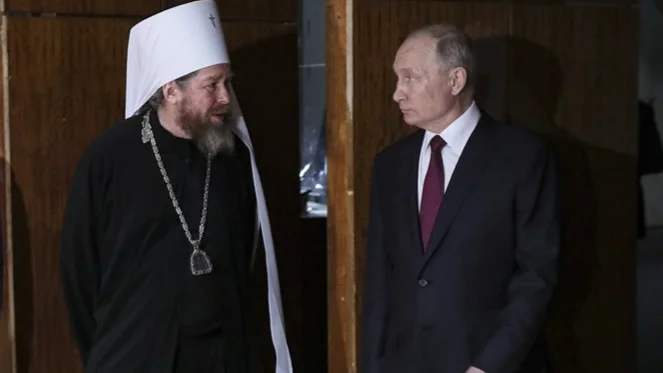
Tikhon Shevkunov and Vladimir Putin. Photo: Era
On June 5, the Russian Book Chamber - a statistical department involved in the literature published in Russia - summed up the results of the first quarter of 2023. The figures of the reduced circulations and names did not surprise anyone, but the journalists with some bewilderment saw whose books in Russia the times of “special operations” are published most. Previously, this place was occupied by Stephen King, and now it was replaced by Metropolitan Tikhon (Shevkunov) - a man who is called the confessor of Putin. His Longseller “Treaty Saints” only in the first quarter of 2023 reached the circulation of 50 thousand copies, and the total circulation, according to Shevkunov himself, exceeds 3 million. What kind of book is and why it is so popular, says Sergey Lebedenko.
To begin with, let's talk about the elephant in the room - about why the “unanimous saints” took the place where Stephen King and Elena Malisova with Katerina Silvanova used to be the authorized “summer in a pioneer tie”. The point here, of course, is that with the adoption of the Law on “LGBT Propagand” books like “LVPG” were banned, and Stephen King was self-destroyed from the Russian market. But it is important to pay attention to the figure of Shevkunov himself - a man who, thanks to friendship with Putin and influence in the Russian Orthodox Church, was able to accumulate gigantic amounts and develop custom -made projects, for example, “Russia. My story. " Now Shevkunov is actively promoting the war (his propaganda projects have earned at least 20 billion rubles in recent years). His ties with the security forces are also known: Shevkunov himself writes about friendship with the KGB-Lieutenant Nikolai Leonov, including in the “incoherent saints”. It is believed that thanks to this friendship, Shevkunov established acquaintances among the highest officials of the KGB, later - the FSB, which he still uses. According to rumors , it was Shevkunov who stood behind the “theatrical business” against Kirill Serebrennikov and the Gogol Center.
Now the “unanimous saints” is published by the Free Wanderer Publishing House. As it is easy to guess, the editor -in -chief of the publishing house is the same Shevkunov. The address of the publishing house is the Pskov-Pechersk Lavra, which Shevkunov has also been headed for a long time. At the same time, the publishers regularly come out of new products, social networks are actively conducted , Muscovites are invited to a bookstore designed with taste - in general, the “free wanderer” behaves as a fashionable independent publishing house. But there is a nuance: “Free Wanderer”, of course, is not an independent publishing house. Money comes from the Russian Orthodox Church, and the books of publishers are distributed through church shops - a profitable scheme and ensuring the release of printed products. Indeed, if every church shop in Russia is provided with books of the publisher, there will be circulations. Before the “free wanderer”, the publication of the “tonent saints” was engaged in “Olma-Press” and the publisher of the Sretensky monastery-the Primate of which, as you guess, was Shevkunov.
In short, the “unanimous saints” can be rightfully called the most expensive and most profitable samizdat in the modern history of Russia - Shevkunov, the book brought 370 million rubles.
Now what this collection is.
Here you need to make another reservation. Metropolitan Tikhon graduated from the Faculty of Faculty of VGIK, his teachers themselves were Paola Volkova and Sergey Bondarchuk, so Shevkunov knows his job: “The Non -Union Saints” were written cheerfully, and in those places where Shevkunov forgets about the promotion of Orthodoxy, it’s even interesting. The letter courses were not in vain.
If we attribute “unanimous saints” to any genre, then this is rather a collection of production prose (in the sense in which it can be called production, for example, stories about doctors). Shevkunov’s story about the monastery life is also decorated in this style: you seem to watch a series about Dr. House, only instead of the hospital - the Pechersky Monastery, and instead of medical cases - the expulsion of demons and spiritual conversations. Perhaps, stopping only at the stories about the expulsion of demons, Shevkunov could write a cool noir thriller or even a comic book in the spirit of comics about John Konstantin, but propaganda was more interested in him.
The book opens up to the fact that Shevkunov’s associates of the great art critic Paola Volkova advises to guess on the book “And Jing” - the famous “Book of Changes” (the oldest Chinese philosophical text, which many turned from Borges and Philip Dick to Lennon). But Shevkunov and friends decided to go further and began to arrange spiritualistic sessions. On one of them, the voice, allegedly belonging to Stalin, in spacecraft of the ambulance to Mikhail Gorbachev. And on the other, supposedly the spirit of Gogol suggested that the students take the poison. Shevkunov and his friends were frightened and no longer called the spirits. In order to cleanse himself from esoteric filth, Shevkunov went to the monastery, after which, having returned to Moscow, he found that the modernity was disgusting to him: he felt lonely, complained that the young man did not pray before eating, and so on. So Georgy Shevkunov decided to accept obedience in order to subsequently become a monk.
The central line of the collection is dedicated to the monks of the Pechersk Monastery, with which Shevkunov lived during the obedience. The main among them is Archimandrite John (Peasant), whom Shevkunov considers his spiritual mentor. Generally speaking, John is a figure in the modern history of the Church is really significant : he seriously influenced church policy in the nineties, advocated the unity of the Orthodox Church and sharply criticized the “schismatical” church of abroad. But for Shevkunov, John is primarily a wise teacher who gives unreasonable Padavans timely tips, and sometimes even prophesies. Here, the parents of a seriously ill boy categorically forbids to put a child for surgery (he wisely silent about his fate of Shevkun), here - predicts that the Pechora first among the Russian monasteries will be given a courtyard in Moscow. He talks about how, in his youth, two novices were expelled from the monastery for an unnamed misconduct ...
In general, any attempt by Shevkunov to tell about miracles or fun stories from the life of monks no, no, and causes a feeling of awkwardness. It seems that we should marvel at the wisdom of the elders, but in fact you see only a totalitarian indoctrination. For example, in the story of how a particularly ardent novice is the abbot Father Gabriel to ask a kick under the ass of a respected monk. After the performance of his will, Gabriel expels the novice for good, but does not even apologize to the monk. Morality? So that the monk is not arrogant. Or one more thing: from the deacon who came to visit and decided to give it to an expensive censer, intended only for the abbot, the abbot demands to abandon Kadilo immediately. The deacon does not want to do this so that carpets do not light up from crumbling coals. Then the enraged abbot orders to do the same to his monk - he implicitly submits to Gabriel. Kadilo falls on the carpets, the carpets light up, all the brethren is engaged in extinguishing the fire. Morality? "This is what real obedience looks like." It turns out some kind of bad tracing paper from jokes about the army, although Shevkunov was clearly far from writing his version of “Culinary-22”.
Other stories are performed by the same moralism. In the house where the police officer lives, objects are spontaneously light up? The officer was simply baptized incorrectly. In the non -executive in the Shevkunov monastery, there are hallucinations - the sounds of high -profile strokes with iron on iron? These are demons from thoughts about God distract. Does the priest receive an expensive red Mercedes as a gift? He will definitely break on it. And so on. The main idea: the authorities must be obeyed, especially the spiritual authorities. You won’t obey - trouble will happen to you.
Ultimately, the same thing happens with “incoherent saints” as with any moralizing art: it is simply boring. There are really funny stories in the collection - for example, about how the monks arranged a procession to the district election commission, so that the next time they would bring the urn directly to the monastery and do not disturb the fraternity - but they are lost against the backdrop of moralizing wisdom. For art, you need a certain degree of detachment: a little look from the side of what is happening and ask a question. And Shevkunov does not need questions, because he has an answer. And a brisk letter here does not save.
It turns out such a perverted version of Stephen King:
King’s stories about monsters and miracles are needed to ask questions about the nature of evil, about how injustice appears in society. Shevkunov is also needed in order to even forget about everything worldly
And in all troubles to blame only God or His absence. Such an Orthodox escapism.
The text also slides the social aspect of monasticism: among the monks about which Shevkunov writes, many repressed and war veterans. You involuntarily recall that in the same 1980s socially similar priests of the Catholic Church supported the Polish union “Solidarity”, which later laid an end to the dictatorship. In the USSR, socially and value -similar people became the backbone of the regime, and remained for them after 1991. Why? Shevkunov’s book will not give an answer to this really interesting question. And sorry.