
Translated material
Don't make your own peace
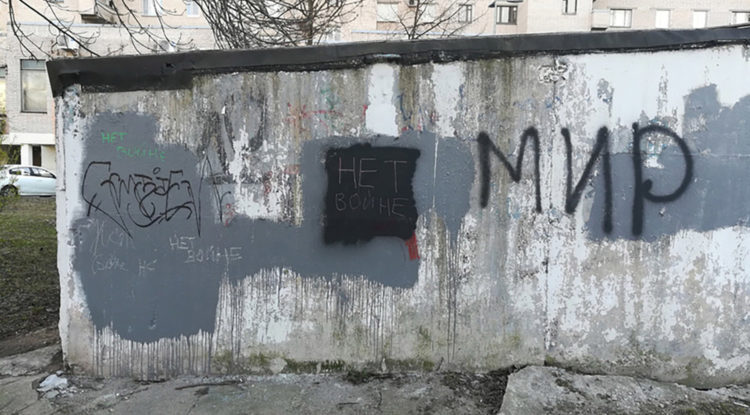
How the war devalued the main word of the pacifist movement
The war in Ukraine has changed the meaning of the word "peace". For Russian courts, it is now a “discredit” for the army, for Russian propaganda it is a symbol of weakness and defeatism. Opponents of the invasion "peace" is also no longer satisfied. The defeat of the aggressor army is not “peace”, but capitulation, therefore calls for “peace” are perceived by a significant part of Ukrainians as pro-Russian. About how and who devalued the main word of the pacifist movement, at the request of Kholod, the journalist, candidate of philological sciences, member of the expert council of the Word of the Year contest, Ksenia Turkova, explains.
In order not to miss the main materials of "Cold", subscribe to our instagram and telegram .
On May 11, 2023, the Moscow Church Court defrocked Priest John Koval, a cleric of the Church of St. Andrew the First-Called in the Lyublino district. Vigilant parishioners wrote a denunciation against the priest: one of them noticed that the priest, while reading the prayer "On Holy Russia" (a new prayer, first read by Patriarch Kirill in 2022. - Note "Cold") , replaced the word "victory" in the text to the word "peace". Instead of "Arise, O God, to help Thy people and give us victory by Thy power," Koval said, "Arise, O God, to help Thy people, and give us peace by Thy power." After that, Patriarch Kirill, with whose blessing prayer was read in Moscow churches, personally banned the clergy from serving.
This story alone allows us to judge how the Russian military discourse has distorted the meaning of the word “peace”. "Peace" in the text of the prayer was perceived by patriotic parishioners not as a synonym for the end of the war, but as the antonym of victory. "Peace" in the vocabulary of Russian power is something dangerous, a rejection of Russia's "sacred mission" and claims to foreign territories.
The very fact that the word "peace" was noticed in the oral text, that it hurts the ear and is perceived as a foreign body, is an important symptom. The official ban on the word "war" in Russia has been replaced by an unspoken ban on the word "peace". While the “war” seems to have already been resolved (even Putin uses this word when talking about the “war between Russia and NATO”), “peace” is increasingly fading into the shadows and the Russian authorities seem to be more and more dangerous.
At the May Day demonstrations that took place in Russian cities in both 2022 and 2023, people were actively detained for the slogans “Peace! Work! May!" or "Peace to the world!" . At the same time, protocols were drawn up on many of them on the "discrediting" of the Russian army - another evidence of the artificially created antonymy "peace" vs. "victory, success of the Russian army."
The fear of the “world” reached the point of absurdity: in April 2022, Moscow police detained Konstantin Goldman, who was standing in the Alexander Garden with a novel by Leo Tolstoy. in Moscow At about the same time, a man was detained who raised a package of Miratorg ham over his head - the second half of the word was crossed out in such a way that the word “world” was obtained.
They are afraid of the world and on television. Producer Alexander Rodnyansky, in an interview with the Current Time channel , said that on Russian television channels, including entertainment, they fear that not only the word “war”, but also the word “peace” will not get on the air. “Although I am sure that no one from the Kremlin wrote to them,” Rodnyansky noted. “They are just afraid; it is such a madness, described many times in quality literature.
It turns out that the word "peace" under the influence of the attitudes of the authorities and propaganda narratives has formed a completely new meaning. The Kremlin, as is the case with many other words, “reinvented” this noun, endowed it with a new meaning – within the framework of the artificial language that it (the Kremlin) itself creates.
All these conclusions are not just reasoning and speculation. Under this summed up including the "scientific" base. Scientists devote articles to the word "peace" as a synonym for the anti-Russian war and the defeat of the Russian army.
For example, Nina Ishchenko, Ph.D. in Philosophy, culturologist, literary critic and member of the Union of Writers of the self-proclaimed LPR, recently published an article in the journal Vestnik of the Tyumen State Institute of Culture entitled “Calls for peace in Ukraine as a method of military propaganda ” .
According to Ishchenko, calls for peace are “manipulation aimed at increasing anxiety in society and provoking anti-government actions.” In the annotation to the article, Ishchenko writes that he is researching this phenomenon “using the cultural-anthropological method and content analysis of the information content of anti-Russian propaganda in the modern information space.” However, to the surprise of the reader, there is no analysis or content in the article: not a single (I emphasize: not a single) example is given in the text.
But Nina Ishchenko gives a detailed definition of the word "peace" - in its new, propagandistic meaning. “The appeals for peace in Ukraine,” she writes, “exploit a sense of compassion for the victims of hostilities, develop a sense of guilt that requires immediate removal, and form a feeling of hatred and fear towards the Russian army and the Russian leadership that has taken these actions. <...> Calls for peace are based on the dehumanization of the inhabitants of Donbass.”
It turns out that “peace” in this new, parallel vocabulary is not only a synonym for hatred of the authorities and the Russian army, but also a synonym for the dehumanization of the inhabitants of Donbass. You call for peace - you nullify the "atrocities of the Nazis" for all the notorious eight years.
However, the paradox lies in the fact that the Russian authorities are afraid of the word "peace" in the mouths of citizens, but at the same time they actively use this word. And for this, she has one more, third meaning of this noun in store. “The current Kyiv authorities should respect the free will of the residents of the DPR, LPR, Zaporozhye and Kherson regions. This is the only way to peace," the President of the Russian Federation said .
In this and other similar quotes, the words “peace” and “peaceful” (process, negotiations) are already used in a different meaning. "Peace" in Putin's vocabulary is the end of the war on his terms, the triumph of the war of conquest.
in December 2022 The Ukrainian Center for Counteracting Disinformation, as well as the American Institute for the Study of War , noted : Russia has strengthened the narrative in the Western press about peace talks and their necessity. As examples, analysts cited a publication in The American Conservative , in an interview with which retired US Army Colonel Douglas McGregor allegedly stated that the only solution to the “Ukrainian conflict” is “peace negotiations and recognition of Russia’s legitimate security interests in the region” (in fact, such There is no quote in McGregor's article, but it reflects the general mood of the text. - Note "Cold") .
Russian telegram channels distributed a survey by the Bulgarian publication Fakty about the prospects for peace talks. The publications cited comments from ordinary Bulgarians who allegedly spoke out for the fact that Ukrainians should stop resisting Russian aggression.
The word “peace” eventually turned out to be so poisoned by aggressive rhetoric and propaganda that it became toxic outside of Russia as well. That is why any abstract calls for "peace talks" from world leaders, public figures and public figures are perceived as support for the aggressor.
Thus, the Russian authorities “invented” two new meanings of the word “peace”: one for internal use (“peace” is the failure of the Russian army, a return to the starting point), and the other for export (“peace” = absolute victory for Russia and satisfaction of all appetites of the Kremlin).
The toxicity of this word has led to the fact that in the Ukrainian information space there are no slogans about peace - there is a main narrative about victory. And the very word (“victory”) is now synonymous with the world that we have lost.