
Translated material
Frontman for Putin's inner circle

May 2014. Munich. Two men are supposedly standing in front of Stepan Bandera’s grave and filming a video. “Well, hello, you fucking ghoul. You are lying here on German soil. We have come to tell you that Crimea is ours again. Thanks to your followers,” says one of them. In the background you can hear the second one starting to laugh. “And you will still rot in German soil, whore,” continues the first. “We’ll definitely come back in another six months to say that Donbass is now ours.” Let's keep rolling over in our graves here, you bastard."
October 2019. Moscow. The man who posted the video from the German cemetery on YouTube is surrounded by three men dressed in suits. On his left is the cousin of the late Queen Elizabeth II of Great Britain, Prince Michael of Kent. “The Great Master,” as our stranger called him on his Instagram.
It was not by chance that the “Grand Master” - this is how the title of Prince of Kent sounds inone of the Masonic orders - ended up in Moscow. A member of the British royal family does business with the man on the right - the one who posted the video of cursing over Bandera's grave. The name of this person will most likely mean nothing to you, but people like him have become especially popular among Vladimir Putin’s inner circle in the last decade. After Western countries introduced personal sanctions against Russian oligarchs and officials for the annexation of Crimea and the start of the war in Donbass.
In the Kremlin environment, such people are usually called frontmen. Their task is to manage the financial and personal affairs of their patrons, but in such a way that no one finds out in whose interests this is being done.
Meet the Prince of Kent's partner, a jingoistic patriot who has supported Russia's military aggression against Ukraine since 2014, a connoisseur of rare musical instruments, an equestrian - all this is Maxim Viktorov. He is also a confidant of Vladimir Putin’s childhood friends, oligarchs Arkady and Boris Rotenberg.
The source, who requested anonymity for security reasons, provided “Important Stories” with an archive of Maxim Viktorov’s correspondence. We shared the documents with journalists from OCCRP, Le Monde, Forbes, The Times and other global media. Together we worked for several months on the leak in order to simultaneously publish our investigations into how, with the help of frontmen, Putin’s entourage managed to preserve many of their foreign palaces and yachts and continued to secretly invest money in assets in the West, despite sanctions and their anti-Western rhetoric.
***
This article is part of the Rotenberg Files project. What is this project and where are the other articles?
The “Rotenberg Archive” is a leak of more than 50 thousand letters and documents from the management company Evocorp, which worked mainly for Boris and Arkady Rotenberg. Important Stories shared this data with the world's leading media outlets, resulting in more than 60 journalists from 17 publications working on the project.
Thanks to the Rotenberg Archive we learned:
how Arkady Rotenberg’s structure allocated millions of euros for the purchase of an Alpine chalet where Vladimir Putin’s eldest daughter and her former common-law husband from the Netherlands were vacationing (read here );
how the brothers’ chosen ones—citizens of the United States and Latvia—rescued the Rotenbergs and family assets during difficult sanctions times (read here );
how a major Moscow developer fooled everyone for years by denying any connection with the Rotenbergs (read here ).
***
Generalist
In February 2006, the British Ambassador to Russia gave the last reception before the residence was closed for reconstruction. The occasion was the presentation of the Order of the British Empire to actor Vasily Livanov. There were many eminent guests at the reception, but, as Kommersant wrote, “the guests became really excited” only when a man in the uniform of a general, the chairman of the board of trustees of the Violin Art Foundation, Maxim Viktorov, entered the hall. On his chest were the Orders of “Alexander Nevsky” and “For Service to Russia”.
The order, apparently, was issued to him by the so-called Academy of Security, Defense and Law Enforcement (ABOP): Viktorov was its “academician”. In 2008, the Prosecutor General’s Office liquidated the ABOP “for discrediting government bodies”: the “academy” handed out orders, titles and certificates of “almost state standard” to everyone. Orders from the ABOP were received by Radovan Karadzic, sentenced to 40 years for genocide, Belarusian citizen Alexander Lukashenko and writer Daria Dontsova. The founder of the academy, KGB-FSB officer Viktor Shevchenko, personally presented the fake order to Margaret Thatcher - at the instigation of the Russian Foreign Ministry, as Novaya Gazeta wrote .
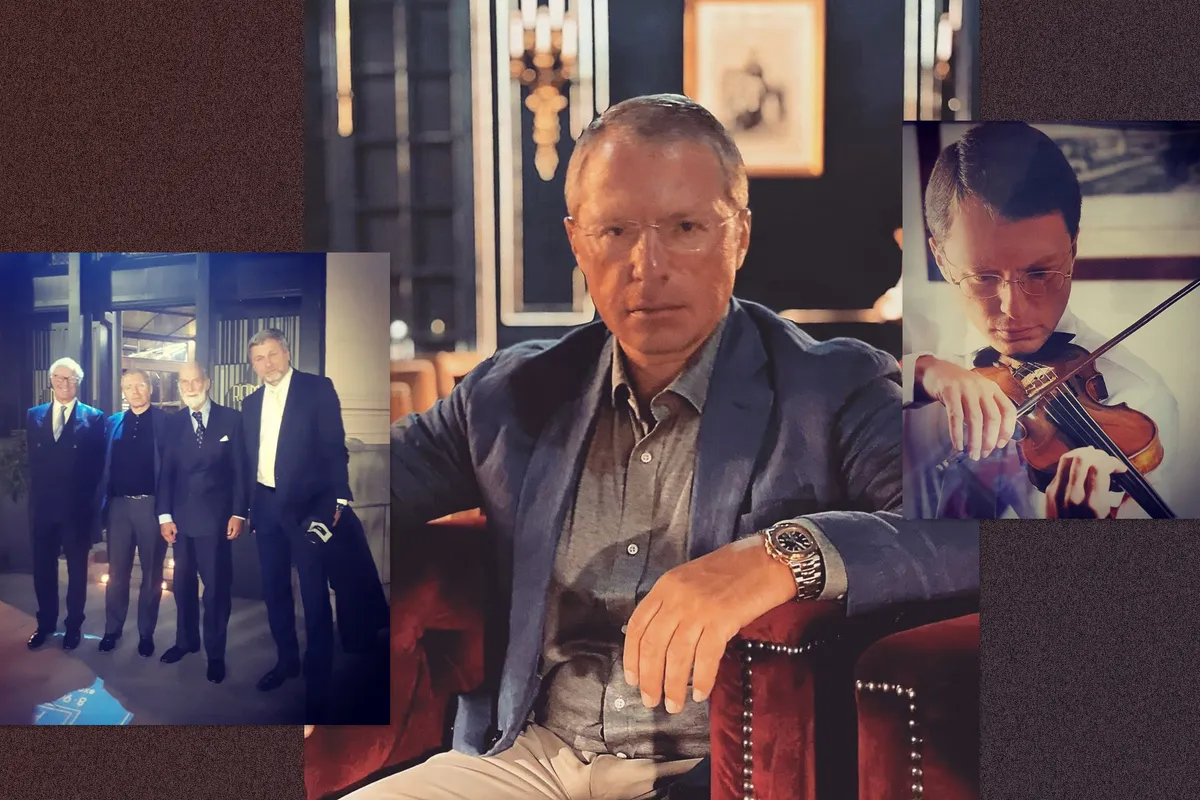
That evening at the British Embassy, Viktorov boasted to the guests of his new acquisition - a violin by the Italian master Carlo Bergonzi, which previously belonged to Niccolo Paganini. Viktorov purchased the violin at Sotheby's for $1.1 million; it added to his collection of unique Stradivarius , Guarneri del Gesù , and Bergonzi instruments.
Collecting rare violins is an unusual occupation for a former security official, as Viktorov likes to present himself: on his website he writes that from 1989 to 1990 he worked as an employee of the Investigation Department of the RSFSR Prosecutor's Office, then went to the KGB of the USSR.
After serving in the security agencies, Viktorov began providing legal services to entrepreneurs and officials. In 2012, he became an adviser to then Defense Minister Anatoly Serdyukov. At the Ministry of Defense, Viktorov briefly supervised “military-patriotic education” - interaction with the Suvorov Military School (he is a member of its board of trustees) and other military educational institutions.
By that time, Viktorov was already familiar with Vladimir Putin’s entourage. In 2011, he co-founded the Russian Association for the Promotion of Science along with Putin's longtime acquaintance, Mikhail Kovalchuk. Together they joined the association's presidium.
In 2016, endocrinologist Maria Vorontsova, the eldest daughter of the Russian president, joined them. Viktorov and Putin’s daughter are connected not only by the presidium of the association: in the leak we found documents about the purchase of an expensive villa in the Austrian Alps; According to local residents, Vorontsova often stayed in the chalet with her ex-husband, Dutch citizen Jorrit Faassen. Read more about this here .
Kovalchuk and Vorontsova were not the only people from Putin’s circle with whom Viktorov knew. His company handled the divorce case between Boris Rotenberg’s son, Roman, and Latvian model Marta Berzkalna.
Subscribe to the "Important Stories" newsletter You will learn more stories about those who run our countryIn 2014, both Rotenberg brothers - Arkady and Boris - were included in the US sanctions list as one of the most influential oligarchs in Russia. “Thanks to Putin, they earned billions of dollars from contracts with Gazprom and the construction of Olympic facilities in Sochi,” the US Treasury decision said . Later, the European Union introduced restrictions against them, and then all the European and American property that the brothers acquired with money from Russian state contractors was in danger. Judging by the documents at our disposal, Maxim Viktorov came to their rescue. He began helping the Rotenberg family hide assets in Russia, but more importantly, abroad.
Sudden loss of interest
Shares in their companies, as a rule, were transferred to various closed-end mutual investment funds (CLIFs), which had one thing in common: they were all managed by Evocorp. Its owner is Maxim Viktorov.
What are closed-end mutual funds and how are they managed?Evocorp is engaged in investment activities, managing closed-end mutual investment funds.
The peculiarity of such funds is that they do not disclose information about their shareholders. A closed mutual fund cannot be declared bankrupt, its assets cannot be confiscated. Even if the management company is declared bankrupt, the assets of the funds cannot be seized or sold at auction.
The Rotenbergs denied in every possible way their connection with Evocorp. Representatives of the company also assured that they do not represent the interests of the brothers. However, judging by documents from Viktorov’s archive, this is not the case.
In July 2017, Evocorp employees came to the office of the Central Bank for a meeting . Judging by the minutes of the event, Viktorov’s company managed 13 closed-end mutual funds, and the shareholders of most of them were the Rotenberg brothers.
What closed-end mutual funds did the Rotenberg brothers hide behind?In February 2014, Arkady Rotenberg named himself the main shareholder of the new development company RG-Development. At the same time, only Ruslan Goryukhin was listed as the sole founder of the company from the very beginning. Read more about how Goryukhin ended up being the owner of two vast estates in France, two five-star German hotels and a palace in the center of Munich, without being included in the list of rich Russians according to Forbes.
Representatives of RG-Development already stated in October 2014 that Rotenberg was not among the company’s shareholders. Nevertheless, the annual report of Evocorp states that at the end of December 2016, the closed mutual fund Lontano acquired 80% in RG-Development. The fund was owned by Latvian citizen Maria Borodunova, the common-law wife of Arkady Rotenberg, it turned out from the leak.
Read about who Maria Borodunova is here .
Other assets of the Rotenberg brothers were hidden in closed-end mutual funds managed by Evocorp:
The Albiorix Foundation owned 100% of the Sarych company, which owns the Palmida sanatorium and 12.5 hectares of land in Crimea annexed by Russia.
The Argon and Phoenix Trust foundations own a cultural heritage site in St. Petersburg - the Lantern Baths complex in the city center.
Closed-end mutual fund "Iridiy" belongs to the company "Vozrozhdenie VVTs" , which owns the largest oceanarium in Europe "Moskvarium".
The Avabi Fund, whose shareholder is Boris Rotenberg, owned 16.2% of the Mosenergo FEC company.
Through the Oktant fund, Boris owned 17.3% of Dynamo Management Company.
Closed mutual fund Forward, formally owned by Maxim Viktorov's Legal Intelligence Group, owned the offshore Faraotis Holdings Limited through a chain of companies. Faraotis's only asset was a private business jet associated with Boris Rotenberg, and the Forward itself was noted as being used for Boris's benefit.
Other closed-end mutual funds of the Rotenbergs, which were managed by Viktor's Evocorp: Closed-end mutual fund DPI "Brianit" (unit owner - Arkady Rotenberg), Closed-end mutual fund DPI "Hyperion" (owners of the shares - Boris and Arkady Rotenberg), Closed-end mutual fund DPI "Rubus" (Boris Rotenberg), Closed-end mutual fund DPI "Rygras" (Boris Rotenberg), Closed-end mutual fund DPI "Phoenix Trust" (Boris Rotenberg), closed-end mutual fund DPI "Evolti" (unit owners - Boris Rotenberg and Evgeny Vdovin) and others.
Evocorp tried to strictly ensure that information about the real owners of the assets allegedly sold by the Rotenbergs did not leak anywhere. Once on WhatsApp (some correspondence from the messenger was leaked), the following dialogue took place between Viktorov and the security director of his company, Alexander Stepanenko:
“ Alexander Stepanenko : Forward, Meridian, Ruby (closed-end mutual funds managed by Evocorp. - Ed. ) should they be included in the table? The shareholders there are not BR [Boris Rotenberg]
Maxim Viktorov : No
Stepanenko: Meridian is his asset. Surely not? There's Sasha K.
Maxim Viktorov : No need to write this here!!!! Sasha!!!!!!!!! »
The Meridian Foundation was a co-owner of the Business Trend company, which supplied equipment to Gazprom for such grandiose projects as the construction of the Nord Stream to Europe and the Power of Siberia to China. The formal owner of the fund is the one whom Viktorov and his colleague call “Sasha K.” in correspondence. — was Alexander Kozlov. It is known about him that he fought in Chechnya, then worked as a bodyguard for the Rotenberg family, and then unexpectedly found himself the “owner” of the brothers’ large assets. For example, the yacht “Rakhil” was registered in his name for 21 million euros.
Who paid for the banquet?
At the end of 2014, Viktorov and his colleagues negotiated the purchase of a villa in the elite Spanish resort Oliva Nova Beach and Golf Resort near Valencia for 9 million euros. They tried to arrange the deal in such a way as to hide the real owner: first the house was owned by a company from Malta, then from Cyprus.

“Max, look, are we making a bunch right away? I understand that at the second step it will still be clear who paid for the banquet…” his colleague who helped with the deal wrote to Viktorov. She was worried that the money trail could lead to the real owner of the villa, whom the employees of Viktorov’s office called by her initials: KR.
The same letters - KRB - were also displayed above the gates of the house. This is the monogram of Boris Rotenberg and his wife Karina, a passionate fan of equestrian sports. Her Instagram account has photos with a horse and the same monogram.
Karina Rotenberg was personally involved in furnishing a house in Spain. “You installed IKEA quality in the main dressing rooms for 163,500 €! Are you taking me for a fool??!!! I chose and paid for a different quality! Where is the leather on the interior trim? Where are the beautiful hands? Shame on you?!!" , she swore at contractors at the end of 2015. Dressing rooms for 164 thousand euros are not the biggest expense the Rotenbergs spent on the interior of their villa. The curtains alone cost 200 thousand euros, that is, more than 15 million rubles at the then exchange rate.
Visualization: OCCRPIn 2019, due to sanctions, the Rotenbergs lost their private jets. But aviation enthusiasts noticed that another business jet with tail number M-KBSD began to fly along the brothers’ routes. This aircraft, worth $42 million, is owned by an offshore company from the British Virgin Islands, which in turn belongs to Maxim Viktorov.
According to the Big Stories count , the business jet flew to Valencia alone at least 18 times over several years. However, Russia's full-scale invasion of Ukraine closed this route for the Rotenberg family: Spanish authorities froze the villa.

Lay low in Monaco
At the end of August 2014, Boris and Karina Rotenberg, together with their children, flew on a private flight to Nice airport on the Cote d'Azur in France. While going through border control, the Rotenbergs explained that the whole family was returning home to Monaco after a summer vacation in Russia. Boris presented his Finnish passport, and Karina and the children presented their Monaco resident cards. Karina talked with the border guards and told them that the children would soon go to first grade at a school in Monaco.
Soon the Rotenberg family regretted their revelations. In July 2014, Boris Rotenberg's 42-meter yacht Rachel collided with another vessel. Its owners sued to recover damages, and "Rachel" was temporarily seized. On board Rotenberg's yacht, French customs officers found a photocopy of Karina's Monaco resident card. This discovery led to a large-scale investigation : French authorities decided to find out whether the Rotenbergs were tax residents of Monaco and whether they had paid tax on the yacht.
Maxim Viktorov’s office took on the task of solving this problem. For this purpose, Viktorov hired the law office of Donald Manasse from Monaco. Together they tried to prove that Boris Rotenberg is a Russian entrepreneur and the center of his personal interests is in Russia, which means he should not pay tax on the yacht.
However, the Main Directorate of Customs Services and Indirect Taxes found villas, apartments, planes, yachts, horses, cars of the Rotenberg family in the European Union, studied flights, social networks, declarations and bank payments. Tax officials tried to prove that since 2011, the main center of interests of one of the oligarchs closest to Putin is Monaco, which means Rotenberg evaded paying 3.6 million euros in taxes for a yacht worth 21 million euros. "Rachel" was arrested .

The court sided with the tax authorities and found that Boris Rotenberg spends most of his time in Monaco, only occasionally coming to Russia. The lawyers had to conclude a settlement agreement, and Rotenberg had to pay the tax. Only after paying the full amount did the French authorities agree to lift the seizure of the yacht.
What other assets did the French customs service discover from the Rotenbergs?Yachts and boats
yacht Rahil (42.4 m), owner - Medexlite Ltd, beneficiaries/users - Boris Rotenberg, Karina Rotenberg, Sofia Rotenberg, Daniil Rotenberg (all users are determined according to the opinion of French customs);
yacht Rahil 2 (30 m), owner - Medexlite Ltd, beneficiaries/users - Boris Jr. and Roman Rotenberg (according to Medexlite Ltd, to respond to a request from French customs);
boat Kalibri (6.14 m), owner - Boris Rotenberg;
boat Arina (9 m), owner - Medexlite Ltd, beneficiaries/users - Boris Rotenberg.
Aircraft
aircraft GL5T—Bombardier global 5000 (registration number M-BRRB), owner - Damstone Limited, beneficiaries/users - Boris Rotenberg;
Embraer Legacy 600 aircraft (registration number OE-IBR), beneficiaries/users - Boris Rotenberg and Karina Rotenberg.
Real estate
real estate in the Principality of Monaco, owner - SCI DES CITRONIERS 1, beneficiaries/users - Boris Rotenberg (through the ICS Nominees SA trust);
real estate in the Principality of Monaco, owner - SCI DES CITRONIERS 3, beneficiaries/users - Boris Rotenberg (through the company SCI DES CITRONIERS 1);
real estate in Carro (France), owner - SMP Racing SARL, beneficiaries/users - Boris Rotenberg and Karina Rotenberg;
real estate in Mouans-Sartoux (France), owner - SCP Tannor 2, beneficiaries/users - Boris Rotenberg (via Natalfin);
real estate in Grasse (France), owner - SCP CASCADEUR, beneficiaries/users - Boris Rotenberg (via Natalfin);
real estate in Eze (France), owner - CHAMPIGNAC, beneficiaries/users - Boris Rotenberg;
real estate in Eze (France), owner - SCP Tannor, beneficiaries/users - Boris Rotenberg (via CHAMPIGNAC);
equestrian club L'Ertier a Mandelieu La Napoule in Mouans-Sartoux (France): warehouse building, two stable buildings, one of which with two apartments for living, two arenas - one indoor and one outdoor, a water tank of 900 m3 and a planting area, cost 10,052,000 euros, owner - SCEA des Canebiers, beneficiaries/users - Boris Rotenberg and Karina Rotenberg.
Cars
Boris Rotenberg owns nine cars registered in the regular Monegasque series, which is intended only for residents of Monaco: Ferrari rouge 1325, Ferrari rouge K690, Ferrari rouge R690, Ferrari rouge 418B, Ferrari noire 428B, Ferrari rouge 871B, Mercedes rouge 9799, Mercedes grise R772, Porsche noire D840;
Boris Rotenberg owns 13 cars in Germany with registration numbers: B-C057, B-BR7000, B-BRS565, B-BP961, B-BR560, B-BR561, B-BR231, B-XK957, B-BR696, B-BR413, B-BR392, B-BR564, B-BR545;
Roman Rothebenrg (Boris's son) owns six cars with Monegasque Z license plates. This registration is only for persons temporarily residing in Monaco;
Karina Rotenberg owns a Ferrari (registration number BS-826-CJ) and an Aston Martin (registration number B-BR 8000).
Horses
Karina Rotenberg owns seven horses: Carlonso, Cornelus, Leopard, Wessels Vibe, Wimbeldon, Won Ton Ton and another Won Ton Ton.
Accounts
An account in the Societe Generale bank from which the Rotenbergs paid for education at a school in Monaco for children, paid for lawyers (including Donald Monasse), work on the arrangement of their villas, training with horses about four times a week, it also paid for a veterinary clinic at the hippodrome, etc.
Stock
On May 4, 2009, Boris Rotenberg acquired 10 shares (9631 4 9640) of the company du Marina de plaisance in Beaulieu at a price of 15,000 euros.
In 2009, he acquired 10 shares in the Finnish port of Helsinki.
Viktorov’s office turned to Donald Monasse for another service - to help Boris Rotenberg “create a positive image” and avoid EU sanctions, which had already overtaken his brother Arkady in 2014. In January 2015, when the proceedings for non-payment of yacht tax were still ongoing, an employee of Maxim Viktorova wrote to Manasse:
“Please publish the following excerpt from the article on the sale of a 17% stake in Stroygazmontazh LLC in the Principality of Monaco and France.
<...> We want to provide information that BR ( Boris Rotenberg - Ed. ) does not have shares in a company subject to sanctions (or companies subject to sanctions). He left the project, and not only sold his shares to his brother. The article should create a positive image of BR.
<...> Please note that a meeting of the Government of the Russian Federation is scheduled for tomorrow morning, at which the construction of a bridge across the Kerch Strait by the Stroygazmontazh company will likely be announced, and in addition, additional sanctions against several Russian companies will be considered at a meeting of the European Council.
In connection with the press coverage of tomorrow’s events, references to information that BR has withdrawn from the company involved in the construction of the bridge to Crimea will be timely and informative.”

However, Monasse expressed concern that posting such an article could only harm Rotenberg.
“To connect this story with Monaco or the coast, it would be necessary to say that a businessman from Monaco BR sold his shares in the holding ... (but I am concerned that this will further tie BR with Monaco in the issue of taxes on Rachel), wrote Donald Monasse. — Given the sensitive nature of the issues under consideration, I would like to be sure that we know why it is important for the AR ( Arkady Rotenberg - Ed. ) or BR to publish this information in Monaco or France. For a BR that is not subject to European sanctions, the act of selling something to the AR could be considered a violation of sanctions against the AR (as it could be seen receiving money from a sanctioned entity).”
However, already in 2017, Boris Rotenberg found himself in a comical situation: on the contrary, he had to convince the European courts that he lives in the European Economic Area (which does not coincide with the European Union). Four banks (Danish Danske Bank, Swedish Svenska Handelsbanken and Nordea Bank and Finnish OP Corporate Bank) stopped servicing accounts associated with the family of Boris Rotenberg after the entry into force in the United States of a law that threatens secondary sanctions with any bank in the world for “material financial transactions” in the interests of Russian individuals included in the American sanctions list in connection with the war in Ukraine.
Support honest journalism! With your help, we will tell more important stories that every Russian should know about . I want to help “Important Stories”In October 2018, Boris Rotenberg sued the banks, considering their actions to be discrimination. However, the court did not find any violations, since the banks’ refusal to work with the Rotenbergs is not related to Boris’s individual characteristics, but to his deliberately chosen circle of friends and his own actions.
At the same time, Boris Rotenberg was not subject to EU restrictions.
Royal Startup
In his work for the Rotenbergs, Maxim Viktorov often turned to his foreign colleagues for help or services. In general, Viktorov can be called a person with great connections in the West. When he needed to obtain a visa to the UK in 2018, Nicholas Chance, a Knight of the Victorian Order and Private Secretary to His Royal Highness Prince Michael of Kent, argued for him before the British Foreign Office. In 2018, the Viktorov Investment Program Fund became a shareholder of the British fintech startup RemitRadar - Prince Michael of Kent was its ambassador.
Viktorov and the Prince of Kent could have met in 2007 at a charity concert in support of disadvantaged children at the British Embassy in Moscow. “Having entered the residence building, Mr. Viktorov first of all rushed to meet the Prince of Kent. Having said a few words in English, he even tried to hug the prince, but he deftly dodged,” Kommersant described this meeting.
The website of Viktorov’s “Investment Program Fund” states that since 2006 he has been “a member of the Board of the Foundation of His Royal Highness Prince Michael of Kent.” The grandson of the British King George V, Prince Michael of Kent is the great-nephew of the Russian Emperor Nicholas II. He knows Russian and has been to Russia dozens of times. Immediately after the full-scale invasion of Ukraine, he publicly severed his ties with Russia - leaving his position as patron of the Russo-British Chamber of Commerce and refusing the Order of Friendship awarded to him in 2009 by then Russian President Dmitry Medvedev. Despite this, a member of the British royal family still has a joint business with Viktorov - the same RemitRadar , an aggregator of international money transfer systems designed for migrant workers.
In May 2021, the Sunday Times published a sensational story about how the Prince of Kent was trading on his name and making money on his alleged closeness to Vladimir Putin. In particular, he was ready to provide his “royal approval” to a fictitious company created by journalists for $200,000.
As follows from correspondence from Viktorov’s office, RemitRadar was going to pay the Prince of Kent about 800 thousand pounds sterling for the company’s PR. Judging by letters from the archive, the Prince of Kent asked the monarchs of several Arab countries - the UAE, Saudi Arabia and Morocco - to support RemitRadar.
Another business of Viktorov and the Prince of KentIn 2005, the Prince of Kent established the Arts House development company in Russia. Viktorov became its co-owner. “Arts House” was going to build a “cultural and educational center” in Moscow, which would include a concert hall, a hotel complex, a cinema and a gallery. The investment was estimated at at least $150 million. However, the development project was never received.
The director of Arts House from the creation of the company to the present day is Sergei Markov, “a former diplomat who became an entrepreneur,” as he describes himself . Markov also works as director of the Prince of Kent's charity in Russia. In 2012, he became a municipal deputy of the Moscow district of Zamoskvorechye and in this capacity in 2017 lobbied for the installation of a memorial plaque in honor of the murdered politician Boris Nemtsov.
Viktorov surprisingly combined his activities in the West with support for Russia’s military aggression against Ukraine. “I am pleasantly surprised that the text of the speech was mainly compiled by quoting almost verbatim my public appearances in the media in recent days. I’m not even angry that he didn’t refer to me,” Viktorov wrote in 2014 to his friend, producer Fyodor Bondarchuk, following Vladimir Putin’s speech in the Kremlin after the annexation of Crimea. He attached to the letter a picture of a bear and the inscription “Nam pohuy. New Russia" .

“Important Stories” and other media outlets participating in the project sent questions to all the heroes of the publications. The Prince of Kent, like the Rotenberg brothers, did not respond to media requests. Maxim Viktorov insisted that journalists come to him for an interview in Moscow in person. This is an impossible condition: Important Stories journalists face arrest in Russia for collaborating with an undesirable organization and refusing to submit to military censorship. After Russian authorities arrested American journalist Evan Gershkovich on absurd charges of espionage, foreign media journalists also found Viktorov’s demand unacceptable.
Viktorov refused to talk with online reporters, as well as the offer to meet in another country where the authorities do not take journalists hostage.
Editor: Roman Anin