
Translated material
Volunteer spent a week rescuing animals in a flooded city
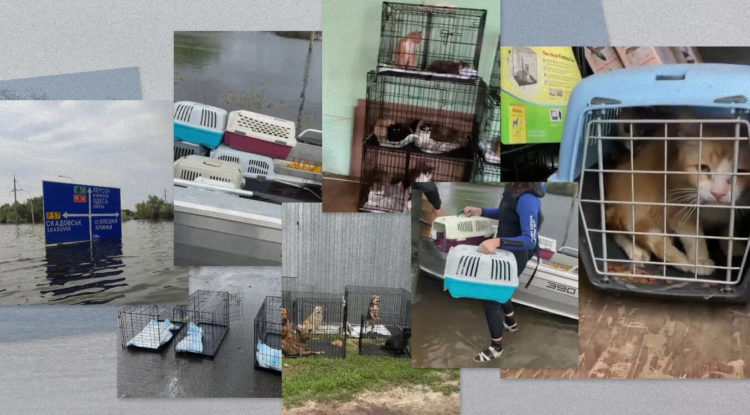
That's what she saw
After the breakthrough of the dam of the Kakhovskaya hydroelectric power station in settlements, including the occupied part of the Kherson region, both people and animals were in danger. Ekaterina Semenova (name changed) , a volunteer from Ryazan, who has been involved in animal rescue for about 10 years, managed to get to Oleshki, one of the most affected settlements. For almost a week, together with the driver and a team of volunteers, they evacuated the animals that they managed to save. "Cold" recorded her story.
In order not to miss the main materials of "Cold", subscribe to our instagram and telegram .
How many animals were affected? The head of the Ministry of Natural Resources of Ukraine said that more than 160,000 wild birds and 20,000 wild animals were under the threat of death due to a dam break at the Kakhovskaya hydroelectric power station. The occupation authorities of the city also reported that the Nizhnedneprovsky National Natural Park went under water and thousands of animals that were there died.
In the first hours, it was also reported that all the animals of the Kazkova Dibrova Zoo in Nova Kakhovka also died. However, later the zoo administration clarified that some animals still managed to escape: one of the zoo workers took them to her home.
I probably learned about the destruction of the dam, like most people: on the morning of June 6, from news telegram channels. On the same day, I saw that volunteer girls from Moscow were urgently looking for a car to go to Oleshki and evacuate the animals. We are in touch with them, and over the past year and a half, we have repeatedly organized the rescue of animals from areas where it is now dangerous. All day we were together looking for a man who would agree.
But a driver is a driver, and you still need to feed the animals, negotiate everything, and be in touch with volunteers. And he can drive the car: he can’t burst. It was necessary for someone else to go, but for obvious reasons, there were no willing people. There is a war, it's scary - people have an instinct for self-preservation. And I don't seem to have it. Or, at least, the desire to help overcame. I decided to go myself.
Together on the "gazelle"
Our trip was not coordinated either with the Ministry of Emergency Situations or with other departments. We just decided in two hours that we were going, and got into the "gazelle". There were no problems along the way. At each checkpoint, our car was searched, questions were asked about the purpose of our visit, and our passports were checked. Having learned that we were going to Oleshki, the military warned that the city was flooded and we would not get there. But we explained that we were going to evacuate the animals, that people on boats were waiting for us there, ready to hand over the animals to us, and they let us through.
It was not possible to drive right away only to Oleshki themselves. They explained to us that this was due to heavy shelling. The military at the checkpoints said that we simply would not return alive, so we had to wait and return to the checkpoint several times.
I do not think that this was due to the fact that they did not want to let volunteers in. They didn't let anyone in at all. I’m not sure that even the Ministry of Emergency Situations worked there that day: no one would have survived.
about the evacuation under shelling Other volunteers also spoke , but Kholod was unable to confirm that they were not allowed to enter Oleshki for this very reason. In the first days of the flood, volunteers working in the flooded area reported that the Russian military not only did not let volunteers from other regions into Oleshki themselves, but also did not let evacuated residents out of the city.
Rooftop Rescue
When we were finally allowed to pass, we contacted the owner of the Kherson shelter "Chance" . While we were driving through the checkpoints, the hostess sailed a boat from house to house and rescued the surviving animals that climbed onto the roofs. Her own house also went under water, like a shelter, but she was sheltered in a house on a small island, and she tried to transport everyone she could there: homeless animals, pets whose owners died or could not pick them up for some reason in this chaos.
The hostess's contact was given to us by Moscow volunteers, they also collected money for boats, food and everything necessary and figured out where to temporarily place the animals. We knew the address, but it was impossible to get to it on our first visit: the water was still standing. Therefore, we stopped the "gazelle" at the very water, and the hostess sailed to us on a boat and brought several dogs and cats. We transplanted them into cages and loaded them into a car, and then drove them to Radensk, a 10-minute drive from Oleshki, in order to later evacuate them to Moscow. There was our makeshift camp where we spent the night.
In the following days, when the water subsided a little, we already drove by "gazelle" to the very shelter. The military again did not want to let us through, but perseverance and persuasion helped. Finally, the guard gave us a briefing: he told us to take care of ourselves and advised us to drive at high speed, “not to bunch up”, not to stand still and return as soon as possible.
We drove all the way to the shelter, picked up the animals, and on the way back we drove through the streets and asked the locals if we needed to pick up someone.
The animals were stressed, many with hypothermia, because they spent a lot of time in the water, some were injured: bites, broken legs. Most of them did not react to us in any way, because they were very exhausted, but one dog bit the driver. She can be understood. This happened not because she was angry, she was just stunned that some strange people in their arms carried her from the water to the boat, and from the boat into the cage. If they did that to me, I probably would not sit silently either.
serious condition
Before our eyes, the Ministry of Emergency Situations rescued people, took out old people with domestic dogs from there. Some locals with boats spoke of hundreds of corpses. When the water stood, the bodies were caught and somehow fixed - on trees, balconies, and so on. So that later, when the water leaves, it would be possible to pick it up, identify it and somehow bury it. But I myself hardly saw the bodies, only on the first day - a human hand sticking out from under the water.
According to the latest data, 38 people died due to the consequences of the explosion of the dam at the Kakhovskaya hydroelectric power station in the territories occupied by Russia, TASS writes with reference to emergency services. Another 115 people were hospitalized with hypothermia and other injuries. On the evening of June 19, Minister of Internal Affairs of Ukraine Igor Klymenko announced that on the right bank of the Dnieper, which is under the control of Ukraine, 18 people died, 14 of them drowned, and four more received gunshot wounds during the evacuation. 31 people are listed as missing.
Having taken everyone we could, we distributed the animals in cars, other volunteers also came to Radensk and went to Moscow. Unfortunately, we were not able to take out all of them, there are still many animals left in the Kherson region that need help.
On the way back, we were again stopped at each checkpoint, they checked that we were definitely transporting animals. But the military was as understanding as possible, they didn’t detain us anywhere, because we had animals in serious condition that needed medical attention.
Animals endured the road normally, all arrived alive. I can only be responsible for the car I was driving in: we took out 39 dogs and eight newborn puppies that were born right before our arrival: we took a pregnant dog and she gave birth the night before we left. Other dogs were also evacuated and left in another car; cats were evacuated, but they did not fit in with us. They all found temporary housing and then helped to attach.
I emphasize that saving all these animals is not my sole merit, it is the merit of the whole team. A driver who was not afraid to drive under fire, girls in Moscow who helped solve all this.
Like from another universe
We spent almost a week in the flood zone and made three trips to Oleshki. One was on the first day, when there was water, two on the last, when we were already driving into the city itself by car. During this time, we almost drowned the car and came under fire. It was very scary, I don’t want anyone to be there or somewhere else where some kind of hostilities are going on, no matter who is fighting with whom and for what.
Recently, fireworks rumbled at night, maybe there was some kind of wedding, but I was twitching. I don't know how to live a normal life now. Every night I dream of explosions, war. Maybe I am a very impressionable person, but I have never been in such situations. All I can now is endlessly crying with or without reason. This is probably some kind of nervous breakdown, when you calmed down and did everything that needed to be done, and then emotions covered your head so that you can drown.
On the way back, we passed Mariupol and Azovstal — they seem to have suffered the most. I would describe the situation as follows: people are trying to start living anew. There is such a thing, as I learned, - "new Mariupol", which was rebuilt. Everything is very clean, beautiful, tidy there, some shops, coffee houses are opening. It can be seen that people walk the streets, with dogs, by the hand. And there are still ruins nearby. This is very eye catching. Conditionally, a ruined house, and on the first floor they sell tea there. For a simple person who first got into a war zone, it looks like from another universe. All this is very scary.
When you look at any destroyed high-rise building, you understand how many lives are behind each of these houses, how many people died, how many lives were destroyed, both in Mariupol and in Oleshki, where we were, everything was also destroyed there by flooding and shelling. This is terrible, and in my opinion there can no longer be a victory in this war.